
Pulp Fiction, 1884 · page 27 of 32
Beadle's New York Dime Library No. 308 — page 27: what you’re looking at
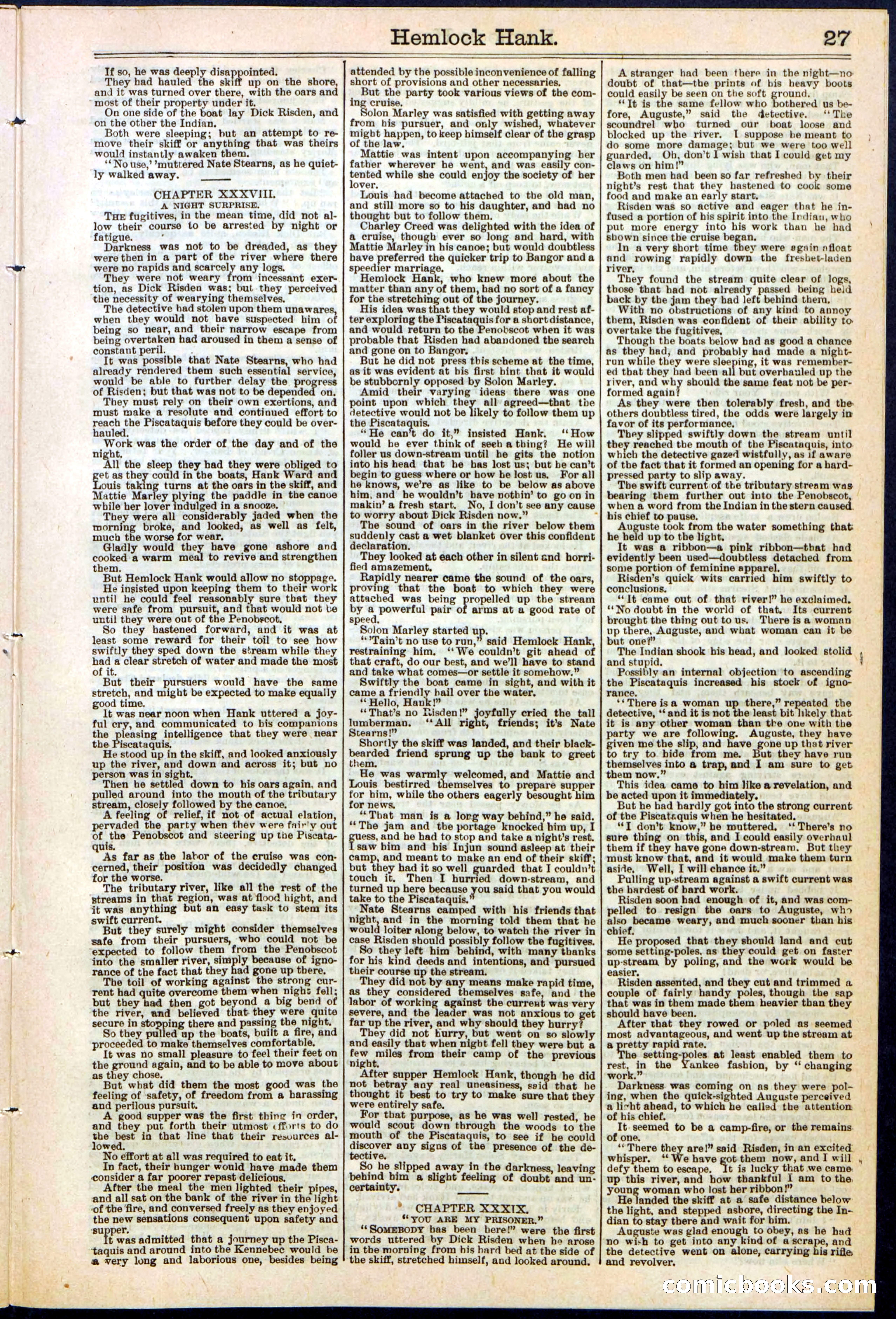
A restored page from Pulp Fiction, 1884. Page through the whole issue in the reader above.
📄 Transcribed text from this page (OCR, searchable)
Machine-transcribed from the original scan — historical spelling and the odd misread are preserved.
ea If so, he was deeply disappointed. They had hauled the skiff up on the shore, and it was turned over there, with the oars and most of their property under it. On one side of the boat lay Dick Risden, and on the other the Indian. Both were sleeping; but an attempt to re- move their skiff or anything that was theirs would instantly awaken them. ‘*No use,’ muttered Nate Stearns, as he quiet- ly walked away. CHAPTER XXXVIIL A NIGHT SURPRISE. Tre fugitives, in the mean time, did not al- low their course to be arrested by night or fatigue. ; Darkness was not to be dreaded, as they were then in a part of the river where there were no rapids and he any logs. They were not weary from incessant exer- tion, as Dick Risden was; but they perceived the necessity of wearying themselves, The detective bad stolen upon them unawares, when they would not bave suspected him of being so near, and their narrow escape from being overtaken had aroused in them a sense of constant peril. It was possible that Nate Stearns, who had already rendered them such essential service, would be able to further delay the progress of Risden; but that was not to be depended on. They must rely on their own exertions, and must make a resolute and continued effort to reach the Piscataquis before they could be over- hauled. ap cre was the order of the day and of the night, All the sleep they had they were obliged to et as they could in the boats, Hank Ward and ouis taking turns at the oars in the skiff, and Mattie Marley plying the paddle in the canoe while her lover indulged in a snooze. They were all considerably jaded when the morning broke, and looked, as well as felt, much the worse for wear, Gladly would they have gone ashore and cooked a warm meal to revive and strengthen them. But Hemlock Hank would allow no stoppage. He insisted upon keeping them to their work until he could feel reasonably sure that they were safe from pursuit, and that would not be until they were out of the Penobscot. So they hastened forward, and it was at least some reward for their toil to see how swiftly they sped down the stream while they had a clear stretch of water and made the most of it. But their pursuers would have the same stretch, and might be expected to make equally good time. lt was near noon when Hank uttered a joy- ful cry, and communicated to his companions the peeeing intelligence that they were near the Piscataquis. He stood up in the skiff, and looked anxiously up the river, and down and across it; but no person was in sight. Then he settled down to his oars again, and pulled around into the mouth of the tributary stream, closely followed by the canoe. A feeling of relief, if not of actual elation, pervaded the party when thev were fnir'y out of the Penobscot and sieering up the Piscata- uis. ‘ As far as the lator of the cruise was con- cerned, their position was decidedly changed for the worse. ; The tributary river, like all the rest of the streams in that region, was at flood higbt, and it was anything but an easy task to stem its swift current. But they surely might consider themselves safe from their pursuers, who could not be expected to follow them from the Penobscot into the smaller river, wl because of igno- rance of the fact that they had gone up there, The toil of working against the strong cur- rent had quite overcome them when nighs fell; but they had then got beyond a big bend of the river, and believed that. they were quite secure in sto ping there and passing the night. So they pulled up the boats, built a fire, and proceeded to make themselves comfortable, It was no small pleasure to feel their feet on the ground again, and to be able to move about as they chose. But what did them the most good was the feeling of ‘safety, of freedom from a harassing and perilous pursuit. A good supper was the first thine in order, and they put forth their utmost ¢fforts to do the best in that line that their resources al- lowed. No effort at all was required to eat it. In fact, their bunger would have made them consider a far poorer repast delicious, After the meal the men lighted their pipes, and all sat on the bank of the river in the light of the fire, and conversed freely as they enjoyed the new sensations consequent upon safety and ‘supper. Frit admitted that a journey up the Pisca- ‘taquis and around into the Kennebec would be @ very long and laborious one, besides being Hemlock Hank. attended by the possible inconvenience of falling short of provisions and other necessaries, But the party took various views of the com- ing cruise. Solon Marley was satisfied with getting away from his pursuer, and only wished, whatever might happen, to keep himself clear of the grasp of the law. Mattie was intent upon accompanying her father wherever he went, and was easily con- — while she could enjoy the society of her over. Louis had become attached to the old man, and still more so to his daughter, and had no thought but to follow them. Charley Creed was delighted with the idea of a cruise, though ever so long and hard, with Mattie Marley in his canoe; but would doubtless have preferred the quicker trip to Bangor anda speedier marriage. Hemlock Hank, who knew more about the matter than any of them, bad no sort of a fancy for the stretching out of the journey. His idea was that they would stop and rest af- ter exploring the Piscataquis for a short distance, and would return to the Penobscot when it was probable that Risden had abandoned the search and gone on to Bangor, But he did not press this scheme at the time, as it was evident at bis first bint that it would be stubbornly opposed by Solon Marley. Amid their varying ideas there was one point upon which ag ¢ all agreed—that tbe detective would not be likely to follow them up the Piscataquis. “He can’t do it,” insisted Hank. ‘How would be ever think of seehathing? He will foller us down-stream until he gits the notion into his head that be bas lost us; but be can’t begin to guess where or bow be lost us. For all he knows, we’re as like to be below as above him, and he wouldn’t bave nothin’ to go on in makin’ a fresh start. No, I don’t see any cause to worry about Dick Risden now,” : The sound of oars in the river below them suddenly cast a wet blanket over this confident declaration. They looked at each other in silent and borri- fied amazement, idly nearer came the sound of the oars, proving that the boat to which they were attached was being gh ona up the stream by “! powerful pair of arms at a good rate of spee peed. Solon Marley started up. “?*Tain’t no use to run,” said Hemlock Hank, restraining him. ‘‘We couldn’t git ahead of that craft, do our best, and we'll have to stand and take what comes—or settle it somehow.” Swiftly the boat came in sight, and with it came a friendly bail over the water, ‘* Hello, Hank!” ‘“‘That’s no Kisden!” wees cried the tall lumberman. ‘All right, ends; it’s Nate Stearns!” Shortly the skiff was landed, and their black- pe = friend sprung up the bank to greet them. He was warmly welcomed, and Mattie and Louis bestirred themselves to prepare supper for him, while the others eagerly besought him for news, “That man is a lorg way behind,” he said. “The jam and the portage knocked him up, I gues and he had to stop and take a night’s rest. saw him and his Injun sound asleep at their camp, and meant to make an end of their skiff; but they had it so well guarded that I couldn’t touch it. Then I hurried down-stream, and turned up here because you said that you would take to the Piscataquis, Nate Stearns camped with his friends that night, and in the morning told them that he would loiter along below, to watch the river in case Risden should possibly follow the fugitives. So they left him behind, with many thanks for his kind deeds and intentions, and pursued their course up the stream. They did not by any means make rapid time, as they considered themselves safe, and the labor of bret re py the current was very severe, and the leader was not anxious to get far up the river, and why should they hurry? They did not b , but went on so slowly and easily that when night fell they were but a hee — from their camp of the previous nig After supper Hemlock Hank, though he did not betray ar real uneasiness, seid that he thought it to try to make sure that they were entirely safe, For that purpose, as he was well rested, he would scout down through the woods to the mouth of the Piscataquis, to see if he could a any signs of the presence of the de- ve. So he slipped away in the darkness, leavi behind bim a slight feeling of doubt’ ma mn certainty. * CHAPTER XXXIX, “YoU ARE MY PRISONER.” ‘*SomeBopY bas been here!” were the first words uttered by Dick Risden when he arose in the morning from his hard bed at the side of the skiff, stretched himself, and looked around, 27 A stranger had been there in the night—no doubt of that—the prints of bis heavy boots could easily be seen on the soft ground, ‘‘It is the same fellow who bothered us be- fore, Auguste,” said the detective. ‘The scoundrel who turned our boat loose and blocked up the river. I suppose he meant to do some more damage; but we were too well guarded, Ob, don’t 1 wish that I could get my claws on him!” Both men had been so far refreshed by their night’s rest that they hastened to cook some food and make an early start, Risden was so active and eager that he in- fused a portion of his spirit into the Indiau, who put more energy into his work than he had sbown since tbe cruise began. In a very short time they were egain nfloat and rowing rapidly down the freshet-laden river, They found the stream quite clear of logs, those that had not already passed being held back by the jam they had left behind therm, With no obstructions of any kind to annoy them, Risden was confident of their ability to overtake the fugitives, Though the boats below had as good a chance as they had, and probably bad made a night- run while they were sleeping, it was remember- ed that they bad been all but overhauled up the river, and war should the same feat not be per- formed again As they were then tolerably fresh, and the others doubtless tired, the odds were largely in favor of its performance, They slipped swiftly down the stream until they reached the mouth of the Piscataquis, into which the detective gazed wistfully, as if aware of the fact that it formed an opening for a hard- pressed party to slip away. The swift current of the tributary stream was bearing them further out into the Penobscot when a word from the Indian in the stern caused. bis chief to pause. Auguste took from the water something that he held up to the light. It was a ribbon—a pink ribbon—that had evidently been used—doubtless detached from some portion of feminine apparel, Risden’s quick wits carried him swiftly to conclusions. “It came out of that river!” he exclaimed. ‘‘No doubt in the world of that. Its current brought the thing out tous. There is a woman up there, Auguste, and what woman can it be but one?” The Indian shook bis head, and looked stolid and stupid. Possibly an internal objection to ascending the Piscataquis increased his stock of igno- rance. ‘* There is a woman there,” repeated the detective, ‘‘ and it is not the least bit likely that it is any other woman than the one with the party we are following. Auguste, they have given me the slip, and have gone up that river to try to hide from me. But they have run themselves into a trap, and I am sure to get them now.” This idea came to him like a revelation, and be acted upon it immediately, But he had hardly got into the strong current of the Piscataquis when he hesitated. ‘I don’t know,” he muttered, ‘*There’s no sure thing on this, and I could easily overhaul them if they have gone down-stream. But they must know that, and it would make them turn aside, Well, I will chance it.” Pulling up-stream against a swift current was the bardest of bard work. Risden soon had enough of it, and was com- pelled to resign the oars to Auguste, wh» pra ee ng weary, and much sooner than his chief. He proposed that they should land and cut some setting-poles. as they could get on faster up-stream by poling, and the work would be easier. Risden assented, and they cut and trimmed a couple of fairly handy poles, though the sap that was in them made them heavier than they should have been. After that they rowed or poled as seemed most advantageous, and went up the stream at a pretty rapid rate. e setting-poles at least enabled them to rest, in the Yankee fashion, by ‘ changing work.” Darkness. was coming on as they were pol- ing, when the quick-sighted Auguste perceived a livht ahead, to which he called the attention of his chief. Ri, seemed to be a camp-fire, or the remains. of one. . ‘*There they are!” said Risden, in an excited. whisper. ‘‘ We have got them now, and I will defy them toescape, It is lucky that we came up this river, and how thankful I am to the, young woman who lost her ribbon!” He landed the skiff at a safe distance below the light, and stepped asbore, directing the In- dian to stay there and wait for bim. Auguste was glad enough to obey, as he hud no wish to get into any kind of ascrape, and = the detective went on alone, carrying his rifle | and revolver, Jooks (G(e) (ale) AMLICE ee ; \