
Pulp Fiction, 1884 · page 26 of 32
Beadle's New York Dime Library No. 308 — page 26: what you’re looking at
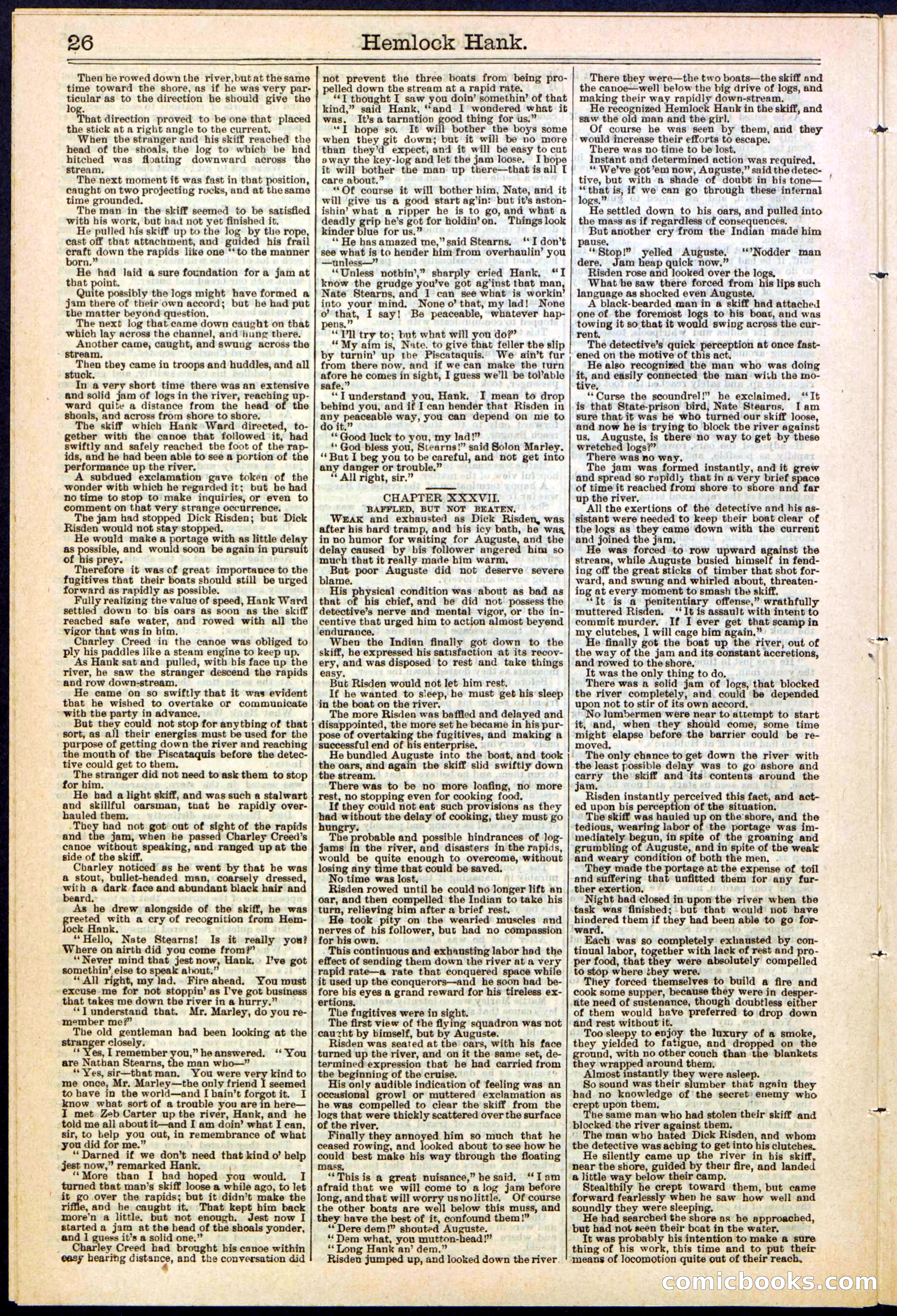
A restored page from Pulp Fiction, 1884. Page through the whole issue in the reader above.
📄 Transcribed text from this page (OCR, searchable)
Machine-transcribed from the original scan — historical spelling and the odd misread are preserved.
oes gee a a ee — - = ae et ee ogee = -~ 26 Hemlock Hank. Then he rowed down the river,but at the same time toward the shore, as if he was very par- ticular as to the direction he should give the log. Phat direction proved to be one that placed the stick at a right angle to the current. When the stranger and his skiff reached the head of the shoals, the log to which he had hitched was floating downward across the stream. The next moment it was fast in that position, caught on two projecting rocks, and at the same time grounded. The man in the skiff seemed to be satisfied witb his work, but bad not yet finished it. He pulled his skiff up to the log by the rope, cast off that attachment, and guided his frail craft down the rapids like one **to the manner born.” He had laid a sure foundation fora jam at that point. Quite possibly the logs might have formed a jam there of their own accord; but he had put the matter beyond question. The next log that came down caught on that which lay across the channel, and hung there. Another came, caught, and swung across the stream. = ape they came in troops and huddles, and all uc . In a very short time there was an extensive and solid jam of logs in the river, reaching up- ward quite a distance from the head of the shoals, and across from shore to shore. The skiff which Hank Ward directed, to- gether with the canoe that followed it, had swiftly and safely reached the foot of the rap- ids, and he had been able to see a portion of the performance up the river. A subdued exclamation gave token of the wonder with which he regarded it; but he had no time to stop to make inquiries, or even to comment on that very strange occurrence, The jam had stopped Dick Risden; but Dick Risden would not stay stopped. He would make a portage with as little dela as ible, and would soon be again in pursuit of his prey. Therefore it was of great importance to the fugitives that their boats should still be urged forward as rapidly as possible. Fully realizing the value of speed, Hank Ward settled down to bis oars as soon as the skiff reached safe water, and rowed with al] the vigor that was in bim. Charley Creed in the canoe was obliged to ply his paddles like a steam engine to keep up. As Hank sat and pulled, with bis face up the river, he saw the stranger descend the rapids and row down-stream. He came on so swiftly that it was evident that he wished to overtake or communicate with the party in advance, But they could not stop for anything of that sort, as all their energies must be used for the urpose of getting down the river and reaching e mouth of the Piscataquis before the detec- tive could get to them. The stranger did not need to ask them to stop for him. He had a light skiff, and was such a stalwart and skillful oarsman, that he rapidly over- hauled them. voted had not got out of sight of the rapids and the jam, when he passed Charley Creed’s canoe without speaking, and ranged up at the side of the skiff, Charley noticed ss he went by that he was a stout, bullet-headed man, coarsely dressed, wit 7 dark face and abundant black hair and As he drew alongside of the skiff, he was ee with a cry of recognition from Hem- ock Hank. ‘Hello, Nate Stearns! Is it really you? Where on airth did you come from?” “Never mind that jest now, Hank, » I’ve got somethin’ else to speak about,’ * All right, my lad. Fire ahead. You must excuse me for not stoppin’ as I've got business that takes me down the river in a hurry.” “*T understand that. Mr. Marley, do you re- member me?” The old gentleman bad been looking at the stranger closely. ‘* Yes, l remember you,” he answered. ‘* You are Nathan Stearns, the man who—” ‘Yes, sir—that man. You were very kind to me once, Mr. Marley—the only friend L seemed to have in the world—and I bain’t ee it. I know what sort of a trouble you are in here— I met Zeb Carter up the river, Hank, and he told me all about it—and I am doin’ what I can, sir, to help you out, in remembrance of what you did for me.” “‘Darned if we don’t need that kind o’ help jest now,” remarked ‘ ‘More than I had hoped you would. I turned that man’s skiff loose a while ago, to let it Hm over the rapids; but it didn’t make the riffle, and he caught it. That kept him back more’n a little. but not enough. Jest now I started a jam at the bead of the shoals yonder, and | guess it’s a solid one.” Charley Creed had brought bis canoe within easy hearing distance, and the conversation did not prevent the three boats from being pro- lied down the stream at a rapid rate. **T thought I saw you doin’ somethin’ of that kind,” said Hank, ‘‘and I wondered what it was. It’s a tarnation Boe thing for us.” “I hope so. It will bother the boys some when they git down; but it will be no more than they’d expect, and it will be easy to cut away the key-log and let the jam loose, I hope it will bother the man up tbhere—that is all I care about.” “Of course it will bother him, Nate, and it will give us a good start ag’in: but it’s aston- ishin’ what a ripper he is to go, and what a deadly grip he’s got for holdin’on. Things look kinder blue for us.” ‘* He has amazed me,” said Stearns. ‘I don’t see what is to hender him from overhaulin’ you —unless—” ‘“Unless nothin’,” sharply cried Hank, “I know the grudge you’ve got ag’inst that man, Nate Stearns, and I can see what is workin’ into your mind, None o’ that, my lad! None 0’ that, I say! Be peaceable, whatever hap- ns,’ “Tl try to; but what will you do?’ “My aim is, Nate. to give that feller the slip by turnin’ up tbe Piscataquis. We ain’t fur from there now, and if we can make the turn re hry comes in sight, I guess we’ll be tol’able safe,’ “‘T understand you, Hank. I mean to drop behind you, and if I can hender that Risden in oy peaceable way, you can depend on me to Oo it. ** Good luck to you, my lad!” ** God bless you, Stearns!” said Solon Marley. ‘*But I beg you to be careful, and not get into any danger or trouble.” ** All right, sir.” CHAPTER XXXVII. BAFFLED, BUT NOT BEATEN, WEAK and exhausted as Dick Risden, was after his bard tramp, and bis icy bath, he wag in no humor for waiting for Auguste, and the delay caused by bis follower angered him so nave: § thut it really made him warm. But poor Auguste did not deserve severe blame. His en condition was about as bad as that of his chief, and he did not ss the detective’s nerve and mental vigor, or the in- centive that urged him to action almost beyend endurance. When the Indian finally got down to the skiff, he expressed his satisfaction at its recov- ery, and was disposed to rest and take things easy. But Risden would not let him rest. If he wanted to sleep, he must get his sleep in the boat on the river. The more Risden was baffled and delayed and disappointed, the more set he became in his pur- pose of tm | the fugitives, and making a successful end of his enterprise. He bundled Auguste into the boat, and took the oars, and again the skiff slid swiftly down the stream. There was to be no more loafing, no more rest, no stopping even for cooking food. If they could not eat such provisions as they vem without the delay of cooking, they must go ungry. The probable and possible hindrances of log- jams in the river, and disasters in the rapids, would be quite enough to overcome, without losing any time that could be saved. No time was lost. Risden rowed until he could no longer lift an oar, and then compelled the Indian to take his turn, relieving him after a brief rest. He took pity on the wearied muscles and nerves of his follower, but had no compassion for his own. This continuous and exhausting labor had the effect of sending them down the river at a ver rapid rate—a rate that conquered space while it used up the conquerors—and he soon had be- fore bis eyes a grand reward for his tireless ex- ertions. The fugitives were in sight. The first view of the flying squadron was not cauztht by himself, but by Auguste. Risden was seated at the oars, with his face turned up the river, and on it the same set, de- termined expression that he had carried from the beginning of the cruise. His only audible indication of feeling was an occasional growl or muttered exclamation as he was compelled to clear the skiff from the logs that were thickly scattered over the surface of the river. Finally they annoyed him so much that he ceased rowing, and looked about to see how he could best make his way through the floating mass, “This is a great nuisance,” he said. “Iam afraid that we will come to a log jam before long, and that will worry usnolittle, Of course the other boats are well below this muss, and they bave the best of it, confound them!” “*Dere dem!” shouted Auguste. **Dem what, you mutton-head!” ‘* Long Hank an’ dem.” Risdeu jumped up, and looked down the river. they yielded to fatigue, and drop There they were—the two boats—the skiff and the canoe—well below the big drive of logs, and making their way rapidly down-stream. He recognized Hemlock Hank in the skiff, and saw the old man and the girl. Of course he was seen by them, and they would increase their efforts to escape. There was no time to be lost, Instant and determined action was required, ** We've got’em now, Auguste,” said the detec- tive, but with a shade of doubt in his tone— ' ‘ that is, if we can go through these infernal ogs. He settled down to his oars, and pulled into the mass as if regardless of consequences, But another cry from the Indian made him pause, ‘*Stop!” yelled Auguste. ‘“’Nodder man dere. Jam heap quick now,” Risden rose and looked over the logs, What he saw there forced from his lips such language as shocked even Auguste. A black-bearded man in a skiff had attached one of the foremost logs to his boat, and was ie it so that it would swing across the cur- ren The detective’s quick perception at once fast- ened on the motive of this act, He also recognized the man who was doing it, and easily connected the man wiih the mo- tive, ‘*Curse the scoundrel!” he exclaimed. ‘It is that State-prison bird, Nate Stearns. I am sure that it was he who turned our skiff loose, and now he is trying to block the river against us. Auguste, is there no way to get by these wretched logs?” There was no way. The jam was formed instantly, and it grew and spread so rapidly that in a very brief space of time it reached from shore to sbore and far up the river. All the exertions of the detective and his as- sistant were needed to keep their boat clear of the logs as they came down with the current and joined the jam. He was forced to row upward against the stream, while Auguste busied himself in fend- ing off the great sticks of timber that shot for- ward, and swung and whirled about, threaten- ing at every moment to smash the skiff. “Tt is a penitentiary offense,” wrathfully muttered Risden. ‘It is assault with intent to commit murder. If I ever get that scamp in pealubel es I will cage him again,” e finally got the t up the river, out of the way of the jam and its constant accretions, and rowed to the shore. It was the only thing to do. There was a solid jam of logs, that blocked the river completely, and could be depended upon not to stir of its own accord. o lumbermen were near to attempt to start it, and, when they should come, some time might elapse before the barrier could be re- moved. The only chance to get down the river with the least possible delay was to go ashore and carry the skiff and its contents around the jam. Risden instantly perceived this fact, and act- ed upon bis perception of the situation. The skiff was hauled up on the’shore, and the tedious, wearing labor of the portage was im- mediately begun, in spite of the groaning and grumbling of Auguste, and in spite of the weak and weary condition of both the men, They made the portage at the expense of toil and suffering that unfitted them for any fur- ther exertion. Night bad closed in upon the river when the task was finished; but that would not have ree pp them if they had been able to go for ward. Each was so completely exhausted by con- tinual labor, together with lack of rest and pro- per food, that they were absolutely compelled to stop where they were. They forced themselves to build a fire and cook some supper, because they were in d r- tite need of sustenance, though doubtless either of them would have preferred to drop down and rest without it. Too sleepy to enjoy the luxury of a sf on the ground, with no otber couch than the blankets they wrapped around them. Almost instantly they were asleep. So sound was their slumber that again they had no knowledge of the secret’ enemy who crept upon them, he same man who had stolen their skiff and blocked the river against them. ' The man who ha Dick Risden, and whom the detective was acbing to get into his clutches. He silently came up the river in bis skiff, near the shore, guided by their fire, and landed a jittle way below their camp. Stealthily he crept toward them, but came forward fearlessly when he saw how well and soundly they were sleeping. He had searched the shore as he approached, but had not seen their boat in the water. — It was probably bis intention to make a sure thing of his work, this time and to put their means of locomotion quite out of their reach, ef cS GEoOmiichboo (ao) ‘