
Pulp Fiction, 1884 · page 28 of 32
Beadle's New York Dime Library No. 308 — page 28: what you’re looking at
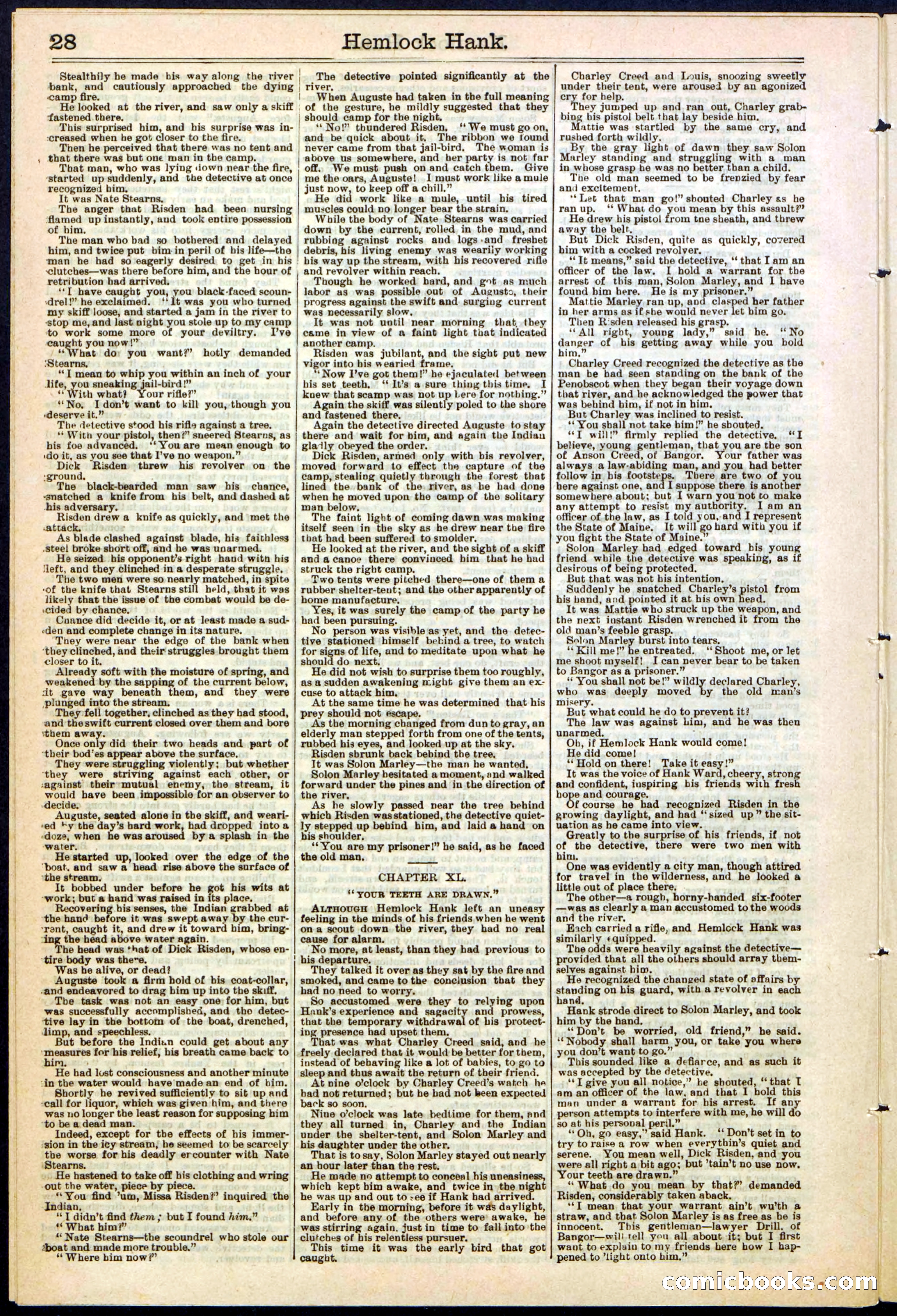
A restored page from Pulp Fiction, 1884. Page through the whole issue in the reader above.
📄 Transcribed text from this page (OCR, searchable)
Machine-transcribed from the original scan — historical spelling and the odd misread are preserved.
a 28 Hemlock Hank, Stealthily he made bis way along the river bank, and cautiously approached the dying camp fire. He looked at the river, and saw only a skiff ‘fastened there. This surprised him, and his surprise was in- creased when be got closer to the fire. Then he perceived that there was no tent and that there was but one man in the camp. That man, who was lying own near the fire, ‘started up suddenly, and the detective at once recognized him, It was Nate Stearns, The anger that Risden had been nursing ‘flamed up instantly, and took entire possession of him. The man who bad so bothered and delayed him, and twice put bim-in peril of bis life—the man he had so eagerly desired to get in his clutches—was there before him, and the bour of retribution had arrived. **T have caught you, you black-faced scoun- drel!” he exclaimed. ‘'It was you who turned my skiff loose, and started a jam in the river to stop me, and last night you stole up to my camp ‘to work some more of your deviltry. I’ve caught you now!” “What do: you want?’ hotly demanded ‘Stearns, “| mean to whip you within an inch of your dife, you sneaking jail-bird!”’ ‘With what? Your rifle?” ‘No. I don’t want to kill you, though you deserve it.” The detective stood his rifle against a tree, ‘* With your pistol, then?” sneered Stearns, as bis foe advanced. ‘‘Youare mean enough to ido it, as you see that I’ve no weapon.” Dick Risden threw his revolver on the ‘ground, The black-bearded man saw his chance, snatched a knife from his belt, and dashed at his adversary. Risden drew a knife as quickly, and met the attack, As blade clashed against blade, his faithless steel broke short off, and he was unarmed. He seized his opponent’s right haud with his left, and they clinched in a desperate struggle. The two men were so nearly matched, in spite -of the knife that Stearns still held, that it was likely that the issue of the combat would be de- cided by chance, Cuance did decide it, or at least made a sud- eden and complete change in its nature. “They were near the edge of the bank when ‘they clinched, and their struggles brought them closer to it. Already soft with the moisture of spring, and weakened by the sapping of the current below, dit gave way beneath them, and they were plunged into the stream. They fell together, clinched as they had stood, and theswift current closed over them and bore ‘them ~ e Once only did their two heads and part of ‘their bod‘es appear above the surface. They were struggling violently; but whether ‘they were striving against each other, or sagainst their mutual enemy, the stream, it would bave been impossible for an observer to decide, Auguste, seated alone in the skiff, and weari- ved *y the day’s bard work, had dropped intoa -doze, when he was aroused by a splash in the water. He started up, looked over the edge of the ‘boat. and saw a head rise above the surface of ‘the stream. It bobbed under before he got his wits at “work; but a hand was raised in its place. Recovering his senses, the Indian grabbed at ‘the hand before it was swept away by the cur- ‘rent, caught it, and drew it toward him, bring- ‘ing the head above water again. he head was *hat of Dick Risden, whose en- tire body was theve. Was he alive, or dead? Au took a firm hold of bis coat-collar, -and endeavored to drag bim up into the skiff. Tbe task was not an easy one for him, but was successfully accomplished, and tho detec- tive lay in the bottom of the boat, drenched, limp, and speechless. But before the Indi:n could get about any ‘measures for his relief, bis breath came back to He had lust consciousness and another minute ‘in the water would have made an end of bim. Shortly he revived sufficiently to sit up and ‘call for liquor, which was given him, and there was no longer the least reason for supposing him ‘to be adead man. — Indeed, except for tbe effects of his immer- ‘sion in the icy stream, he seemed to be scarcely the worse for his deadly ercounter with Nate ‘Stearns. . He hastened to take off his clothing and wring -out the water, piece by piece. “You find ’um, Missa Risden?’ inquired the dian, “ T didn’t find them ; but I found him,” * What him?’ ' “Nate Stearns—the scoundrel who stole our ‘boat and made more trouble.” ** Where bim now?’ i > — Oe a’ OO ————————— _The detective pointed significantly at the river, When Auguste had taken in the full meaning of the gesture, he mildly suggested that they should camp for the night, ‘* No!” thundered Risden, ‘* We must go on, and be quick about it, The ribbon we tound never came from that jail-bird, The woman is above us somewhere, and ber party is not far off. We must push on and catch them. Give me the oars, Auguste! I must work like a mule just now, to keep off a chill.” He did work like a mule, until his tired muscles could no longer bear the strain. While the body of Nate Stearns was carried down by the current, rolled in the mud, and rubbing against rocks and logs:-and freshet debris, his living enemy was wearily working bis way up the stream, with his recovered rifle and revolver within reach. Though he worked bard, and got as much Jabor as was ible out of Augusto, their progress against the swift and surging current was necessarily slow, It was not uotil near morning that they came in view of a faint light that indicated another camp. Risden was jubilant, and the sight put new vigor into bis wearied frame. ‘Now I’ve got them!” he ejaculated between his set teeth, ‘‘ It’s a sure thing this time. I knew that scamp was not up Lere for nothing.” Again the skiff was sileutly poled to the shore and fastened there, Again the detective directed Auguste to stay there and wait for bim, and again the Indian glaily obeyed the order. Dick Risden, armed only with bis revolver, moved forward to effect the capture of the camp, stealing quietly through the forest that lined the bank of the river, as he had done when he moved upon the camp of the solitary man below. The faint light of coming dawn was making itself seen in the sky as he drew near the fire that had been suffered to smolder. He looked at the river, and the sight of a skiff and acanoe there convinced him that he had struck the right camp. Two tents were pitched there—one of them a rubber shelter-tent; and the other apparently of bome manufacture, Yes, it was surely the camp of the party he had been pursuing. No person was visible as yet, and the detec- tive stationed himself bekind a tree, to watch for signs of life, and to meditate upon what he should do next. He did not wish to surprise them too roughly, as a sudden awakening might give them an ex- cuse to attack him. At the same time he was determined that his prey should not escape. | As the morning changed from dun to gray, an elderly man stepped forth from one of the tents, rubbed his eyes, and looked up at the sky. Risden sbrunk back bebind the tree, It was Solon Marley—the man he wanted, Solon Marley besitated a moment, and walked forward under the pines and in the direction of the river, As he slowly near the tree behind which Risden wasstationed, the detective quiet- ly stepped up bebind him, and laid a hand on bis shoulder, ‘*You are my prisoner!” he said, as he faced the old man. CHAPTER XL. ‘“YOUR TEETH ARE DRAWN.” AutHoucH Hemlock Hank left an uneasy feeling in the minds of his friends when he went ona scout down the river, they bad no real cause for alarm. No more, at least, than they had previous to his departure. They talked it over as they sat by the fire and smoked, and came to the conclusion that they had no need to worry. So accustomed were they to relying upon Hank’s experience and sagacity and prowess, that the temporary withdrawal of his protect- ing presence had upset them, hat was what Charley Creed said, and he freely declared that it would be better for them, instead of bebaving like a lot of babies, to go to sleep and thus await the return of their friend. At nine o'clock by Charley Creed’s watch he bad not returned; but he bad not been expected back so soon. Niue o’clock was late bedtime for them, and they all turned in, Charley and the Indian under the shelter-tent, and Solon Marley and his daughter under the other. That is tosay, Solon Marley stayed out nearly an hour later than the rest. He made no attempt to conceal his uneasiness, which kept bim awake, and twice in the night he was up and out to -ee if Hank had arrived. Early in the morning, before it was daylight, and before any of the others were’ awake, he was stirring again, justin time to fall into the clutcbes of bis relentless pursuer. : This time it was the early bird that got caught, Charley Creed and Louis, snoozing sweetly under their tent, were aroused by an agonized cry for help. They jumped up and ran out, Charley grab- bing bis pistol belt that lay beside him, Mattie was startled by the same cry, and rushed forth wildly. By the gray light of dawn they saw Solon Marley standing and struggling with a man in whose grasp he was no better than a child. The old man seemed to be frenzied by fear and excitement, ‘*Let that man go!” sbouted Charley ss he ranup. ‘‘ What do you mean by this assault?’ He drew his pistol from tne sheath, and threw away the belt. But Dick Risden, quite as quickly, covered bim with a cocked revolver, ‘‘ Tt means,” said the detective, ‘‘ that Iam an officer of the law. I bold a warrant for the arrest of this man, Solon Marley, and I have found bim here. He is my prisoner.” Mattie Marley ran up, and clasped her father in her arms as if sbe would never let bim go. Then Risden released his grasp. ‘All right, young lady,” said he. “No danger of his getting away while you bold him.” Charley Creed recognized the detective as the man be bad seen standing on the bank of the Penobscot when they began their voyage down that river, and he acknowledged the power that was behind bim, if not in him, But Charley was inclined to resist. ** You sball not take bim!” he shouted, ‘*T will!” firmly replied the detective, “I believe, young pentioman, that you are the son of Anson Creed, of Bangor. our father was always a law-abiding man, and you had better follow in bis footste There are two of you here against one, and I suppose there is another somewhere about; but I warn you not to make any attempt to resist my authority. I am an officer of the law, as I told you, and I represent the State of Maine. It will go hard with you if you fight the State of Maine.” Solon Marley had edged toward bis young friend while the detective was speaking, as if desirous of being protected. But that was not bis intention, Suddenly he snatched Charley’s pistol from his band, and pointed it at his own heed. It was Mattie who struck up the weapon, and the next instant Risden wrenched it from the old man’s feeble grasp. Solon Marley burst into tears. ** Kill me!” he entreated. ‘‘Shoot me, or let me shoot myself! I can never bear to be taken to Bangor as a prisoner.” ** You shall not be!” wildly declared Charley, who was deeply moved by the old man’s misery. But what could he do to prevent it? The law was against Lim, and he was then unarmed. Oh, if Hemlock Hank would come! He did come! ‘* Hold on there! Take it easy!” It was the voice of Hank Ward, cheery, stron and confident, iuspiring bis friends with fres none and courage. f course he had recognized Risden in the growing daylight, and had ‘sized up” the sit- uation as he came into view. Greatly to the surprise of his friends, if not of the detestive, there were two men with bim. One was evidently a city man, though attired for travel in the wilderness, and he looked a little out of place there, The other—a rough, horny-handed_ six-footer —was as clearly a man accustomed to the woods and the river, Each carried a rifle, and Hemlock Hank was similarly «quipped. The odds were heavily against the detective— provided that all the others should array them- selves against him. He recognized the changed state of affairs b standing on his guard, with a revolver in eac h and, Hank strode direct to Solon Marley, and took him by the hand, ‘‘Don’t be worried, old friend,” he said. ‘* Nobody shall harm you, or take you where you don’t want to go.” This sounded like a defiarce, and as such it was accepted by the detective, ‘* I give you all notice,” be shouted, “that [ am an officer of the law, and that I bold this man under a warrant for bis arrest. If any person attempts to interfere with me, he will do so at his personal peril.” ‘Oh, go easy,’ said Hank. ‘‘ Don’t set in to try to raise a row when everythin’s quiet and serene. You mean well, Dick Risden, and you were all right a bit ago; but ’tain’t no use now. Your teeth are drawn.” ‘What do you mean by that?’ demanded Risden, considerably taken aback, ‘*T mean that your warrant ain’t wu’th a straw, and that Solon Marley is as free as he is innocent. This gentleman—lawyer Drill. of Bangor—wili tell you all about it; but I first wanut to explain to my friends bere bow I hap- pened to ‘light onto him,” Gomilchboo SCOT