
Pulp Fiction, 1878 · page 19 of 32
Beadle's Dime Library, Vol. III, No. 29 — page 19: what you’re looking at
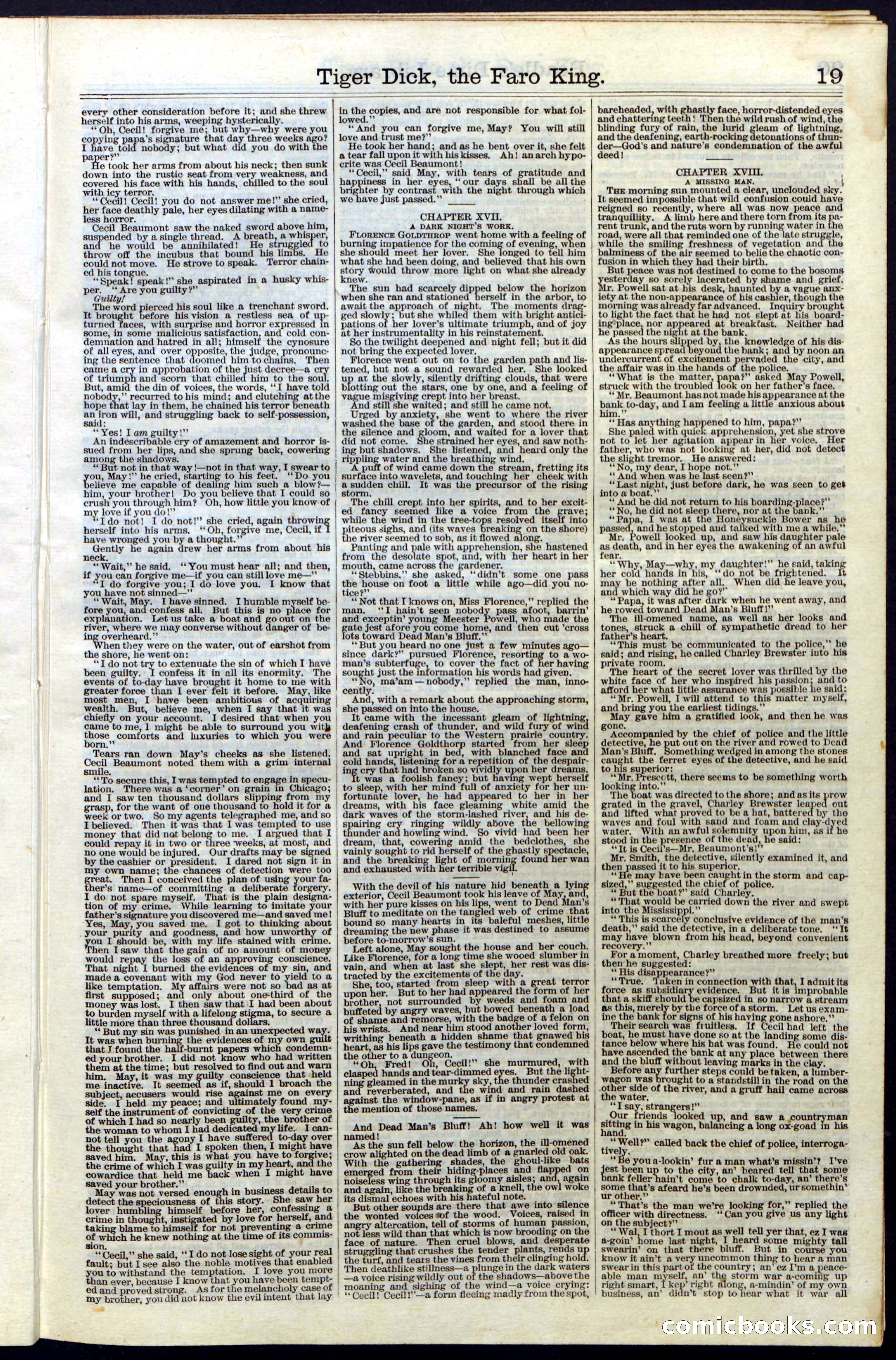
A restored page from Pulp Fiction, 1878. Page through the whole issue in the reader above.
📄 Transcribed text from this page (OCR, searchable)
Machine-transcribed from the original scan — historical spelling and the odd misread are preserved.
every other consideration before it; and she threw herself into his arms, weeping hysterically. “Oh, Cecil! forgive me; but why—why were you copying pape 5 signature that day three weeks ago? I have told nobody; but what did you do with the oe agi e took her arms from about his neck; then sunk down into the rustic seat from very weak covered his face with his hands, chilled to the soul with icy terror. “Cecil! Cecil! you do not answer me!” she cried, her face deathly pale, her eyes dilating with a name- less horror. Cecil Beaumont saw the naked sword above him, ness, an ‘Tiger Dick, the Far in the copies, and are not responsible for what fol- owed.” *And you can forgive me, May? You will still love and trust me?” He took her hand; and as he bent over it, she felt a tear fall upon it with his kisses. Ah! anarch hypo- crite was Cecil Beaumont! “Cecil,” said May, with tears of gratitude and ha — in her eyes, “our days shall be all the b ter by contrast with the night through which we have just passed.” CHAPTER XVII. A DARK NIGHT’S WORK. suspended by a single thread. A breath, a whisper, FLORENCE GoLpTHROP went home with a feeling of and ‘he would be annihilated! He s rugel to | burning impatience for the coming of evening, when throw off the incubus that bound his limbs. He | she should meet her lover. She longed to tell him could not move. He strove to speak. Terror chain- | what she had been doing, and believed that his own ed his tongue. story Would throw more light on what she already “Speak! speak!” she aspirated in a husky whis- ew. per. ‘Are you guilty?” The sun had scarcely open below the horizon Guilty! when she ran and stationed herself in the arbor, to The word pierced his soul like a trenchant sword. | await the approach of night. The moments Greg: It brought before his vision a restless sea of up- ici- turned faces, with surprise and horror expressed in some, in some malicious satisfaction, and cold con- demnation and hatred in all; himself the cynosure of all eyes, and over opposite, the judge, pronounc- ing the sentence that doomed him tochains, Then came a ay in approbation of he ie decree—a c of triumph and scorn that chilled him to the soul, But, amid the din of voices, the words, “I have told nobody,” recurred to his mind: and clutching atthe hope that lay in them, he chained his terror beneath an 1 sg will, and struggling back to self-possession, said: “Yes! I am guilty!” An indescribable cry of amazement and horror is- sued from her lips, and she sprung back, cowering among the shadows. “But not in that way !—not in that way, I swear to you, May !"’ he cried, starting to his feet. ‘Do you elieve me capable of dealing him such a blow?— him, your brother! Do you believe that I could so crush you through him? Oh, how little you know of my love if you do!” “T do not! I do not!” she cried, again throwing herself into his arms. ‘Oh, forgive me, Cecil, if have wronged you by a thought.” ory he again drew her arms from about his neck. “Wait,” he said. ‘You must hear all; and then, if you can forgive me—if you can stilllove me—"’ “TI do — you; I do love you. I know that you have not sinned—”’ “Wait, May. I have sinned. I humble myself be- fore you, and confess all. But this is no place for explanation. Let us take a boat and goout on the river, where we may converse without danger of be- ing overheard.” en they were on the water, out of earshot from the shore, he went on: “I do not try to extenuate the sin of which I have been eg confess it in all its enormity. The events of to-day have brought it home to me with : ged mer but she whiled them with bright ant pations 0 her lover's ultimate triumph, and of joy at her instrumentality in his reinstatement. So the twilight deepened and night fell; but it did not bring the expected lover. Florence went out on to the garden path and lis- tened, but not a sound rewarded her. She looked up at the slowly, silently drifting clouds, that were blotting out the stars, one by one, and a feeling of vague misgiving crept into her breast. nd still she waited; and still he came not. Urged by anxiety, she went to where the river washed the base of the garden, and stood there in the silence and gloom, and waited for a lover that did not come. She strained her eyes, and saw noth- but shadows. She listened, and heard only the rippling water and the breathing wind. A puff of wind came down the stream, fretting its surface into wavelets, and touching her cheek with a Fn chill. It was the precursor of the rising storm. The chill crept into her spirits, and to her excit- ed fancy seemed like a voice from the grave; while the wind in the tree-tops resolved i into piteous sighs, and (its waves breaking on the shore) the river seemed to sob, as it flowed along. O King. ee Panting and pale with apprehension, she hastened | from the desolate spot, and, with her heart in her mouth, came across the gardener. %y Stebbins,” she asked, ‘“‘didn’t some one pass = house on foot a little while ago—did you no- ‘* Not that I knows on, Miss Florence,” replied the man. ‘I hain’t seen nobody, pass afoot, barrin’ and exceptin’ young Meester Powell, who made the gue jest afore you come home, and then cut ’cross ots toward Dead Man's Bluff.” ‘*But you heard no one just a few minutes ago— since dark?” pursued Florence, resorting to a wo- man’s subterfuge, to cover the fact of her having sought just the information his words had given. **No, ma’am — nobody,” replied the man, inno- greater force than I ever felt it before. May, like | cently. most men, I have been ambitious of acquiring wealth. But, believe me, when I say that it was chiefly on your account. I desired that when you came to me, 1 might be able to surround you wit) x ,c0 orts and luxuries to which you were rn.’ Tears ran down May’s cheeks as she listened, i Beaumont noted them with a grim internal smile. “To secure this, l was tempted to eng. in specu- lation. There was a ‘corner’ on avait Chicago; and I saw ten thousand dollars slipping from my grasp, for the want of one thousand to hold it for a week or two. So my agents telegraphed me, and so I believed. Then it was that I was tempted to use money that did not belong to me. I argued that I could repay it in two or three weeks, at most, and no one would be injured. Our drafts may be signed by the cashier or president. I dared not sign it in my own name; the chances of detection were too reat. Then I conceived the plan of using your fa- er’s name—of committing a deliberate forgery. I do not spare myself. That is the plain dealgnia” tion of my crime. While learning to imitate your father’s signature you discovered me—and saved me! Yes, May, you saved me, I got to thinking about _ your purity and goodness, and how unwo of ro. I should be, with my life stained with crime. en Isaw that the gain of no amount of money would repay the loss of an approving conscience. That night I burned the evidences of my sin, and made a covenant with my God never to yield to a like temptation. My affairs were not so as at supposed; and only about one-third of the money was lost. I then saw that I had been about to burden myself with a lifelong s , to secure a little more than three thousand dol ‘** But my sin was punished in an unexpected way. It was when b the evidences of my own that J found the -burnt papers which condemn- ed your brother. I did not know who had written them at the time; but resolved to find out and warn him. May, it was my — conscience that held me inactive. It seemed as if, should 1 broach the subject, accusers would rise ane me on every side. I held my e; and ately found my- self the instrument of convicting of the very crime of which I had so nearly been ty, the brother of the woman to whom I had dedicated my life. 1 can- not tell you the I have suff over the thought that I spoken then, I might have saved him. May, this is what you have to forgive; } 8) the crime of which I was guilty in my heart, the cowardice that held me when I might have saved your brother.”’ May was not versed rR OF business details to detect the speciousness of story. She saw her lover humbl himself before her, confessing a crime in thought, instigated by love for herself, and taking blame to hi for not preven a e -* which he knew nothing at the time of its commis- on. ae ” she said, ‘I do not lose sight of your real fault; but I see also the noble motives that enabled ou to withstand the temptation. I love you more an ever, because I know that you have been tempt- ed and proved strong. As for the melancholy case of my neteher; you did not know the evil intent that lay a | | i eEeEeEeEeEEeeeee ee And, with a remark about the approaching storm, she passed on into the house. It came with the incessant gleam of lightning deafening crash of thunder, and wild fury of wind and rain peculiar to the Western prairie country. And Florence vies started from her slee and sat upright in , With blanched face an cold hands, | ing fora ph ses of the despair- my i ceca tet en so vividly upon her dreams, t was a foolish fancy; but ha wept herself to sleep, with her mind full of anxiety for her un- fortunate lover, he had appeared to her in her dreams, with his face gleaming white amid the dark waves of the storm-lashed river, and his de- pet = ringing wildly above the bellowing under and howling wind. So vivid had been her dream, that, cowering amid the bedclothes, she vainly sought to rid herself of the ghastly and the breaking light of morning found her wan and exhausted with her terrible vigil With the devil of his nature hid beneath a lying exterior, Cecil Beaumont took his leave of May, and, with her pure kisses on his 48 went to Dead ’s Bluff to meditate on the tangled web of crime that bound so many hearts in its baleful meshes, little dreaming the new phase it was destined to assume re to-morrow’s sun. berort alone, May sought the house and her couch, Like Florence, for a long time she wooed slumber in vain, and when at last she slept, her rest was dis- tracted by the excitements of the day. She, too, started from sleep with a t terror upon her. But to her had appeared the form of her brother, not surrounded by weeds and foam and buffeted by angry waves, but bowed beneath a load of shame and remorse, with the badge of a felon on his wrists. And near him stood another loved form, writhing beneath a hidden shame that gnawed his heart, as his — gave the testimony that condemned toa eon. ne ohn Brea Oh, Cecil!” she murmured, with hands and tear-dimmed eyes. But the light- ning gleamed in the murky sky, the thunder ed and reverberated, and the wind and nst the window-pane, as if in angry protest at e mention of those names. And Dead Man’s Bluff! Ah! how well it was named! . As the sun fell below the horizon, the ill-omened crow alighted on the dead limb of a gnarled old oak. With the gathering shades, the ghoul-like bats i from their qin homer 5 and fla no wing through its gloomy aisles; an and again, like the b of a knell, the owl woke its dismal echoes with his 1 note. But other so are there that awe into silence the wonted voices *%f the wood. Voices, in angry altercation, tell of storms of human passion, not less wild than that which is now brooding on the face of nature. Then cruel blows, and d te struggling that crushes the tender plants, rends 4 the turf, and tears the vines from their clinging hold. Then deathlike stillness—a pinnge in the dark waters —a voice rising wildly out of the shadows—above the moaning and sighing of the wind—a voice crying: Cecil! Cecil!"—a form fleeing madly from the spot, on 19 bareheaded, with ghastly face, horror-distended eyes and chat teeth! Then the wild rush of wind, the blinding fury of rain, the lurid , bars of lightning, and the deafening, earth-rocking etonations of thun- > Pee and nature's condemnation of the awful ; CHAPTER XVIII. ’ A MISSING MAN, f THE morning sun mounted a clear, unclouded sky. It seemed impossible that wild confusion could have reigned so recently, where all was now peace and tranquillity. A limb here and there torn from its = rent trunk, and the ruts worn by running water in the road, were all that reminded one of the late struggle, while the smiling freshness of vegetation an rr) balminess of the air seemed to belie the chaotic con- fusion in which they had their birth. But was not destined to come to the bosoms esterday so sorely lacerated UE shame and grief. r. Powell sat at his desk, haunted by a vague anx- iety at the non-appearance of his cashier, though the morning was already far advanced, Inquiry brought to light the fact that he had not slept at his board- pe eae nor pppeared at breakfast. Neither had he passed the night at the bank. As the hours sli ped by, the knowledge of his dis- appearance spread beyond the bank; and by noon an undercurrent of excitement pervaded the city, and the affair was in the hands of the police. ‘““What is the matter, papa?” asked May Powell, struck with the troubled look on her father’s face. ‘Mr. Beaumont has not made his appearance at the Lo pl Mk and lam feeling a little anxious about ‘*Has anything ne 5 Spe to him, papa?” She paled with quick apprehension, yet she strove not to let her agitation appear in her voice, Her father, who was not looking at her, did not detect the slight tremor. He answered: ‘*No, my dear, I hope not.” ‘* And when was he last seen?” “Last night, just before dark, he was seen to get into a boat.” ‘“* And he did not return to his boarding-place?”’ ‘**No, he did not sleep there, nor at the bank,”’ “Papa, I was at the Honeysuckle Bower as he pa and he aes and talked with me a while.” Mr. Powell looke up, and saw his sevenier pale a death, and in her eyes the awakening of an awful ear. “Why, May—why, my daughter!” he said, takin her cold hands in his, ‘“‘do not be frightened. It ay be nothing after all, When did he leave you, and which way did he go?’ “Papa, it was after dark when he went away, and he rowed toward Dead Man’s Bluff!” The illomened name, as well as her looks and tones, struck a chill of sympathetic dread to her father’s heart. “This must be communicated to the police,” he said; and rising, he called Charley Brewster into his private room, The heart of the secret lover was thrilled by the white face of her who inspired his passion; and to afford her what little assurance was possible he said: “Mr. Powell, I will attend to this matter myself, and bring you the earliest tidings.” May gave him a gratified look, and then he was gone. Accompanied by the chief of police and the little detective, he put out on the river and rowed to Dead Man's Bluff, Something wedged in among the stones 5 ap the ferret eyes of the detective, and he said to superior: “Mr, looking into. The boat was directed to the shore; and as its prow grated in the gravel, Charley Brewster jeape out and what proved to be a hat, battered by the waves and foul with sand and foam and ge SN water. With an awful solemnity upon him, as if he stood in the presence of the dead, he said: “Tt is s—Mr, Beaumont’s!” Mr . Smith, the detective, silently examined it, and then pee te superior. “‘He may have been caughtin the storm and cap- sized,’’ suggested the chief of police. at wou car own the river and swept into the perce ioe - “ This is scarcely conclusive evidence of the man’s death,"’ said the detective, ina deliberate tone. ‘It may have blown from his head, beyond convenient recovery.” For OES Charley breathed more freely; but then he suggested: “ His ae arance?!” “True. en in connection with tha force as subsidiary evidence. But it is that a skiff chould be capsized in so narrow a stream as this, merely by the force ofastorm. Let us exam- ine the bank for signs of his having gone ashore,” Their search was fruitless. If Cecil had left the boat, he must have done so at the landing some dis- tance below where his hat was found. He could not have ascended the bank at any place between there and the bluff without leaving marks in the clay. Before ay further steps could be taken, a lumber- wagon was brought to a standstillin the road on the scott, there seems to be something worth TI admitits probable -other side of the river, and a gruff hail came across e water, “T say, strangers he ' Our friends looked up, and saw a countryman ee in his wagon, balancing a long oxgoad his “Well?” called back the chief of police, interroga- tively. “Be you a-lookin’ fur a man what’s missin’? I've est been up to the city, an’ heared tell that some ank feller hain’t come to chalk to-day, an’ there's rs that's afeard he’s been drownded, ur somethin’ other,” “That's the man we're looking for,” replied the officer with directness. “Can you give us any light on the id real n’ home eard some swearin’ on that there bluff. But in oe you know it ain’t a very uncommon t to hear a man swear in this partof the country; an’ ez I’m a peace- able man ee, an’ the storm war a-com up right smart, [ kep’ right along, a-mindin’ of my own business, an’ didn’t stop to hear what it war all JEOMIGDOO (GS <SiGO