
Pulp Fiction, 1878 · page 20 of 32
Beadle's Dime Library, Vol. III, No. 29 — page 20: what you’re looking at
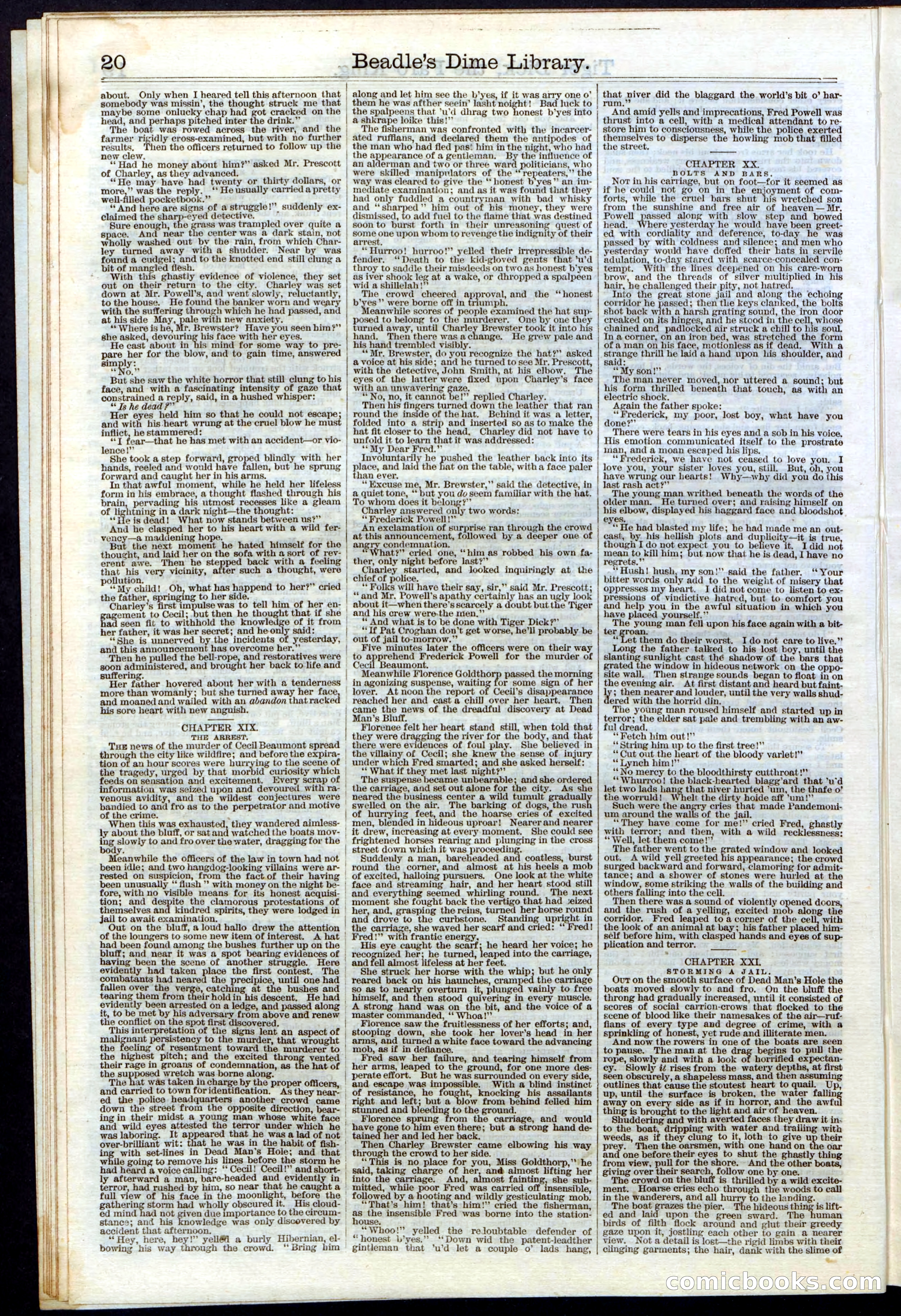
A restored page from Pulp Fiction, 1878. Page through the whole issue in the reader above.
📄 Transcribed text from this page (OCR, searchable)
Machine-transcribed from the original scan — historical spelling and the odd misread are preserved.
ee rare —* 20 oa —-- - ——_ about. Only when I heared tell this afternoon that | somebody was missin’, the thought struck me that maybe some onlucky chap had got cracked on the | head, and perhaps pitched inter the drink.” | The boat was rowed across the river, and the | farmer rigidly cross-examined, but with no further | results, Then the officers returned to follow up the new clew. ‘*Had he money about him?” asked Mr. Prescott of Charley, as they advanced. | “He may have had twenty or thirty dollars, or | more,” was the reply. ‘* He usually carried a pretty | well-filled pocketbook.” r * And here are signs of a struggle!’ suddenly ex- claimed the sharp-eyed detective. Sure enough, the ye was trampled over quite a space. And near the center was a dark stain, not wholly washed out by the rain, from which Char- | ley turned away with a shudder. Near by was found a cudgel; and to the knotted end still clung a bit of mangled flesh. With this ghastiy evidence of violence, they set out on their return to the city. Charley was set down at Mr. Powell's, and went slowly, reluctantly, to the house. He found the banker worn and weary with the suffering through which he had passed, and at his side May, pale with new anxiety. ‘Where is he, Mr. Brewster? Have you seen him?” she asked, tbe’ his face with her eyes. He cast about in his mind for some way to pre- pare her for the blow, and to gain time, answered oe oO. bh But she saw the white horror that still clung to his } | face, and with a fascinating intensity of gaze that constrained a reply, said, in a hushed whisper: “* Ts he dead ?” Her eyes held him so that he could not escape; and with his heart wrung at the cruel blow he must inflict, he stammered: “T fear—that he has met with an accident—or vio- lence!" She took a step forward, erpeee blindly with her hands, reeled and would have fallen, but he sprung forward and caught her in his arms. In that awful moment, while he held her lifeless | form in his embrace, a thought flashed through his brain, pervading his utmost recesses like a gleam of lightning in a dark night—the thought: ‘He is dead! What now stands between us?” And he — se mid to his heart with a wild fer- vency—a maddening hope. But the next eet bs hated himself for the thought, and laid her on the sofa with a sort of rev- erent awe. Then he mone back with a feeling that his very vicinity, after such a thought, were ement to Cecil; fad seen fit to withhold the knowle ge of it from her father, it was her secret; and he only said: “‘She is unnerved by the incidents of yesterday, and this announcement has overcome her.” Then he pulled the bell-rope, and restoratives were soon administered, and brought her back to life and suffering. Her father hovered about her with a tenderness more than womanly; but she turned away her face and moaned and wailed with an abandon that rack his sore heart with new anguish. CHAPTER XIX. THE ARREST. Tux news of the murder of Cecil Beaumont spread through the city like wildfire; and before the expira- tion of an hour scores were boryine to the scene of the tragedy, urged by that morbid curiosity which feeds on sensation and excitement. Every scrap of | information was seized upon and devoured with ra- venous avidity, and the wildest conjectures were bandied to and fro as to the perpetrator and motive of the crime. E When this was exhausted, they wandered aimless- ly about the bluff, or sat and watched the boats mov- | ing, slowly to and fro over the water, dragging for the Meanwhile the officers of the law in town had not been idle; and two hangdog-looking villains were ar- rested on suspicion, from the fact.of their having been unusually “ flush ” with money on the night be- | fore, with no visible means for its honest acquisi- | tion; and despite the clamorous protestations of themselves and kindred spirits, they were lodged in | jail to await examination. | Out on the bluff, a loud hallo drew the attention of the loungers to some new item of interest. A hat had been found among the bushes further up on the | bluff; and near it was a spot bearing evidences of | having been the scene of another struggle. Here | evidently had taken place the first contest. The | combatants had nea the precipice, until one had — fallen over the verge, catching at the bushes and poe Se from er holdin his Rescent. oe had © evidently been arrested on a ledge, and passed alo it, to be met by his adversary trom above and rena ollution. - “My child! Oh, what has happend to her?” cried | ar crepe renege = at tell him of her en | ; first impulse was 5 | ene pe Dut then he thought that if she | the conflict on the spot first discovered, This interpretation of the signs lent an aspect of malignant persistency to the murder, that wrought the feeling of resentment toward the murderer to | the highest pitch; and the excited throng vented | their rage in groans of condemnation, as hat of | the suppored wretch was borne along. The hat was taken inch by the proper officers, | and carried to town foridentification. As they near- ed the police headquarters another crowd came down the street from the opposite direction, bear- ing in their midst a young man whose white face and wild eyes attested the terror under which he was laboring. It appeared that he wasaladofnot tain over-brilliant wit: that he was in the habit of fish- he set-lines in Dead Man’s Hole; and that w had e going to remove his lines before the storm he | heard & voice calling: ‘* Cecil! Cecil!” and short- | ly afterward a man, bare-headed and evidently in | terror, had rushed by him, so near that he caught a — full view of his face in the moon ht, before the gathering storm had wholly obscured it. His cloud- | ed mind had not given due importance to the circum- stance; and his knowledge was only discovered by accident that afternoon. : : “Hey, here, hey!’ yell4i a burly Hibernian, el- bowing his way through the crowd. ‘ Bring him sie Veer Die bikrary along and let him see the b’yes, if it was arry one o’ them he was afther seein’ lasht noight! Bad luck to the spalpeens that ‘u’d dhrag two honest b’yes into a shkrape loike this!” The fisherman was confronted with the incareer- ated ruffians, and declared them the antipodes of the man who had fled past him in the night, who had the appearance of a gentleman. By the influence of an alderman and two or three ward politicians, who were skilled manipulators of the “ repeaters,”’ the way was cleared to give the “ honest b'yes” an im- mediate examination; and as it was found that they had only fuddled a countryinan with bad whisky and ‘“‘sharped”’ him out of his money, they were dismissed, to add fuel to the flame that was destined soon to burst forth in their unreasoning quest of some ag upon whom to revenge the indignity of their arrest, “Hurroo! hurroo!” yelled their irrepressible de- fender. “Death to the kid-gloved gents that ‘u’d throy to saddle their misdeeds on two as honest b’yes as iver shook leg at a wake, or dhropped a spalpeen wid a shillelah!” The crowd cheered anuroyal, and the “honest b'yes *’ were borne off in triumph, eanwhile scores of people examined the hat sup- posed to belong to the murderer. One by one they turned away, until Charley Brewster took it into his hand. Then there wasachange. He grew pale and his hand trembled visibly. “Mr. Brewster, do you recognize the hat?” asked a voice at his side; and he turned to see Mr, Prescott, with the detective, John Smith, at his elbow, The eyes of the latter were fixed upon Charley's face with an unwavering gaze. * No, no, it cannot be!”’ replied Charley. Then his fingers turned down the leather that ran round the inside of the hat. Behind it was a letter, folded into a strip and inserted so as to make the hat fit closer to the head, Charley did not have to unfold it to learn that it was addressed: **My Dear Fred.” Invyoluntarily he pushed the leather back into its place, and laid the hat on the table, with a face paler than ever. “Excuse me, Mr. Brewster,’’ said the detective, in a quiet tone, “* but you do seem familiar with the hat. To whom does it belong?”’ Charley answered only two words: “Frederick Powell!” An exclamation of surprise ran through the crowd at this announcement, followed by a deeper one of ang condemnation. - t?”’ cried one, “him as robbed his own fa- ther, only night before lasty”’ Charley started, and looked inquiringly at the chief of police. ** Folks will have their say, sir,” said Mr. Prescott; “‘and Mr. Powell’s apathy certainly has an ugly look about it—when there's scarcely a doubt but the Tiger and his crew werethe men,” ** And what is to be done with Tiger Dick?” “If Pat Croghan don’t get worse, he’ll probably be out of jail to-morrow.” Five minutes later the officers were on their way to ig toe Frederick Powell for the murder of Cecil Beaumont. Meanwhile Florence Gone passed the morning in agonizing suspense, waiting for some sign of her lover. At noon the report of Cecil’s disappearance reached her and cast a chil] over her heart. Then came the news of the dreadful discovery at Dead Man's Bluff. Florenee felt her heart stand still, when told that they were dragging the river for the body, and that there were evidences of foul play. She believed in the villainy of Cecil; she knew the sense of injury under which Fred smarted; and she asked herself: ‘** What if they met last night?” The suspense e unbearable; and she ordered the carriage, and set out alone for the city. As she neared the business center a wild tumult graduall swelled on the air. The barking of dogs, the rus of hurrying feet, and the hoarse cries of excited men, blended in hideous uproar! Nearerand nearer it drew, increasing at every moment. She could see frightened horses rearing and plunging in the cross | street down which it was proceedin Suddenly a man, bareheaded ant coatless, burst round the corner, and almost at his heels a mob of excited, halloing pursuers. One look at the white face and streaming hair, and her heart stood still and ev ing seemed whirling round. The next moment she fought back the vertigo that had seized her, and, graspiog the reins, turned her horse round and drove to the curbstone. Standing upright in the carriage, she waved her scarf and cried: “* ! | Fred!” with frantic energy, His eye caught the scarf; he heard her voice; he recognized her; he turned, leaped into the carriage, and fell almost lifeless at her feet. She struck her horse with the whip; but he only reared back on his haunches, cramped the carriage so as to nearly overturn it, plunged vainly to free himself, and then stood quivering in every muscle. A strong hand was on the bit, and the voice of a master commanded, ‘‘ Whoa!” Florence saw the fruitlessness of her efforts; and, stooping down, she took her lover’s head in her arms, and turned a white face toward the advancing mob, as if in defiance. Fred saw her failure, and tearing himself from her arms, leaped to the ground, for one more des- perate effort. But he was surrounded on every side, and escape was im ble. With a blind instinct of resistance, he fought, knocking his assailants right and left; but a blow from behind felled him stunned and bli to the ground. Florence sprung from the carriage, and would have gone to even there; but a strong hand de- her and led her back. Then Charley Brewster came elbowing his way through the crowd to her side. ‘“‘This is no place for you, Miss Goldthorp,’* he said, taking charge of her, ané almost lifting her into the carriage. And, almost fainting, she sub- mitted, while r Fred was carried off insensible, followed by a hooting and wildly gesticulating mob. “That’s him! that’s him!” cried the fisherman, a the insensible Fred was borne into the station- ouse. 6 ““Whoo!” yelled the reloubtable defender of ‘honest b’yes.”’ ‘‘Down wid the patent-leadther gintleman that ‘u’d let a couple o’ lads hang, ES ' ' is ee Oe +e — — —— that niver did the blaggard the world’s bit o’ har- rum. And amid yells and imprecations, Fred Powell was thrust into a cell, with a medical attendant to re- store him to consciousness, while the police exerted sige Hitt to disperse the howling mob that filled 1e street. CHAPTER XX. BOLTS AND BARS. Not in his carriage, but on foot—for it seemed as if he could not go on in the enjoyment of com- forts, while the cruel bars shut his wretched son from the sunshine and free air of heaven — Mr. Powell passed along with slow step and bowed head. here yesterday he would have been greet- ed with cordiality and deference, to-day he was passed by with coldness and silence; and men who yesterday would have doffed their hats in servile adulation, to-day stared with scarce-concealed con- tempt. With the lines deepened on his care-worn brow, and the threads of silver multiplied in his hair, he challenged their pity, not hatred. Into the great stone jail and along the echoing corridor he passed; then the keys clanked, the bolts shot back with a harsh grating sound, the iron door creaked on its hinges, and he stood in the cell, whose chained and padlocked air struck a chill to his soul In a corner, on an iron bed, was stretched the form of a man on his face, motionless as if dead. With a sranee thrill he laid a hand upon his shoulder, and said: ‘The man never moved, nor uttered a sound; but his form thrilled beneath that touch, as with an electric shock. Again the father spoke: pene ies my poor, lost boy, what have you done?”’ There were tears in his eyes and a sob in his voice, His emotion communicated itself to the prostrate man, and a moan escaped his lips. “Frederick, we have not ceased to love you. I love you, your sister loves you, still. But, oh, you have wrung our hearts! Why—why did you do this last rash act?” The young man writhed beneath the words of the older man. He turned over; and raising himself on his elbow, displayed his haggard face and bloodshot ves. . “He had blasted my life; he had made me an out- cast, by his hellish plots and duplicity—it is true, though I do not expect you to believe it. Idid not meant kill him; but now that he is dead, I have no regrets.” ‘Hush! hush, my son!" said the father. ‘Your bitter words only add to the weight of misery that oppresses ny heart. I did not come to listen to ex- pressions of vindictive hatred, but to comfort you and help you in the awful situation in which you have placed yourself.” ztae young man fell upon his face again with a bit- r “ Let them do their worst. I do not care to live.” Long the father talked to his lost boy, until the slanting sunlight cast thé shadow of the bars that grated the window in hideous network on the oppo- site wall, Then strange sounds began to float in on the evening air. At first distant and heard but faint- Wy then nearer and louder, until the very walls shud- ered with the horrid din, The young man roused himself and started up in terror; the elder sat pale and trembling with an aw- ful dread, **Fetch him out!” ‘String him up to the first tree!” “Cut out the heart of the bloody varlet!" a ee him!" ‘**No mercy to the bloodthirsty cutthroat!" ““Whurroo! the black-h blagg’ard that ’u‘d let two lads ig niver hurted ’um, the thafe o’ the worruld! elt the dirty hoide aff *um!”" Such were the an cries that made Pandemoni- um around the w of the jail. “They have come for me!" cried Fred, ghastly with terror; and then, with a wild recklessness: ‘Well, let them come!’ The father went to the angie window and looked out. A wild yell greeted his appearance; the crowd surged backward and forward, clamoring for admit- tance; and a shower of stones were hurled at the window, some striking the walls of the building and others falling into the cell. Then there was a sound of violently opened doors, and the rush of a yelling, excited mob along the corridor, Fred leaped to a corner of the cell, with the look of an animal at bay; his father p him- self before him, with clasped hands and eyes of sup- plication and terror. » od CHAPTER XXI. STORMING A JAIL. Out on the smooth surface of Dead Man's Hole the boats moved slowly to and fro. On the bluff the throng had gradually increased, until it consisted of scores of social carricn-crows that flocked to the scene of blood like their namesakes of the air—ruf- fians of ev type and degree of crime, with a sprinkling of honest, yet rude and illiterate men. And now the rowers in one of the boats are seen to pause. The man at the begins to pull the rope, slowly and with a look of horrified expectan- cy. Slowly i¢ rises from the watery depths, at first seen 0 rely, a shapeless mass, and then ng outlines that cause the stoutest heart to Up, up, until the surface is broken, the water fallin away on every side as if in horror, and the awf thing is brought to the light and air of heaven. Shuddering and with averted faces they draw it in- to the boat, dripping with water and trailing with weeds, as if they clung to it, loth to give up their a Then the oarsmen, with one hand on the oar and one before their eyes to shut the ghastly thing from view, pull for the shore. And the other boats, giving over their search, follow one by one. The crowd on the bluff is thrilled by a wild excite- ment. Hoarse cries echo through the woods to call in the wanderers, and all hurry to the landing. The boat 1 goa the pier. The hideous is lift- ed and laid upon the green sward. The human birds of filth flock around and glut their greedy gaze upon it, jostling each otber to gain a nearer view. Nota detail is lost—the rigid limbs with their clinging garments; the hair, dank with the slime of ECORAIE OOO KS eC) Ss) > Oe Se ee