
Pulp Fiction, 1878 · page 18 of 32
Beadle's Dime Library, Vol. III, No. 29 — page 18: what you’re looking at
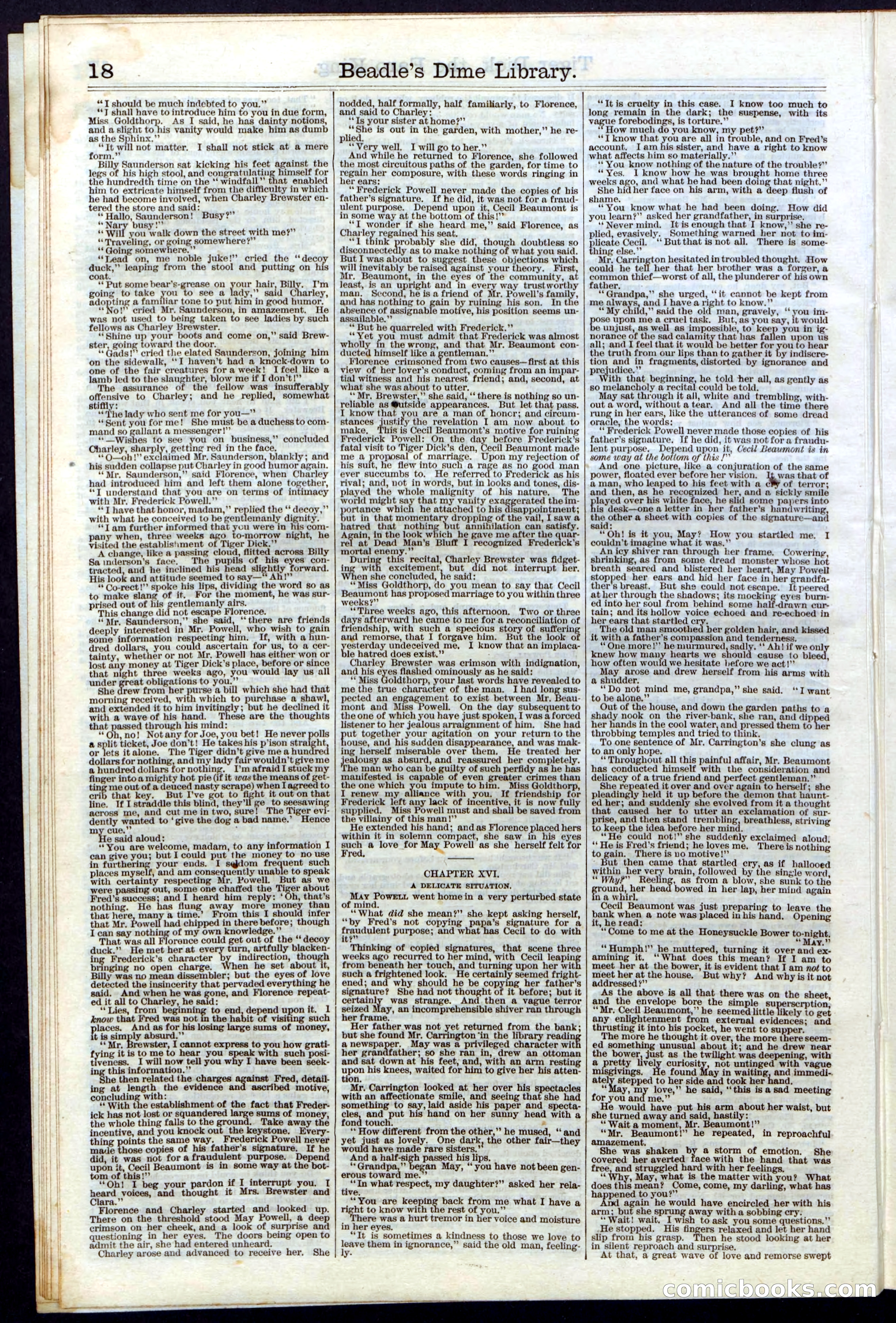
A restored page from Pulp Fiction, 1878. Page through the whole issue in the reader above.
📄 Transcribed text from this page (OCR, searchable)
Machine-transcribed from the original scan — historical spelling and the odd misread are preserved.
—E oe ee ws wr ee ee -- 13. “T should be much indebted to you.” **] shall have to introduce him to you in due form, Miss Goldthorp. As I said, he has dainty notions, and a slight to his vanity would make him as dumb as the Sphinx,”’ “Tt will not matter. form.” Billy Saunderson sat kicking his feet against the legs of his high stool, and congratulating himself for the hurdradch time on the *‘ windfall” that enabled him to extricate himself from the difficulty in which he had become involved, when Charley Brewster en- tered the store and said: I shall not stick at a mere ** Hallo, Saunderson! Busy?” *Nary busy!” : A “Will you walk down the street with me? “Traveling, or going somewhere?” ‘** Going somewhere.” ‘‘TLead on, me noble juke!’’ cried the “deco duck,” leaping from the stool and putting on his coat. ** Put some bear’s-grease on your hair, Billy. I’m going to take you to see a lady,” sald C arley, adopting a familiar tone to put him in good humor, ‘*No!” cried Mr. Saunderson, in amazement. He was not used to being taken to see ladies by such fellows as Charley Brewster. “Shine ap your boots and come on," said Brew- ster, going toward the door. ‘*Gads!” cried the elated Saunderson, joining him on the sidewalk, “I haven’t had a knock-down to one of the fair creatures for a week! I feel like a lamb led to the slaughter, blow me if I don’t!" The assurance of the fellow was_insufferably offensive to Charley; and he replied, somewhat stiffly: “The lady who sent me for you—” “Sent you for me! She must be a duchess to com- mand so gallant a messenger!” ‘*_Wishes to see you on business,’’ concluded Charley, sharply, getting red in the face. *O—oh!”’ excldigind Mr. Saunderson, blankly; and his sudden collapse put Charley in good humor again. ‘Mr, Saunderson,”’ said Florence, when Charley had introduced him and left them alone together, *“T understand that you are on terms of intimacy with Mr, Frederick Powell.” “IT have that honor, madam,” replied the “ decoy,”’ with what he conceived to be gentlemanly dignity. ‘*T am further informed that you were in his com- pany when, three weeks ago to-morrow night, he visited the establisment of Tiger Dick.” A change, like a passing cloud, flitted across Billy Sa inderson’s face. The pupils of his eyes con- tracted, and he inclined his head slightly forward. His look and attitude seemed to say—“ Ah! “ Co-rect!’’ spoke his lips, dividing the word so as to make slang of it. For the moment, he was sur- prised out of his pengemanty airs. This change did not escape Florence. “Mr, Saunderson,” she said, “there are friends deeply interested in Mr. Powell, who wish to gain some information respecting him. If, with a hun- dred dollars, you could ascertain for us, to a cer- tainty, whether or not Mr. Powell has either won or lost any money at Tiger Dick’s place, before or since that night ont ti ge ago, you would lay us all under t obligations to you.’ She drew trom het urse a bill which she had that morning received, with which to purchase a shawl, and extended it to him Se ut he declined it with a wave of a pe : ese are the thoughts that passed through his mind: 7 Mh, no! Notany for Joe, you bet! He never polls a split ticket, Joe don’t! He takes his p’ison stra ght, or lets italone. The Tiger didn’t give me a hun dollars for nothing, and my lady fair wouldn't give me a hundred dollars for nothing. I’mafraidI stuck m finger into a mighty hot pie (if it was the means of get- me out of a deuced nasty scrape) when I to crib that key. But I've got to fight it out on that line. If I straddle this blind, they’ Re to seesawin across me, and cut me in two, sure! The Tiger evi- dently wanted to ‘give the dog a bad name.’ Hence ma Cue e said aloud: “You are welcome, madam, to any information I can give you; but I could put the money to no use in furthe your ends. I s@jdom frequent such places myself, and am consequently unable to speak with certainty respecting Mr. Powell. But as we were out, some one chatfed the Tiger about Fred's success; and I heard him reply: ‘Oh, that’s nothing. He has flung away more money than that here, many a time.’ From this I should infer that Mr. Powell had chipped in there before; though I can say nothing of my own knowledge. . That was all Florence could get out of the *‘ decoy duck.” He met her at every turn, artfully blacken- ing Frederick’s character Sg econ though bringing no open charge. When he set about it, Billy was no mean dissembler; but the eyes of love detected the insincerity that pervaded everything he said. And when he etigane and Florence repeat- « sf ¢ ie to d, d d = 2 “ » from end, depend upon it. know that Fred was noe the habit of visi such laces. And as for his losing large sums of money, ft is pate absurd.” “Mr. wster, I cannot express to you how grati- f itis to meto hear you ag yma such posi- ee BA I will now tell you why I have been seek- this information.” he then related the c nst Fred, detail- ascribed motive, harges ing at length the evidence an concluding with ~ ‘* With the establishment of the fact that Freder- ick has not lost or squandered e sums of money, the whole thing falls to the ground, Take away the incentive, and you knock out_the keystone. Every- thing points the same way. Frederick Powell never made those copies of his father’s . If he did, it was not fora fraudulent purpose. Depend upon 3t, Cecil Beaumont is in some way at the bot- ron te pardon if I interrupt you. I . our — voices, ree thought it Mrs. Brewster and lara.”’ Florence and Charley started and looked up. There on the threshold stood May Powell, a deep crimson on her cheek, and a look of surprise and questioning in her eyes, The doors being open to admit the air, she had entered unheard. Charley arose and advanced to receive her. She ‘**Is your sister at home?”’ a is out in the garden, with mother,” he re- plied. “Very well. I will go to her.” And while he returned to Florence, she followed the most circuitous paths of the garden, for time to regain her composure, with these words ringing in her ears: ‘Frederick Powell never made the copies of his father’s signature. If he did, it was not for a fraud- ulent purpose. Depend upon it, Cecil Beaumont is in some way at the bottom of this!"’ “*T wonder if she heard me,” said Florence, as Charley regained his seat. ‘““1 think probably she did, though doubtless so disconnectedly as to make nothing of what you said. But I was about to suggest these objections which will inevitably be raised against your theory. First, Mr. Beaumont, in the eyes of the community, at Jeast, is an upright and in every way trustworthy man. Second, he isa friend of Mr. Powell's family, and has nothing to gain by ruining his son. In the absence of assignable motive, his position seems un- assailable.”’ ‘** But he quarreled with Frederick.” “Yet you must admit that Frederick was almost wholly in the wrong, and that Mr. Beaumont con- ducted himself like a gentleman.” lorence crimsoned from two causes—first at this view of her lover’s conduct, coming from an impar- tial witness and his nearest friend; and, second, at what she was about to utter. ‘*Mr, Brewster,”’ she said, “ there is nothing so un- reliable as @utside appearances. But let that pass. I know that you are a man of honcr; and circum- stances justify the revelation I am now about to make, This is Cecil Beaumont’s motive for ruining Frederick Powell: On the day before Frederick's fatal visit to Tiger Dick’s den, Cecil Beaumont made me a proposal of marriage. Upon my rejection of his suit, he flew into such a rage as no good man ever succumbs to. He referred to Frederick as his rival; and, not in words, but in looks and tones, dis- played the whole malignity of his nature, The world might say that my vanity exaggerated theim- yortance which he attached to his disappointment; ut in that momentary dropping of the vail, Isaw a hatred that nothing but annihilation can satisfy. Again, in the look which he gave me after the quar- rel at Dead Man’s Bluff I recognized Frederick's mortal enemy.”’ During this recital, baoera Brewster was fidget- ing with excitement, but did not interrupt her. When she concluded, he said: ““Miss Goldthorp, do you mean to say that Cecil me oa has proposed marriage to you within three weeks?” “Three weeks ago, this afternoon. Two or three days afterward he came to me for a reconciliation of friendship, with such a specious story of sufferin and remorse, that I forgave him. But the look o \bingreer ons! undeceived me, I know that an implaca- le hatred does exist.” Charley Brewster was crimson with indignation, and his ores flashed ominously as he said: ** Miss Goldthorp, your last words have revealed to me the true character of the man. I had long sus- pected an en RgSMent to exist between Mr. Beau- mont and owell. On the day subsequent to the one of which you haye just spoken, I was a forced listener to her jealous ¢ gnment of him. She had ps together your agitation on your return to the ouse, and his sudden disappearance, and was mak- ing herself miserable over them, He treated her ealousy as absurd, and reassured her completely. he man who can be guilty of such perfidy as he has manifested is capable of even greater crimes than the one which you impute to him. Miss Goldthorp, I renew my ce with you. If friendship for Frederick left any lack of incentive, it is now fully supplied. Miss Powell must and shall be saved from the villainy of this man!” He extended his hand; and as Florence placed hers within it in solemn compact, she saw in his eyes a a love for May Powell as she herself felt for CHAPTER XVI. A DELICATE SITUATION, Ky re nes went homein a very perturbed state of mind. ‘i ma oo open ?” she kept ‘we J “eee “by Fred’s not copying a’s § ure for a Fepodplert purpose; and what Cecil to do with Thinking of copied tures, that scene three weeks ago recurred to her mind, with Cecil leapin from beneath her touch, and turning upon her wit such a ey yk nine look. He certainly seemed fright- ened; and why should he be cop her father’s signature? She had not thought of it before; but it certainly was strange. And then a vague terror a y, an incomprehensible shiver ran through er frame. Her father was not yet returned from the bank; but she found Mr. Carrington ‘in the library readi a newspaper. May was a privileged character wi her grandfather; so she ran in, drew an ottoman and sat down at his feet, and, with an arm resting ono his knees, waited for him to give her his atten- on, Mr. Carrington looked at her over his tacles with an affectionate , and seeing that she had something to say, laid aside his paper and _ specta- cles, and put his hand on her sunny head with a fond touch. ** How different from the other,” he mused, “ and yet just as lovely. One dark, the other fair—they would have made rare sisters.’ And a half-sigh passed his lips. * Grand "began May, “ you have not been gen- erous toward me.”’ be ‘*In what respect, my daughter?” asked her rela- ve. “You are keeping back from me what I have a right to know with the rest of you.” _ There was a hurt tremor in her voice and moisture in her eyes. “It is sometimes a kindness to those we love to a them in ignorance,” said the old man, feeling- y- “It is cruelty in this case. I know too much to long remain in the dark; the suspense, with its vague forebodings, is torture.” “* How much do you know, my pet?” ‘*T know that you are all in trouble, and on Fred’s account. Iam his sister, and have a right to know what affects him so materially.” * You know nothing of the nature of the trouble?” “Yes. I know how he was brought home three weeks ago, and what he had been doing that night.” She hid her face on his arm, with a deep flush of shame. ‘You know what he had been doing. How did you learn?” asked her grandfather, in surprise, ‘*Never mind, It is enough that I know,” she re- plied, evasively. Something warned her not to im- licate Cecil. ‘‘ Butthat is not all. There is some- hing else.” Mr. Carrington hesitated in troubled thought. How could he tell her that her brother was a forger, a common thief—worst of all, the plunderer of his own father. “Grandpa,” she urged, “it cannot be kept from me avers and I have a right to know.” “Myc ild,”” said the old man, gravely, ‘ you im- = upon me a cruel task. But, as you say, it would unjust, as well as impossible, to keep you in ig- norance of the sad calamity that has fallen upon us all; and I feel that it would be better for you to hear the truth from our lips than to gather it by indiscre- tion — in fragments, distorted by ignorance and prejudice.’ With that beginning, he told her all, as gently as so melancholy a recital could be told. May sat through it all, white and trembling, with- out a word, without a tear. And all the time there rung in her ears, like the utterances of some dread oracle, the words: ‘* Frederick Powell never made those copies of his father’s signature. If he did, it was not for a fraudu- lent purpose, Depend upon it, Cecil Beaumont is in some way at the bottom of this /” And one picture, like a conjuration of the same power, floated ever before her vision. was that of aman, who leaped to his feet with a c¥¥ of terror; and then, as he recognized her, and a sickly smile layed over his white face, he slid some papers into his desk—one a letter in her father's hanc writing the other a sheet with copies of the signature—anc said: “Oh! is it you, May? How you startled me. I couldn't imagine what it was.” An icy shiver ran through her frame. Cowering, shrinking, as from some dread monster whose hot breath seared and blistered her heart, May Powell stopped her ears and hid her face in her grandfa- ther’s breast. But she could not escape. It peered at her through the shadows; its mocking eyes burn- ed into her soul from behind some half-drawn cur- tain; and its hollow voice echoed and re-echoed in her ears that startled cry. The old man smoothed ber golden hair, and kissed it with a father’s compassion and tenderness. “One more!’’ he murmured analy ** Ah! if we onl knew how many hearts we should cause to bl ; how often would we hesitate hefore we act!” May arose and drew herself from his arms with a shudder. “Do not mind me, grandpa,” she said. toOut of the h d down th ut of the house, and down the garden paths to a shady nook on the river-bank, she ran, dnd dip her hands in the cool water, and pressed them to her throbbing temples and tried to think, To one sentence of Mr. Carrington’s she clung as to an only hope. , “ Throughout all this painful affair, Mr. Beaumont has conducted himself with the consideration and delicacy of a true friend and perfect gentleman.” She repeated it over and over again to herself; she pleadingly held it up before the demon that haunt- ed her; and suddenly she evolved from it a thought that caused her to utter an exclamation of sur- prise, and then stand trembling, breathless, striving to keep the idea before her mind. ‘““He could not!” she suddenly exclaimed aloud, ‘* He is Fred’s friend; he loves me. There is nothing to mp There is 1 gma ; u en came that startled cry, as if hallooed within her very brain, followed byt the single word, “Why?” Ree Bng. as from a blow, she sunk to the ound, her h bowed in her lap, her mind again ec umont was just preparing to leave th bank vneg a note was placed _ his ry Opening , he read: “Come to me at the Honeysuckle Bower to-night, “* May." ““Humph!"’ he muttered, turning it over and ex- amining it. ‘‘ What does this mean? It I am to went nee oie. bower, A ee a not to meet her at the house, But w why i yore: th ye is all that th : EO @ above t ere was on the sh and the envelope bore the simple su aiken “Mr, Cecil Beaumont,” he seemed little ely to get and any enlightenment from external evidences; thrusting it into his pocket, he went to supper. The more he thought it over, the more there seem- ed something unusual about it; and he drew near the bower, just as the twilight was deepening, with é pees lively curiosity, not untinged with vague givings. He found in waiting, and immedi-. ares pped to her side and took her hand, ‘May, my love,"’ he said, “this isa sad meeting for you and me.” He would have put his arm about her waist, but she turned away and said, hastily: “Wait a moment, Mr. Beaumont!” “Mr. Beaumont!” he repeated, in reproachful amazement, She was shaken by a storm of emotion. She covered her averted face with the hand that was free, and struggled hard with her feelin “Why, May, what is the matter with you? What does this mean? Come, come, my darling, what has happened to you?” sean he would sta’ grotrens, her with his arm; but she sp away a sobbing cry. “Wait! wait. ‘Twish to ask you some questions." He sobbed, His fingers relaxed and let her hand slip from his grasp. Then he stood looking at her in silent reproach and surprise, At that, a great wave of love and remorse swept *T want GoOmilchbooks: €