
Pulp Fiction, 1878 · page 13 of 32
Beadle's Dime Library, Vol. III, No. 29 — page 13: what you’re looking at
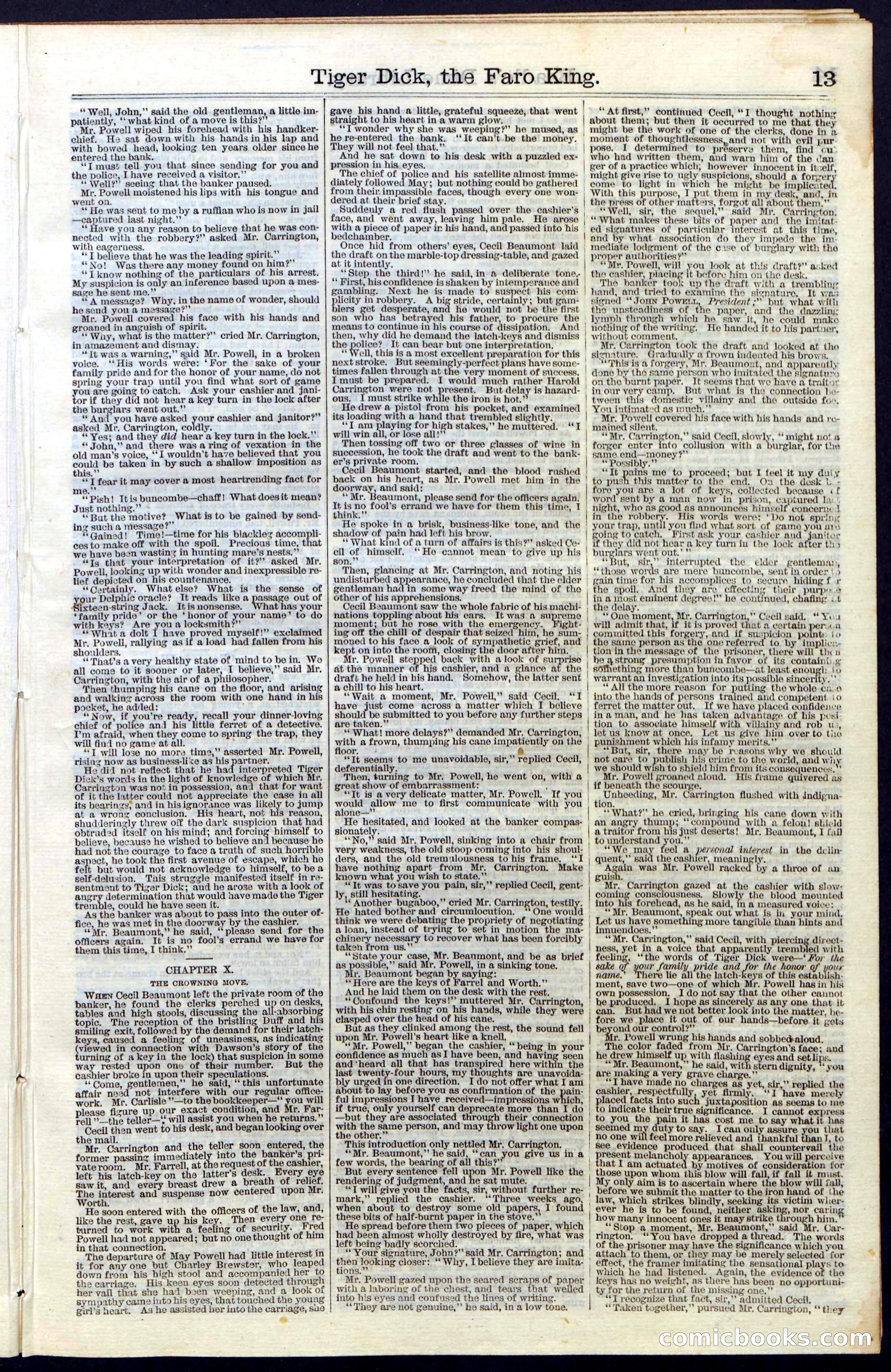
A restored page from Pulp Fiction, 1878. Page through the whole issue in the reader above.
📄 Transcribed text from this page (OCR, searchable)
Machine-transcribed from the original scan — historical spelling and the odd misread are preserved.
OS Lh a re oe ane i eee NE ———E——EEEe “Well, John,” said the old gentleman, a little im- patiently, ‘‘ what kind of a move is this?” Mr, Powell wiped his forehead with his handker- chief. He sat down with his hands in his lap and with bowed head, looking ten years older since he entered the bank. “T must tell you that since sending for you and the police, I have received a visitor.”’ ‘* Well?’ seeing that the banker paused. Mr. Powell moistened his lips with his tongue and went on, f i ‘He was sent to me by a ruffian who is now in jail —captured last night.” ‘* Have you any reason to believe that he was con- nected with the robbery?” asked Mr. Carrington, with eagerness. “whith “T believe that he was the leading spirit.” ‘““No! Was there any money found on him? “I know nothing of the particulars of his arrest. My suspicion is only an inference based upon a mes- sare he sent me.”’ “A message? Why, in the name of wonder, should he send you a message?” Mr. Powell covered his face with his hands and groaned in anguish of spirit. ; ‘Why, what is the matter?’ cried Mr. Carrington, in amazement and dismay. “It was a warning,’’ said Mr. Powell, in a broken voice. ‘‘His words were: ‘For the sake of your family pride and for the honor of your name, do not spring your trap until you find what sort of game you are going to catch. Ask your cashier and jani- tor if they did not hear a key turn in the lock after the burglars went out.” * And you have asked ead cashier and janitor?” asked Mr, Carrington, coldly. “Yes; and they did hear a key turn in the lock.”’ John,” and there was a ring of vexation in the old man’s voice, ‘I wouldn’t have believed that you could be taken in by such a shallow imposition as this.”’ ‘“‘T fear it may cover a most heartrending fact for 99 “Pish! Itis buncombe—chaff! What does it mean? ust nothing.”’ " * But the motive? What is to be gained by send- nz such a message?” “Gained! Time!—time for his blackleg accompli- ces to make off with the spoil. Precious time, that sve have been wasting in hunting mare’s nests,”’ “Ts that your interpretation of it?’ asked Mr. Powell, looking up with wonder and inexpressible re- lief depicted on his countenance. “Qortainly. What else? What is ur Delphic oracle? It reads like a passage out of teen-string Jack. Itisnonsense. Whathas your ‘family pride’ or the ‘honor of your name’ to do with keys? Are you a locksmith?” **“Whata dolt 1 have pert myself!"’ exclaimed Mr. Powell, rallying as if a load had fallen from his shoulders. A “'That’s a very healthy state of mind to bein. Wo all come to it sooner or later, I believe,” said Mr. Carrington, with the air of a philosopher. Then thumping his cane on the floor, and arising and walking across the room with one hand in his pocket, he added: “Now, if you're ready, recall your dinner-loving chief of police and his little ferret of a detective. I’m afraid, when they come to spring the trap, they will find no game at all. ‘‘T will lose no more time,” asserted Mr. Powell, rising now as business-like as his partner. - He did not reflect that he had interpreted Tiger Dick’s words in the light of knowledge of which Mr. Carrington was no‘ in possession, and that for want of it the latter could not appreciate the case in all its bearings; and in his ignorance was likely to jump at a wrong conclusion. His heart, nob his reason, shudderingly threw off the dark suspicion that had obtrudad itself on his mind; and forcing himself to believe, because he wished to believe and because he had not the courage to face a truth of such horrible aspoct, he took the first avenue of escape, which ho felt but would not acknowledge to himself, to be a self-delusion. This struggle manifested itself in re- sentment to Tiger Dick; and he arose with a look of angry determination that would have made the Tiger tremble, could he have seen it. As the banker was about to pass into the outer of- fice, he was met in the doorway by the cashier. “Mr. Beaumont,” he said, “please send for the officers again. It is no fool's errand we have for them this time, I think.”’ the sense of CHAPTER X. THE CROWNING MOVE. Wuen Cecil Beaumont left the private room of the banker, he found the clerks perched uP on desks, tables and high stools, discussing the all-absorbin topic. The reception of the bristling Duff and h smiling exit, followed by the demand for their latch- keys, caused a feeling of uneasiness, as indicating (viewed in connection with Dawson's story of the turning of a key in the lock) that suspicion in some way rested upon one ee t cel Ny er. But the cashier broke in upon their sp ations. ‘Come, gentlemen," he said, “this unfortunate affair need not interfere with our regular office- work. Mr. Carlisle ’’—to the bookkeeper—* you will please figure up our exact condition, and Mr. Far- rell ’—the teller—'! will assist you when he returns.”’ Cecil then went to his desk, and began looking over the mail. Mr. Carrington and the teller soon entered, the former passing immediately into the banker’s pri- vateroom. Mr. Farrell, at the request of the cashier, left his latch-key on the latter's desk. Every eye saw it, and every breast drew & breath of aan ie ionams and suspense now centered upon Mr. orth, He soon entered with tho officers of the law, and, like the rest, gave up his key. Then every one Je turned to work with a feeling of security. f hir Powell had not appeared; but no one thought of him in that connection. oe The departure of May Powell had little interest in it for any one but Charley Brewster, who leaped down from his high stool and accompanied her to the carriage. His keen eyes soon detected through her vail that she had been weeping, and a look of sympathy came into his eyes, that touched the young girl’s heart. As he assisted her into the carriage, sao i Tiger Dick, the Faro King. gave his hand a little, grateful squeeze, that went straight to his heart in a warm glow. **T wonder why she was weeping?’ he mused, as he re-entered the bank. ‘It can’t.be the money. They will not feel that.” And he sat down to his desk with a puzzled ex- pression in his. eyes, The chief of pcaee and his satellite almost imme- diately followed May; but nothing could be gathered from their. impassible faces, though every one won- dered at their brief stay. Suddenly a red flush passed over the cashier's face, and went away, leaving him pale. He arose with a piece of paper ir his hand, and passed into his bedchamber. Once hid from others’ eyes, Cecil Beaumont laid the draft on the marble-top dressing-table, and gazed at it intently. “Step the third!’ he said, in a deliberate tone, | ‘* First, his confidence is shaken by intemperance and gambling. Next he is made to suspect his com- dlicity in robbery. A big stride, certainly; but gam- ylers get desperate, and he would not be the first son who has betrayed his father, to procure the means to continue in his course of dissipation. And | then, why did he demand the latch-keys and dismiss the ee _It can bear but one interpretation, ‘** Well, this is a most excellent preparation for this next stroke, But seemingly-porfect plans have some- times fallen through at the very moment of success. I must be prepared. I would much rather Harold Carrington were not present. ous, I must strike while the iron is hot.’ He drew a pistol from his pocket, and examined its loading with a hand that trembled slightly. **T am playing for high stakes,’ he muttered. “I will win all, or lose all!” Then tossing off two or three glasses of wine in succession, he took the draft and went to the bank- er’s private room. Cecil Beaumont started, and the blood rushed back on his heart, as Mr. Powell met him in the doorway, and said: “Mr. Beaumont, please send for the officers again. a is Seo fool’s errand we have for them this time, I ink.”’ He spoke in a brisk, business-like tone, and the shadow of pain had left his brow. “What kind of a turn of affairs is this?” asked Ce- cil of himself. “He cannot mean to give up his son.” Then, glancing at Mr. Carrington, and noting his undisturbed cima n he concluded that the elder gentleman had in some way freed the mind of the other of his apprehensions. Cecil Beaumont saw the whole fabric of his machi- nations toppling about his ears, It was a wh? ahs moment; but he rose with the emergency. Fight- ing off the chill of despair that seized him, he sum- | moned to his face a look of sympathetic grief, and kept on into the room, closing the door after him, Mr. Powell stepped back with a look of surprise at the manner of his cashier, and a glance at the draft he held in his hand, Somehow, the latter sent a chill to his heart. “Wait a moment, Mr. Powell,” said Cecil. “TI have just come across a matter which I believe should be submitted to you before any further steps are taken.” ** What! more delays?” demanded Mr, Carrington, ae a frown, thumping his cane impatiently on the por, 7" a “It seems to me unavoidable, sir,"’ replied Cecil, deferentially, Then, turning to Mr. Powell, he went on, with a great show of embarrassment: ; “Tt is a very delicate matter, Mr. Powell. If you pA be allow me to first communicate with you alone—’ He hesitated, and looked at the banker compas- sionately. ‘*No,” said Mr. Powell, sinking into a chair from very weakness, the old stoop coming into his shoul: | ders, and the old tremulousness to his frame, “I have nothing apart from Mr. Carrington. Make known what you wish to state.” “It was tosave you pain, sir,’’ replied Cecil, gent- ly, still hesitating. ‘Another bugaboo,” cried Mr, Carrington, testily. He hated bother and circumlocution, ‘One would think we were debating the propriety of negotiating a loan, instead of trying to set in motion the ma- chinery necessary to recover what has been forcibly taken from us.” “State your case, Mr. Beaumont, and be as brief as possible,” said Mr. Powell, in a sinking tone, r. Beaumont began rk saying: ** Here are the keys of Farrel and Worth.”’ And he laid them on the desk with the rest. ‘**Confound the keys!’ muttered Mr, Carrington, with his chin resting on his hands, while they were | can. But clasped over the head of his cane. But as they clinked among the rest, the sound fell upon Mr. Powell's heart like a knell, ‘Mr. Powell,” began the cashier, “ being in your confidence as much asSI have been, and hav seen and'heard all that has transpired here within the last twenty-four hours, my thoughts are unavoida- bly urged in one direction, I do not offer what I am about to lay before you as confirmation of the pain- ful impressions I have received—impressions which, if true, only yourself can deprecate more than I do —but they are associated eet their connection bp a same person, and may throw light one upon e other.” This introduction only nettled Mr, Carrington. ‘Mr. Beaumont,”’ he said, ‘‘ can you give us ina few words, the bearing of all this?? - But every sentence fell upon Mr. Powell like the rendering of judgment, and he sat mute. “T will give you the facts, sir, without further re- mark,” replied the cashier. ‘Three weeks ago when about to destroy some old papers, I foun these bits of half-burnt paper in the stove.’ He spread before them two pieces of paper, which had been almost wholly destroyed by fire, what was | left being badly scorched. , ‘Your signature, John?” said Mr. Carrington; and i looking closer: “‘Why, I believe they are imita- | ions.” Mr. Powell gazed upon the seared scraps of paper with a laboring of the chest, and tears that welled into his eyes and confused the lines of writing. ** They are not genuine,”’ he said, in a low tone. , 5 | withou | | But delay is hazard- | 13 —— ‘At first,” continued Cecil, “I thought nothing about them; but then it occurred vo ae that they might be the work of one of the clerks, done in 2 a _ moment of thoughtlessness, and not with evil pur pose. I determined to preserve them, find cu’ who had written them, and warn him of the van ger of a practice which, however innocent in itself, might give rise to ugly sige eg eS should a forger come to light in which he might be implicated. With this purpose, I put them in my desk, and, in the press of other matters, forgot all about them.” “Well, sir, the sequel,” said Mr. Carrington. “What makes these bits of paper and the imitat- ed signatures of particular interest at this time, and by what association do they impede the im- , mediate lodgement of the cise of burglary with the proper authorities?” “Mr. Powell, will you look at this draft?” asked the cashier, placing it before him on the desk, The banker took up the draft with a trembling hand, and tried to examine the sienature, It was signed ““Joun Pow, President; but what with the unsteadiness of the paper, and the dazzling: lymph through which he saw it, he could mako nothing of the writing. He handed it to his partner, comment, Mr. Carrington took the draft and looked at the sienature. G radually a frown indented his brows. “This is a forgery, Mr. Beaumont, and apparently done by the same person who imitated the s gnaturo on the burnt paper. It seems that we have a traitor in our very camp. But what is the connection ho- tween this domestic villainy and the outside for, You intimated as much,” Mr. Powell covered his face with his hands and ro- mained silent, ‘ “Mr. Carrington,” said Cecil, slowly, “‘ might not a forger enter into collusion with a burglar, for the same end—money?” * Possibly.” “It pains me to proceed; but I feel it my duly to push this matter to the end. On the desk L. - fore you are a lot of keys, collected because « f word sent by @ man now in prison, captured ly | in the robbery. His words were: ‘Do not spring your trap, until you flnd what sort of fame you are oing to catch. First ask your cashier and janitor | if they did not hear a key turn in the lock after th» burglars went out.’ ”’ “But, sir,’ interrupted the elder gentleman, “those words are mere buncombe, sent in order ‘o gain time for his accomplices to secure hiding f r the spoil, And they are cffecting their purp:¢ in a most eminent degree!’ he continued, chafing «.t , the delay. ‘*One moment, Mr, Carrington,” Cecil said. “ You will admit that, if it is proved that a certain persca committed this forgery, and if suspicion points: to the same person as the one referred to by implice- tion in the message of the prisoner, there will thy u | he astrong presumption in favor of its containt.e | night, who as good as announces himeelf concerne:! | something more than buncombe—at least enough {o warrant an investigation into its possible sincerity." | “All the more reason for sutting the whole cao into the hands of persons trained and competent io _ ferret the matter out. If we have placed confidence ina man, and he has taken advantage of his posi tion to associate himself with villainy and rob ua, let us know at once, Let us give him over to tie punishment which his infamy merits.” “But, sir, there may be reasons why we should not care to publish his crime to the world, and wh we should wish to shield him from its consequences.” Mr. Powell groaned aloud, His frame quivered as if beneath the scourge, r Unheeding, Mr. Carrington flushed with indigna- on, ‘What?’ he cried, bringing his cane down with an angry ya “compound with a felon! shield a traitor from his just deserts! Mr. Beaumont, I fail to understand os “We may feel a personal interest in the dclin- | quent,” said the cashier mpaningly. ain was Mr. Powell racke by a throe of an Mr. Carrington gazed at the cashier with slow- | co consciousness. Slowly the blood mounted Into his forehead, as he said, in a measured voice: __ “Mr. Beaumont, speak out what is in your mind. | Let us have something more tangible than hints and _ Innuendoes.' “Mr. Carrington,” said Cecil, with piercing direct- ness, yet in a voice that apparently trembled with feeling, ‘“‘the words of Tiger Dick were—‘ For the sake iu Samily pride and for the honor of your name here lie all the latch-keys of this eatablish- ment, save two—one of which Mr. Powell has in his own possession. I do not say that the other cannot ' he produced, I hope as sincerely as any one that it d we not better look into the matter, be- fore we place it out of our hands—before it pots Deerane Coy pone ihe: . Powell wrung his hands and sobb , The color faded from Mr. Garcinaton'e fie: and he drew himself up with gee | eyes and set lips. th stern dignity, “you “Mr. Beaumont,” he said, wi avery grave ch , “T have made no charges an yet sir,” replied the cashier, respectfully, yet “I have merely laced facts into such juxtaposition as seems to me o indicate their true significance. I cannot ress to you the it has cost me to say what ithas seemed my uty tosay. I can only assure you that no one will feel more relieved and thankful J, to see evidence produced that shall countervail the ee Lg pate appearances, You will perceive hat I am actuated by motives of consideration for those upon whom this blow will fall, if fall it must. My only aim is to ascertain where the blow will fal), before we submit the matter to the iron hand of ‘he law, which strikes blindly, seeking its victim wlier- ever he is to be found, neither asking, nor caring how many innocent ones it may strike through him. Stop a moment, Mr. Beaumont,” said Mr, Car- rington. “You have dropped a thread. The words of the prisoner may have the significance which you attach to them, or they may be merely selected for effect, the framer imitating the sensational plays to Which he had listened. Again, the evidence of the keys has no weight, as there has been no opportuni- ty for the return of the missing one,” “*T recognize that fact, sir,’ admitted Cecil. “Taken together,” pursued Mr. Carrington, “ they (COMNMIE KOOKS * (E(@)