
Pulp Fiction, 1878 · page 14 of 32
Beadle's Dime Library, Vol. III, No. 29 — page 14: what you’re looking at
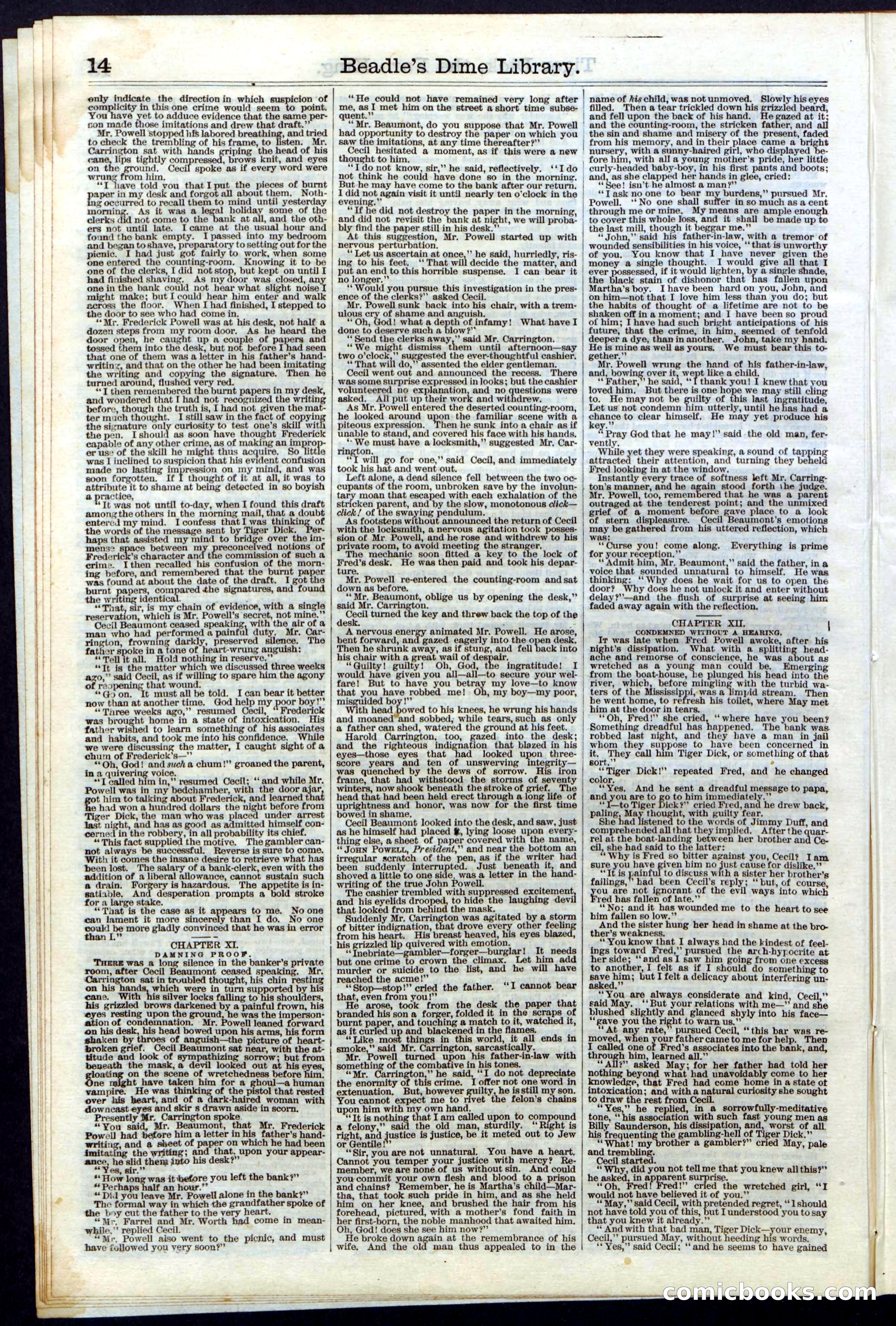
A restored page from Pulp Fiction, 1878. Page through the whole issue in the reader above.
📄 Transcribed text from this page (OCR, searchable)
Machine-transcribed from the original scan — historical spelling and the odd misread are preserved.
eR SS 14 ee illine enly indicate the direction in which icion of ee Pino in this one crime would seem point. You have yet to adduce evidence that the same per- son made those imitations and drew that draft.”’ Mr. Powell stopped hfs labored breathing, and tried to check the trembling of his frame, to listen. Mr. Carrington sat with hands griping the head of his cane, lips tightly com , brows knit, and eyes on the ground, Cecil spoke as if every word were wrung from him. ““T have told you that I put the pieces of burnt paper in my desk and forgot all about them, Noth- ¢ occurred to recall them to mind until yesterday morning. As it was a ig holiday some of the clerks did not come to the bank at all, and the oth- ers not until late. Icame at the usual hour and found the bank empty. I passed into my bedroom and began toshave, preparatory to setting out for the pienic. I had just got fairly to work, when some one entered the counting-room. Knowing it to be one of the clerks, I did not stop, but kept on until I had finished shaving. As my door was closed, one in the bank could not hear what slight noises might make; but I could hear him enter and walk across the floor. When I had finished, I stepped to the door to see who had come in. “Mr. Frederick Powell was at his desk, not half a dozen steps from my room door. As he heard the door open, he caught up a ere of papers and tossed them into the desk, but not before I seen that one of them was a letter in his father’s hand- writinz, and that on the other he had been imitating the writing and copying the signature. Then he turned around, flushed very red. “‘T then remembered the burnt papers in my desk, and wondered that I had not recognized the writing before, though the truth is, I had not given the mat- ter much thought. I still saw in the fact of copyin the signature only curiosity to test one’s skill wit the pen. Ishould as soon have thought Frederick capable of any other crime, as of making an impro er use of the skill he might thus acquire. So little was I inclined to suspicion that his evident confusion made no lasting a amet on my mind, and was soon forgotten. If I thought of it at all, it was to attribute it to shame at being detected in so boyish a practice, ‘It was not until to-day, when I found this draft among the others in the morning mail, that a doubt entercd my mind. I confess thatI was thi of the words of the message sent by Tiger Dick. Per- haps that assisted my mind to bridge over the im- mens? seve between m presnnce ved notions of Frederick’s character and the commission of such a crime. I then recalled his confusion of the morn- ing before, and remembered that the burnt Payor was found at about the date of the draft. I got the burnt papers, pg the signatures, and found the writing identic “That, sir, is my chain of evidence, with a single reservation, which is Mr. Powell’s secret, not mine.” Cecil Beaumont ceased speaking, with the air of a man who had performed a painful duty, Mr. Car- ringion, frowning darkly, preserved silence, The father ke in a tone of heart-wrung anguish: “Tell it all. Hold nothing in reserve,” “Tt is the matter which we discussed three weeks azo,” said Cecil, as if willing to spare him the agony of reo that wound. “Goon. It must all be told. I can bear it better now than at another time. God help my poor boy!’ “Three weeks ago,’’ resumed Cecil, “ Frederick was brought home in a state of intoxication. His father wished to learn something of his associates and habits, and took me into his confidence, While we were discussing the matter, I caught sight of a chum of Frederick’s—”’ ‘Oh, God! and such a chum!”’ groaned the parent, in a quivering voice. **T called him in,” resumed Cecil; ‘and while Mr. Powell was in my bedchamber, with the eS ad t him to talking about Frederick, and learned that had won a hundred dollars the night before from Tiger Dick, the man who was placed under arrest last night, and has as good as admitted himself con- cerned in the robbery, in all probability its chief. “This fact supplied the motive. The gambler can- not always be successful. Reverse is sure to come. With it comes the insane desire to retrieve what has been lost. The salary of a bank-clerk, even with the addition of a liberal allowance, cannot sustain such a drain. Ad gp A is hazardous. The appetite is in- satiable. And desperation prompts a bold stroke for a large stake. “That is the case as it a to me. Noone can lament it more sincerely than I do. No one ne more gladly convinced that he was in error CHAPTER XI. DAMNING PROOF. THERE was a long silence in the banker's private room, after Cecil Beaumont ceased speaking. : m sat in troubled thought, his chin resting Carri on his which were in turn supported by his cans. With silver locks falling to his shoulders, his grizzled brows darkened by a painful frown, his = resting upon the ground. ie Vee the imperson- onof condemnation. Mr. Powell leaned forward on his Goat. ite heed bowed upon his arms, his form shaken by of —the picture of heart- broken grief. Cecil Beaumont sat near, with the at- titude and look of sympathizing sorrow; but from beneath the mask, a devil looked out at his eyes, loating on the scene of wretchedness before ne t have taken him for a ghoul—a human vampire. He was thinking of the 1 that rested over his heart, and of a dark-haired woman with dow neast hic fok and skir s drawn A ge: in scorn, Present . Carrington “You at Mr. Hagar: that Mr. Frederick Powell had before him a letter in his father's hand- Fe ae Rae Se of eating beds Bre A had been tat: the g; an % appear- ance, he slid theme into his desk?’ Fe 8 was it before you left the bank?” er f an hour. “Did os leave Mr. Powell alone in the bank?” The formal way in which the grandfather spoke of the boy cut the father to the very heart. “Mr. Farrel and Mr. Worth had come in mean- hile,” replied Cecil. ‘Mr. Powell also went to the picnic, and must have followed you very soon?” pee mS SEES enaasinspeete ——_——__ — — = Beadle’s Dime Library. ‘*He could not have remained very long after name of his child, was not unmoved. Slowly his eyes me, - I met him on the street a short time subse- quent.”’ “Mr. Beaumont, do you suppose that Mr. Powell had opportunity to destroy the paper on which you saw the imitations, at any time thereafter?” Cecil hesitated a moment, as if this were a new thought to him. ‘Ido not know, sir,” he said, reflectively. ‘‘I do not think he could have done so in the morning. But he may have come to the bank after our return. I bn again visit it until nearly ten o'clock in the evening.” “If he did not destroy the paper in the morning, and did not revisit the bank at night, we will proba- | bly find the paper still in his desk.” At this suggestion, Mr. Powell started up with nervous perturbation. ‘‘ Let us ascertain at once,’’ he said, hurriedly, ris- ing to his feet, ‘‘ That will decide the matter, and put an end to this horrible suspense. I can bear it no longer.”’ ‘* Would you pursue this investigation in the pres- ence of the clerks?’ asked Cecil. Mr. Powell sunk back into his chair, with a trem- ulous oxy of shame and anguish. * Oh, ! what a cope of infamy! What have I done to deserve such a blow?” ‘* Send the clerks away,” said Mr. Carrington. ‘We might dismiss them until afternoon—say ' and fell upon the back of his hand. filed. Then a tear trickled down his grizzled beard, He gazed at it; ‘ and the counting-room, the stricken father, and all through me or mine. My the sin and shame and misery of the present, faded from his memory, and in their place came a bright nursery, with a sunny-haired girl, who displayed be- fore him, with all a young mother’s pride, her little curly-headed baby-boy, in his first pants and boots; and, as she clapped her hands in glee, cried: ‘*See! isn’t he almost a man?”’ **T ask no one to bear my burdens,” pursued Mr. Powell. ‘‘No one shall suffer in so much as a cent means are ample enough to cover this whole loss, and it shall be made up to the last mill, though it beggar me.” ‘‘ John,” said his father-in-law, with a tremor of wounded sensibilities in his voice, ‘that is unworthy of you. You know that I have never given the money a single thought. I would give all that I ever pont, if it would lighten a a single shade, the black stain of dishonor that has fallen upon Martha’s boy. I have been hard on you, John, and on him—not that I love him less than you do; but the habits of thought of a lifetime are not to be shaken off in a moment; and I have been so proud of him; I have had such bright anticipations of his future, that the crime, in him, seemed of tenfold pg es a dye, than in another, John, take my hand. H mine as well as yours. We must bear this to- two o'clock,” suggested the ever-thoughtful cashier. | gether.” “That will > do,” assented the elder gentleman, Cecil went out and announced the recess. There was some surprise expressed in looks; but the cashier volunteered no explanation, and no questions were asked. All put up their work and withdrew. As Mr. Powell entered the deserted counting-room, he looked around upon the familiar scene with a piteous expression. Then he sunk into a chair as if unable to stand, and covered his face with his hands. ‘We must have a locksmith,” suggested Mr. Car- gear “I will go for one,” said Cecil, and immediately took his hat and went out. Left alone, a dead silence fell between the two oc- cupants of the room, unbroken save by the involun- tary moan that escaped with each exhalation of the stricken gee and by the slow, monotonous el click / of the swaying pendulum. As footsteps without announced the return of Cecil with the locksmith, a nervous agitation took posses- sion of Mr Powell, and he rose and withdrew to his private room, to avoid meeting the stranger. The mechanic soon fitted a key to the lock of Trred’s desk. He was then paid and took his depar- ture. Mr. Powell re-entered the counting-room and sat oon opera t, obli b ning the desk “Mr. Beaumont, oblige us by ope the desk,” said Mr. yg, ET ~ ; a ae turned the key and threw back the top of the es ; - A nervous energy animated Mr. Powell. He arose, bent forward, and gazed eagerly into the o desk, Then he shrunk away, as if stung, and fell back into his chair with a great wail of des , “Quilty! guilty! Oh, God, the ingratitude! I would have given you all—all—to secure your wel- fare! But to have you ms my love—to know that you have robbed me! Oh, my boy—my poor, aa Fags boy! th head bowed to his knees, he wrung his hands and moaned”’and sobbed, while tears, such as only a father can shed, watered the ground at his feet. Harold Carrington, too, gazed into the desk; and the righteous indi on that blazed in his eyes—those eyes that looked mpen score years and ten of unswerving bogey — was quenched by the dews of sorrow. His iron frame, that had withstood the storms of seventy winters, now shook beneath the stroke of grief. The head that had been held erect through a long life of uprightness and honor, was now for the first time bowed in shame. Cecil Beaumont looked into the desk, and saw, just as he himself had placed &, lying loose upon every- thing else, a sheet of paper covered with the name, “ JoHN Powe, President,” and near the bottom an Se ae ee en a Se beneath Ihe and een su rupted. J enea shoved a little to one side was a letter in the hand- writing of the true John Powell. The cashier trembled with suppressed excitement and his eyelids droo to hide the laughing dev that looked from b the mask, Suddenly Mr, Ca ton was agitated by a storm of bitter indignation, that drove every other feelin from his heart. His breast heaved, his eyes - his led lip quivered with emotion. ‘fhebriate-gambler—forgerburgiar! It needs but one crime crown the climax. Let him add murder or suicide to the list, and he will have reached the acme!” “Stop—stop!”’ cried the father. “I cannot bear that, even from you!”’ He arose, took from the desk the paper that branded his son a forger, folded it in the scraps of burnt paper, and touching a match to it, watched it, as it curled up and blackened in the flames. sd ai m g's in this word, 1 all ends in smoke,”’ said Mr. Carrington, sarcas y- n his father-in-law with “Mr. winee mn.” be waa AT Gn nck depreciate ‘Mr. , mee, o not dep the enormity ee his crime. I offer not one word in extenuation, But, however guilty, he is still my son. You cannot expect me to rivet the felon’s chains upon him with my own hand. “It is no that Iam called upon to compound a felony,” said the old man, sturdily. “Right is right, ane justice is justice, be it meted out to Jew or Gentile!”’ “Sir, you are not unnatural, You have a heart. Cannot you temper your justice with mercy? Re- member, we are none of us without sin. And could you commit your own flesh and blood to a prison and chains? Remember, he is Martha’s child—Mar- tha, that took such pride in him, and as she held him on her knee, and brushed the hair from his forehead, pictured, with a mother's fond faith in her first-born, the noble manhood that awaited him. Oh, God! does she see him now?” He broke down in at the remembrance of his wife, And the old man thus appealed to in the three- | | | | | Mr, Powell wrung the hand of his father-in-law, and, bowing over it, wept like a child. “Father,” he said, “1 thank you! I knew that you loved him. But there is one hope we may still cling to. He may not be guilty of this last ingratitude, Let us not condemn him utterly, until he has had a ae to clear himself. He may yet produce his ey.” eae God that he may!” said the old man, fer- vently. While yet they were speaking, a sound of tapping attracted their attention, and turning they beheld Fred looking in at the window, Instantly every trace of softness left Mr, Carring- ton’s manner, and he again stood forth ihe judge. Mr. Powell, too, remembered that he was a parent outraged at the tenderest point; and the unmixed grief of a moment before gave place to a look of stern displeasure. Cecil Beaumont’s emotions may be gathered from his uttered reflection, which was: ‘*Curse you! come along. Everything is prime or your reception,” ‘Admit him, Mr. Beaumont," said the father, in a voice that sounded unnatural to himself, He was thinking: ‘‘Why does he wait for us to open the door? Why does he not unlock it and enter without delay ?’’—and the flush of surprise at seeing him faded away again with the reflection, CHAPTER XI. | CONDEMNED WITHOUT A HEARING, Ir was late when Fred Powell awoke, after his night’s dissipation. What with a splitting head- ache and remorse of conscience, he was about as wretched as a young man could be. Emerging from the boat-house, he plunged his head into the river, which, before mingling with the turbid wa- ters of the Mississip i, was a limpid stream. Then he went home, to refresh his toilet, where May met him at the door in tears, ‘*Oh, Fred!"’ she cried, ‘‘where have you been? Something dreadful has happened. The bank was robbed last night, and they have a man in jail whom they suppose to have been concerned in it. They call Tiger Dick, or something of that ort. i Tiger Dick!’ repeated Fred, and he changed color. “Yes, And he sent a dreadful message to papa, and yon are to fo to him ge pee GY **I—to Tiger Dick?’ cried Fred, and he drew back, paling, May thought, with guilty fear. She had listened to the words of Jimmy Duff, and comprehended allthat they implied. After the quar- rel at the boat-landing between her brother and Ce- cil, she had said to the latter: ‘Why is Fred so bitter against you, Cecil? Iam sure te have given him no just cause for dislike,” “It is painful to discuss with a sister her brother's failings,” had been Cecil’s reply; “but, of course, you are not ignorant of the evil ways into which red has fallen of late.” ‘““No; and it has wounded me to the heart to see him fallen so low.” And the sister hung her head in shame at the bro- Ome ouknow fiat. always had th ‘You know that I always the kindest of feel- ings toward Fred,” pursued the arch-hypocrite at her side; ‘‘and asI saw him going from one excess to another, I felt as if I should do something to gave him; but I felt a delicacy about interfering un- “You are always considerate and kind, Cecil,” said May. ‘But your relations with me—” and she blushed slightly and glanced shyly into his face— ‘gave you the right to warn us,” ‘At any rate,” pursued Cecil, “this bar was re- moved, when yur father came to me for help. Then 7 Called one of Fred’s associates into the bank, and, ‘* All?” asked May; for her father had told her nothing beyond what had unavoidably come to her knowledge, that Fred had come home in a state ot intoxication; and witha natural ty she sought to draw the rest from Cecil. “Yes,” he replied, in a sorrowfully-meditative tone, “his association with such fast young men as Billy Saunderson, his dissipation, and, worst of all. his Prequen sis 526 gambling-hell of Dick.” ““What! my brother a gambler?” cried May, pale and trembling. Cecil s' R “Why, did you not tell me that you knew all this?” he asked, in ap rent ge i oo “Oh, Fred 1’ cried the wretched girl, “I would not have believed it of you.” "said with pretended regret, “1should not have told you of this, but I understood you to say that you knew it already.” “ And with that bad man, Tiger Dick—your enemy, Cecil,’ pursued May, without heeding his words. ‘** Yes,"’ said Cecil: ‘““and he seems to have gained ="OrY eyveyoy <S- Orr