
Pulp Fiction, 1878 · page 12 of 32
Beadle's Dime Library, Vol. III, No. 29 — page 12: what you’re looking at
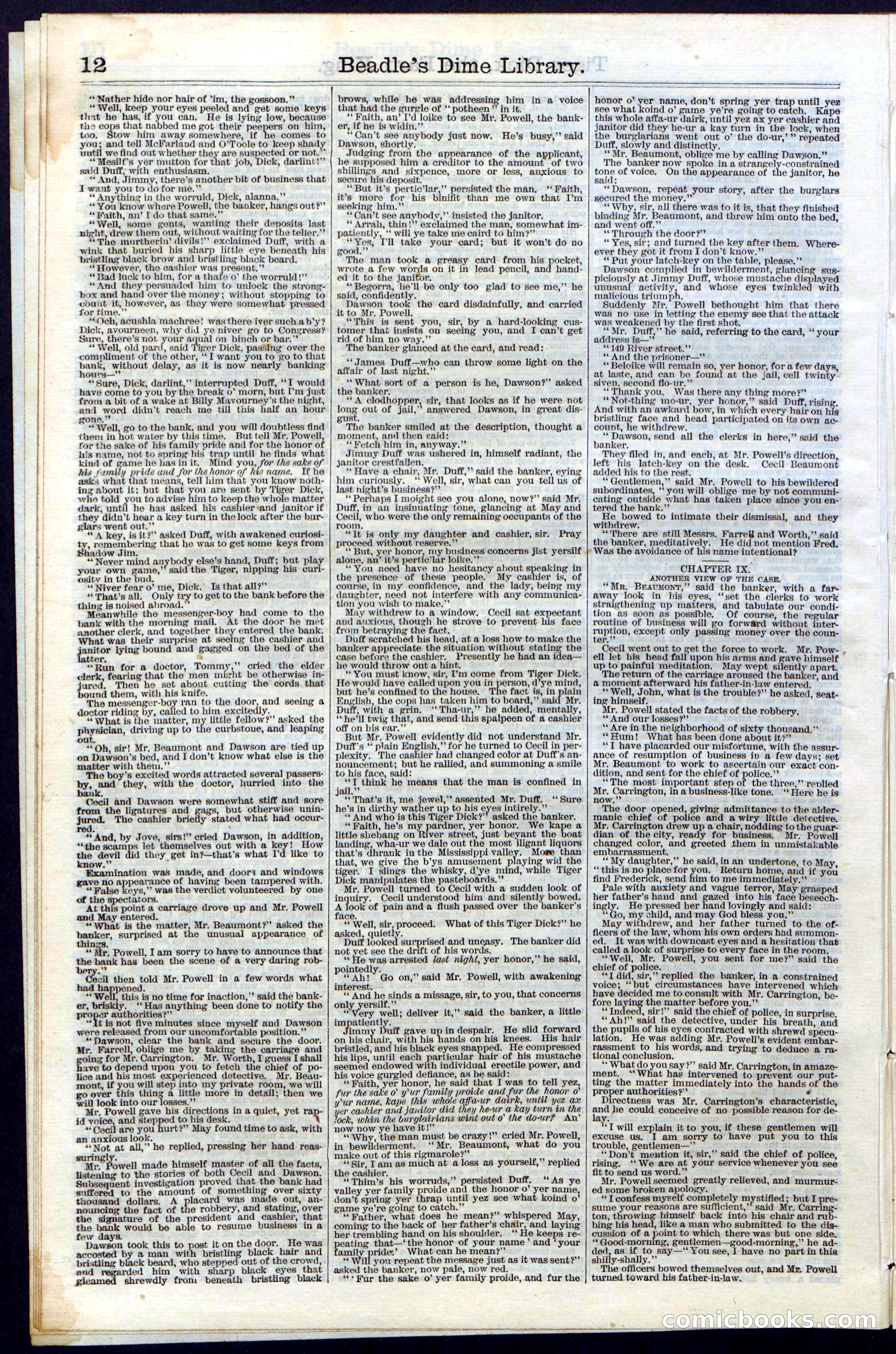
A restored page from Pulp Fiction, 1878. Page through the whole issue in the reader above.
📄 Transcribed text from this page (OCR, searchable)
Machine-transcribed from the original scan — historical spelling and the odd misread are preserved.
ES —- 8 SSS SS 12 “* Nather hide nor hair of ‘im, the gossoon.” “Well, keep your eyes peeled and get some keys that he has, if you can. He is lying low, because the eops that nabbed me got their peepers on him, too. Stow him away somewhere, if he comes to you; and tell McFarland and O'Toole to keep shady uutil we find out whether they are suspected or not.** ‘*Mesilf’s yer mutton for that job, Dick, darlint!” said Duff; with enthusiasm. “ And, Jimmy, there’s another bit of business that I want you to do for me.” “ Anything in the worruld, Dick, alanna,”’ ** You know where Powell, the banker, hangs out?”’ “Waith, an’ I do that same.” “Well, some gents, wanting their deposits last night, drew them out, without waiting for the telier.”’ “The murtherin’ divils!’’ exclaimed Duff, with a wink that buried his sharp little eye beneath his bristling black brow and bristling black beard. ** However, the cashier was iehonppnas ht * Bad luck to him, for a thafe 0’ the worruld!” *And they persuaded him to unlock the strong- box and hand over the money; without stopping to count it, however, as they were somewhat pressed for time.” “(Och, acushla machree! was there iver such ab’y? Dick, avourneen, why did ye niver go to Congress? Sure, there's not. your aqual on binch or bar.”’ “Well, old pard, said Tiger Dick, pasSing over the compliment of the other, ““I want you to go to that bank, without delay, as it is now nearly banking hours—”’ “Sure, Dick, darlint,”’ interrupted Duff, ‘T would have come to you by the break o’ morn, but ['m just from a bit of a wake at Billy Mavourney’s the night, and word didn’t reach me till this half an hour yone,”” ae Well, go to the bank, and you will doubtless find them in hot water by this time. But tell Mr. Powell for the sake of his family pride and for the honor of his name, not to spring his trap until he finds what kind of game he has init. Mind you, for the sake of his family pride and for the honor of his name. Te he asks what that means, tell him that you know noth- ing about it; but that you are sent by Tiger Dick, who told you to advise him to keep the whole matter dark, until he has asked his cashier ‘and janitor if they didn’t hear a key turn in the lock after the bur- gilars went out.”’ “A key, is it?’ asked Duff, with awakened curiosi- ty, remembering that he was to get some keys from hadow Jim, “ Never mind anybody else's hand, Duff; but pla your own game,” said the Tiger, nipping his curi- ositv in the bud, “‘ Niver fear o’ me, Dick. Is that all?” ““That’s all. Ouly try to get to the bank before the thing is noised abroad.” Meanwhile the messenger-boy had come to the bank with the morning mail. At the door he met another clerk, and together they entered the bank. What was their surprise at seeing the cashier and —— lying bound and gagged on the bed of the » “Run for a doctor, Tommy,” cried the elder clerk, fearing that the men m eht be otherwise in- ured. Then he set about cutting the cords that fo them, with his knife. The messenger-boy ran to the door, and seeing a doctor riding by, called to him excitedly. “ What is the matter, my little fellow?” asked the physician, driving up to the curbstoue, and leaping out. **Oh, sir! Mr, Beaumont and Dawson are tied up on Dawson's bed, and I don’t know what else is the matter with them.”’ The boy’s excited words attracted several passers- by, and they, with the doctor, hurried into the bank, Cecil and Dawson were somewhat stiff and sore from the ligatures and gags, but otherwise unin- jured. The cashier briefly stated what had occur- red. : “And, by Jove, sirs!” cried Dawson, in addition, “*the scamps let themselves out with a pg How the devil did they get in?—that’s what I'd like to ” » Ww. Examination was made, and doors and windows gave no appearance of having been tampered with. “Walse keys,’’ was the verdict volunteered by one of the ctators. At this point a carriage drove up and Mr, Powell and May entered. “What is the matter, Mr. Beaumont?” asked the banker, surprised at the unusual appearance of ngs. “ Mr, Powell, Iam sorry to have to announce that the bank has been the scene of a very daring rob- bery.” “Cecil then told Mr. Powell in a few words what ned. “WwW P this is no time for inaction,” said the bank- er, . “Has anything been done to notify the proper authorities?” “It is not five minutes since myself and Dawson were released from our uncomfortable position.” “Dawson, clear the bank and secure the door. Mr. Farrell, oblige me by taking the carriage and ing for Mr. Carrington. Mr. Worth, I guess I shall Fave to depend upon you to fetch the chief of po- lice and his most experienced detective. Mr. Beau- mont, if you will step into my private room, we will over this thing a little more in detail; then we will look into our losses.”’ Mr. Powell gave his directions in a quiet, yet ra id voice, and ag ta to his desk. “ Qeeil are you hurt?’ May found time to ask, with an anxious look. ““Not at all,’ he replied, pressing her hand reas- 1 . oun” Rowell made himself master of all the facts, to the stories of both Cecil and Dawson. Subsequent investigation proved that the bank had suffered to the amount of something over sixty thousand dollars. A placard was made out, an- nouncing the fact of the robbery, and stating, over the signature of the president and cashier, that the bank would be able to resume business in a few days. 7 - ost iton the door. He was Dawson took this to accosted by a man with bristling black hair and out of the crowd, bristling black beard, who steppe ee gape him with ener > black eyes that end rded I prvctions, shrewdly from beneath bristling black Beadle’s Dime Library. — —$$— =< $$, -- brows, while he was addressing him in a voice that had the gurgle of ‘ potheen”’ in it. ‘Faith, an’ I’d loike to see Mr. Powell, the bank- er, if he is widin.”’ “Can't see anybody just now. He’s busy,” said Dawson, shortly. Judging from the appearance of the applicant, he supposed him a creditor to the amount of two shillings and sixpence, more or less, anxious to secure his deposit. _** But it’s pertic’lar,”’ persisted the man, ‘ Faith, it’s more for his binifit than me own that I’m seeking him.” **Can’t see anybody,’ insisted the janitor. * Arrah, thin!’’ exclaimed the man, somewhat im- patiently, ‘‘ will ye take me caird to him?” nae I'll take your card; but it won't do no The man took a greasy card from his pocket, wrote a few words on it in lead pencil, and hand- ed it to the janitor. **Begorra, he'll be only too glad to see me,” he said, confidently. Dawson took the card disdainfully, and carried it to Mr. Powell. “This is sent you, sir, by a hard-looking cus- tomer that insists on seeing you, and I can’t get rid of him no way.” The banker glanced at the card, and read: ‘James Duff—who can throw some light on the affair of last night.”’ ‘What sort of a person is he, Dawson?” asked the banker. ‘**A clodhopper, sir, that looks as if he were not ae out of jail,’ answered Dawson, in great dis- gust. The banker smiled at the description, thought a moment, and then said: “Fetch him in, anyway.” Jimmy Duff was ushered in, himself radiant, the janitor crestfallen. ‘*Have a chair, Mr. Duff,” said the banker, eying him curiously. ‘* Well, sir, what can you tell us of last night’s business?” ‘**Perhaps I moight see you alone, now?” said Mr. Duff, in an insinuating tone, glancing at May and Cecil, who were the only remaining occupants of the room, “It is only my daughter and cashier, sir. Pray proceed without reserve.” ‘* But, yer honor, my business concerns jist yersilf alone, an’ it’s pertie’lar loike.”’ * You need have no hesitancy about speaking in the presence of these people. My cashier is, of course, in my confidence, and the lady, being my daughter, need not interfere with any communica- tion you wish to make,” May withdrew to a window. Cecil sat expectant and anxious, though he strove to prevent his face from betraying the fact. Duff scratched his head, at a loss how to make the banker appreciate the situation without ae the case before the cashier. Presently he had an idea— he would throw out a hint, “You must know, sir, I’m come from Tiger Dick. He would have called upon you in person, d’ye mind, but he’s confined to the house, The fact is, in plain English, the cops has taken him to board,” said Mr. Duff, with a grin. ‘*Tha-ur,”’ he added, mentally, ‘* he'll twig that, and send this spalpeen of a cashier off on bis ear.” But Mr. Powell evidently did not understand Mr. Duff's * plain oe nat for he turned to Cecil in per- plexity. The cashier had changed color at Duff's an- nouncement; but he rallied, and summoning a smile to his face, said: . ’ ae think he means that the man is confined in ‘*That’s it, me jewel,’’ assented Mr. Duff. ‘‘ Sure he’s in dirthy wather up to his eyes intirely.” ‘* And who is this Tiger Dick?’’ asked the banker. ‘Waith, he’s my pardner, yer honor. We kape a little shebang on River street, just beyant the boat landing, wha-ur we dale out the most iligant liquors that’s dhrank in the Mississippi pr More than that, we give the b’ys amusement playing wid the tiger. I slings the whisky, d’ye mind, while Tiger Dick manipulates the pasteboards,”’ Mr. Powell turned to Cecil with a sudden look of inquiry. Cecil understood him and silently bowed. A look of pain and a flush passed over the banker's face, ‘‘ Well, sir, proceed. What of this Tiger Dick?” he asked, quietly. Duff looked surprised and uneasy. The banker did not yet see the drift of his words, ‘ ‘He was arrested fast night, yer honor,” he said, pointedly. ‘Ah! Go on,’ said Mr. Powell, with awakening interest. ** And pe anes a missage, sir, to you, that concerns only yersilf.”’ Kh ery well; deliver it,” said the banker, a little impatiently. . immy Duff gave up in despair. He slid forward on his hate with his hands on his knees. His hair bristled, and his black eyes weed oy He compressed his lips, until each particular hair of his mustache seemed endowed with individual erectile power, and his voice gurgled defiance, as he said: ‘“Waith, yer honor, he said that I was to tell yez, fur the sake 0 yur family proide and fur the honor o yur name, kape this whole ae dairk, until yez ax yer cashier and janitor did they he-ur a kay turn in the lock, whin the Seo ney toh» wint out o the do-ur? An’ now now ye have it!” “Why, the man must be crazy !’’ cried Mr. Powell, in bewilderment. ‘‘Mr. Beaumont, what do you make out of this rigmarole?” *: “Sir, 1am as much at a loss as yourself,”’ replied the cashier. “Thim’s his worruds,” persisted Duff. “As ye valley yer family proide and the honor o’ yer hame, don’t spring yer Sse until yez see what koind o game ye're going to catch.” “Father, what does he mean?’’ whispered May, coming to the back of her father’s chair, and laying her trembling hand on his shoulder. “ He keeps re- eating that—‘the honor of your name’ and ‘your amily pride.’ What canhe mean?” — s wal you repeat the message just as it was sent?” asked the banker, now pale, now red. ‘“** Mur the sake o' yer family proide, and fur the — —_ —_—__ honor o’ yer name, don’t spring yer trap until yez see what koind o’ game ye'’re going to catch. Kape this whole affa-ur dairk, until yez ax yer cashier and janitor did they he-ur a kay turn in the lock, when the burglarians went out o’ the do-ur,’” repeated Duff, slowly and distinetly. ‘“Mr. Beaumont, oblige me by calling Dawson.” The banker now spoke in a strangely-constrained a of voice. On the appearance of the janitor, he said: ‘**Dawson, repeat your story, after the burglars secured the money.” “Why, sir, all there was to it is, that they finished binding Mr. Beaumont, and threw him onto the bed, and went off.” ‘Through the door?” “Yes, sir; and turned the key after them. Where- ever they got it from I don’t know.” “Put your latch-key on the table, please.” Dawson complied in bewilderment, glancing sus- piciously at Jimmy Duff, whose mustache displayed unusual activity, and whose eyes twinkled with malicious trium ph. Suddenly Mr. Powell bethought him that there was no use in letting the enemy see that the attack was weakened by the first shot, ‘Mr. Duff,” he said, referring to the card, * your address is—"’ **149 River street.”’ * And the prisoner—”’ ** Beloike will remain so, yer honor, for a few days, at laste, and can be found at the jail, cell swinty siven, second flo-ur.”’ ‘‘Thank you. Was there any thing more?” ‘*Not-thing mo-ur, yer honor,” said Duff, rising. And with an awkard bow, in which every hair on his eon face and head participated on its own ac- count, he withdrew. ‘Dawson, send all the elerks in here,” said the banker. They filed in, and each, at Mr. Powell’s direction, left his latch-key on the desk. Cecil Beaumont added his to the rest. **Gentlemen,”’ said Mr. Powell to his bewildered subordinates, ‘‘ you will oblige me by not communi- cating outside what has taken place since you en- tered the bank." He _ bowed to intimate their dismissal, and they withdrew. “There are still Messrs, shee and Worth,” said the banker, meditatively. He did not mention Fred. Was the avoidance of his name intentional? CHAPTER IX. ANOTHER VIEW OF THE CASE, “Mr. Beaumont,” said the banker, with a far- away look in his eyes, “set the clerks to work straigthening up matters, and tabulate our condi- tion as soon as possible. Of course, the regular routine of business will go forward without inter- mk except only passing money over the coun- er. Cecil went out to get the force to work. Mr. Pow- ell let his head fall upon his arms and gave himself up to painful meditation. May wept silently apart. The return of the carriage aroused the banker, and a moment afterward his father-in-law entered. “Well, John, what is the trouble?” he asked, seat- ing himself. r. Powell stated the facts of the robbery. ** And our losses?”’ ‘Are in the neighborhood of sixty thousand.” ‘Hum! What has been done about it?” ‘“*T have placarded our misfortune, with the assur- ance of resumption of business iv a few days; set Mr. Beaumont to work to ascertain our exact con- peg and —_ for the rene of police,”’ “The most important step of the three,” revlied Mr. Carrington, in a business-like tone. ‘*Fere he is now.’ The door opened, giving admittance to the alder- manic chief of police and a wiry litile detective, Mr. Carrington drew up a chair, nodding to the ruar- dian of the city, ready for business. Mr. Powell changed color, and greeted them in unmistakable embarrassment, “My daughter,”’ he said, in an undertone, to May, ‘this is no placefor you. Return home, and if you find ’rederick, send him to me immediately,” Pale with anxiety and vague terror, May grasped her father’s hand and gene into his face beseech- ingly. He pressed her hand lovingly and said: ‘Go, my child, and may God bless you.” May withdrew, and her father turned to the of- ficers of the law, whom his own orders had summon- ed. It was with downcast eyes and a hesitation that called a look of surprise to every face in the room. ‘*Well, Mr. Powell, you sent for me?” said the chief of police. ‘*T did, sir,’ replied the banker, in a constrained voice; ‘‘but circumstances have intervened which have decided me to consult with Mr. Carrington, be- peg n poeta om te ou.” eed, sir!’’ sa e chief of police, in surprise. “Ah!” said the detective, under his breath, anid the pupils of his eyes contracted with shrewd specu- lation. He was adding Mr, Powell's evident embar- rassment to his words, and trying to deduce a ra- i ta oan e ¥ at do yousay?”’ said Mr. Carrington, in amaze- ment. ‘What has intervened to prevent our put- ting the matter immediately into The hands of the proper authorities?” . Directness was Mr. Carrington's characteristic, and he could conceive of no possible reason for de- lay. My will explain it to you, if these gentlemen will excuse us. I am sorry to have put you to this trouble, gentlemen—” “Don't mention it, sir,’ said the chief of police, rising. ‘‘We are at your service whenever you see fit to send us word.” u Mr. Powell seemed greatly relieved, and murmur- ed some broken apoio “T confess myself completely mystified ; but I sume your reasons are sufficient,”’ said Mr. C - ton, throwing himself back into his chair and mb bing his head, like a man who submitted to the dis- cussion of a point to which there was but one side. ** Good-mor , gentlemen—good-morning,” he ad- ded, as. if to say—‘ You see, I have no part in this shilly-shally “iss The officers bowed themselves out, and Mr, Powell turned toward his father-in-law. re- = im VJOOKSAGO