
Pulp Fiction, 1878 · page 4 of 28
Beadle's Dime Library No. 27 — page 4: what you’re looking at
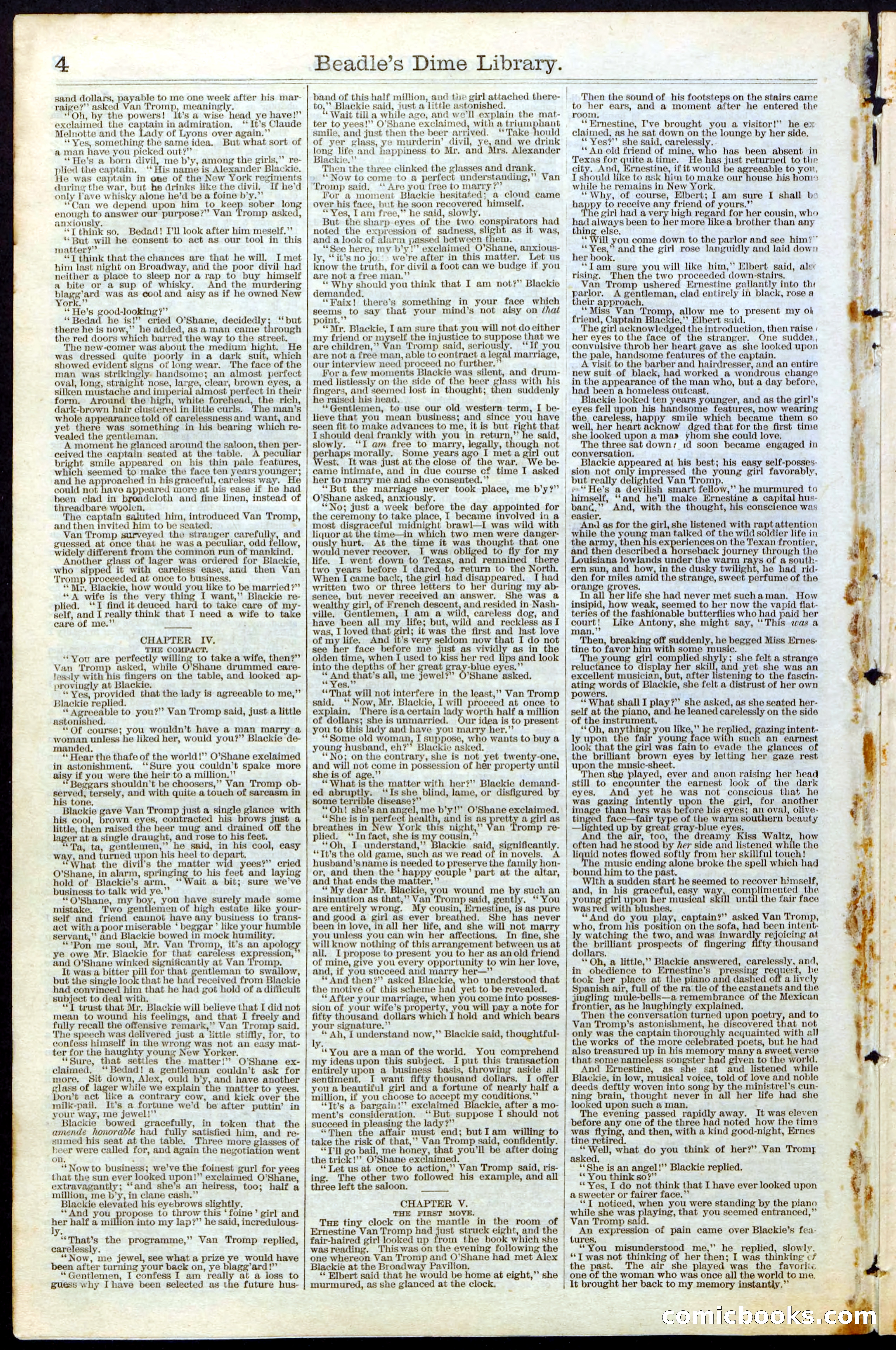
A restored page from Pulp Fiction, 1878. Page through the whole issue in the reader above.
📄 Transcribed text from this page (OCR, searchable)
Machine-transcribed from the original scan — historical spelling and the odd misread are preserved.
4: sand dollars, payable to me one week after his mar- raige?’’ asked Van Tromp, meaningly. ‘Oh, by the powers! It’s a wise head ye have!” exclaimed the captain in admiration. ‘It’s Claude Melnotte and the Lady of Lyons over again.”’ “Yes, something the same idea. But what sort of a man have you picked out?” ‘‘He’s a born divil, me b’y, among the girls,”’ re- ied the captain. ‘‘ His name is Alexander Blackie. He was captain in one of the New York regiments If he'd during the war, but he drinks like the divil. only lave whisky alone he’d be a foine b’y.”’ ‘Can we depend upon him to keep sober long enough to answer our purpose?” Van Tromp asked, anxiously. “Tl think so. Bedad! I'll look after him meself,”’ *“ But will he consent to act as our tool in this matter?” “7 think that the chances are that he will. I met him last night on Broadway, and the poor divil had neither a place to sleep nor a rap to buy himself a bite or a sup of whisky. And the murdering blagg’ard was as cool and aisy as if he owned New form.” “ He’s good-looking?” ‘‘Bedad he is!” cried O’Shane, decidedly; ‘but there he is now,”’ he added, as a man came through the red doors which barred the way to the street. The new-comer was about the medium hight. He was dressed quite poorly in a dark suit, which showed evident signs of long wear. The face of the man was strikingly: handsome; an almost perfect oval, long, straight nose, large, clear, brown eyes, a silken mustache and imperial almost perfect in their form. Around the high, white forehead, the rich, dark-brown hair clustered in little curls. The man’s whole appearance told of carelessness and want, and yet there was something in his bearing which re- vealed the gentleman. A moment he glanced around the saloon, then per- ceived the captain seated at the table. A peculiar bright smile appeared on his thin pale features, which seemed to make the face ten years younger; and he approached in his graceful, careless way. He could not have appeared more at bis ease if he had been clad in broadcloth and fine linen, instead of threadbare woolen. The captain saluted him, introduced Van Tromp, and then invited him to be seated. Van Tromp surveyed the stranger carefully, and guessed at once that he was a peculiar, odd fellow, widely different from the common run of mankind. Another glass of lager was ordered for Blackie, who sipped it with careless ease, and then Van Tromp proceeded at once to business, “Mr, Blackie, how would you like to be married?” “A wife is the very thing I want,’’ Blackie re- plied. “I find it deuced hard to take care of my- self, and I really think that I need a wife to take care of me.” CHAPTER IV. THE COMPACT. ‘““You are perfectly willing to take a wife, then?” Van Tromp asked, while O’Shane drummed care- lessly with his fingers on the table, and looked ap- provingly at Blackie. “Yes, provided that the lady is agreeable to me,” Blackie replied. “ Agreeable to you?’ Van Tromp said, just a little astonished. “Of course; you wouldn't have a man marry a woman unless he liked her, would you?” Blackie de- manded. ** Hear the thafe of the world!’ O’Shane exclaimed in astonishment. ‘Sure you couldn’t spake more aisy if you were the heir to a million.” “Beggars shouldn't be choosers,” Van Tromp ob- He ah tersely, and with quite a touch of sarcasm in tone, Blackie gave Van Tromp just a single glance with his cool, brown eyes, contracted his brows just a little, then raised the beer mug and drained off the lager at a single draught, and rose to his feet. ‘Ta, ta, gentlemen,” he said, in his cool, easy way, and turned upon his heel to depart, ) “What the divil’s the matter wid yees?’’ cried O’Shane, in alarm, springing to his feet and laying hold of Blackie’s arm. ‘‘ Wait a bit; sure we've business to talk wid ye.” **O’Shane, my boy, you have surely made some mistake. Two gentlemen of high estate like your- self and friend cannot have any business to trans- act with a poor miserable * beggar ’ like your humble servant,” and Blackie bowed in mock humility. “*Pon me soul, Mr. Van Tromp, it’s an apology ye owe Mr. Blackie for that careless expression,” and O’Shane winked significantly at Van Tromp. It was a bitter pill for that gentleman to swallow, but the single look that he had received from Blackie had convinced him that he had got hold of a difficult subject to deal with. ‘“*T trust that Mr. Blackie will believe that I did not mean to wound his feelings, and that I freely and fully recall the offensive remark,’ Van Tromp said. The speech was delivered just a tittle stiffly, for, to confess himself in the wrong was not an easy mat- ter for the haughty young New Yorker. “Sure, that settles the matter!’ O’Shane ex- claimed, ‘“Bedad! a gentleman couldn't ask for more, Sit down, Alex, ould b’y, and have another glass of lager while we explain the matter to yees. Don’t act like a contrary cow, and kick over the milk-pail. It’s a fortune we'd be after puttin’ in your way, me jewel!” Blackie bowed gracefully, in token that the amende honorable had fully satisfied him, and re- sumed his seat at the table. Three more glasses of heer were called for, and again the negotiation went on, : ‘Now to business; we've the foinest gurl for yees that the sun ever looked upon!” exclaimed O’Shane, extravagantly; ‘“‘and she’s an heiress, too; half a million, me b’y, in clane cash.” Blackie elevated his eyebrows slightly. “And you ee to throw this ‘ foine’ girl and ue half a million into my lap?” he said, incredulous- ys “That's the programme,’’ Van Tromp replied, carelessly. *““Now, me jewel, see what a prize ye would have been after turning your back on, ye blagg’ard!”’ “Gentlemen, I confess I am en at a loss to guess why I have been selected as the future bhus- Beadle’s Dime Library. band of this half million, and the girl attached there- to,” Blackie said, just a little astonished. ‘Wait till a while aco, and we'll explain the mat- ter to yees!” O’Shane exclaimed, with a triumphant smile, and just then the beer arrived. “Take hould of yer glass, ye murderin’ divil, ye, and we drink ee te and happiness to Mr. and Mrs, Alexander ackie.”’ Then the three clinked the glasses and drank. ‘*Now to come to a perfect understanding,”’ Van Tromp said. ‘* Are you free to marry?” For a moment Blackie hesitated; a cloud came over his face, but he soon recovered himself. “Yes, Iam free,” he said, slowly. } But the sharp eyes of the two conspirators had noted the expression of sadness, slight as it was, and a look of alarm passed between them. “See here, my b’y!"’ exclaimed O’Shane, anxious- ly, “it’s no jo... we’re after in this matter. Let us know the truth, for divil a foot can we budge if you are not a free man.” ; “Why should you think that I am not?” Blackie demanded. “Paix! there’s something in your face which seems to say that your mind’s not aisy on ‘hal oint.’ * ‘““Mr. Blackie, Iam sure that you will not do either my friend or myself the injustice to pap pone that we are children,’ Van Tromp said, seriously. “If you are not a free man, able to contract a legal marriage, our interview need proceed no further.’ For a few moments Blackie was silent, and drum- med listlessly on the side of the beer glass with his fingers, and seemed lost in thought; then suddenly he raised his head. **Gentlemen, to use our old western term, I be- lieve that you mean business; and since you have seen fit to make advances to me, itis but right that I should deal frankly with you in return,” he said, slowly. ‘I am free to marry, legally, though not peers morally. Some years ago I met a girl out Vest. It was just at the close of the war. We be- came intimate, and in due course cf time I asked her to marry me and she consented.”’ “But the marriage never took place, me b’y?” O’Shane asked, anxiously. “No; just a week before the day appointed for the ceremony to take Pee I became involved in a most disgraceful midnight brawl—I was wild with liquor at the time—in which two men were danger- ously hurt. At the time it was thought that one would never recover. I was obliged to fly for my life. I went down to Texas, and remained there two years before I dared to return to the North. When I came back, the girl had disappeared. I had written two or three letters to her during my ab- sence, but never received an answer. She was a wealthy girl, of French descent, and resided in Nash- ville. Gentlemen, Ll am a wild, careless dog, and have been all my life; but, wild and reckless as I was, I loved that girl; it was the first and last love of my life. And it’s very seldom now that I do not see her face before me just as vividly as in the olden time, when I used to kiss her red lips and look into the depths of her great gray-blue eyes.”’ Ss pe dap all, me jewel?” O’Shane asked. O68.” “That will not interfere in the least,’ Van Tromp said. ‘‘ Now, Mr. Blackie, I will proceed at once to explain. There isa certain lady worth half a million of dollars; she is unmarried. Our idea is to present you to this lady and have you marry her.” ** Some old woman, I suppose, who wants to buy a young husband, eh?’ Blackie asked. ‘**No; on the contrary, she is not yet twenty-one, and will not come in possession of her property until she is of age.” * What is the matter with her?” Blackie demand- ed abruptly. ‘Is she blind, lame, or disfigured by some terrible disease?” “Oh! she’s an angel, me b’y!"" O’Shane exclaimed. “She is in perfect health, and is as pretty a girl as breathes in New York this night,’’ Van Tromp re- plied. ‘In fact, she is my cousin,” ‘Oh, I understand,’ Blackie said, significantly. “Tt’s the old game, such as we read of in novels. A husband’s name is needed to preserve the family hon- or, and then the ‘happy couple’ part at the altar, and that ends the matter.” “* My dear Mr. Blackie, you wound me by such an insinuation as that,’ Van Tromp said, gently, ‘ You are entirely wrong. My cousin, Ernestine, is as pure and good a girl as ever breathed. She has never been in love, in all her life, and she will not marry you unless you can win her affections. In fine, she will know nothing of this arrangement between us at all. I propose to present you to her as anold friend of mine, give you every opportunity to win her love, and, if you succeed and marry her—”’ ** And then?’ asked Blackie, who understood that the motive of this scheme had yet to be revealed. “After your marriage, when you come into posses- sion of your wife’s property, you will pay a note for fifty thousand dollars which I hold and which bears your signature.” * Ah, [ understand now,”’ Blackie said, thoughtful- veyou are aman of the world. You comprehend my ideas upon this subject. I put this transaction entirely upon a business basis, throwing aside all sentiment. I want fifty thousand dollars. I offer you a beautiful girl and a fortune of nearly half a million, if you choose to accept my conditions.” ‘“*Tt’s a bargain!’ exclaimed Blackie, after a mo- ment’s consideration. ‘But suppose I should not succeed in pleasing the lady?” “Then the affair must end; butIam willing to take the risk of that,’’ Van Tromp said, confidently. “T’ll go bail, me honey, that you'll be after doing the trick!’’ O’Shane exclaimed. : * Let us at once to action,” Van Tromp said, ris- ing. The other two followed his example, and all three left the saloon. CHAPTER V. THE FIRST MOVE. — Tre tiny clock on the mantle in the room of Ernestine Van Tromp had just struck eight, and the fair-haired girl looked up from the book which she Then the sound of his footsteps on the stairs came to her ears, and a moment after he entered the room, ‘**Ernestine, I've brought you a visitor!’ he ex claimed, as he sat down on the lounge by her side. ‘** Yes?’ she said, carelessly. **An old friend of mine, who has been absent in Texas for quite atime. He has just returned to the city. And, Ernestine, if it would be agreeable to yon, I should like to ask him to make our house his hom while he remains in New York. “Why, of course, Elbert; I am sure I shall bo happy to receive any friend of yours.” he girl had a very high regard for her cousin, who had always been to her more like a brother than any thing else. ** Will you come down to the parlor and see him?” “Yes,” and the girl rose languidly and laid down her book. “Tam sure you will like him,’’ Elbert said, ale rising. Then the two proceeded down-stairs, Van Tromp ushered Ernestine gallantly into the parlor. A gentleman, clad entirely in black, rose a their approach. “Miss Van Tromp, allow me to present my ol friend, Captain Blackie,” Elbert said. The girl acknowledged the introduction, then raise : her eyes to the face of the stranger. One sudden, convulsive throb her heart gave as she looked upon the pale, handsome features of the captain. A visit to the barber and hairdresser, and an entire new suit of black, had worked a wondrous change in the appearance of the man who, but a day before, had been a homeless outcast, Blackie looked ten years younger, and as the girl's eyes fell upon his handsome features, now wearing the. careless, happy smile which became them so well, her heart acknow dged that for the first time she looked upon a mas yhom she could love. The three sat down; id soon became engaged in conversation. Blackie appeared at his best; his easy self-posses- sion not only impressed the young girl favorably, but really delighted Van Tromp. «© He’s a devilish smart fellow,”’ he murmured to Ne eee —— 2 eee —————— ——ae ' was reading. This was on the evening following the | one whereon Van Tromp and O’Shane had met Alex | Blackie at the Broadway Pavilion. ‘* Elbert said that he would be home at eight,” she murmured, as she glanced at the clock, j i himself, ‘‘and he'll make Ernestine a capital hus- banc.” And, with the thought, his conscience was easier. And as for the girl, she listened with rapt attention while the young man talked of the wild soldier life in the army, then his experiences on the Texan frontier, and then described a horseback journey through the Lo na lowlands under the warm rays of a south- ern sun, and how, in the dusky twilight, he had _ rid- den for miles amid the strange, sweet perfume of the orange groves. In all her life she had never met suchaman. How insipid, how weak, seemed to her now the vapid flat- teries of the fashionable butterflies who had paid her court! Like Antony, she might say, “This was a man.”’ Then, breaking off suddenly, he begged Miss Ernes- ee to favor me with mie le pa een e young girl complied shyly; she felt a strange reluctance to display her skill, and yet she aa excellent musician, but, after listening to the fascin- ating words of Blackie, she felt a distrust of her own powers. ‘* What shall I play?’ she asked, as she seated her- self at the piano, and he leaned carelessly on the side of the instrument. ; Oh, ane you like,” he replied, gazing intent- ly upon the fair young face with such an earnest look that the girl was fain to evade the glances of the brilliant brown eyes by letting her gaze rest upon the music-sheet. Then she played, ever and anon raising her head still to encounter the earnest look of the dark eyes. And yet he was not conscicus that he was gazing intently upon the girl, for another image than hers was before his eyes; an oval, olive- ee face—fair wpe of the warm southern beauty ghted up by great gray-blue eyes. And the air, too, the dreamy Kiss Waltz, how often had he stood by her side and listened while the liquid notes flowed softly from her skillful touch! he music ending alone broke the spell which had bound him to the past. Wlth a sudden start he seemed to recover himself, and, in his graceful, easy way, complimented the young girl upon her musical skill until the fair face was with blushes. “And do you lay. captain?’ asked Van Tromp, who, from his position on the sofa, had been intent- ly watching the two, and was inwardly rejoicing at the brilliant prospects of fingering fifty thousand oHars. “Oh, a little,” Blackie answered, carelessly, and, in obedience to Ernestine’s pressing request, he took her place at the piano and dashed off a lively Spanish air, full of the ra tle of the castanets and the jingling mule-bells—a remembrance of the Mexican frontier, as he laughingly explained. Then the conversation turned upon poetry, and to Van Tromp’s astonishment, he discovered that not only was the captain thoroughly acquainted with all the works of the more celebrated poets, but he had also treasured up in his memory many a sweet verse that some nameless songster had given to the world. And Ernestine, as she sat and listened while Blackie, in low, musical voice, told of love and noble deeds deftly woven into song by the ministrel’s cun- ing brain, thought never in all her life had she looked upon such a man, The evening passed rapidly away. It was eleven before any one of the three had noted how the time was flying, and then, with a kind good-night, Ernes tine retired. fF eee what do you think of her?’ Van Tromy asked. ‘She is an angel!"’ Blackie replied. ** You think so?” ** Yes, I do not think that I have ever looked upon a sweeter or fairer face.” ‘*T noticed, when you were standing by the piano while she was playing, that you seemed entranced,” Van Tromp said. 4 An expression of pain came over Blackie’s fea- ures. “You misunderstood me,’’ he replied, slowly. ‘‘T was not thinking of her then; I was thi ge cf the past. The air she played was the favoriic one of the woman who was once all the world to me. It brought her back to my memory instantly.’ Gomichboo (C 7 - a See ee wt >= eis ~~ eee a