
Pulp Fiction, 1878 · page 3 of 28
Beadle's Dime Library No. 27 — page 3: what you’re looking at
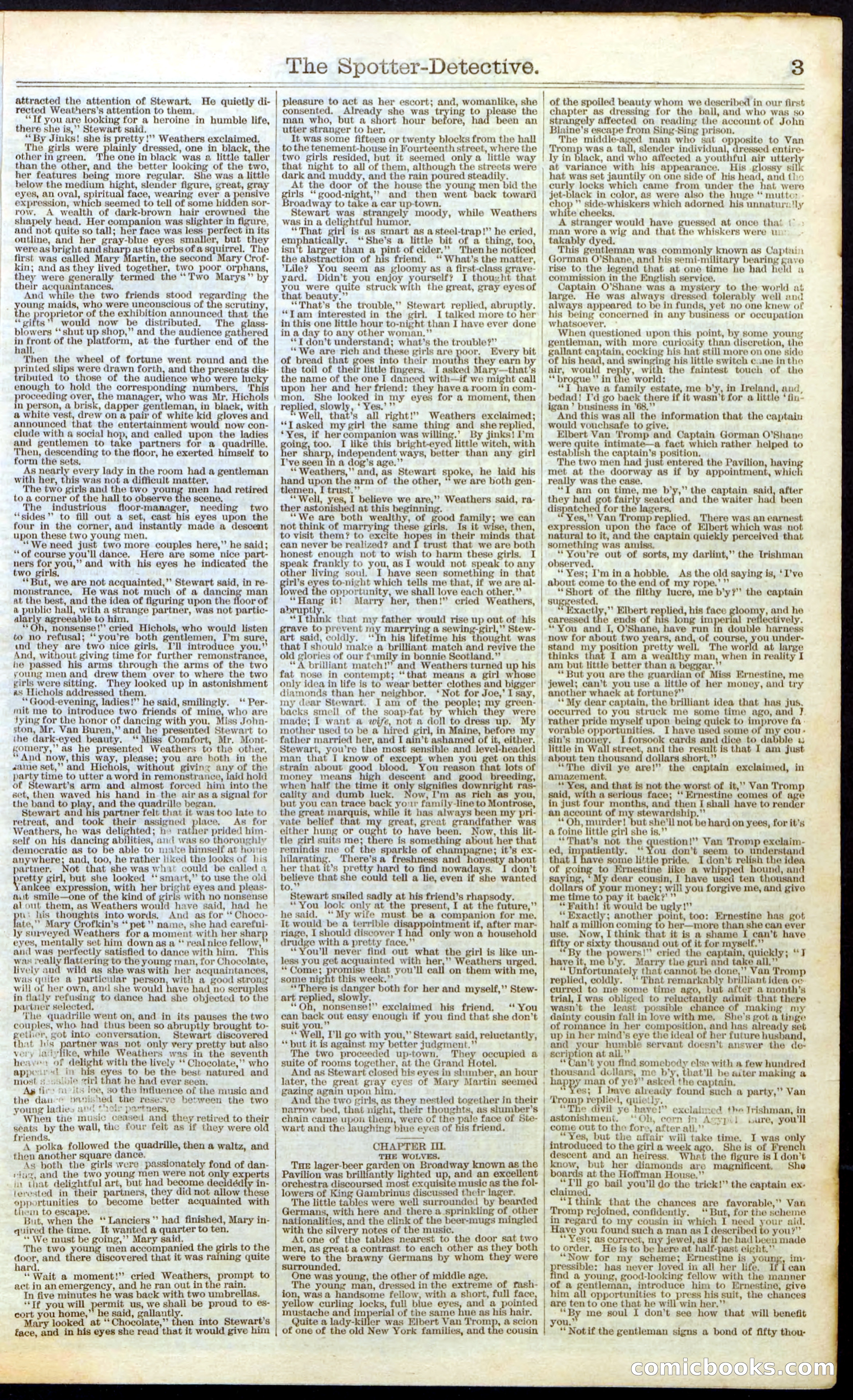
A restored page from Pulp Fiction, 1878. Page through the whole issue in the reader above.
📄 Transcribed text from this page (OCR, searchable)
Machine-transcribed from the original scan — historical spelling and the odd misread are preserved.
attracted the attention of Stewart. He quietly di- rected Weathers’s attention to them. “Tf you are looking for a heroine in humble life, there she is,’ Stewart said. “By Jinks! she is pretty !"’ Weathers exclaimed. The girls were plainly dressed, one in black, the other in green. than the other, and the better looking of the two, her features being more regular. She was a little below the medium hight, slender figure, great, gray eyes, an oval, spiritual face, wearing ever a pensive expression, whicb seemed to tell of some hidden sor- row. A wealth of dark-brown hair crowned the shapely head. Her companion was slighter in figure, and not quite so tall; her face was less perfect in its outline, and her gray-blue eyes smaller, but they were as bright and sharp as the orbs of a squirrel. The first was called Mary: Muetia. the second Mary Crof- ~ —— The one in black was a little taller | kin; and as they lived together, two poor orphans, | they were generally termed the “Two Marys” by their acquaintances. And while the two friends stood regarding the young maids, who were unconscious of the scrutiny, he roprietor of the exhibition announced that the “rifts’’ would now be distributed. The glass- blowers “‘shut up shop,” and the audience gathered Eyosis of the platform, at the further end of the iall. Then the wheel of fortune went round and the printed slips were drawn forth, and the presents dis- tributed to those of the audience who were lucky enough to hold the corresponding numbers, Th proceeding over, the manager, who was Mr. Hichols in person, a brisk, dapper gentleman, in black, with a white vest, drew on a pair of white kid gloves and announced that the entertainment would now con- clude with a social hop, and called upon the ladies and gentlemen to take partners for a quadrille. Then, descending to the floor, he exerted himself to form the sets. As nearly every lady in the room had a gentleman with her, this was not a difficult matter, The two girls and the two young men had retired to a corner of the hall to observe the scene, The industrious floor-manager, needing two ‘**sides”’ to fill out a set, cast his eyes upon the four in the corner, and instantly made a descent upon these two young men. ‘We need just two more couples here,’ he said; “of course you'll dance. Here are some nice part- ners for you,” and with his eyes he indicated the two girls, **But, we are not acquainted,’’ Stewart said, in re- monstrance, He was not much of a dancing man at the best, and the idea of figuring upon the floor of a public hall, with a strange partner, was not partic- alarly agreeable to him, **Oh, nonsense!" cried Hichols, who would listen to no refusal; ‘‘you’re both gentlemen, I’m sure, und they are two nice girls. Ill introduce you.’ And, without giving time for further remonstrance, he passed his arms through the arms of the two young men and drew them over to where the two girls were sitting. They looked up in astonishment | as Hichols addressed them. ‘““Good-evening, ladies!’ he said, smilingly. ‘ Per- mit me to introduce two friends of mine, who are lying for the honor of dancing with you. Miss John- ston, Mr. Van Buren,” and he presented Stewart to the dark-eyed beauty. ‘“ Miss Comfort, Mr. Mont- xomery,’’ as he presented Weathers to the other, “And now, this way, please; you are hoth in the same set,’’ and Hichols, without giving any of the party time to utter a word in remonstrance, laid hold of Stewart's arm and almost forced him into the set, then waved his hand in the air as a signal for the band to play, and the quadrille began. Stewart and his partner felt that it was too late to retreat, and took their assigned place. As for Weathers, he was delighted; he rather prided him- self on his dancing abilities, ant was so thoroughiv democratic as to be able to mate himself at home anywhere; and, too, he rather liked the looks of his partner. Not that she was what could be called a pretsy girl, but she looked ‘ smart,” to use the old ‘ankee expression, with her bright i and pleas- ait smile—one of the kind of girls with no nonsense al out them, as Weathers would have said, had he 1) his thoughts into words. And as for * Choco- ate,’’ Mary Crofkin’s “ pet *’ name, she had careful- ly surveyed Weathers for a moment with her sharp eyes, mentally set him down as a “ real nice fellow,” and was perfectly satisfied to dance with him. was really flattering to the young man, for Chocolate, lively and wild as she was with her acquaintances, yard. was quite a particular person, with a good strong | will of her own, and she would have had no seruples in flatly refusing to dance had she objected to the partner selected, The quadrille went on, and in its pauses the two couples, who had thus been so abruptly brought to- gether, got into conversation. Stewart discovered that his porto’ was not only very pretty but also vory iadylike, while Weathers was in the seventh heaves of delight with the lively ‘* Chocolate,’’ who appeirst in his eyes to be the best natured and most s-o5lole virl that he had ever seen. Ag fic’ ni-its lee, so the influence of the music and the dau Drnisied the reserve bepween the two young ladies am! thcir partners, When tie music ceased and they retired to their seats by the wall, the four felt as if they were old friends. A polka followed the quadrille, then a waltz, and then another square dance, As both the girls were passionately fond of dan- iug, and the two young men were not only experts i: that delightful art, but had become decidédly in- lerested in their partners, they did not allow these Sppoctuniyes to some better acquainted with tiem to escape. But, when the ** Lanciers ” had finished, Mary in- qitired the time. It wanted a quarter to ten. * We must be going,’’ Mary said. The two young men accompanied the girls to the door, and there vered that it was Z quite hard. “Wait a moment!” cried Lager icon prompt to act in anemergency, and he ran out in the rain. In five minutes he was back with two umbrellas, it you will ee ne - be proud to es- rt you ho e said, autly. Mar looked’ at Chocolate,” then into Stewart's face, and in his eyes she read that it would give him The Spotter-Detective. pleasure to act as her escort; and, womanlike, she consented. gags! she was trying or the man who, but a short hour before, | been an utter stranger to her. It was some fifteen or twenty blocks from the hall to the tenement-house in Fourteenth street, where the two girls resided, but it seemed only a little way that night to all of them, although the streets were dark and muddy, and the rain poured steadily. At the door of the house the young men bid the zirls “‘ good-night,’’ and then went back toward Prpanthe: to take a car up-town. Stewart was strangely moody, while Weathers was in a delightful humor, “That girl is as smart as asteel-trap!”’ he cried, emphatically. “She's a little bit of a thing, too isn’t larger than a pint of cider.” the abstraction of his friend. “ What's the matter, *Lile? You seem as gloomy as a first-class grave- Didn't you enjoy yourself? I thought that you were quite struck with the great, gray eyes of that beauty.” ‘That's the trouble,’ Stewart replied, abruptly. “Tam interested in the girl. I talked more to her in this one little hour to-night than I have ever done in a day to any other woman.” **T don’t understand; what’s the trouble?” ‘We are rich and these girls are poor. Every bit of bread that goes into their moutlis they the toil of their little fingers. I asked Mary—that’s the name of the one I danced with—if we might call upon her and her friend: they have a room in com- mon. She looked in my eyes for a moment, then replied slowly, * Yes.’ ”’ ‘Well, that’s all right!” Weathers exclaimed; “T asked my girl the same thing and she replied, ‘Yes, if her companion was oveie By jinks! 'm oing, too. I like this bright-eyed little witch, with 1er sharp, independent ways, better than any girl I've seen in a dog’s age.”’ ‘* Weathers,’ and, as Stewart spoke, he laid his hand upon the arm of the other, * we are both gen- tlemen, I trust.” “Well, yes, I believe we are,’’ Weathers said, ra- ther astonished at this beginning. ‘““We are both wealthy, of good family; we can not think of marrying these girls. Is it wise, then, to visit them? to excite ho can never be realized? and I trust that we are both honest enough not to wish to harm these girls. I speak frankly to you, asI would not speak to any other living soul. I have seen something in that _ eyes to-night which tells me that, if we are al- owed the opportunity, we shall love each other,” “Hang it! Marry her, then!" cried Weathers, magia os “IT think that my father would rise up out of his grave to prevent my marrying a sewing-girl,’’ Stew- art said, coldly. ‘In his lifetime his thought was that I should make a brilliant match and revive the old glories of our family in bonnie Scotland.” “A brilliant match!’ and Weathers turned Sawa fat nose in contempt; “that means a girl whose only idea in life is to wear better clothes and bigger diamonds than her neighbor, ‘ Not for Joe,’ I say, my dear Stewart. I am of the people; my green- backs smell of the soap-fat by which they were made; I want a wife, not a doll to dress up. My mother used to be a hired girl, in Maine, before my father married her, and I ain’t ashamed of it, either. Stewart, you're the most sensible and level-headed man that I know of except when you get on this strain about good blood. You reason that lots of money means high descent and good breeding, when half the time it only signifies downright ras- cality and dumb luck. ow, I'm as rich as you, but you can trace back your family-line to Montrose, the great marquis, while it has always been my pri- vate belief that my great, great grandfather was either hung or ought to have been. Now, this lit- tle girl suits me; there is something about her that reminds me of the sparkle of ¢ pagne; it’s ex- hilarating. ‘There’s a freshness and honesty about her that it’s pretty hard to find nowadays. I don’t believe that she could tell a lie, even if she wanted to.’ Stewart smiled sadly at his friend’s Jaye sere “You look only at the present, I at the future,” he said. “My wife must a companion for me. It would be a terrible disappointment if, after mar- riage, I should discover Thad only won a household drudge with a pretty face.” “You'll never find out what the girl is like un- less you get acquainted with her,” Weathers urged. “Come; promise that you'll call on them with me, some night this week.”’ “There is anger both for her and myself,’’ Stew- art replied, slowly. “Oh, nonsense!"’ exclaimed his friend, ‘* You can back out easy enough if you find that she don’t suit you.” ** Well, I'll go with you,” Stewart said ‘but it is against my better judgment.’ The two proceeded up-town, They occupied a suite of rooms together, at the Grand Hotel. And as Stewart closed his eyes in slumber, an hour later, the great gray eyes of Mary Martin seemed gazing again upon him. And the two girls, as they nestled together in their narrow bed, that night, their thoughts, as slumber’s chain came upon them, were of the pale face of Ste- : reluctantly, _ wart and the laughing bine eyes of his friend, CHAPTER OL THE WOLVES. Tue lager-beer garden on Broadway known as the Pavilion was brillantly lighted up, and an excellent orchestra discoursed most exquisite music as the fol- lowers of King Gambrinus discussed their lager. The little tables were well surrounded by bearded ermans, with here and there a sprinkling of other nationalities, and the clink of the beer-mugs with the silvery notes of the music. At one of the tables nearest to the door sat two men, as great a contrast to each other as they both were to the brawny Germans by whom they were surrounded. One was young, the other of middle age. The young man, dressed in the extreme of fash- ion, was a handsome fellow, with a short, full face yellow curling locks, full blue eyes, and a pointed mustache and imperial of the same hue as his hair. tea -killer was Elbert Van Tromp, a scion of one of the old New York families, and the cousin Then he noticed | earn by in their minds that | 3 —— ed of the spoiled beauty whom we described in our first chapter as dressing for the ball, and who was so strangely affected on reading the account of John Bliaine's escape from Sing-Sing prison. The middle-aged man who sat opposite to Van Tromp was a tall, slender individual, dressed entire- ly in black, and who affected a youthful air utter! at variance with his appearance. His glossy sill hat was set jauntily on one side of his head, and tho curly locks which came from under the hat were jet-black in color, as were also the huge * muttor chop " side-whiskers which adorned his unnaturs'ly white cheeks, A stranger would have guessed at once that man wore a wig and that the whiskers were wi takably dyed. This gentleman was commonly known as Captain Gorman O’Shane, and his semi-military bearing gave rise to the legend that at one time he had held a commission in the English service. Captain O’Shane was a vnion ph to the world at large. He was always dressed tolerably well and always appeared to be in funds, yet no one knew of his being concerned in any business or occupation whatsoever, When questioned upon this point, by some young gentleman, with more curiosity than discretion, the gallant captain, cocking his hat still more on one side of his head, and swinging his little switch c..ne in the air, would reply, with the faintest touch of the **brogue in the world: “T have a family estate, me b’y, in Ireland, and, bedad! I'd go back there if it wasn’t for a little * fin- igan ’ business in ’68,”’ And this was all the information that the captain would vouchsafe to give. Elbert Van Tromp and Captain Gorman O'Shane were quite intimate—a fact which rather helped to establish the captain's position, The two men had just entered the Pavilion, havi met at the doorway as if by appointment, which really was the case. “T am on time, me b’y,” the captain said, after they had got fairly seated and the waiter had been dispatch for the lagers, “ Yes," Van Tromp replied. There was an earnest Ne hm upon the face of Elbert which was not natural to it, and the captain quickly perceived that / something was amiss. <A ee ee — “You're out of sorts, my darlint,’’ the Trishman observed, ‘Yes; mina hobble. As the old saying is, ‘I’ve about come to the end of my rope.’ ”’ “Short of the filthy lucre, me b’y?’’ the captain suggested, Exactly,’ Elbert replied, his face gloomy, and he caressed the ends of his long ny reflectively. “You and I, O’Shane, have run double harness now for about two years, and, of course, you under- stand my a ga pretty well. The world at large thinks that I am a wealthy man, when in reality I am but little better than a beggar.” “But you are the guardian of Miss Ernestine, me jewel; can’t you use a little of her money, and try another whack at fortune?” ‘*My dear captain, the brilliant idea that has jus. occu to you struck me some time ago, and J rather pride myself upon being quick to improve fa. vorable opportunities. I have used some of my cou - sin’s money. I forsook cards and dice to dabble u little in Wall street, and the result is that I am just about ten thousand dollars short.” “The divil ye are!” the captain exclaimed, in amazement. * Yes, and that is not the worst of it,’’ Van Tromp said, with a serious face; ‘‘ Ernestine comes of age in just four months, and then I shall have to render an account of my stewardship.” “Oh, murder! but she'll not be hard on yees, for it’s a foine little girl she is.” “That’s not the question!” Van Tromp exclaim- ed, im “You don't seem to understand that I little pride, Idon’t relish the idea of going to Ernestine like a whipped hound, and saying, ‘My dear cousin, I have used ten thousand dollars of your money; will you forgive me, and give me time to pay it back? ¥ “Faith! it would be “ Exactly; another ve some ly!” paint too: Ernestine has got half a on coming to her—more than she can ever use. Now, I think t it is a shame I can't have fifty or sixty thousand out of it for if.” “By the powers!" cried the cap quickly; “J have it, me b’y. M the guri and take all.” = nfortunately that cannot be done,”’ Van Tromp replied, coldly. ‘ That remarkably brilliant idea oc: curred to me some time ago, bus after a month's trial, Iwas obliged to reluctantly admit that there wasn't the least possible chance of making my dainty cousin fall in love with me, She's got a tinge of romance in her composition, and has already set up in her mind's eye the ideal of her future husband, and your humble servant doesn’t answer the de- scription at all.” **Can’t you find somebody else with a few hundred thousand dollars, me b’y, that'll be aiter making a happy man of ye?” asked the captain, . ; I lve already found such a party,” Van Tromp replied, quietly. “The divil ye have!” exclaimed the Trishman, in astonishment. “Oh, corn in Acyp.l wure, you'll come out to the fore, after all.” “Yes, but the affair will take time. I was or introduced to the girl a week ago. She is of Fren descent and an heiress. What the fi is I don’t know, but her diamonds are magnificent, She ards at the Hoffman House,” I'll go bail you'll do the trick!” the captain ex- “I think that the chances are favorable,” Van Tromp rejoined, confidently. “ But, for the scheme in regard to mo! cousin in which I need your aid. Have you found such a man as I described to you?” “Yes; as correct ~ jewel, as if he had been m to order. He is to be here at half-past eight.” “Now for my scheme; E eis young, im- preamnle: has never loved in all her life. it can nd a young, good-looking fellow with the manner of a gentleman, introduce him to Ernestine, give him all opportunities to press his suit, the chances are ten to one that he will win her.” “By me soul I don’t see how that will benefit u % you. * Notif the gentleman signs a bond of fifty thou- IOOKS — = _ im (EO) (¢ (E() a