
Pulp Fiction, 1878 · page 5 of 28
Beadle's Dime Library No. 27 — page 5: what you’re looking at
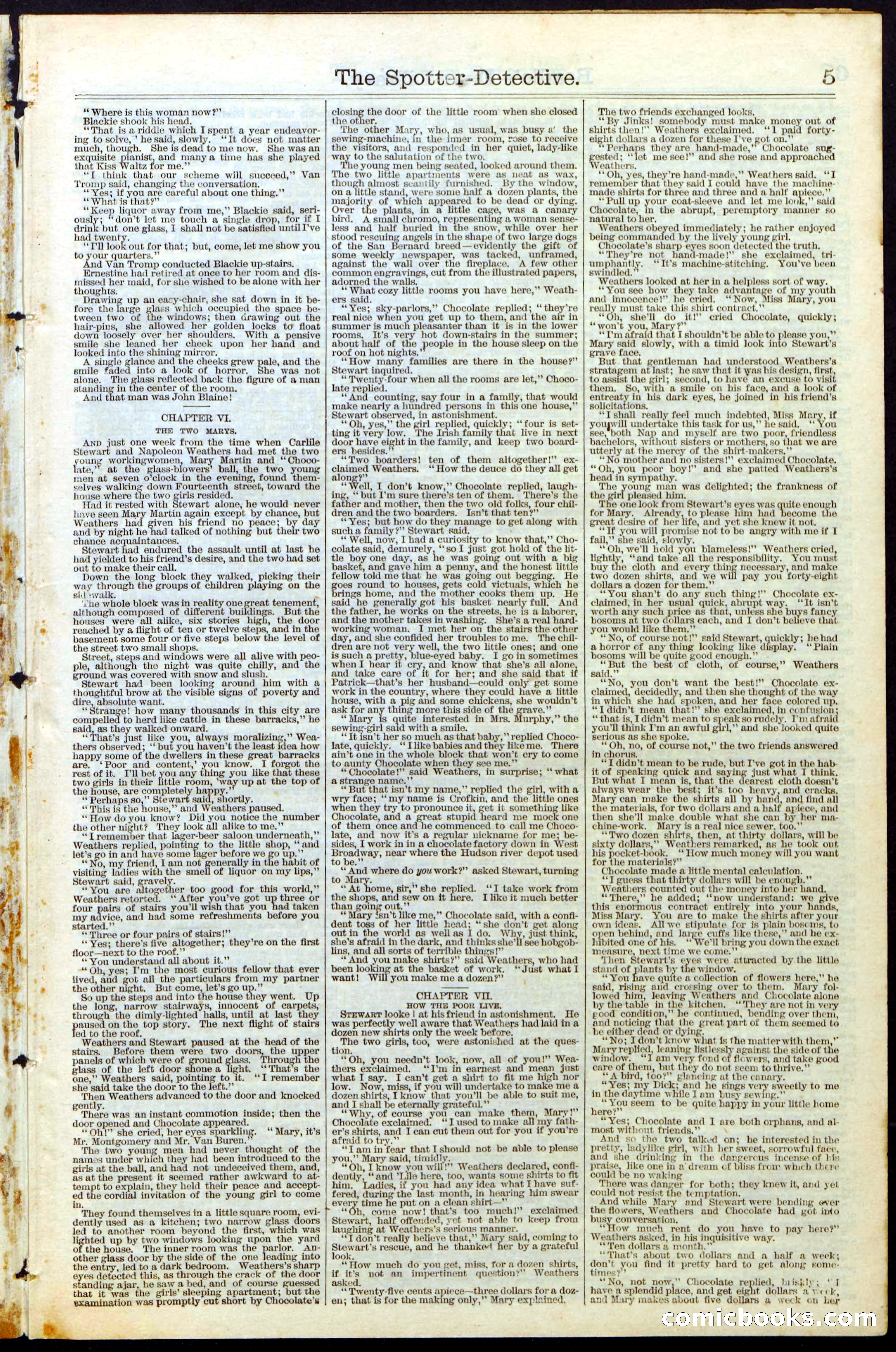
A restored page from Pulp Fiction, 1878. Page through the whole issue in the reader above.
📄 Transcribed text from this page (OCR, searchable)
Machine-transcribed from the original scan — historical spelling and the odd misread are preserved.
ot ~ ~~ = OC -- - SO - — = - ——— “Where is this woman now?” Blackie shook his head. “That is a riddle which Ispent a year endeavor- ing to solve,’ he said, slowly. “It does not matter much, though. She is dead to me now. She was an exquisite pianist, and manya time has she played that Kiss Waltz for me.” “[ think that our scheme will succeed,” Van Tromp said, changing the conversation. ‘Yes; if you are careful about one thing.” “What is that?” “Keep liquor away from me,” Blackie said, seri- oan: ‘don’t let me touch a single drop, for if I drink but one glass, I shall not be satisfied until I’ve had twenty. “ru look out for that; but, come, let me show you to your quarters.” nd Van Tromp conducted Blackie up-stairs. Ernestine had retired at once to her room and dis- missed her maid, for she wished to be alone with her thoughts. Drawing up an eacy-chair, she sat down in it be- fore the large glass which occupied the space be- tween two of the windows; then drawing out the hair-pins, she allowed her golden locks to float down loosely over her shoulders. With a pensive smile she leaned her cheek upon her hand and looked into the shining mirror. A single glance and the cheeks grew pale, and the smile faded into a look of horror, She was not alone. The glass reflected back the figure of a man standing in the center of the room, And that man was John Blaine! CHAPTER VI. THE TWO MARYS. Anp just one week from the time when Carlile Stewart and Napoleon Weathers had met the two young workingwomen, Mary Martin and * Choco- late,’ at the glass-blowers’ ball, the two young men at seven o'clock in the evening, found them- celves walking down Fourteenth street, toward the house where the two girls resided. Had it rested with Stewart alone, he would never have seen Mary Martin again except by chance, but Weathers had given his friend no peace; ba day and by night he had talked of nothing but their two chance acquaintances, Stewart had endured the assault until at last he had yielded to his friend’s desire, and the two had set out to make their call. ‘ Down the long block they walked, picking their way through the groups of children playing on the sidl swalk, : ‘he whole block was in reality one great tenement, although composed of different bui ge But the houses were all alike, six stories high, the door reached by a flight of ten or twelve steps, and in the basement some four or five steps below the level of the street two small shops. Street, steps and windows were all alive with peo- ple, although the night was quite chilly, and the ground was covered with snow and slush. Stewart had been looking around him with a thoughtful brow at the visible signs of poverty and dire, absolute want. “Strange! how many thousands in this city are cdritpetion to herd like cattle in these barracks,’ he said, as they walked onward. " t’s just like you, always moralizing,’’ Wea- thers observed; ‘* but you haven't the least idea how happy some of the dwellers in these great barracks are, ‘Poor and content,’ you know. I forgot the rest of it. Ill bet you any thing you like that these two girls in their little room, ‘way up at the top of the house, are completely bas he “Perhaps so,” Stewart said, shortly. ‘This is the house,” and Weathers paused. “ How do you know? Did you notice the number the other night? They look all alike to me,” “T remember that lager-beer saloon underneath,” Weathers replied, pointing to the little shop, “ and let’s go in and have some lager before we go up.” “No, my friend, I am not peneraly in the habit of visiting ladies with the smell of liquor on my lips,” Stewart said, gravely. “You are altogether too good for this world,” Weathers retorted. ‘‘ After you’ve got up three or four pairs of stairs you'll wish that you_had taken my advice, and had some refreshments before you started.” “Three or four pairs of stairs!” ‘Yes; there's five altogether; they’re on the first floor—next to the roof.” : “You understand all about it.” , “Oh, yes; I'm the most curious fellow that ever lived, and got all the particulars from my partner the other night. But come, let’s go up.” So up the steps and into the house they went. Up the long, narrow stairways, innocent of compen through the dimly-lighted halls, until at last they aused on the top story. The next flight of stairs ed to the roof, Weathers and Stewart paused at the head of the stairs. Before them were two doors, the upper panels of which were of ground glass. Through the glass of the left door shone a light, ‘*That’s the ane,’’ Weathers said, pointing to it. ‘I remember she said take the door to the left.” Then Weathers advanced to the door and knocked gently. There was an instant commotion inside; then the door opened and Chocolate appeared. : “Oh!” she cried, her eyes § rarkling. “Mary, it’s Mr. Montgomery and Mr. Van Buren.’ The two young men had never thought of the names under which they had been introduced to the girls at the ball, and had not undeceived them, and, as at the present it seemed rather awkward to at- tempt to explain, they held their peace and accept- ed the cordial invitation of the young girl to come n, They found themselves in a little square room, evi- dently used as a kitchen; two narrow glass doors led to another room beyond the first, which was lighted up by two windows looking upon the yard of the house. The inner room was the parlor, An- other glass door by the side of the one leading into the entry, led to a dark bedroom. Weathers’s sharp eyes detected this, as through the crack of the door standing ajar, he saw a bed, and of course gu that it was the girls’ sleep apartment; but the on was promptly cut short by Chocolate’s The Spotter-Detective. closing the door of the little room when she closed the other. The other Mary, who, as usual, was busy a’ the sewing-machine, in the inner room, rose to receive the visitors, and responded in her quiet, lady-like way to the salutation of the two. ie young men being seated, looked around them. The two little apartments were as neat as wax, though almost scantily furnished. By the window, on a little stand, were some half a dozen plants, the majority of which appeared to be dead or dying. Over the plants, in a little cage, was a canary bird. A small chromo, representing a woman sense- less and half buried in the snow, while over her stood rescuing angels in the shape of two large dogs of the San Bernard breed—evidently the gift of some weekly newspaper, was tacked, unframed, against the wall over the fireplace. A few other common engravings, cut from the illustrated papers, adorned the walls. ‘* What cozy little rooms you have here,’* Weath- ers said. “Yes; sky-parlors,’’ Chocolate replied; “ they're real nice when you get up to them, and the air in summer is much pleasanter than it is in the lower rooms, It’s very hot down-stairs in the summer; about half of the people in the house sleep on the roof on hot nights.’ ‘How many families are there in the house?” Stewart inquired. “Twenty-four when all the rooms are let,’’ Choco- late replied. “And counting, say four in a family, that would make nearly a hundred persons in this one house,” Stewart observed, in astonishment. ‘Oh, yes,” the girl replied, quickly; “‘four is set- ting it very low. The Irish family that live in next door have eight in the family, and keep two board- ers besides.” “Two boarders! ten of them altogether!” ex- cee Weathers. ‘‘ How the deuce do they all get along?’ ‘Well, I don’t know,’’ Chocolate replied, laugh- ing, ‘** but I'm sure there’s ten of them. There’s the father and mother, then the two old folks, four chil- dren and the two boarders. Isn't that ten?” “Yes; but how do they manage to get along with such a family?’ Stewart said. ** Well, now, I had a curiosity to know that,’’ Cho- colate said, demurely, ‘so I just got hold of the lit- tle boy one day, as he was going out with a big basket, and gave him a penny, and the honest little fellow told me that he was going out begging. He ee round to houses, gets cold victuals, which he rings home, and the mother cooks them up. He said he generally got his basket nearly full. And the father, he works on the streets, he is a laborer, and the mother takes in washing. She’s a real hard- working woman. I met her on the stairs the other day, and she confided her troubles to me. The chil- dren are not very well, the two little ones; and one is such a pretty, blue-eyed baby. I go in sometimes when I hear it cry, and know that she’s all alone and take care of it for her; and she said that if Patrick—that’s her husband—could only get some work in the country, where they could have a little house, with a pig and some chickens, she wouldn’t ask for ay thing more this side of the grave.” ““Mary is quite interested in Mrs. Murphy,” the sewing-girl said with a smile. ‘** Tt isn’t her so much as that baby,” replied Choco- late, quickly. ‘“‘ llike babies and they likeme. There ain’t one in the whole block that won't cry to come to aunty Chocolate when they see me.” *“ Chocolate!’ said Weathers, in surprise; ‘“* what a strange name.’’ “But that isn’t my name,” replied the girl, with a face; ‘“‘my name is Crofkin, and the little ones when they try to pronounce it, get it something like Chocolate, and a great stupid heard me mock one of them once and he commenced to me Choco- late, and now it’s a regular nickname for me; be- sides, I work in in a chocolate factory down in West Broadway, near where the Hudson river depot used to ,’ e. ** And where do you work?” asked Stewart, turning to Mary. «At home, sir,’ she replied. ‘I take work from the shops, and sew on it here. I like it much better than going out.”’ ** Mary ‘sn't like me,’ Chocolate said, with a confi- dent toss of her little head; “she don’t get along out in the world as wellas I do. Why, just think, she’s afraid in the dark, and thinks she'll see hobgob- lins, and all sorts of terrible things!” “And you make shirts?’’ said Weathers, who had been looking at the basket of work. “Just what I want! Will you make me a dozen?” , CHAPTER VIL. HOW THE POOR LIVE. Stewart looke | at his friend in astonishment. He was perfectly well aware that Weathers had laid in a dozen new shirts only the week before. # The two girls, too, were astonished at the ques- on, “Oh, you needn’t look, now, all of you!’’ Wea- thers exclaimed. “I’m in earnest and mean just what I say. I can't get a shirt to fit me high nor low. Now, miss, if you will undertake to make me a a ct I waht es yoo be able to suit me, and I sha etern grateful.” “Why, of course you can make them, Mary!” Chocolate exclaimed. “I used to make all my fath- er’s shirts, and I can cut them out for you if you're afraid to try.” “Tam in fear that Ishould not be able to please you,”’ Mary said, timidly. “Oh, I know you will!’ Weathers declared, confi- dently, “and ’Lile here, too, wants some shirts to fit him. es, if you had any idea what I have suf- fered, during the last month, in hearing him swear every time he put on a clean shirt—"" , “Oh, come now! that’s too much!” exclaimed Stewart, half offended, yet not able to keep from laughing at Weathers’s serious manner. **T don’t really believe that,” egtd said, coming to Faas igh rescue, and he thanke her by a grateful ook. “How much do you get, miss, for a dozen shirts, if it’s not an impertinent question’? Weathers asked, “Twenty-five cents apiece—three dollars for a doz- en; that is for the making only,"’ Mary explained, Oi The two friends exchanged looks, “By Jinks! somebody must make money out of shirts then!’* Weathers exclaimed. ‘1 paid forty- eight dollars a dozen for these I’ve got on,” * Perhaps they are hand-made,"’ Chocolate sug- ested; ‘let me see!’ and she rose and approached Veathers. ‘* Oh, yes, they're hand-made,” Weathers said. ‘I remember that they said I could have the machine- made shirts for three and three and a half apiece.”’ ‘Pull up your coat-sleeve and let me louk,” said Chocolate, in the abrupt, peremptory manner so natural to her. Weathers obeyed immediately; he rather enjoyed being commanded by the lively young girl. Chocolate’s sharp eyes soon detected the truth, “They're not hand-made!’ she exclaimed, tri- umphantly. “It’s machine-stitching. You've been swindled.’ Weathers looked at her in a helpless sort of way. “You see how they take advantage of my youth and innocence!” he cried. “Now, Miss Mary, you really must take this shirt contract.” “Oh, she'll do it!’ cried Chocolate, quickly; “won't you, Mary ?”’ **[’'m afraid that I shouldn't be able to preare you,” Mary said slowly, with a timid look into Stewart's grave face. But that gentleman had understood Weathers’s stratagem at last; he saw that it was his design, first to assist the girl; second, to have an excuse to visit them. So, with a smile on his face, and a look of entreaty in his dark eyes, he joined in his friend's solicitations. “T shall really feel much indebted, Miss Mary, if yougwill undertake this task for us,” he said, ** You see, both Nap and myself are two poor, friendless bachelors, without sisters or mothers, so that we are utterly at the merey of the shirt-makers,”’ *“No mother and no sisters!’ exclaimed Chocolate, *Oh, you poor boy!” and she patted Weathers's head in sympathy. The young man was delighted; the frankness of the girl pleased him. The one look from Stewart's eyes was quite enough for Mary. Already, to please 1 had become the great desire of her life, and yet she knew it not, “If you will promise not to be angry with me if I fail,” she said, slowly. “Oh, we'll hold you blameless!” Weathers cried lightly, ‘““and take all the responsibility. You mus buy the cloth and every thing necessary, and make two dozen shirts, and we will pay you forty-eight dollars a dozen for them.” “You shan’t do any such thing!’ Chocolate ex- claimed, in her usual quick, abrupt way. “It isn’t worth any such price as that, unless she buys fancy bosoms at two dollars each, and I don’t believe that you would like them.”’ ** No, of course not!’’ said Stewart, quickly; he had a horror of any thing looking like display. ‘Plain bosoms will be quite good enough.” ey the best of cloth, of course,” Weathers said.” **No, you don't want the best!’ Chocolate ex- claimed, decidedly, and then she thought of the way in which she had spoken, and her face colored up. “T didn’t mean that!" she exclaimed, in confusion; “that is, I didn’t mean to speak so rudely. I'm afraid you'll think I'm an awful girl,” and she looked quite serious as she spoke. **Oh, no, of course not,”’ the two friends answered in chorus. “T didn't mean to be rude, but I’ve got in the hab- it of speaking quick and seying just what I think. But what I mean is, that the dearest cloth doesn’t always wear the best; it’s too heavy, and cracks. Mary can make the shirts all b hand, and find all the materials, for two dollars and a half apiece, and then she'll make double what she can by her ma- chine-work. Mary is a real nice sewer, too.” “Two dozen shirts, then, at thirty dollars, will be sixty dollars,” Weathers remarked, as he took out, his pocket-book, “How much money will you want for the materials?” Chocolate made a little mental calculation. “T guess that thirty dollars will be enough.” Weathers counted out the money into her hand, “There,” he added; ‘now understand: we give this enormous contract entirely into your hands, Miss Mary. You are to make the shirts after your own ideas. All we stipulate for is plain bosoms, to open behind, and large cuffs like these,’ and he ex- hibited one of his. ‘ We'll bring you down the exact measure, next time we come.” Then Stewart’s eyes were attracted by the little stand of plants by the window. “You have quite a collection of flowers here,” he said, rising and crossing over to them, Mary fol- lowed him, leaving Weathers and Chocolate alone by the table in the kitchen, ‘They are not in very good condition,” he continued, bending over them, and noticing that the great part of them seemed to be either dead or dying. “No; I don’t know what fs the matter with them,” Mary replied, leaning lstlessly against the side of the window. “I am very fond of flowers, and take good care of them, but they do not seem to thrive.” * A bird, too?” glancing at the canary. “Yes; my Dick; and he sings very sweetly to me in the daytime while I am busy sewing.” : “You seem to be quite happy in your little home ere?” “Yes; Chocolate and I are both orphans, and al- most without friends.” ‘ And so the two talked on; he interested in the pretty, ladylike girl, with her sweet, sorrowful face, and she drinking in the dangereus incense of bis praise, like one in a’ dream of bliss from which there could be no waking There was danger for both; they knew it, and yet could not resist the temptation. And while Ma and Stewart were bending ever the flowers, Weathers and Chocolate had got ino se ang: tyne “How much rent do you have to pay here?” Weathers asked, in his inquisitive way. “Ten dollars a month.” “That's about two dollars and a half a week; ri you find it pretty hard to get along scome- ‘imes? “No, not now,” Chocolate replied, biiskIy; ‘I have a splendid place, and get eight dollars a veck, and Mary makes about five dollars a weck on her Gomicbooks (Ko)