
Pulp Fiction, 1878 · page 2 of 28
Beadle's Dime Library No. 27 — page 2: what you’re looking at
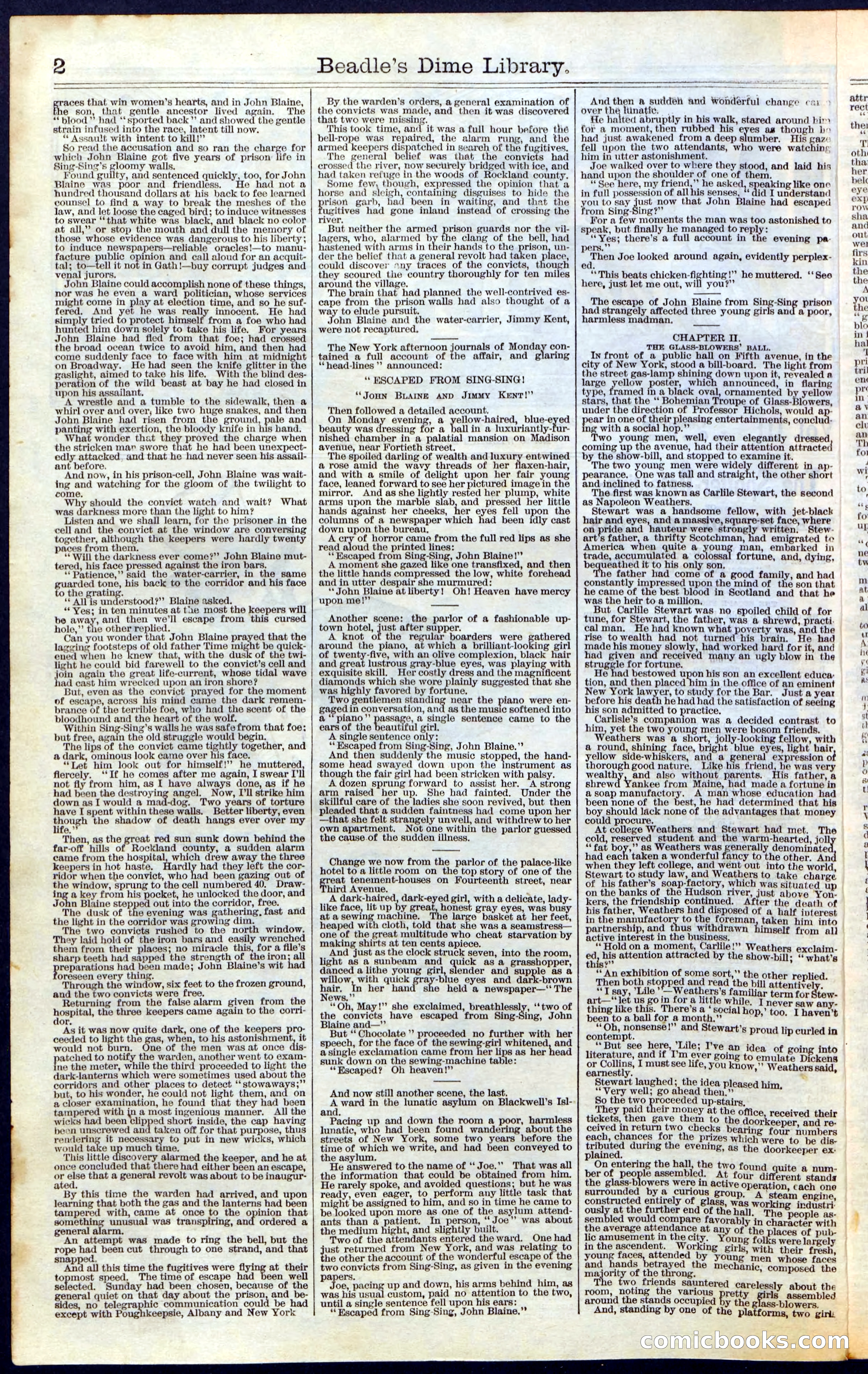
A restored page from Pulp Fiction, 1878. Page through the whole issue in the reader above.
📄 Transcribed text from this page (OCR, searchable)
Machine-transcribed from the original scan — historical spelling and the odd misread are preserved.
2 races that win women’s hearts, and in John Blaine, he son, that gentle ancestor lived again. The “blood” had ‘‘ sported back ”’ and showed the gentle strain infused into the race, latent till now. * Assault with intent to kill!’ So read the accusation and so ran the charge for which John Blaine got five years of prison life in Sing-Sing’s gloomy walls. Found guilty, and sentenced quickly, too, for John Blaine was poor and friendless. He had not a hundred thousand dollars at his back to fee learned counsel to find a way to break the meshes of the law, and let loose the caged bird; to induce witnesses to swear ‘‘that white was black, and black no color at all,” or stop the mouth and dull the memory of those whose evidence was dangerous to his liberty; to induce newspapers—reliable oracles!—to manu- facture public apon and call aloud for an acquit- tal; to—tell it not in Gath!—buy corrupt judges and venal jurors. John Blaine could accomplish none of these things, nor was he even a ward politician, whose services might come in play at election time, and so he suf- fered, And yet he was wit d innocent. He had simply tried to protect himself from a foe who had hunted him down solely to take his life. For years John Blaine had fled from that foe; had crossed the broad ocean twice to avoid him, and then had come suddenly face to face with him at midnight on Broadway. He had seen the knife glitter in the gaslight, aimed to take his life. With the blind des- peration of the wild beast at bay he had closed in upon his assailant. A wrestle and a tumble to the sidewalk, then a whirl over and over, like two huge snakes, and then John Blaine had risen from the ground, pale and panting with exertion, the bloody knife in his hand, What wonder that they proved the charge when the stricken mar swore that he had been unexpect- edly attacked, and that he had never seen his assail- ant before. . And now, in his prison-cell, John Blaine was wait- ing and watching for the gloom of the twilight to come, Why should the convict watch and wait? What was darkness more than the light to him? Listen and we shall learn, for the prisoner in the cell and the convict at the window are conversing together, although the keepers were hardly twenty paces from them, ‘* Will the darkness ever come?’’ John Blaine mut- tered, his face pressed against the iron bars. ‘Patience,’ said the water-carrier, in the same guarded tone, his back to the corridor and his face to the ¢ diguors = Allis understood?’ Blaine asked. ‘‘ Yes; in ten minutes at the most the keepers will be away, and then we'll escape from this cursed hole,” the other replied. Can you wonder that John Blaine prayed that the lagging footsteps of old father Time might be quick- ened when he knew that, with the dusk of the twi- light he could bid farewell to the convict’s cell and join again the great life-current, whose tidal wave iad cast him wrecked upon an iron shore? But, even as the convict prayed for the moment of escape, across his mind came the dark remem- brance of the terrible foe, who had the scent of the bloodhound and the heart of the wolf. Within Sing-Sing’s walls he was safe from that foe; but free, again the old struggle would begin, The lips of the convict came tightly together, and a dark, ominous look came over his face. “Let him look out for himself!” he muttered flercely. “If he comes after me again, I swear rl not fly from him, as I have always done, as if he had been the destroying angel. Now, I'll strike him down as I would a mad-dog. Two years of torture have I spent within these walls. Better liberty, even though the shadow of death hangs ever over my tt ttn life. Then, as the great red sun sunk down behind the far-off hills of Rockland county, a sudden alarm came from the hospital, which drew away the three keepers in hot haste. Hardly had they left the cor- ridor when the convict, who had been gazing out of the window, sprung to the cell numbered 40, Draw- ing @ key from his pocket, he unlocked the door, and John Blaine stepped out into the corridor, free. The dusk of the evening was gathering, fast and the light in the corridor was growing dim. The two convicts rushed to the north window. They laid hold of the iron bars and easily wrenched them from their places; no miracle this, for a file’s sharp teeth had sapped the strength of the iron; all Lid ign had been made; John Blaine’s wit had oreseen every thing. Through the window, six feet to the frozen ground, and the two convicts were free. Returning from the false alarm given from the hospital, the three keepers came again to the corri- dor. As it was now quite dark, one of the ee pro- ceeded to light the gas, when, to his astonishment, it would not burn. One of the men was at once dis- atched to notify the warden, another went to exam- ine the meter, while the third proceeded to light the dark-lanterns which were sometimes used about the corridors and other places to detect ‘“ stowaways;”’ but, to his wonder, he could not light them, and on a closer examination, he found that they had been tampered with n a most ingenious manner. All the wicks had been clipped short inside, the cap having beon unscrewed and taken off for that purpose, thus rendering it necessary to put in new wicks, which would take up much time, This little overy alarmed the keeper, and he at, once concluded that there had either been an escape, 23 ie that a general revolt was about to be inaugur- ated. By this time the warden had arrived, and upon learning that both the gas and the lanterns had been tampered with, came at once to the opinion that somet unusual was transpiring, and ordered a general alarm. An attempt was made to ring the bell, but the rope had been cut through to one strand, and that snapped. And all this time the fugitives were fi at their topmost speed. The time of escape had been well selected. Sunday had been chosen, because of the general quiet on that day about the prison, and_be- sides, no telegraphic communication could be had except with Poughkeepsie, Albany and New York settee By the warden’s orders, a general examination of the convicts was made, and then it was discovered that two were missing. This took time, and it was a full hour before thé bell-rope was repaired, the alarm rung, and the armed keepers dispatched in search of the fugitives. The general belief was that the convicts had crossed the river, now securely bridged with ice, and had taken refuge in the woods of Rockland county. Some few, though, expressed the opinion that a horse and sleigh, containing disguises to hide the pean garb, had been in waiting, and that the ugitives had gone inland instead of crossing the river, But neither the armed prison guards nor the vil- lagers, who, alarmed by the clang of the bell, had hastened with arms in their hands to the prison, un- der the belief that a general revolt had taken lace, could discover ony traces of the convicts, though they scoured the country thoroughly for ten miles around the village. The brain that had planned the well-contrived es- cape from the prison walls had also thought of a way to elude pursuit. ‘ ; John Blaine and the water-carrier, Jimmy Kent, were not recaptured, The New York afternoon souenels of Monday con- tained a full account of the affair, and glaring “‘*head-lines ’? announced: ‘** RSCAPED FROM SING-SING! ‘**Joun BLAINE AND Jimmy Kent!” Then followed a detailed account, On Monday evening, a yellow-haired, blue-eyed beauty was dressing for a ballin a luxuriantly-fur- nished chamber in a palatial mansion on Madison avenue, near Fortieth street. The spoiled darling of wealth and ey entwined a rose amid the wavy threads of her flaxen-hair, and with a smile of delight upon her fair young face, leaned forward to see her pines image in the mirror. And as she lightly rested her plump, white arms upon the marble slab, and pressed her little hands against her cheeks, her eyes fell yn the columns of a newspaper which had been idly cast down upon the bureau, A ery of horror came from the full red lips as she read aloud the printed lines: ‘* Escaped from Sing-Sing, John Blaine!” A moment she gazed like one transfixed, and then the little hands compressed the low, white forehead and in utter despair she murmured: ‘** John Blaine at liberty! Oh! Heaven have mercy upon me!”’ Another scene: the parlor of a fashionable up- town hotel, just after supper. A knot of the regular boarders were gathered around the piano, at which a brilliant-looking girl of twenty-five, with an olive complexion, black hair and great lustrous gray-blue eyes, was playing with exquisite skill. Her costly dress and the magnificent diamonds which she wore plainly suggested that she was highly favored by fortune. Two gentlemen standing near the piano were en- gaged in conversation, and as the music softened into a “ piano”’ — e, a single sentence came to the ears of the beautiful girl. A single sentence only: “Escaped from Sing-Sing, John Blaine.”’ And then suddenly the music stopped, the hand- some head swayed down upon the instrument as though the fair girl had been stricken with palsy. A dozen sprung forward to assist her. A strong arm raised her up. She had fainted. Under the skillful care of the ladies she soon revived, but then pleaded that a sudden faintness had come upon her —that she felt strangely unwell, and withdrew to her own apartment. Not one within the parlor guessed the cause.of the sudden illness. Change we now from the parlor of the palace-like hotel to a little room on the top story of one of the at tenement-houses on Fourteenth street, near hird Avenue. A dark-haired, dark-eyed girl, with a delicate, lady- like face, lit up by great, honest gray eyes, was toe. at a sewing machine. The large basket at her feet, heaped with cloth, told that she was a seamstress— one of the great multitude who cheat starvation by making shirts at ten cents apiece. And just as the clock struck seven, into the room, light as a sunbeam and quick as a grasshopper, danced a lithe young girl, slender and supple as a willow, with quick fray-blue eyes and dark-brown hair, In she held a newspaper—‘ The ‘9 her han “Oh, May!” she exclaimed, breathlessly, ‘‘two of the convicts have escaped from Sing-Sing, John Blaine and—”’ But “‘ Chocolate ’’ proceeded no further with her speech, for the face of the se -girl whitened, and a single exclamation came from her lips as her head sunk down on the sewing-machine table: “*Escaped? Oh heaven!” And now still another scene, the last. A ward in the lunatic asylum on Blackwell’s Isl-: and. Pacing up and down the room a poor, harmless lunatic, who had been found wandering about the streets of New York, some two years before the time of which we write, and had been conveyed to the asylum. He answered to the name of ‘‘ Joe.’’ That was all the information that could be obtained from him. He rarely spoke, and avoided questions; but he was ready, even eager, to perform any little task that might be assigned to him, and so in time he came to be looked upon more as one of the asylum attend- ants than a patient. In person, “Joe” was about the medium hight, and slightly built. Two of the attendants entered the ward. One had ust returned from New York, and was relating to ips other the account of the wonderful escape of the two convicts from Sing-Sing, as given in the evening apers. = oe, pacing up and down, his arms behind him, as was his usual custom, paid no attention to the two, until a single sentence fell upon his ears: “Escaped from Sing-Sing, John Blaine.” Beadle’s Dime Library. en = a And then a sudden and wonderful change cs) over the ltinatic. le haited abruptly in his walk, stared around him for a moment, then rubbed his eyes as though bh» had just awakened from a deep slumber. His gaz« fell upon the two attendants, who were watching him in utter astonishment. Joe walked over to where they stood, and laid his hand upon the shoulder of one of them. “ See here, my friend,’* he asked, speaking like ono in full possession of all his senses, “ did I understand you to say just now that John Blaine had escaped from Sing-Sing?”’ For a few moments the man was too astonished to speak, but finally he managed to reply: ‘Yes; there’s a full account in the evening pa- pers.” Then Joe looked around again, evidently perplex- ed, “This beats Shick ease !” he muttered. ‘‘See here, just let me out, will you?” The escape of John Blaine from Sing-Sing prison had strangely affected three young girls and a poor, harmless madman, CHAPTER II. THE GLASS-BLOWERS’ BALL. In front of a public hall on Fifth avenue, in the city of New York, stood a bill-board. The light from the street gas-lamp shining down upon it, revealed a large P bebe oster, which announced, in flaring type, framed in a black oval, ornamented by yellow stars, that the ‘‘ Bohemian Troupe of Glass-Blowers, under the direction of Professor Hichols, would ap- eg in one of their pleasing entertainments, conclud- ng with a social hop.” Two young men, well, even elegantly dressed coming up the avenue, had their attention attractec by the show-bill, and stopped to examine it. The two young men were widely different in ap- pearance. One was tall and straight, the other short and inclined to fatness. The first was known as Carlile Stewart, the second as Napoleon Weathers. Stewart was a handsome fellow, with jet-black hair and eyes, and a massive, square-set face, where on pride and hauteur were strongly written. Stew- art’s father, a thrifty Scotchman, had emigrated te America when quite a young man, embarked in trade, accumulated a colossal fortune, and, dying, bequeathed it to his only son. e father had come of a good family, and had constantly impressed upon the mind of the son that he came of the best blood in Scotland and that he was the heir to a million, But Carlile Stewart was no spoiled child of for tune, for Stewart, the father, was a shrewd, practi. calman, He had known what poverty was, and the rise to wealth had not turned his brain. He had made his money slowly, had worked hard for it, and had given and received many an ugly blow in the struggle for fortune. He had bestowed upon his son an excellent educa: tion, and then placed him in the office of an eminent New York lawyer, to study for the Bar. Just a year before his death he had had the satisfaction of seeing his son admitted to practice. Carlisle’s companion was a decided contrast to him, yet the two young men were bosom friends. Weathers was a short, jolly-looking fellow, with a round, shining face, bright blue eyes, light bair yellow side-whiskers, and a general expression o thorough good nature. Like his friend, he was very hi beans and also without parents. His father, a shrewd Yankee from Maine, had made a fortune in asoap manufactory. A man whose education had been none of the best, he had determined that his boy should lack none of the advantages that money could procure. At college Weathers and Stewart had met. The cold, reserved student and the warm-hearted, joll ‘fat boy,” as Weathers was generally denominate had each taken a wonderful fancy to the other. And when they left college, and went out into the world, Stewart to study law, and Weathers to take charge of his father’s soap-factory, which was situated up on the banks of the Hudson river, just above Yon- kers, the friendship continued. Atier the death of his father, Weathers had disposed of a half ipterest in the manufactory to the foreman, taken him into partnership, and thus withdrawn active interest in the business, ‘Hold on a moment, Carlile!” Weathers exclaim- attr rect himself from all” ed his attention attracted by the show-bill; “what's | “An exhibition of some sort,”’ the ot Then both stopped and read the bill Pr ni ig 13: dapoin fora Hite wai art—“ let us goin for a little while. I never saw any- thing like this. There’s a ‘ social hop.’ y bee nto eet tor ‘ month." Op,’ too. I haven't nonsenseé!”’ an wart’ i contempt. age hes S proud lip curled in **But see here €; I’ve an j i Epererure, = if I'm ever going to os wise Dickens or Collins, I must see life, you know.” earnestly. aie “ ow, Weathers said, ewa ughed; the idea pl i “Very well: go ahead then > am “3 the Ay pial up-stairs, ey p eir money at the office tickets, then gave them to the tices Sauree ceived in return two checks bearing four numbers each, chances for the prizes which were to be dis- tributed during the evening, as the doorkeeper ex: plained. On entering the hall, the two foun j - ber of mee assembled. At four at the glass-blowers were in active operation, cach one surrounded by a curious up. A steam engine constructed entirely of glass, was working industri ously at the further end of thehall. ‘The people as- sembled would compare favorably in character with the average attendance at any of the places of pub- lic amusement in the city, oung folks were largely in the ascendent. Working girls, with their fresh young tages Sstended by young men whose faces and hands betrayed the mechanic, composed the majority of the throng. The oye friends arous p cer eeely about the retty girls assembled room, not the various around the stands occupied y the blowers. And, standing by one of the pla orms, two gink COnnike SEO! ly. ar term for stow- : into — the 1 oth tha her hek eye OX} row sha and out wel firs kin the the ol he ae blo in | hal ‘I pri tril en pr in a Vv an elv an Th fol