
Pulp Fiction, 1878 · page 1 of 28
Beadle's Dime Library No. 27 — page 1: what you’re looking at
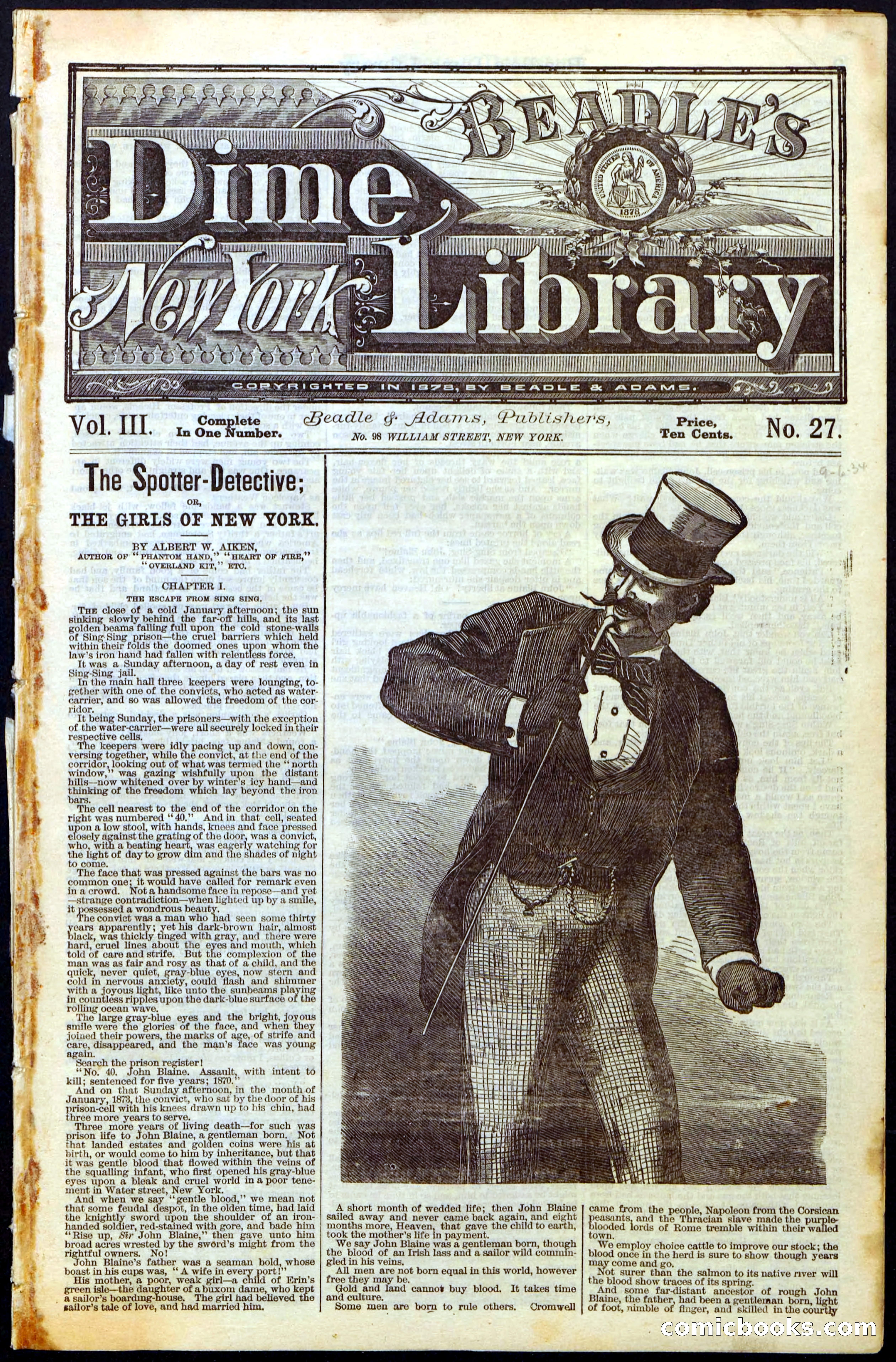
A restored page from Pulp Fiction, 1878. Page through the whole issue in the reader above.
📄 Transcribed text from this page (OCR, searchable)
Machine-transcribed from the original scan — historical spelling and the odd misread are preserved.
TAT) TIITTD o/4 Complete One Number. ain | | Iii! ati ee PEEP LIAFEEAA LEI EE EPIAOIEIEI EP ELIALD SAA ESAS ELS, a Adams, No. 98 WILLIAM STREHT, NEW YORK. De * ital at a Je “a4 aa y, 4 74 aa . ae V4 aaa : ‘a Ee & Aa CO & RA Se Publishers, ee i Price, Fen Cents. The Spotter-Detective: THE GIRLS OF NEW YORK. BY ALBERT W. AIKEN, AUTHOR OF ‘PHANTOM HAND,” “HEART OF £TRE,”’ ‘OVERLAND KIT,”’ ETO, CHAPTER I. THE ESCAPE FROM SING SING, THe close of a cold January afternoon; the sun sinking slowly behind the far-off hills, and its last golden beams falling full upon the cold stone-walls of Sing-Sing prison—the cruel barriers which held within their folds the doomed ones upon whom the law’s iron hand had fallen with relentless force, It was a Sunday afternoon, a day of rest even in Sing-Sing jail. In the main hall three keepers were lounging, to- gether with one of the convicts, who acted as water- beg and so was allowed the freedom of the cor- ridor. It being Sunday, the prisoners—with the exception of the water-carrier—were all securely locked in their respective cells, 16 keepers were idly pacing up and down, con- versing together, while the convict, at the end of the corridor, looking out of what was termed the “ north window,’ was gazing wishfully upon the distant hills—now whitened over by winter’s icy hand—and thinking of the freedom which lay beyond the iron ars. The cell nearest to the end of the corridor on the right was numbered ‘‘40.” And in that cell, seated Epon a low stool, with hands, knees and face pressed closely ye the grating of the door, was a convict, who, with a beating heart, was eagerly watching for the light of day to grow dim and the shades of night to come. The face that was pressed against the bars was no common one; it would have called for remark even inacrowd. Nota handsome face in repose—and yet —strange contradiction—when lighted up by a smile, it possessed a wondrous Paaney "he convict was a man who had seen some thirty yoars apparently; yet his dark-brown hair, almost lack, was thickly tinged with gray, and there were hard, cruel lines about the eyes and mouth, which told of care and strife. But the complexion of the man was as fair and rosy as that of a child, and the quick, never quiet, gray-blue eyes, now stern and cold in nervous anxiety, could flash and shimmer with a joyous light, like unto the sunbeams playing in countless ripples upon the dark-blue surface of the rolling ocean wave, . The large gray-blue eyes and the bright, joyous smile were the glories of the face, and when they joined their powers, the marks of age, of strife and care, disappeared, and the man’s face was young again. Search the prison register! ‘No. 40. John Blaine. Assault, with intent to kill; sentenced for five years; 1870.” And on that Sunday afternoon, in the month of January, 1873, the convict, who sat by the door of his prison-cell with his knees drawn up to his chin, had three more years to serve. Three more years of living death—for such was prison life to John Blaine, a gentleman born, Not that landed estates and golden coins were his at birth, or would come to him by inheritance, but that it was gentle blood that flowed within the veins of the squalling infant, who first opened his gray-blue eyes upon a bleak and cruel world in a poor tene- ment in Water street, New York. And when we say ‘‘gentle blood,’’ we mean not that some feudal despot, in the olden time, had laid the knightly sword upon the shoulder of an iron- handed soldier, red-stained with gore, and bade him “Rise up, Sir John Blaine,” then gave unto him broad acres wrested by the sword’s might from the rightful owners. No! ohn Blaine’s father was a seaman bold, whose boast in his cups was, ‘‘ A wife in every port!”’ His mother, a poor, weak girl—a child of Erin’s green isle—the daughter of a buxom dame, who kept a sailor’s boarding-house, The girl had believed the sailor’s tale of love, and had married him, 6 MMA LA OY Ne A! i. " an PAC) ees Me rivay { itty IAP Mn ty a mises Seanee oo mamma, mm URIS we ess Rist 2nreGSp Sms Lisniasem BE Res a i. eTittiity svemamis SiRkee wees A short month of wedded life; then John Blaine sailed away and never came back again, and eight months more, Heaven, that gave the child to earth, took the mother’s life in payment. We say John Blaine was a gentleman born, though the blood of an Irish lass and a sailor wild commin- gled in his veins, All men are not born equal in this world, however free they ge Bios Gold and d cannot buy blood. It takes time and culture. Some men are born to rule others, Cromwell vy nihWauwe! Ys ry came from the people, Napoleon from the Corsican easants, and the Thracian slave made the purple reded lords of Rome tremble within their walled n, We employ choice cattle to improve our stock; the blood once in the herd is sure to show though years mhay come and go, ot surer than the salmon to its native river will the blood show traces of its spring. And some far-distant ancestor of rough John Blaine, the father, had been a gentleman born, light of foot, nimble of finger, and skilled in the courtly ik Eomichbooks (E(0)