
Pulp Fiction, 1883 · page 6 of 32
Beadle's Dime Library No. 260: The Masked Mystery; or, The Black Crescent — page 6: what you’re looking at
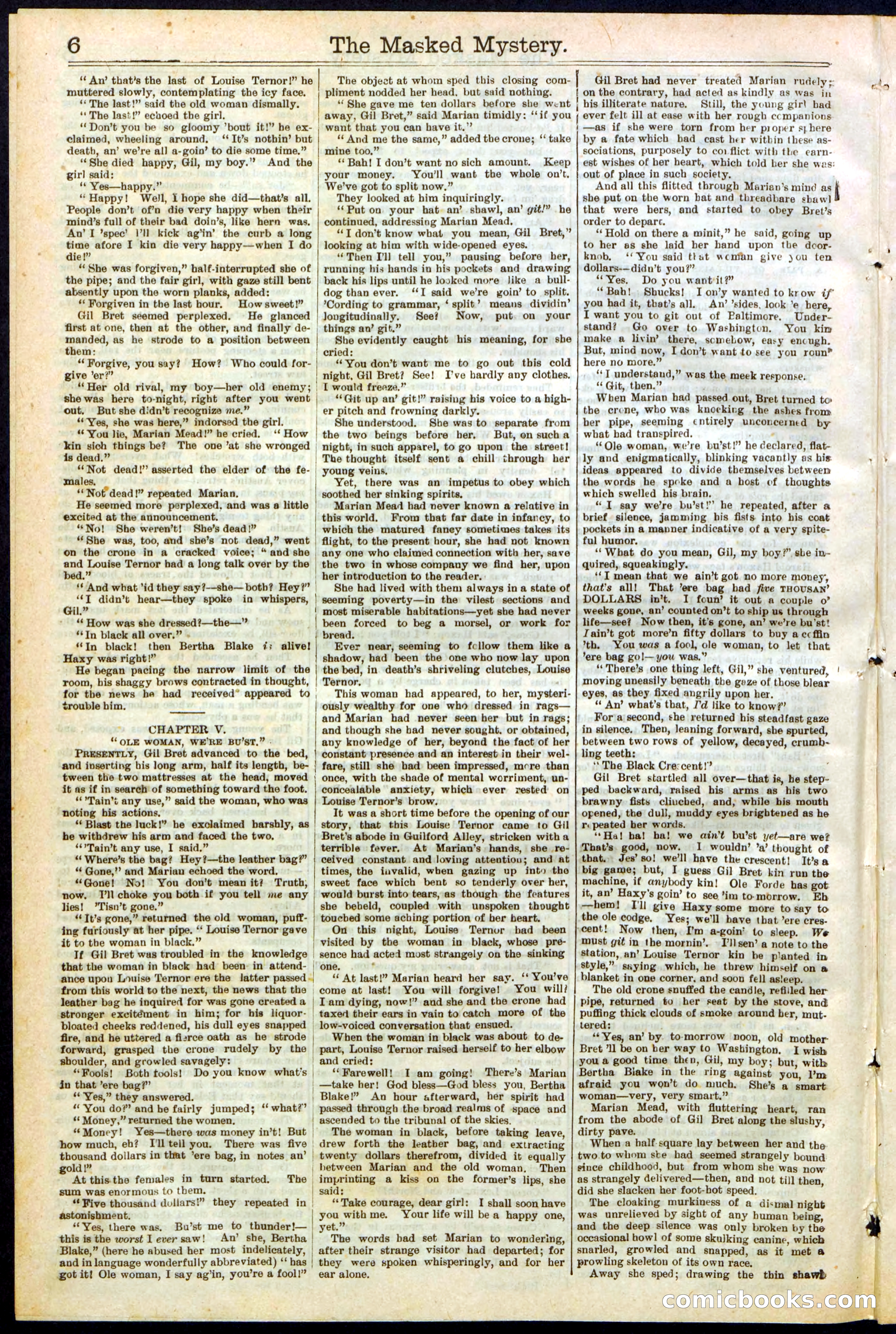
A restored page from Pulp Fiction, 1883. Page through the whole issue in the reader above.
📄 Transcribed text from this page (OCR, searchable)
Machine-transcribed from the original scan — historical spelling and the odd misread are preserved.
2 se y 25 _. » + * # 6 ** An’ that’s the last of Louise Ternor!” he muttered slowly, contemplating the icy face. ‘* The last!” said the old woman dismally. ‘* The last!” echoed the girl. ‘Don’t you be so gloomy ’bout it!” he ex- claimed, wheeling around. ‘“ It’s nothin’ but death, an’ we’re all a-goin’ to die some time,” ———— lt ‘She died happy, Gil, my boy.” And the girl said: ‘* Yes—happy.” “Happy! Well, I hope she did—that’s all. People don’t of’n die very happy when their mind’s full of their bad doin’s, like hern was, An’ I ’spec’ |’ll kick ag’in’ the curb a long time afore I kin die very happy—when I do die!” “She was forgiven,” half-interrupted she of the pipe; and the fair girl, with gaze still bent absently upon the worn planks, added: ‘* Forgiven in the last hour. How sweet!” Gil Bret seemed perplexed. He glanced first at one, then at the other, and finally de- manded, as he strode to a position between them: “Forgive, you say? How? Who could for- give ’er?” ‘Her old rival, my boy—her old enemy; she was here to-night, right after you went out, But she didn’t recognize me.” ‘*- Yes, she was here,” indorsed the girl. ** You Jie, Marian Mead!” he cried. ‘‘ How kin sich things be? The one ’at she wronged | is dead.” “Not dead!” asserted the elder of the fe- males. ‘Not’ dead!” repeated Marian. He seemed more perplexed, and was a little excited at the announcement. “No! She weren’t! She’s dead!” “She was, too, and she’s not dead,” went on the crone in a cracked voice; “ and she and Louise Ternor bad a long talk over by the bed.” ‘‘T didn’t hear—they spoke in whispers, Gil.” ““ How was she dressed?—the—” **In black all over.” - ‘In black! then Bertha Blake 7; Haxy was right!” He began pacing the narrow limit of the room, his shaggy brows contracted in thought, for the news he had received” appeared to trouble bim. alive! CHAPTER V. ‘OLE WOMAN, WE'RE BU’ST,” - PRESENTLY, Gil Bret advanced to the bed, and inserting bis long arm, half its length, be- tween the two mattresses at the head, moved it as if in search of something toward the foot. “'Tain’s any use,” said the woman, who was noting bis actions. ** Blast the luck!” he exclaimed harshly, as he withdrew his arm and faced the two. ‘“’Tain’t any use, I said.” “‘ Where’s the bag? Hey ?—the leather bag?” *“ Gone,’”’ and Marian echoed the word. “Gone! No! You don’t mean it? Truth, now, Tl choke you both if you tell me any lies! ’Tisn’t gone,” : ‘¢Tt’s gone,” returned the old woman, puff- ing furiously at her pipe. ‘‘ Louise Ternor gave it to the woman in black.” If Gil Bret was troubled in the knowledge that the woman in black had been in attend- | ance upou Louise Ternor ere the latter passed -| from this world to the next, the news that the leather bag he inquired for was gone created a stronger excitément in him; for his liquor- bloated cheeks reddened, his dull eyes snapped fire, and he uttered a fierce oath as he strode forward, grasped the crone rudely by the shoulder, and growled savagely: “Fools! Both fools! Do you in that ’ere bag?” ‘* Yes,” they answered. know what's ‘You do?’ and be fairly jumped; ‘ what?” | ‘“ Money,” returned the women. “Money! Yes—there was money in’t! But how much, eh? Illtell you. There was five thousand dollars in that ‘ere bag, in notes an’ gold!” At this the females in turn started. sum was enormous to them. The “Five thousand duliars!” they repeated in | astonishment. ‘“Yes, there was. Bu’st me to thunder!— this is the worst I ever saw! An’ she, Bertha Blake,” (here he abused her most indelicately, and in language wonderfully abbreviated) ‘‘ has got it! Ole woman, I say ag’in, you’re a fool!” ** And what ‘id they say ?——she— both? Hey?’ | The Masked Mystery. ——~-/-_, | The object at whom sped this closing com- | Gil Bret had never treated Marian rudely = pliment nodded her head, but said nothing. on the contrary, had acted as kindly as was in “She gave me ten dollars before she went ; bis illiterate nature, Still, the young girl bad away, Gil Bret,” said Marian timidly: ‘‘if you ; ever felt ill at ease with her rovgh ccmpanions want that you can have it,” i—as if she were torn from ber pioper sj here ‘‘ And me the same,” added the crone; ‘‘ take | by a fate which bad cast her within these as- mine too,” sociations, purposely to con flict with the earn- ‘* Bah! I don’t want no sich amount. Keep your money. You'll want the whole on’t. We've got to split now.” They looked at him inquiringly. ‘‘Put on your hat an’ sbawl, an’ git!” he continued, addressing Marian Mead, “T don’t know what you mean, Gil Bret,” looking at bim with wide-opened eyes. ‘‘Then Tl) tell you,” pausing before her, running his hands in his pockets and drawing back his lips until he looked more Jike a bull- dog than ever. ‘‘I said we're goin’ to split. ‘Cording to grammar, ‘ split’ means dividin’ lovgitudinally. See? Now, put on your things an’ git.” She evidently caught his meaning, for she cried: ‘¢¥You don’t want me to go out this cold night, Gil Bret? See! I’ve hardly any clothes. I would freeze,” “Git up an’ git!” raising his voice to a high- er pitch and frowning darkly. She understood. She was to separate from the two beings before ber. But, on sucha night, in such apparel, to go upon the street! | The thought itself sent a chill through her young veins. Yet, there was an impetus to obey which soothed her sinking spirits, Marian Mead had never known a relative in this world. From that far date in infancy, to which the matured faney sometimes takes its flight, to the present hour, she had not known any one who claimed connection with her, save the two in whose company we find her, upon her introduction to the reader. She had lived with them always in a state of | seeming poverty—in the vilest sections and ' most miserable habitations—yet she had never been forced to beg a morsel, or work for bread. Ever near, seeming to fcllow them like a shadow, had been the one who now lay upon the bed, in death’s shriveling clutches, Louise | Ternor, | This woman had appeared, to her, mysteri- | ously wealthy for one who dressed in rags— and Marian had never seen her but in rags; and though she bad never sought, or obtained, avy knowledge of her, beyond the fact of her constant presence and an interest in their wel- fare, still she bad been impressed, more than once, with the shade of mental worriment, un- concealable anxiety, which ever vested on Louise Ternor’s brow. It was a short time before the opening of our story, that this Louise Ternor came to Gil Bret’s abode in Guilford Alley, stricken with a terrible fever. At Marian’s hands, sbe re- ceived constant and loving attentiou; and at times, the invalid, when gazing up into the sweet face which bent so tenderly over her, would burst into tears, as though the features she bebeld, coupled with unspoken thought toucbed some aching portion of ber beart. On this night, Louise Ternur bad been out of place in such society, And all this flitted through Marian’s mind as she put on the worn bat and threadbare shaw] that were hers, and started to obey Bret’s order to deparc. “Hold on there a minit,” he said, going up to her as she laid her hand upon the door- knob, ‘‘ You said that wentan give jou ten dollars-—didn’t you?” “Yes. Do you wantit?” ‘* Bah! Sbucks! you had it, that’s all. An’ ’sides, look ’e here, I want you to git out of Paltimore. Under- stand? Go over to Washington. ‘You kim make a livin’ there, somebow, easy encugh. But, mind now, I don’t want to see you roun” here no more,” “T understand,” was the meek response. “ Git, then.” ' When Marian had passed out, Bret turned to the crene, who was knocking the ashes from ber pipe, seeming cntirely unconcerned by what had transpired. “Ole woman, we’re bu’st!” he declared, flat- ly and enigmatically, blinking vacantly as his ideas appeared to divide themselves between the words he speke and a host of thoughts which swelled his brain. “ I say we're bu’st!”’ he repeated, after a brief silence, jamming his fists into his coat pockets in a manner indicative of a very spite- ful humor. ‘What do you mean, Gil, my boy?” she in- quired, squeakingly. ‘‘T mean that we ain’t got no more money, that’s all! That ’ere bag bad five THOUSAN’ DOLLARS in't. I foun’ it out a couple o” weeks gone, an’ counted on’t to ship us through life—see? Now then, it’s gone, an’ we’re bu’st! Tain’t got more’n fifty dollars to buy a ecffin th. You was a fool, ole woman, to let that ’ere bag gol— you was,” eee a a a ee . moving uneasily beneath the goze of those blear eyes, as they fixed angrily upon her. ‘‘ An’ what’s that, J’d like to know?’ For a second, the returned his steadfast gaze in silence. Then, leaning forward, she spurted, between two rows of yellow, decayed, crumb- ling teeth: ‘The Black Cre:cent!” Gil Bret startled all over—that is, he step- ped backward, raised his arms as his two brawny fists cliucbed, and, while bis mouth opened, the dull, muddy eyes brightened as he r. peated ber words. ‘Hal ba! ba! we ain’t bu’st yet—are we? That’s good, now. 1 wouldn’ ’a’ thought of that. Jes’ so! we'll have the crescent! It’sa big game; but, I guess Gil Bret kin run the machine, if anybody kin! Ole Forde bas got it, an’ Haxy's goin’ to see im to-morrow. Eb —hem! I'll give Haxy some more to say to the ole codge. Yes; we'll have that ere cres- cent! Now then, I’m a-goin’ to sleep. We visited by the woman in black, whose pre- | Must git in the mornin’. Tllsen’ a note to the _ sence had acted most strangely on the sinking | Station, an’ Louise Ternor kin be planted in one. ‘ ; style,” saying which, he threw himself on a “ At last!” Marian heard her say. ‘‘ You’ve | blanket in one corner, and soon fell asleep. come at last! You will forgive! You will? The old crone snuffed the candle, refilled her | Iam dying, now!” and she and the erone had | pipe, returned to her seat by the stove, and taxed their ears in vain to catch more of the | puffing thick clouds of smoke around ber, mut- _ low-voiced conversation that ensued. tered: . | When the woman in black was about to de- ‘Yes, an’ by. tomorrow noon, old mother- _ part, Louise Ternor raised herself to her elbow | Bret ‘ll be on her way to Washington. I wish you a good time then, Gil, my boy; but, with Bertha Biake in the ring against you, ’m afraid you won’t do much. She’s a smart woman—very, very smart,” Marian Mead, with fluttering heart, ran from the abode of Gil Bret along the slushy, dirty pave. When a half square lay between her and the two.to whom sbe had seemed strangely bound since childhood, but from whom she was now as strangely delivered—then, and not ti}] then did she slacken her foot-hot speed. . The cloaking murkiness of a dismal night was unrelieved by sight of any human being, and the deep silence was only broken by the occasional how! of some skujking canine, which snarled, growled and snapped, as it met a prowling skeleton of its own race. EL and cried: , | “Farewell! I am going! There’s Marian | —take her! God bless—God bless you, Bertha | Blake!” An hour afterward, her spirit had passed through the broad realms of space and | ascended to the tribunal of the skies. _ The woman in black, before taking leave, drew forth the leather bag, and extracting _ twenty dollars therefrom, divided it equally | hetween Marian and the old woman, Then imprinting a kiss on the former’s lips, she said: ‘*Take courage, dear girl: I shall soon have you with me. Your life will bea happy one, yet.” | The words bad set Marian to wondering, | after their strange visitor had departed; for they were spoken whisperingly, and for her ear alone, est wishes of her heart, which told ber she was: | I on’y wanted to krow if ‘“There’s one thing left, Gil,” she ventured, | Away she sped; drawing the thin shawk : ‘s ‘ ’ | ™ | ¢ 4 m S GOmiiGghdoo a eon fa ‘