
Pulp Fiction, 1883 · page 7 of 32
Beadle's Dime Library No. 260: The Masked Mystery; or, The Black Crescent — page 7: what you’re looking at
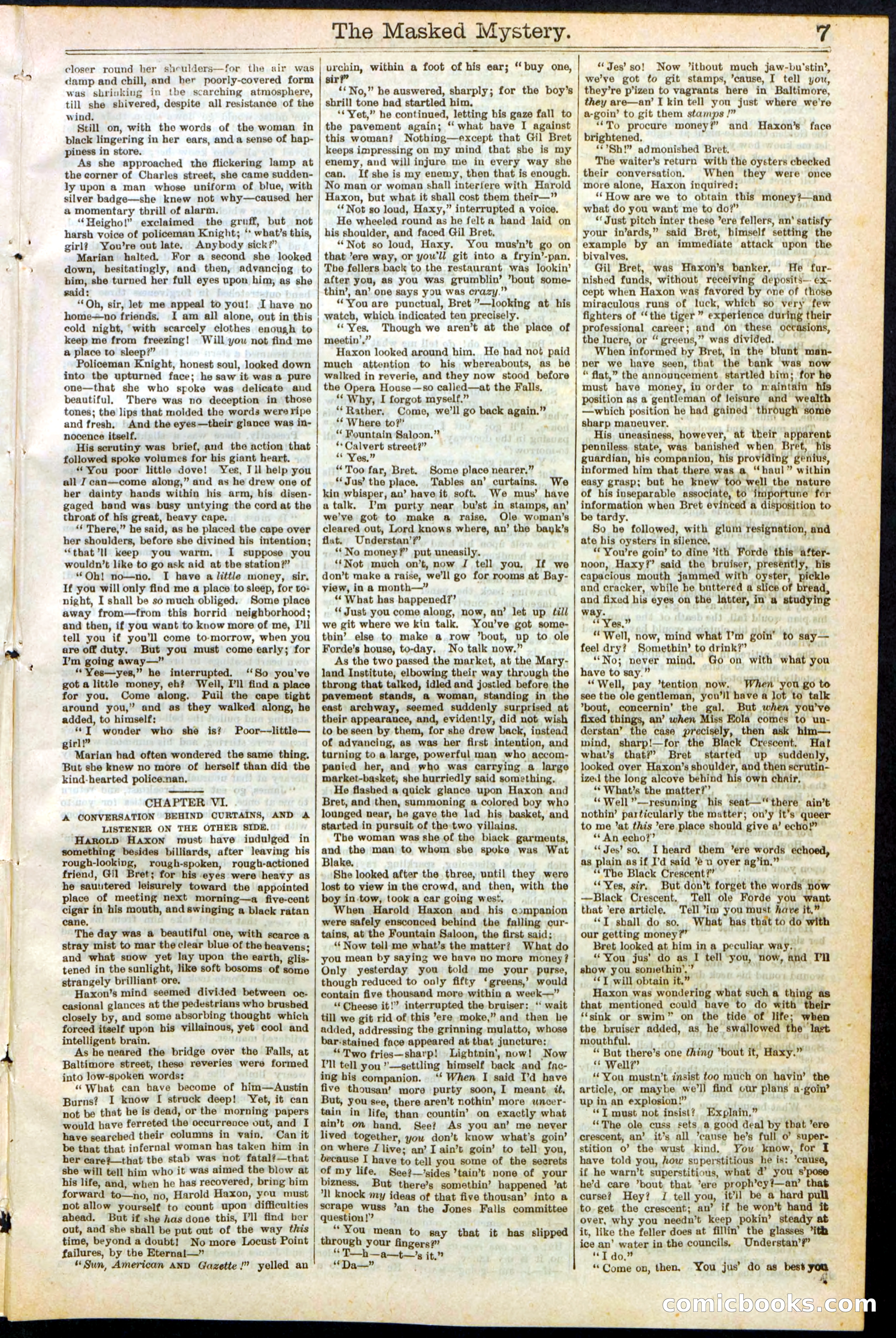
A restored page from Pulp Fiction, 1883. Page through the whole issue in the reader above.
📄 Transcribed text from this page (OCR, searchable)
Machine-transcribed from the original scan — historical spelling and the odd misread are preserved.
— os —— — —_ ————— — ain — — closer round her sheulders—for the air was damp and chill, and her poorly-covered form was shrinking in the scarching atmosphere, till she shivered, despite all resistance of the wind. Still on, with the words of the woman in black lingering in her ears, and a sense of hap- piness in store. As she approached the flickering lamp at the corner of Charles street, she came sudden- ly upon a man whose uniform of blue, with silver badge—she knew not why—caused her a momentary thrill of alarm. “Heigho!” exclaimed the gruff, but not harsh voice of policeman Knight; * what’s this, The Masked Mystery. ———— | urchin, within a foot of his ear; “buy one, sir?” ‘‘ No,” be auswered, sharply; for the boy’s shrill tone bad startled him. ‘* Yet,” he continued, letting bis gaze fall to the pavement again; “ what bave I against this woman? Nothing—except that Gil Bret keeps impressing on my mind that she is my enemy, and will injure me in every way she can. If she is my enemy, then that is enough. No man or woman shall interfere with Harold Haxon, but what it shall cost them their—” “Not so loud, Haxy,” interrupted a voice. He wheeled round as he felt a hand laid on his shoulder, and faced Gil Bret, a > ee a ” we / ‘Jes’ so! Now ’ithout much jaw-bu'stin’, we’ye got to git stamps, ’cause, I tell you, they’re p’izen to vagrants here in Baltimore, they are—an’ I kin tell you just where we're a-goin’ to git them stamps !” “To procure money?” and Haxon’s face brightened, **’Sh!” admonished Bret. The waiter’s return with the oysters checked their conversation. When they were once more alone, Haxon inquired; ‘‘ How are we to obtain this money*—and what do you want me to do?” ‘* Just pitch inter these ’ere fellers, an’ satisfy your in’ards,” said Bret, himself setting the . girl? You're out late. Anybody sick?” ‘““Not so loud, Haxy. You mus’n’t go on | example by an immediate attack upon the * Marian halted. For a second she looked | that ’ere way, or you'll git into a fryin’-pan. | bivalves, 4 down, hesitatingly, and then, advancing to | The fellers back to the restaurant was lookin’ Gil Bret, was Haxon’s banker, He fur- ’ eee eee eo ALL bim, she turned her full eyes upon him, as she said: ‘Oh, sir, let me appeal to you! I have no homeno friends. I am all alone, out in this cold night, ‘with scarcely clothes enough to keep me from freezing! Will you not find me a place to sleep?” Policeman Knight, honest soul, looked down into the upturned face; he saw it was a pure one—that she who spoke was delicate and beautiful. There was no deception in those tones; the lips that molded the words were ripe and fresh. And the eyes—their glance was in- nocence itself. His scrutiny was brief, and the action that followed spoke volumes for his giant heart. “You poor little dove! Yes, Ill help you all J can—come along,” and as he drew one of her dainty hands within his arm, bis disen- gaged band was busy untying the cord at the throat of his great, heavy cape. ‘* There,” he said, as he placed the cape over her shoulders, before she divined his intention; “that'll keep you warm, I suppose you wouldn’t like to go ask aid at the station?’ “Oh! no—no. I have a little money, sir. If you will only find me a place to sleep, for to- night, I shall be so much obliged. Some place away from—from this horrid neighborhood; and then, if you want to know more of me, I'll tell you if you'll come to-morrow, when you are off duty. But you must come early; for I’m going away—” ‘* Yes—yes,” he interrupted. ‘‘So you've got a little money, eh? Well, I’ll find a place for you. Come along. Puil the cape tight around you,” and as they walked along, he added, to himself: ‘*T wonder who she is? girl!” Marian bad often wondered the same thing. But she knew no more of herself than did the kind-hearted policeman, CHAPTER VI. A CONVERSATION BEHIND CURTAINS, AND A LISTENER ON THE OTHER SIDE. LD Haxon must have indulged in something besides billiards, after leaving his rough-looking, rough-spoken, rough-actioned friend, Gil Bret; for his eyes were heavy as he sauutered leisurely toward the appointed place of meeting next morning—a five-cent cigar in his mouth, and swinging a black ratan cane, The day was a beautiful one, with scarce a stray mist to mar the clear blue of the heavens; and what suow yet lay upon the earth, glis- tened in the sunlight, like soft bosoms of some strangely brilliant ore. Haxon’s mind seemed divided between oc. casional glances at the pedestrians who brusbed closely by, and some absorbing thought which forced itself upon his villainous, yet cool and intelligent brain. As he neared the bridge over the Falls, at Baltimore street, these reveries were formed into low-spoken words: ‘What can bave become of him—Austin Burns? 1 know [ struck deep! Yet, it can not be that he is dead, or the morning papers would have ferreted the occurrence out, and I have searched their columns in vain, Can it be that that infernal woman has taken him in her care?—that the stab was not fatal?—that she will tell him who it was aimed the blow at his life, and, when he has recovered, bring bim forward to—no, no, Harold Haxon, you must not allow yourself to count upon difficulties abead. But if she has done this, I’ll find ber out, and she shall be put out of the way this time, beyond a doubt! No more Locust Point failures, by the Eternal—” Sun, American AND Gazette !” yelled an Poor—-little— rr after you, as you was grumblin’ "bout some- thin’, an’ one says you was crazy.” “You are punctual, Bret ’—looking at his watch, which indicated ten precisely. ‘“Yes, Though we aren’t at the place of meetin’,” Haxon looked around him. He bad not paid much attention to his whereabouts, as he walked in reverie, and they now stood before the Opera House —so called—at the Falls, “‘ Why, I forgot myself,” ‘“* Rather, Come, we'll go back again.” ‘* Where to?” . “ Fountain Saloon.” ** Calvert street?” ““ Yes,” “Too far, Bret. Some place nearer,” ‘* Jus’ the place, Tables an’ curtains. We kin whisper, an’ have it soft. We mus’ have atalk. I’m purty near bu’st in stamps, an’ we've got to make a raise, Ole woman's cleared out, Lord knows where, an’ the bayk’s flat. Understan’?’ **No money?’ put uneasily. ‘*Not much on’t, now J tell you, If we don’t make a raise, we'll go for rooms at Bay- view, in a month—” “ What has happened?’ ‘* Just you come along, now, an’ let up till we git where we kin talk. You've got some- thin’ else to make a row ‘bout, up to ole Forde’s house, to-day. No talk now.” As the two passed the market, at the Mary- land Institute, elbowing their way through the throng that talked, idled and jostled before the pavement stands, a woman, stunding in the east archway, seemed suddenly surprised at their appearance, and, evidently, did not wish to be seen by them, for she drew back, instead of advancing, as was her first intention, and turning to a large, powerful man who accom- panied her, and who was carrying a large market-basket, she hurriedly said something. He flashed a quick glance upon Haxon and Bret, and then, summoning a colored boy who lounged near, be gave the lad his basket, and started in pursuit of the two villains, The woman was she of the biack garments, and the man to whom sbe spoke was Wat Blake, She looked after the three, until they were lost to view in the crowd, and then, with the boy in-tow, took a car going west, When Harold Haxon and his companion were safely ensconced behind the falling cur- tains, at the Fountain Saloon, the first said; ‘‘ Now tell me what’s the matter? What do you mean by saying we have no more money? Only yesterday you told me your purse, though reduced to only fifty ‘greens,’ would contain five thousand more within a week—” ‘‘ Cheese it!” interrupted the bruiser: ‘ wait till we git rid of this ’ere moke,” and then he added, addressing the grinning mulatto, whose bar-stained face appeared at that juncture: “Two fries—sharp! Lightnin’; now! Now Pll tell you "—settling himself back and fac- ing bis companion. ‘‘ When I said I’d have five thousan’ more purty soon, I meant. it, But, you see, there aren’t nothin’ more uncer- tain in life, than countin’ on exactly what ain’t on hand. See? As you an’ me never lived together, you don’t know what's goin’ on where J live; an’ I ain’t goin’ to tell you, because I have to tell you some of the secrets of my life. See?—’sides ’tain’t none of your biznes. But there’s somethin’ happened ’at ll knock my ideas of that five thousan’ into a scrape wuss ’an the Jones Falls committee question!” “You mean to say that it has sli through your fingers?” wig ‘* T—h—a—t—’s it.” “Da—” nished funds, without receiving deposits— ex- cept when Haxon was favored by one of those miraculous runs of luck, which so very few fighters of “tlie tiger” experience during their professional career; and on these o¢vasions, the lucre, or “ greens,” was divided. When informed by Bret, in the blunt man- ner we have seen, that the bank was now “ flat,” the announcement startled bim; for he must have money, iv order to maintain his position as a gentleman of leisure and wealth —which position he had gained’ through some sharp maneuver. _ -~ His uneasiness, however, at their apparent penniless state, was banished when. Bret, his guardian, his companion, his providing genius, informed him that there was a “haul” within easy grasp; but he knew too well the nature of his inseparable associate, to impofrtune for information when Bret evinced a disposition to be tardy. : _ So he followed, with glum resignation, and ate his oysters in silence, ~ “You're goin’ to dine ‘ith Forde this after- noon, Haxy?? said the bruiser, preséritly, his capacious mouth jammed with oyster, pickle and cracker, while he buttered a slice of bread, and fixed his eyes on the latter, in a studying — way. ‘t'Yes.” . : Well, now, mind what I’m goin’ to say— feel dry? Somethin’ to drink?” a ‘No; never mind, Go on with what you have to say.” “Well, pay ’tention now. Mi ie go to see the ole gentleman, you'll have a lot to talk bout, concernin’ the gal. But when you've fixed things, an’ when Miss Eola comes to un- derstan’ the case precisely, then ask him— mind, sharp!—for the Black Crescent. Hat what’s that?’ Bret started up suddenly, looked over Haxon’s shoulder, and then scrutin- ized the long alcove behind his own chair, ‘* What’s the matter?” ' ‘““Well”—resuming his seat—“ there ain’t nothin’ particularly the matter; on’y it’s’ queer to me ’at this ’ere place should give a’ echo!” “* An echo?” ‘Jes’ so, I heard them ’ere words echoed, as plain asif I’d said ’@ 0 oyer ag’in.” “The Black Crescent?” m yh But don’t forget the words now —Black Crescent, Tell ole Forde you want that ’ere article. Tell im you must have it,” ‘““T shall do so. What has that to do with our getting money?” ' par Bret looked at him in a peculiar way. “You jus’ do as I tell you, now, and Pl show you somethin’,” ‘‘T will obtain it.” Haxon was wondering what such a thing as that mentioned could have to do with ‘thelr “sink or swim” on the tide of life; when the bruiser added, as he swallowed ‘the laet mouthful. Sie farce “ But there’s one thing "bout it, Haxy.” ‘* Well?” “You mustn’t insist too much on havin’ the article, or maybe we'll find our plans a-goin’ up in an explosion!” = ‘¢T must not insist? Explain,” “The ole cuss sets a good deal by that ’ere crescent, an’ it’s all ’cause he’s full o’ super . stition o’ the wust kind. You know, for I have told you, how superstitious he is: ‘cause, if he warn’t superstitious, what d@’ you s’pose he’d care ’bout that ’ere proph’cy!—an’ that curse? Hey? i tell you, it’il be a hard pull to. get the crescent; an’ if he won’t d it over, why you needn’t keep pokin’ dy at it, like the feller does at fillin’ the glasses ‘ith ice an’ water in the councils, Understan’?’ “< I do,” ; ‘Come on, then, You jus’ do as best you (E| 6 0)0) mm <S=GOr “ah ; ~ ‘ . ae > : Clare A (6(0)