
Pulp Fiction, 1883 · page 5 of 32
Beadle's Dime Library No. 260: The Masked Mystery; or, The Black Crescent — page 5: what you’re looking at
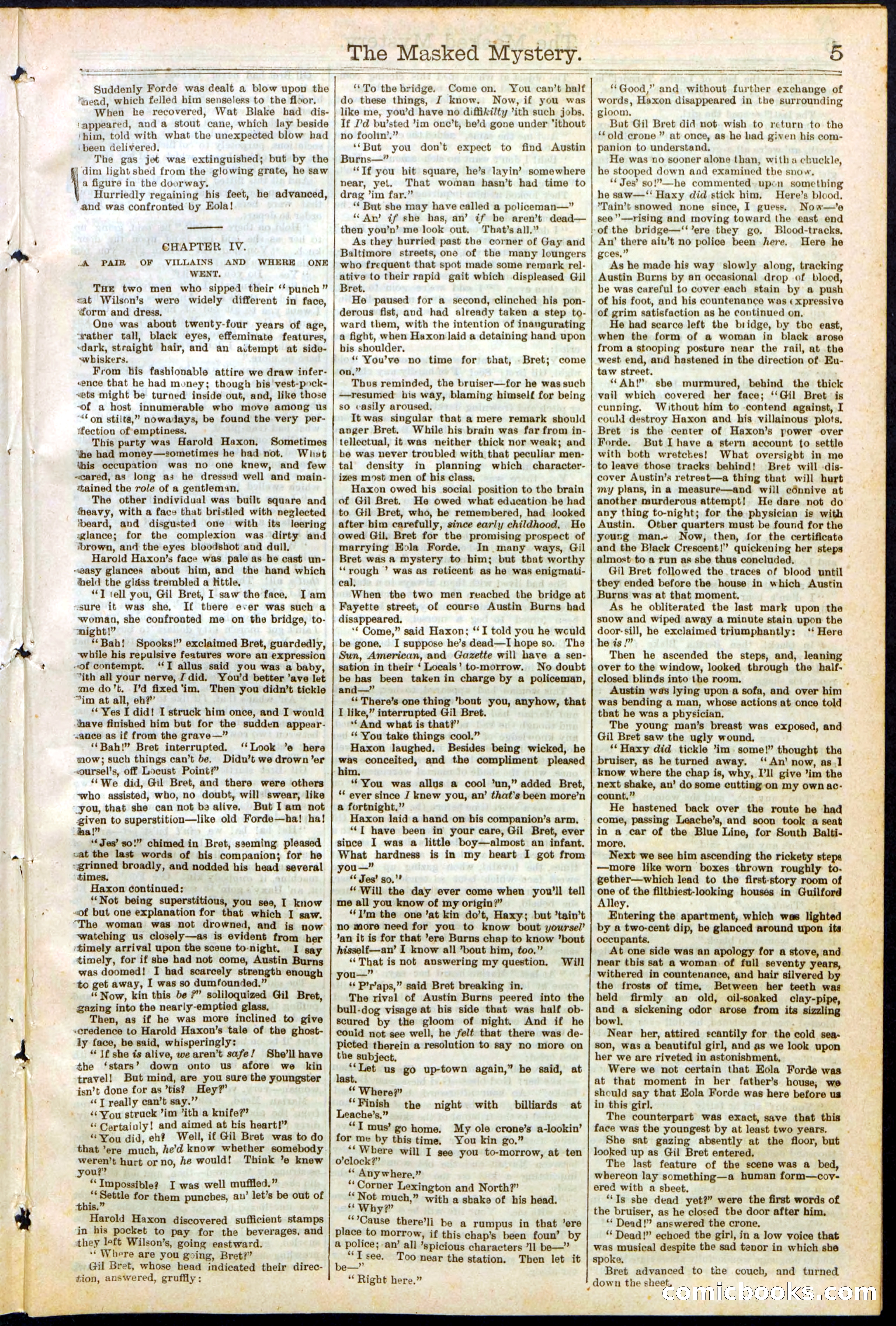
A restored page from Pulp Fiction, 1883. Page through the whole issue in the reader above.
📄 Transcribed text from this page (OCR, searchable)
Machine-transcribed from the original scan — historical spelling and the odd misread are preserved.
-. ' i] hy * = — eT" a4 ee re Suddenly Forde was dealt a blow upon the ‘head, which felled him senseless to the floor, When ke recovered, Wat Blake had dis- ‘appeared, and a stout cane, which lay beside ‘him, told with what the unexpected blow had been delivered, The gas jet was extinguished; but by the a figure in the doorway. Hurriedly regaining his feet, he advanced, and was confronted by Hola! | es light shed from the glowing grate, he saw CHAPTER IV. A PAIR OF VILLAINS AND WHERE ONE WENT, Tue two men who sipped their “ punch” sat Wilson’s were widely different in face, ‘orm and dress. One was about twenty-four years of age, ‘wather tall, black eyes, effeminate features, ~dark, straight hair, and an aitempt at side- whiskers. From bis fashionable attire we draw infer- “ence that he had money; though bis vest-pock- “ets might be turned inside out, and, like those -of a host innumerable who move among us “fon stilts,” nowadays, be found the very per- fection of emptiness. This party was Harold Haxon, Sometimes ‘he had money—sometimes he had not. Wht ‘his occupation was no one knew, and few “cared, as long as he dressed well and main- ttained the role of a gentleman, The other individual was built square and fheavy, with a face that bristled with neglected ‘beard, and disgusted one with its leering lance; for the complexion was dirty and brown, and the eyes bloodshot and dull, Harold Haxon’s face was pale as he cast un- easy glances about him, and the hand which held the gidss trembled a little. “T tell you, Gil Bret, I saw the face, I am sure it was she, If there ever was such a woman, she confronted me on the bridge, to- might!” ‘Bah! Spooks!” exclaimed Bret, guardedly, while his repulsive features wore an expression of contempt. ‘TI allus said you was a baby, “jth all your nerve, J did. You'd better ’ave let me do’t. I’d fixed'‘im. Then you didn’t tickle “im at all, eh?’ ‘*- Yes I did! I struck him once, and I would shave finished him but for the sudden appear- ance as if from the grave—” ‘*Bah!” Bret interrupted. ‘‘Look ’e here mow; such things can’t be. Didun’t we drown’er -oursel's, off Locust Point?” ‘‘We did, Gil Bret, and there were others ‘who assisted, who, no doubt, will swear, like -you, that she can not bealive. But Iam not given to superstition—like old Forde—ha! ha! ha!” ‘Jes’ so!” chimed in Bret, sseming pleased vat the last words of his companion; for he -grinned broadly, and nodded his head several times. Haxon continued: “Not being superstitious, you sea, I know “of but one explanation for that which I saw. ‘The woman was not drowned, and is now watching us closely—as is evident from her ‘timely arrival upon the scene to-night. I say timely, for if she had not come, Austin Burns was doomed! I had scarcely strength enough to get away, I was so dumfounded.” “ Now, kin this be ?” soliloquized Gil Bret, gazing into the nearly-emptied glass, Then, as if he was more inclined to give -credence to Harold Haxon’s tale of the ghost- ly face, be said, whisperingly: “ If she is alive, we aren’t safe! She’ll have the ‘stars’ down onto us afore we kin travel! But mind, are you sure the youngster isn’t done for as ’tis? Hey?” ‘“T really can’t say.”’ ‘¢-You struck ’im ‘ith a knife?’ “Certainly! and aimed at kis heart!” “You did, eh? Well, if Gil Bret was to do that ’ere much, he’d know whether somebody weren’t hurt or no, he would! Think ’e knew you?” ‘‘Impossible? I was well muffled.” “* Settle for them punches, au’ let’s be out of this.” Harold Haxon discovered sufficient stamps in his pocket to pay for the beverages, and they left Wilson’s, going eastward. ‘‘ Where are you going, Bret?” Gil Bret, whose head indicated their direc- tion, answered, gruffly: The Masked Mystery. ‘*To the bridge. Come on. You can’t half do these things, J know. Now, if you was like me, you’d have no diffiki/ty ’ith such jobs. If I’d bu’sted ’im onc’t, he’d gone under ‘ithout no foolin’.” ‘*But you don’t expect to find Austin Burns—” ‘Tf you hit square, he’s layin’ somewhere near, yel. That woman hasn’t had time to drag ’im far.” ‘* But she may have called a policeman—” ‘An’ if she has, an’ if be aren’t dead— then you’n’ me look out. That's all.” As they burried past the corner of Gay and Baltimore streets, one of the many loungers who frequent that spot made some remark rel- ative to their rapid gait which displeased Gil Bret. He paused for a second, clinched his pon- derous fist, and had already taken a step to- ward them, with the intention of inangurating a fight, when Haxon laid a detaining hand upon bis shoulder, ‘ You’ve no time for that, on,” Thus reminded, the bruiser—for he was such —resumed his way, blaming himself for being so vasily aroused, It was singular that a mere remark should anger Bret, While his brain was far from in- tellectual, it was neither thick nor weak; and be was never troubled with that peculiar men- tal density in planning which character- izes most men of bis class. Haxon owed his social position to the brain of Gil Bret. He owed what education he had to Gil Bret, who, be remembered, had looked after bim carefully, since early childhood, He owed Gil. Bret for the promising prospect of marrying Eola Forde. In many ways, Gil Bret was a mystery to him; but that worthy ‘*rough ’ was as reticent as he was enigmati- cal, When the two men reached the bridge at Fayette street, of course Austin Burns bad disappeared. ‘* Come,” said Haxon; ‘I told you he weuld be gone, I suppose he’s dead—I hope so. The Sun, American, and Gazette will have a sen- sation in their ‘ Locals’ to-morrow. No doubt be bas been taken in charge by a policeman, and—” ‘‘ There’s one thing ’bout you, anyhow, that I like,” interrupted Gil Bret. ‘‘And what is that?” ** You take things cool.” Haxon laughed. Besides being wicked, he was conceited, and the compliment pleased him. ‘You was allus a cool ’un,” added Bret, * ever since J knew you, an’ that’s been more’n a fortnight.” Haxon laid a band on bis companion’s arm, “‘[ have been in your care, Gil Bret, ever since I was a little boy—almost an infant. What hardness is in my beart I got from you—” ‘* Jes’ so,’ “Will the day ever come when you'll tell me all you know of my origin?” ‘I’m the one ’at kin do’t, Haxy; but ’tain’t no more need for you to know bout yoursel’ ’an it is for that ’ere Barns chap to know ’bout hisself—an’ I know all "bout him, too.” “That is not answering my question. Will you—” ‘* P’r’aps,” said Bret breaking in. The rival of Austin Burns peered into the bull-dog visage at his side that was half ob- scured by the gloom of night. And if he could not see well, he felt that there was de- picted therein a resolution to say no more on the subject, ‘“‘Let us go up-town again,” he said, at last. ** Where?” ‘Finish the Leache’s,” “IT mus’ go home. My ole crone’s a-lookin’ for me by this time, You kin go.” ** Where will I see you to-morrow, at ten o’clock?” ‘* Any where,” ‘ Corner Lexington and North?” - Not much,” with a sbake of his head. Why?” “Cause there’li be a rumpus in that ’ere place to morrow, if this chap’s been foun’ by a police; an’ all ’spicious characters ’1l be—” * I see. Too near the station. Then let it “ Right here.” Bret; come night with billiards at a 5 en gre eee —e, ee ae ee ee **Good,” and without further exchange of words, Haxon disappeared in the surrounding gloom. But Gil Bret did not. wish to return to the ‘fold crone ” at once, as he had given his com- panion to understand. He was no sooner alone than, with a chuckle, he stooped down and examined the snow, ** Jes’ so!’—he commented. upon something he saw—‘' Haxy did stick him. Here’s blood, ’Tain’t snowed none since, I guess. Now—'e see”’—rising and moving toward the east end of the bridge—‘‘’ere they go. Blood-tracks, An’ there aiu’t no police been here. Here he gces,” As he made his way slowly along, tracking Austin Burns by an occasional drop of blood, be was careful to cover each stain by a push of his foot, and his countenance was «xpressive of grim satisfaction as he continued on, He had scarce left the biidge, by tbo east, when the form of a woman in black arose from a stooping posture near the rail, at the west end, and hastened in the direction of Eu- taw street. “Ah!” sbe murmured, behind the thick vail which covered her face; ‘‘Gil Bret is cunning. Without him to contend against, I could destroy Haxon and his villainous plots, Bret is the center of Haxon’s power over Forde. But Ihave a stern account to settle with both wretches! What oversigbt in me to leave those tracks behind! Bret will -dis- cover Austin’s retreat—a thing that will hurt my plans, in a measure—and will cdénnive at another murderous attempt! He dare not do any thing to-night; for the physician is with Austin. Otber quarters must be found for the yourg man. Now, then, for the certificate and the Black Crescent!” quickening her steps almost to a run as she thus concluded. ; Gil Bret followed the traces of blood until they ended before the house in which Austin Burns was at that moment. As he obliterated the last mark upon the snow and wiped away a minute stain upon the door-sill, he exclaimed triumphantly: ‘ Here he is !” Then he ascended the steps, and, leaning over to the window, looked through the half- closed blinds into the room. 4 Austin was lying upon a sofa, and over him was bending a man, whose actions at once told that he was a pbysician. Tbe young man’s breast was exposed, and Gil Bret saw the ugly wound, **Haxy did tickle ’im some!” thought the bruiser, as he turned away. ‘An’ now, as.1 know where the chap is, why, I’ll give ’im the next shake, an’ do some cutting on my own ac- count.” He hastened back over the route be had come, passing Leache’s, and soon took a seat in a car of the Blue Line, for South Balti- more, Next we see him ascending the rickety steps —more like worn boxes thrown roughly to. gether—which lead to the first-story room of — of the filtbiest-looking houses in Guilford ey. Entering the apartment, which was lighted by a two-cent dip, be glanced around upon ita occupants, At one side was an apology for a stove, and near this sat a woman of full seventy years, withered in countenance, and hair silvered by the frosts of time. Between her teeth was held firmly an old, oil-soaked clay-pipe, _— a sickening odor arose from its sizzling wl, Near her, attired scantily for the cold sea- son, was a beautiful girl, and as we look upon her we are riveted in astonishment, | Were we not certain that Eola Forde was at that moment in her father’s house; we should say that Eola Forde was here before in this girl. The counterpart was exact, save that this face was the youngest by at least two years. She sat gazing absently at the floor, but looked up as Gil Bret entered. The last feature of the scene was a bed, whereon lay something—a human form—cov- ered with a sbeet. “Is she dead yet?” were the first words of the bruiser, as he closed tbe door after bim, ‘“‘ Dead!” answered the crone., ‘* Dead!” echoed the girl, in a low voice that was musical despite the sad tenor in which she spoke, Bret advanced to tke couch, and turned ee (COLAC LOOOLSn( GO