
Pulp Fiction, 1883 · page 8 of 32
Beadle's New York Dime Library No. 255 — page 8: what you’re looking at
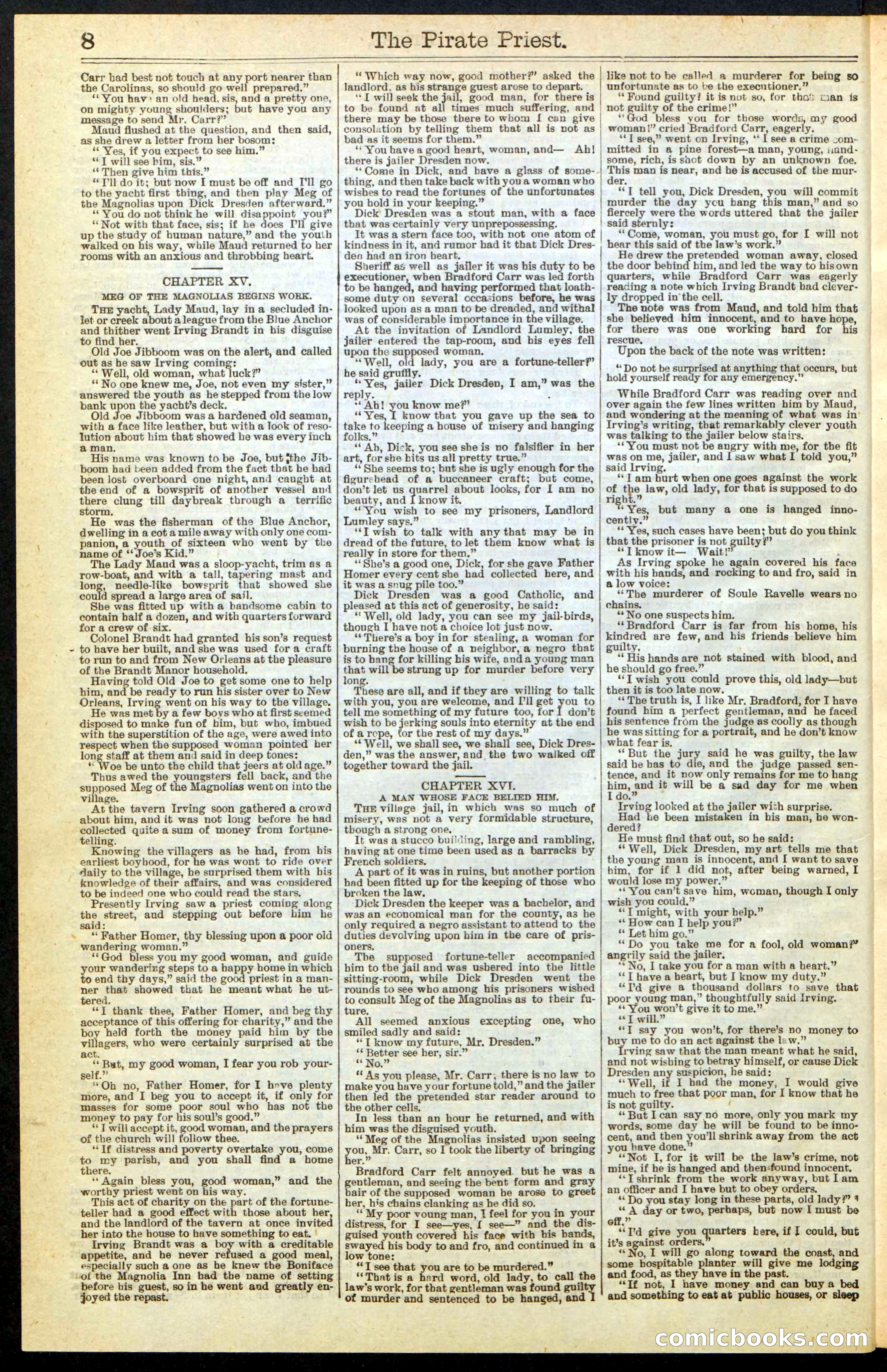
A restored page from Pulp Fiction, 1883. Page through the whole issue in the reader above.
📄 Transcribed text from this page (OCR, searchable)
Machine-transcribed from the original scan — historical spelling and the odd misread are preserved.
8 The Pirate Priest. _--——_ Carr bad best not touch at any port nearer than the Carolinas, so should go well prepared.” ‘*You hav? an old head, sis, and a pretty one, on mighty young shoulders; but have you any message to send Mr. Carr?” Maud flushed at the question, and then said, as she drew a letter from her bosom: “« Yes, if you expect to see him.” “T will see bim, sis.” ‘*Then give him this.” *Tll do it; but now I must be off and I'll go to the yacht first thing, and then play Meg of the Magnolias upon Dick Dresden afterward.” ** You do not think he will disappoint you?’ ** Not with that face, sis; if he does [Pll give up the study of human nature,” and the youth walked on his way, while Maud returned to her rooms with an anxious and throbbing heart. CHAPTER XV, MEG OF THE MAGNOLIAS BEGINS WORK. THE yacht, Lady Maud, lay in a secluded in- let or creek about a league from the Blue Anchor : and thither went Irving Brandt in bis disguise to find her. Old Joe Jibboom was on the alert, and called out as he saw Irving coming: “Well, old woman, what luck?” ** No one knew me, Joe, not even my sister,” answered the youth as he stepped from the low bank ets the yacht’s deck. Old Joe Jibboom was a hardened old seaman, with a face like leather, but with a look of reso- lution about him that showed he was every inch a man. His name was known to be Joe, but jthe Jib- boom had been added from the fact that he had been lost overboard one night, and caught at the end of a bowsprit of another vessel and there clung till daybreak through a_ terrific storm. He was the fisherman of the Blue Anchor, dwelling in a cot a mile away with only one com- panion, a youth of sixteen who went by the name of ‘‘ Joe’s Kid.” The Lady Maud was a sloop-yacht, trim as a row-boat, and with a tall, tapering mast and long, needle-like bowsprit that showed she could spread a large area of sail. She was fitted up with a bandsome cabin to ‘ contain half a dozen, and with quarters forward for a crew of six. Colonel Brandt had granted his son’s request ~ to have her built, and she was used fora craft to run to and from New Orleans at the pleasure of the Brandt Manor household. ; Having told Old Joe to get some one to help him, and be ready to run his sister over to New Orleans, Irving went on his way to the village. He was met by a few bovs who at first seemed ‘ disposed to make fun of him, but who, imbued with the superstition of the age, were awed into respect when the supposed woman pointed her long staff at them and said in deep tones: 5 Woe be unto the child that jeers at old age.” Thus awed the youngsters fell back, and the supposed Meg of the Magnolias went on into the village. At the tavern Irving soon gathered a crowd - about him, and it was not long before he had collected quite a sum of money from fortune- telling. Knowing the villagers as he had, from bis ; earliest boybood, for he was wont to ride over a daily to the village, he surprised them with his - knowledge of their affairs, and was considered to be indeed one who could read the stars, Presently Irving saw a priest coming along sme street, aud stepping out before him he said: , ~ ‘Father Homer, thy blessing upon a poor old f wandering woman.” ‘ **God bless you my good woman, and guide our wandering steps to a bappy home in which Be 16 end thy days,” said the good priest in a man- ner that showed that he meant what he ut- tered. “‘T thank thee, Father Homer, and beg thy 4 acceptance of this offering for charity,” and the he boy held forth the money paid him by the : villagers; who were certainly surprised at the act. + But, my good woman, I fear you rob your- “Ob no, Father Homer, for I hve plenty more, and I beg you to accept it, if only for ¢ masses for some poor soul who has not the = money to pay for his soul’s good.” i ‘**T will accept it, good woman, and the prayers ‘ of the church will follow thee. | ‘If distress and poverty overtake you, come my parish, and you shall find a home there, \— ‘* Again bless you, good woman,” and the worthy priest went on his way. This act of charity on the part of the fortune- ; teller had a good effect with those about her, and the landlord of the tavern at once invited oie her into the house to have something to eat. | 2 Irving Brandt was a boy with a creditable ae appetite, and he never refused a good meal, ba especially such a one as he knew the Boniface vol the Magnolia Inn had the name of setting before bis guest, so in he went and greatly en- joyed the repast. “Which way now, good mother?’ asked the landlord, as his strange guest arose to depart. ‘* I will seek the jail, good man, for there is to be found at all times much suffering, and there may be those there to whom I[ can give consolation by telling them that all is not as | bad as it seems for them.” ‘* You have a good heart, woman, and— there is jailer Dresden now. **Come in Dick, and bave a glass of some- Ah! like not to be called a murderer for being so unfortunate as to be the execntioner.” ‘ “Found guilty? it is not so, for thas Man is ' not guilty of the crime!” | “God bless you for those words, my good woman!” cried Bradford Carr, eagerly. ‘** I see,” went on Irving, *‘ | see a crime com- | mitted in a pine forest—a man, young, jiand- some, rich, is saot down by an unknown foe, | This man is near, and he is accused of the mur- thing, and then take back with you a woman who | de wishes to read the fortunes of the unfortunates you hold in your keeping.” Dick Dresden was a stout man, with a face that was certainly very unprepossessing. It was a stern face too, with not one atom of | kindness in it, and rumor had it that Dick Dres- deo had an iron heart. Sheriff as well as jailer it was his duty to be executioner, wben Bradford Carr was led forth to be hanged, and having performed that loath- some duty on several occasions before, he was looked upon as a man to be dreaded, and withal was of considerable importance in the village. At the invitation of Landlord Lumley, the jailer entered the tap-room, and bis eyes fell upon the supposed woman. ‘‘Well, old lady, you are a fortune-teller?”’ he said gruffly. ‘Yes, jailer Dick Dresden, I am,” was the reply. ** Ah! you know me?” ‘* Yes, [ know that you gave up the sea to take to keeping a house of misery and hanging folks.” ‘* Ah, Dick, you see she is no falsifier in her art, for she bits us all pretty true.” ‘* She seems to; but she is ugly enough for the figurehead of a buccaneer craft; but come, don’t let us quarrel about looks, for 1 am no beauty, and | know it. ‘You wish to see my prisoners, Landlord Lumley says.” ‘‘T wish to talk with any that may be in dread of the future, to let them know what is really in store for them,” ‘‘She’s a good one, Dick, for she gave Father Homer every cent she had collected here, and it was a snug pile too.” Dick Dresden was a good Catholic, and pleased at this act of generosity, be said: ‘Well, old lady, you can see my jail-birds, though I have not a choice lot just now. ‘¢There’s a boy in for stealing, a woman for burning the house of a neighbor, a negro that is to hang for killing his wite, anda young man that will be strung up for murder before very long. These are all, and if they are willing to talk with you, you are welcome, and [’ll get you to tell me something of my future too, for lI don’t wish to be jerking souls into eternity at the end of a rope, for the rest of my days.” ** Well, we shall see, we shall see, Dick Dres- den,” was the answer, and the two walked off together toward the jail. CHAPTER XVI. A MAN WHOSE FACE BELIED HIM. THE village jail, in which was so much of misery, was not a very formidable structure, tbough a strong one. It was a stucco building, large and rambling, having at one time been used as a barracks by French soldiers. A part of it was in ruins, but another portion had been fitted up for the keeping of those who broken the law, Dick Dresden the keeper was a bachelor, and was an economical man for the county, as he only required a negro assistant to attend to the duties devolving upon him in the care of pris- oners, The supposed fortune-teller accompanied him to the jail and was ushered into the little sitting-room, while Dick Dresden went the rounds to see who among his prisoners wisbed to consult Meg of the Magnolias as to their fu- ture. All seemed anxious excepting one, who smiled sadly and said: ‘‘T know my future, Mr, Dresden.” ‘¢ Better see her, sir.” ee No.” ** As you please, Mr. Carr, there is no law to make you have your fortune told,” and the jailer then led the pretended star reader around to the other cells, ‘ In less than an hour he returned, and with him was the disguised youth. ‘Meg of the Magnolias insisted upon seeing is Risa Carr, so I took the liberty of bringing er. Bradford Carr felt annoyed. but he was a gentleman, and seeing the bent form and gray bair of the supposed woman he arose to greet her, his chains clanking as he did so. ‘My poor voung man, 1 feel for you in your distress, for I see—yes, { see—” and the dis- guised youth covered his face with bis bands, swayed his body to and fro, and continued in a low tone: **T see that you are to be murdered.” “That is a heard word, old lady, to call the law’s work, for that gentleman was found guil of murder and sentenced to be hanged, and e | “T tell you, Dick Dresden, you will commit | murder the day ycu hang this man,” and so _flercely were the words uttered that the jailer | said sternly: “Come, woman, you must go, for I will not hear this said of the law’s wore He drew the pretended woman away, closed _ the door behind him, and led the way to hisown quarters, while Bradford Carr was eagerly reading a note which Irving Brandt bad clever- ly dropped inthe cell. The note was from Maud, and told him that she believed him innocent, and to have hope, for there was one working hard for hig rescue, Upon the back of the note was written: * Do not be surprised at anything that occurs, but hold yourself ready for any emergency.” | While Bradford Carr was reading over and over again the few lines written bim by Maud, and wondering at the meaning of what was in’ Irving’s writing, that remarkably clever youth was talking to the jailer below stairs. | ‘*You must not be angry with me, for the fit was on me, jailer, and | saw whatI told you,” said Irving. ‘*T am hurt when one goes against the work of t 18 law, old lady, for that is supposed to do righ ‘ ‘Yes, but many a one is hanged inno- cently.” ** Yes, such cases have been; but do you think that the prisoner is not guilty ” *T know it— Wait! i As Irving spoke he again covered his face with his hands, and rocking to and fro, said in a low voice: ‘‘The murderer of Soule Ravelle wears no chains. “* No one suspects him. ‘*Bradford Carr is far from his home, his kindred are few, and his friends believe him guilty, ‘* His hands are not stained with blood, and he should go free.” “‘T wish you could prove this, old lady—but then it is too late now. ‘“‘ The truth is, I like Mr. Bradford, for I have found him a perfect gentleman, and he faced his sentence from the judge as coolly as though he was sitting for a portrait, and he don’t know what fear is. ‘‘But the jury said he was guilty, the law said he has to die, and the judge passed sen- tence, and if now only remains for me to hang ie it will be a sad day for me when do. Irving looked at the jailer with surprise. Had he been mistaken in his man, be won- dered? He must find that out, so he said: “Well, Dick Dresden, my art tells me that the young man is innocent, and [ want to save him, for if 1 did not, after being warned, I would lose my power.” ‘* You can’t save him, woman, though I only wish you could,” “T might, with your belp.” ** How can I help you?” ** Let him go,” ““Do you take me for a fool, old woman?” | angrily said the jailer. “* No, I take you for a man with a heart.” **T have a heart, but I know my duty.” “Td give a thousand dollars to save that poor young man,” thoughtfully said Irving. ‘* You won’t give it to me.” J will.” “I say you won’t, for there’s no money to ~ a? me to do an act against the lew.” ‘ving saw that the man meant what he said, and not wishing to betray himself, or cause Dick Dresden any suspicion, he said: ‘Well, if I had the money, I would give much to free that poor man, for I know that he is not guilty. ‘ ‘But Ican say no more, only you mark my words, some day he will be found to be inno- cent, and then you'll shrink away from the act you have done,” “‘Not I, for it will be the law’s crime, not mine, if he is hanged and then-found innocent. ‘‘T shrink from the work anyway, but lam an officer and I have but to obey orders. ‘*Do you stay long in these parts, old lady?” 4 “A y or two, perhaps, but now I must be ? off quarters kere, if | could, but <a at tt LL LLL LLL LLL LLL LLL LL LLL LL LLL “T'd give you it’s against orders. “No, I will go along toward the coast, and some hospitable planter will give me lodging — and food, as they have in the past. “Tf not, I have money and can buy a bed and something to eat at public houses, or sleep em OSES CO