
Pulp Fiction, 1883 · page 9 of 32
Beadle's New York Dime Library No. 255 — page 9: what you’re looking at
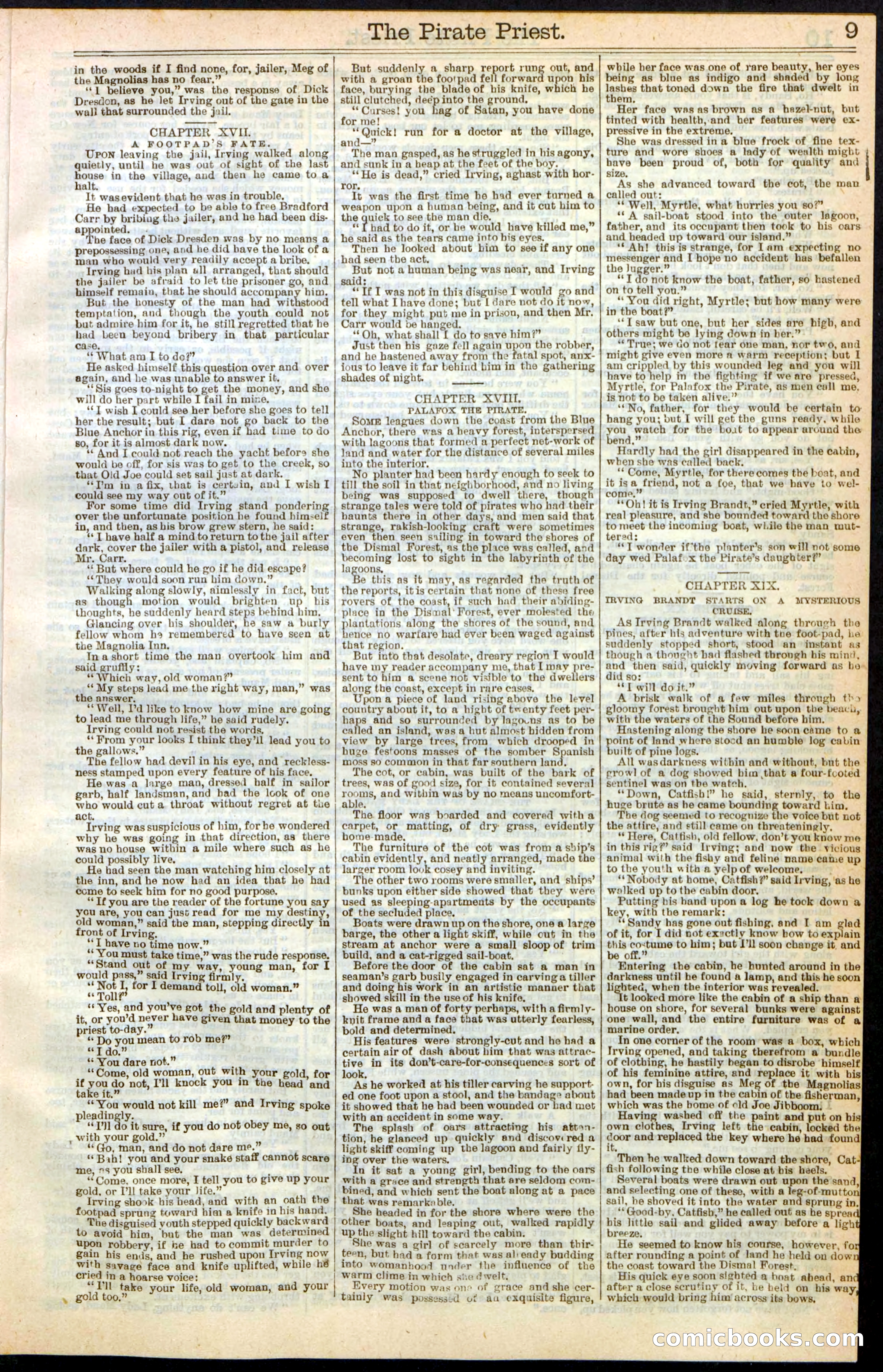
A restored page from Pulp Fiction, 1883. Page through the whole issue in the reader above.
📄 Transcribed text from this page (OCR, searchable)
Machine-transcribed from the original scan — historical spelling and the odd misread are preserved.
The Pirate Priest. 3 ar 2 ‘ in the woods if I find none, for, jailer, Meg of the Magnolias has no fear,” ‘‘] believe you,” was the response of Dick Dresdon, as he let Irving out of the gate in the wall that surrounded the jail. CHAPTER XVII. A FOOTPAD’S FATE. UPON leaving the jail, Irving walked along quietly, until he was out of sight of the last nee in the village, aud then he came toa alt. It wasevident that he was in trouble, He bad expected to be able to free Bradford Carr by bribing the jailer, and he had been dis- appointed. . The face of Dick Dresden was by no means a prepossessing one, and he did bave the look of a man who would very readily accept a bribe. Irving had his plan all arranged, that should the jailer be afraid to let the prisoner go, and himself remain, that he should accompany him. But the honesty of the man had withstood temptation, and though the youth could not but admire him for it, he still regretted that he had been beyond bribery in that particular case. ‘¢ What am I to do?” He asked himself this question over and over again, and he was unable to answer ib, ‘Sis goes to-night to get the money, and she will do her part while I fail in mine. ‘‘T wish I could see her before she goes to tell her the result; but I dare not go back to the Blue Anchor in this rig, even if had time to do so, for it is almost dark now. ** And I could not reach the yacht before she would be off, for sis was to get to the creek, so that Old Joe could set sail just at dark. ‘Tm in a fix, that is certuin, and I wish I could see my way out of it.” For some time did Irving stand pondering over the unfortunate position he found himself in, and then, as his brow grew stern, he said: ‘*T have half a mind to return tothe jail after dark, cover the jailer with a pistol, and release Mr. Carr. ‘“* But where could he go if he did escape? ‘*They would soon run him down,” Walking along slowly, aimlessly in fact, but as though motion would brighten up_ his thoughts, he suddenly heard steps behind him. Glancing over his shoulder, he saw a burly fellow whom hs remembered to have seen at the Magnolia Inn, Inashort time the man overtook him and said grufily: “Which way, old woman?” ** My steps lead me the right way, man,” was the answer. ** Well, I'd like to know how mine are going to lead me through life,” be said rudely. Irving could not resist the words, **From your looks [ think they’il lead you to the gallows.” The fellow had devil in his eye, and reckless- ness stamped upon every feature of his face. He was a large mano, dressed balf in sailor garb, half landsman, and had the look of one who would cut a throat without regret at the act. Irving was suspicious of him, for he wondered why he was going in that direction, as there was no house within a mile where such as he could possibly live. He had seen the man watching him closely at the inn, and he now had an idea that he had come to seek him for no good purpose, “‘ Tf you are the reader of the fortune you say you are, you can just read for me my destiny, old woman,” said the man, stepping directly in front of Irving. ‘*T have no time now.” ri You must take time,” was the rude response. ‘Stand out of my way, young man, for I would pass,” said Irving firmly. ** Not I, for I demand toll, old woman.” “Toll? “Yes, and you’ve got the gold and plenty of it, or you’d never have given that money to the priest to-day.” “ Do you mean to rob me?” So I do.” * You dare not.” . ‘Come, old woman, out with your gold, for if you do not, I'll knock you in the head and take it.” “You would not kill me?” and Irving spoke pleadingly. ‘““1’)] do it sure, if you do not obey me, so out _ with your gold.” ‘‘@o, man, and do not dare me.” ‘*Bah! you and your snake staff cannot scare me, 7s you shall see, , “Come, once more, I tell you to give up your gold, or I’ll take your life.” Irving shook bis bead, and with an oath the footpad sprung toward him a knife in his hand. The disguised youth stepped quickly backward to avoid him, ‘but the man was determined upon robbery, if be had to commit murder to ain his ends, and he rushed upon Irving now with savage face and knife uplifted, while hé cried in a hoarse voice: I'll take your life, old woman, and your , gold too,” LLL LLL LLL LLL LLL LLL LLL LLL LLL LLL LL LL LL A RRL LE mL OT But suddenly a_ sharp renerk rung out, and with a groan the foo'pad fell forward upon his face, burying the blade of his knife, which he still clutched, nese into the ground, “Curses! you hag of Satan, you have done for me! 4 Quick! run for a doctor at the village, and—” The man gasped, as he struggled in his agony, and sunk in a heap at the feet of the boy. *‘He is dead,” cried Irving, aghast with hor- ror. It was the first time he had ever turned a weapon upon a human being, and it cut him to the quick to see the man die. *‘T had to do it, or he would have killed me,” he said as the tears came into bis eyes. Then he looked about him to see if any one had seen the act. But not a human being was near, and Irving said: “Tf T was not in this disguise I would go and tell what I have done; but | dare not do it now, for they might put me in prison, and then Mr. Carr would be hanged. ‘‘Oh, what shall [ do to save him?” Just then his gaze fell again upon the robber, and he hastened away from the fatal spot, anx- ious to leave it far behind bim in the gathering shades of night. CHAPTER XVIII, PALAFOX THE PIRATE. Some leagues down the coast from the Blue Anchor, there was a heavy forest, interspersed with lagoons that formed a perfect net-work of land and water for the distance of several miles into the interior. No planter had been hardy enough to seek fo till the soil in that neighborhood, and no living being was supposed to dwell there, though strange tales were told of pirates who had their haunts there in other days, and men said that strange, rakish-looking craft were sometimes even then seen sniling in toward the shores of the Dismal Forest, as the place was called, and mag lost to sight in the labyrinth of the agoons, e this as it may, as regarded the truth of the reports, itis certain that none of these free rovers of the coast, if such had their abiding- place in the Dismal‘ Forest, ever molested the se ae along the shores of the sound, and ence no warfare bad ever been waged against that region. But into that desolate, dreary region I would have my reader accompany me, that I may pre- sent to him a scene not visible to the dwellers along the coast, except in rare cases, Upon a piece of land rising above the level country about if, to a hight of teenty feet per- haps and so surrounded by lagovns as to be called an island, was a hut almost bidden from view by large trees, from which drooped in huge festoons masses of the somber Spanish moss so common in that far southern land. The cot, or cabin, was built of the bark of trees, was of good size, for it contained several soos, and within was by no means uncomfort- able. The floor was boarded and covered witha carpet, or matting, of dry grass, evidently home-made. The furniture of the cot was from a sbip’s cabin evidently, and neatly arranged, made the larger room look cosey and inviting. The other two rooms were smaller, and ships’ bunks upon either side showed that they were used as sleeping-apartments by the occupants of the secluded place, Boats were drawn up on the shore, one a large barge, the other a light skiff, while out in the stream at anchor were a small sloop of trim build, and a cat-rigged sail-boat, Before the door of the cabin sat a man in seaman’s garb busily engaged in carvinga tiller and doing his work in an artistic manner that showed skill in the use of his knife, He was a man of forty perhaps, with a firmly- knit frame and a face that was utterly fearless, bold and determined. His features were strongly-cut and he had a certain air of dash about him that was attrac- tive in its don’t-care-for-consequences sort of look, As he worked at his tiller carving he support- ed one foot upon a stool, and the bandage about it showed that he had been wounded or bad met with an accident in some way. The splash of oars attracting his atton- tion, he glanced up quickly and discovcred a light skiff coming up the lagoon and fairly fly- ing over the waters. In it sat a young girl, bending to the oars with a grace and strength that are seldom com- bined, and which sent the boat along at a pace that was remarkable. She headed in for the shore where were the other boats, and leaping out, walked rapidly up the slight hill toward the cabin. She was a girl of scarcely more than thir- teen, but had a form that was already budding into womanhood under the influence of the warm Clime in which she dwelt, Every motion was ons of grace and she cer- tainly was possesscd of aa exquisite figure, while her face was one of rare beauty, her eyes being as blue as indigo and shaded by long seaber that toned down the fire that dwelt in em, Her face was as brown as a hazelnut, but tinted with health, and her features were ex- pressive in the extreme. She was dressed in a blue frock of fine tex- ture and wore shoes a lady of wealth might have been proud of, both for quality and size, As she advanced toward the cot, the man called out: ‘ ** Well, Myrtle, what hurries you so?” ‘* A sail-boat stood into the outer lagoon, father, and its occupant then took to his oars and headed up toward our island.” ‘* Ah! this is strange, for Lam expecting no messenger and [ hope no accident has befallen the Jugger.” . **T do not know the boat, father, so hastened on to tell you.” | “You did right, Myrtle; but how many were in the boat?” ‘*T saw but one, but her sides are high, and others might be lying down in her.” “True; we co not fear one man, nor two, and might give even more a warm reception; but I am crippled by this wounded leg and you will have to help in the fighting if we are pressed, Myrtle, for Palafox the Pirate, as men call me, is not to be taken alive.” ‘*No, father, for they would be certain to hang you; dut I will get the guns ready, while you watch for the boat to appear around the bend,” Hardly had the girl disappeared in the cabin, when she was called back. ‘* Come, Myrtle, for there comes the boat, and it isa friend, not a foe, that we have to wel- come,” **Oh! it is Irving Brandt,” cried Myrtle, with real pleasure, and she bounded toward the shore to meet the incoming boat, while the man mut- tered; *“T wonder if*the planter’s son will not some day wed Palafox the Pirate’s daughter?” oe CHAPTER XIX, | IRVING BRANDT STARTS ON A MYSTERIOU CRUISE, As Irving Brandt walked along through the pines, after his adventure with the foot-pad, he suddenly stopped short, stood an instant as. though a thought bad flashed throngh his mint, and then said, quickly moving forward as be» did so: ‘ST will doit.” A brisk walk of a few miles through th» gloomy forest brought him out upon the beach, with the waters of the Sound before him. Hastening along the shore he soon came to a point of land where stocd an humble log cabin built of pine logs. , All was darkness within and without, but the — erowlof a dog showed bim that a four-fcoted sentinel was on the watch. ‘Down, Catfish!” he said, sternly, to the huge brute as he came ee eee him, The dog seemed to recognize the voice but not the attire, and stillcame on threateningly, = ** Here, Cattish, old fellow, don’t-you know me in this rig?’ said Irving; and now the vicious animal with the fishy and feline name came up to the youth with a yelp of welcome. tae ‘Nobody at home, Catfish?’ said Irving, ‘as he walked up to the cabin door. . Putting bis band upon a log he tock down a key, with the remark; f ‘Sandy has gone out fishing, and I am glad of it, for I did not exectly know how to explain ony 9 a to him; but I'll soon change it, and off. Entering the cabin, he hunted around in the darkness until he found a lamp, and this he soon lighted, when the interior was revealed. & t looked more like the cabin of a ship than a house on shore, for several bunks were against one wall, and the entire furniture was of a marine order. ME Poe {In one corner of the room was a box, which Irving opened, and taking therefrom a bundle of clothing, he hastily began to disrobe himself of his feminine attire, and replace it with bis own, for his disguise as Meg of the Magnolias had been made up in the cabin of the fisherman, which was the bome of old Joe Jibboom: Having washed off the paint and put on his own clothes, Irving left the eabin, locked the door and replaced the key where he had found it, Fis J Then he walked down toward the shore, Cat fish following the while close at bis heels. __ Several boats were drawn out upon the sand, and selecting one of these, with a leg-of-muttor sail, he shoved it into the water an sprung in, _‘“Good-by, Catfish,” he called out as he spreac bis little sail and glided away before a light breeze. vi wt . He seemed to know his course, however, for after rounding a point of land he held on dowr the coast toward the Dismal Forest, _ tx His quick eye soon sighted a boat ahead, an¢ after a close scrutiny of it, be beld on his wa which would bring him across its bows. | ‘ con com S Eboo