
Pulp Fiction, 1883 · page 7 of 32
Beadle's New York Dime Library No. 255 — page 7: what you’re looking at
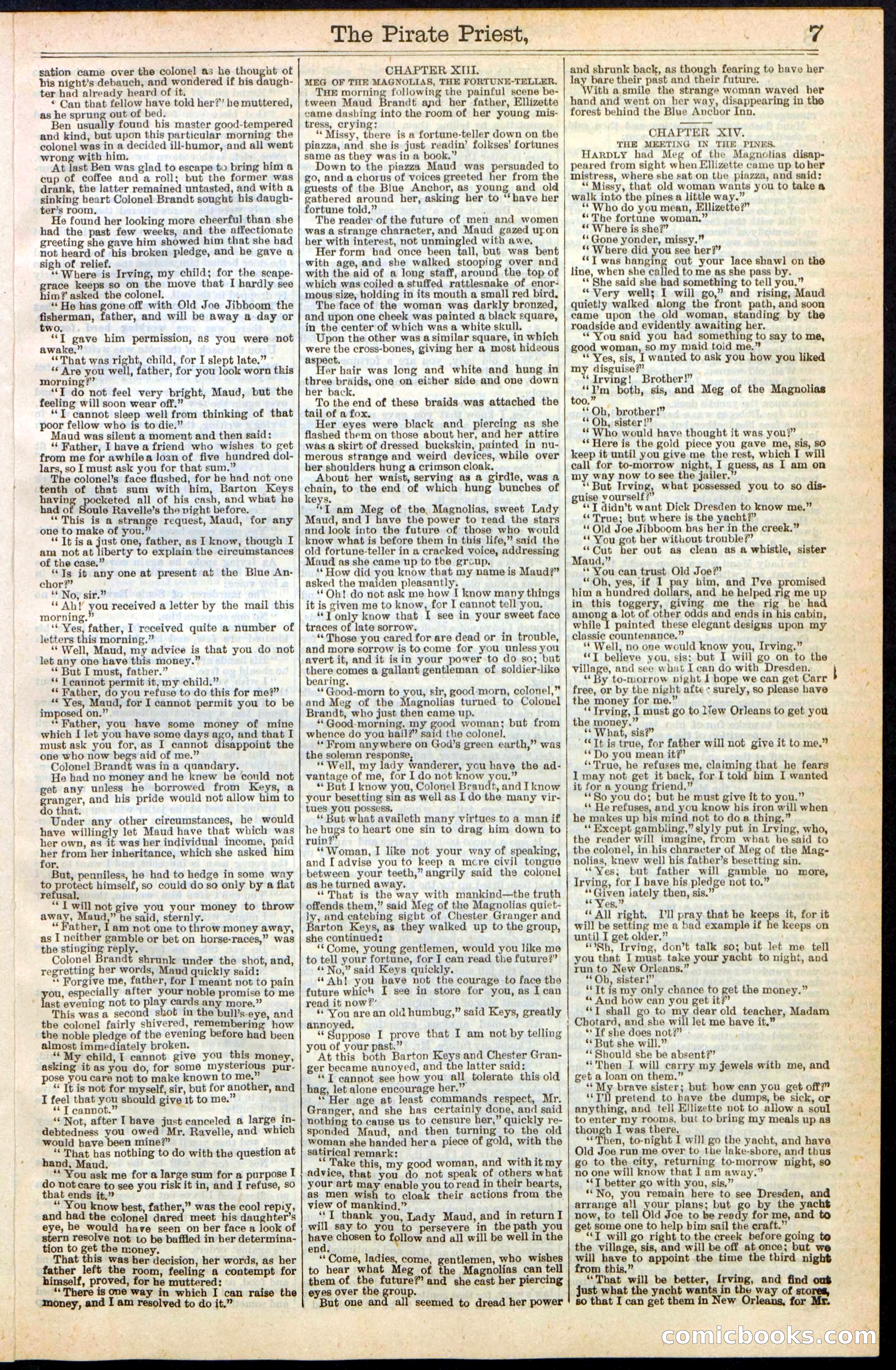
A restored page from Pulp Fiction, 1883. Page through the whole issue in the reader above.
📄 Transcribed text from this page (OCR, searchable)
Machine-transcribed from the original scan — historical spelling and the odd misread are preserved.
sation came over the colonel as he thought of his night’s debauch, and wondered if bis daugh- ter had already heard of it. * Can that fellow have told her?’ he muttered, as he sprung out of bed. Ben usually found his master good-tempered and kind, but upon this particular morning the colonel was in a decided ill-humor, and all went wrong with him. At last Ben was glad to escape to bring him a cup of coffee and a roll; but the former was drank, the latter remained untasted, and with a sinking heart Colonel Brandt sought his daugh- ter’s room, He found her looking more cheerful than she had the past few weeks, and the affectionate greeting she gave him showed him that she had not heard of his broken pledge, and he gave a sigh of relief. , ‘‘ Where is Irving, my child; for the scape- grace keeps so on the move that I hardly see him? asked the colonel. “ He has gone off with Old Joe Jibboom the fisherman, father, and will be away a day or two. ‘“‘T gave him permission, as you were not awake,” “That was right, child, for I slept late.” “ Are you well, father, for you look worn this morning?’ ‘‘T do not feel very bright, Maud, but the feeling will soon wear off.” “T cannot sleep well from thinking of that poor fellow who is to die.” Maud was silent a moment and then said: ‘‘ Father, I have a friend who wishes to get from me for awhilea loan of five hundred dol- lars, so I must ask you for that sum.” The colonel’s face flashed, for he had not one tenth of that sum with him, Barton Keys oe sporected, all of his cash, and what he had o ule Ravelle’s the night before. “This is a strange request, Maud, for any one to make of you.” ‘It is a just one, father, as I know, though I am not at liberty to explain the circumstances of the case.” ‘Ts it any one at present at the Blue An- chor?” ** No; sir.” ** Ah! you received a letter by the mail this morning.” ‘* Yes, father, I received quite a number of letters this morning.” ‘* Well, Maud, my advice is that you do not let any one have this money.” ‘** But I must, father.” ** Tcannot permit it, my child.” ‘‘ Father, do you refuse to do this for me?” ** Yes, Maud, for I cannot permit you to be imposed on.” ** Father, you have some money of mine which [ let you have some days ago, and that I must ask you for, as I cannot disappoint the one who now begs aid of me.” Colonel Brandt was in a quandary. He had no money and he knew he could not get any unless he borrowed from Keys, a granger, and his pride would not allow him to do that. Under any other circumstances, he would have willingly let Maud have that which was her own, as if was her individual income, paid a from her inheritance, which she asked him or. But, penniless, he had to hedge in some way to protect himself, so could do so only by a flat refusal, “I will not give you your money to throw away, Maud,” he said, sternly. “ Father, I am not one to throw money away, as I neither gamble or bet on horse-races,” was the stinging reply. Colonel Brandt shrunk under the shot, and, regretting her words, Maud quickly said: ‘* Forgive me, father, for I meant not to pain ou, especially after your noble promise to me fast evening not to play cards any more.” This was a second shot in the bull’s-eye, and the colonel fairly shivered, remembering how the noble pledge of the evening before had been almost immediately broken. * My child, I cannot give you this money, asking it as you do, for some mysterious pur- se you care not to make known to me,” “ Tt is not for myself, sir, but for another, and I feel that you should give it to me.” ‘“‘ T cannot.” : ‘Not, after [have just canceled a large in- debtedness a owed Mr. Ravelle, and which would have been mine?” “That has nothing to do with the question at hand, Maud. “You ask me for a large sum for a purpose I do not care to see you risk it in, and I refuse, so that ends it,” ** You know best, father,” was the cool repiy, and had the eolonel dared meet his daughter’s eye, he would have seen on her face a look of stern resolve not to be baffled in her determina- tion to get the money. That this was her decision, her words, as her father left the room, feeling a contempt for himself, proved, for he muttered: ‘There is one way in which I can raise the money, and I am resolved to do it.” e. . The Pirate Priest, | CHAPTER XIII, MEG OF THE MAGNOLIAS, THE FORTUNE-TELLER, THE morning following the painful scene be- tween Maud Brandt and her father, Ellizette came dashing into the room of her young mis- tress, crying: “Missy, there is a fortune-teller down on the piazza, and she is just readin’ folkses’ fortunes same as they was in a book.” 2 Down to the piazza Maud was persuaded to go, and a chorus of voices greeted her from the guests of the Blue Anchor, as young and old gathered around her, asking her to ‘‘bave her fortune told,” The reader of the future of men and women was a strange character, and Maud gazed upon her with interest, not unmingled with awe, Her form had once been tall, but was bent with age, and she walked opening over and with the aid of a long staff, around the top of which was coiled a stuffed rattlesnake of enor- mous size, holding in its mouth a small red bird, The face of the woman was darkly bronzed, and upon one cheek was painted a black square, in the center of which was a white skull. Upon the other was a similar square, in which were the cross-bones, giving her a most hideous aspect. fer bair was long and white and hung in three braids, one on either side and one down ber back, To the end of these braids was attached the tail of a fox. Her eyes were black and piercing as she flashed them on those about her, and her attire was a skirt of dressed buckskin, painted in nu- merous strange and weird devices, while over her shoulders hung a crimson cloak. About her waist, serving as a girdle, was a “sen to the end of which hung bunches of eys. ‘IT am Meg of the, Magnolias, sweet Lady Maud, and] have the power to read the stars and look into the future of those who would know what is before them in this life,” said the old fortune-teller in a cracked voice, addressing Maud as she came up to the group. ‘‘ How did you know that my name is Maud?” asked the maiden pleasantly, ‘‘Oh! do not ask me how I know many things it is given me to know, for I cannot tell you, “T only know that I see in your sweet face traces of late sorrow. ‘Those you cared for are dead or in trouble, and more sorrow is tocome for you unless you avert it, and it isin your power to do so; but there comes a gallant gentleman of soldier-like bearing. ‘“‘ood-morn to you, sir, good-morn, colonel,” and Meg of the Magnolias turned to Colonel Brandt, who just then came up. ‘‘Good-morning, my good woman; but from whence do you hail?” said the colonel. ‘From anywhere on God’s green earth,” was the solemn response, ‘*' Well, my lady wanderer, you have the ad- vantage of me, for I do not know you,” * But I know you, Colonel Brandt, and Iknow your besetting sin as well as 1 do the many vir- tues you possess, ** But what availeth many virtues to a manif he hugs to heart one sin to drag him down to ruin? ‘“*Woman, I like not your way of speaking, and [advise you to keep a mcre civil tongue between your teeth,” angrily said the colonel as he turned away, “That is the way with mankind—the truth offends them,” said Meg of the Magnolias quiet- ly, and catebing sigbt of Chester Granger and arton Keys, as they walked up to the group, she continued: ‘¢Come, young gentlemen, would you like me to tell your fortune, for I can read the future?” ‘¢ No,” said Keys quickly. “ Ah! you bave not the courage to face the future which I see in store for you, as I can read it now?’ . ‘* You are an old humbug,” said Keys, greatly annoyed, ; ‘‘ Suppose I prove that I am not by telling you of your past.” At this both Barton Keys and Chester Gran- ger became annoyed, and the latter said: ‘“T cannot see how you all tolerate this old hag, let alone encourage her.” ‘Her age at least commands respect, Mr. Granger, and she has certainly done, and said nothing to cause us to censure her,” quickly re- sponded Maud, and then turning to the old woman she handed hera piece of gold, with the satirical remark: ‘“ Take this, my good woman, and withit my advice, that you do not speak of others what your art may enable you to read in their hearts, as men wis view of mankind.” ‘§ I thank you, Lady Maud, and in return I will say to you to persevere in the path you have chosen to follow and all will be well in the end. “Come, ladies, come, gentlemen, who wishes to hear what Meg of the Magnolias can tell them of the future?’ and she cast her piercing eyes over the group. But one and all seemed to dread her power . _ ‘ Chotard, and she will to cloak their actions from the @ —_—— — and shrunk back, as though fearing to bave her lay bare their past and their future. ith asmile the strange woman waved her hand and went on her way, disappearing in the forest behind the Blue Anchor Inn, CHAPTER XIV. THE MEETING IN THE PINES. | HARDLY had Meg of the Magnolias disap- peared from sight when Ellizette came up to her mnistress, where she sat on the piazza, and said: “ Missy, that old woman wants you to takea walk into the pines a little way.” ‘** Who do you mean, Ellizette?” “The fortune woman.” ** Where is she?” ** Gone yonder, missy.” ** Where did you see her?” **T was hanging out your lace shawl on the line, when she called to me as she pass by. ‘* She said she had something to tell you.” “Very well; I will go,” and rising, Maud quiet!y walked along the front path, and soon came upon the old woman, standing by the roadside and evidently awaiting her. ‘* You said you had something to say to me, good woman, so my maid toid me,” ‘Yes, sis, I wanted to ask you how you liked my disguise?” ‘Irving! Brother!” sot Pm both, sis, and Meg of the Magnolias 0 **Oh, brother!” ** Oh, sister!” “Who would have thought it was you?” ‘*Here is the gold piece you gave me, sis, SO keep it until you give me the rest, which I will call for to-morrow night, I guess, as I am on my way now to see the jailer.” ‘‘But Irving, what possessed you to so dis- guise yourself?” “‘T didn’t want Dick Dresden to know me,” ‘True; but where is the yacht?” ‘© Old Joe Jibboom has her in the creek.” ‘¢- You got ber without trouble?’ ** Cut un out as clean as a whistle, sister Maud.” ** You can trust Old Joe?” “Oh, yes, if I pay him, and I’ve promised him a hundred dollars, and he helped rig me u in this toggery, giving me the rig he had among a lot of other odds and ends in his cabin, while I painted these elegant designs upon my classic countenance.” “ Well, no one would know you, Irving.” ‘‘T believe you, sis: but I will go on to the village, and see what I can do with Dresden. ‘* By to-morrow night 1 hope we can get Carr free, or by the night afte + surely, so please have the money for me.” ‘Trying, I must go to lew Orleans to get you the money.” ** What, sis?” “Tt is true, for father will not give it to me,” ‘*Do you mean it?” **True, he refuses me, claiming that he fears Il may not get it back, for 1 told him I wanted it for a young friend.” **So you do; but he must give it to you.” ** He refuses, and you know bis iron will when he makes up bis mind not to do a thing.” ‘* Except gambling,” slyly put in Irving, who, the reader will imagine, from what he said to the colonel, in. his character of Meg of the Mag- nolias, knew well his father’s besetting sin. ‘Yes; but father will gamble no more, Irving, for I have his pledge not to.” "Given lately then, sis.” ‘All right. Ill pray that be keeps it, for it will be setting me a bad example if he keeps on until I get older.” ‘OSh, Irving, don’t talk so; but let me tell you that, I must take your yacht to night, and run to New Orleans.” ‘Ob, sister!” “It is my only chance to get the money.” * And how can you get it?” ‘‘T shall go to my dear old teacher, Madam let me have it,” ** Tf she does not?” ** But she will.” ‘*Should she be absent?’ *“Then I will carry my jewels with me, and get a loan on them.” ‘* My brave sister; but how ean you get off?” ‘‘ Tl] pretend to have the dumps, be sick, or anything, and tell Ellizette not to allow a soul to enter my rooms, but to bring my meals up as though I was there. ‘Then, to-night I will go the yacht, and have Old Joe run me over to the lake-sbore, and thus go to the city, returning to-morrow night, so no one will know that I am away.” ‘*T better go with you, sis,” ‘*No, you remain here to see Dresden, and arrange all your plans; but go by the yacht now, to tell Old Joe to be een 3 for me, and to get some one to help bim sail the craft.” “T will go right to the creek before going te the village, sis, and will be off at once; but we will have to appoint the time the third night from this,” “That will be better, Irving, and find out vat th t wants in the way of so tha Faruet em in New Orleans, for Mr. _ . s0 that GEomichboo (C S\ol(E)