
Pulp Fiction, 1883 · page 6 of 32
Beadle's New York Dime Library No. 255 — page 6: what you’re looking at
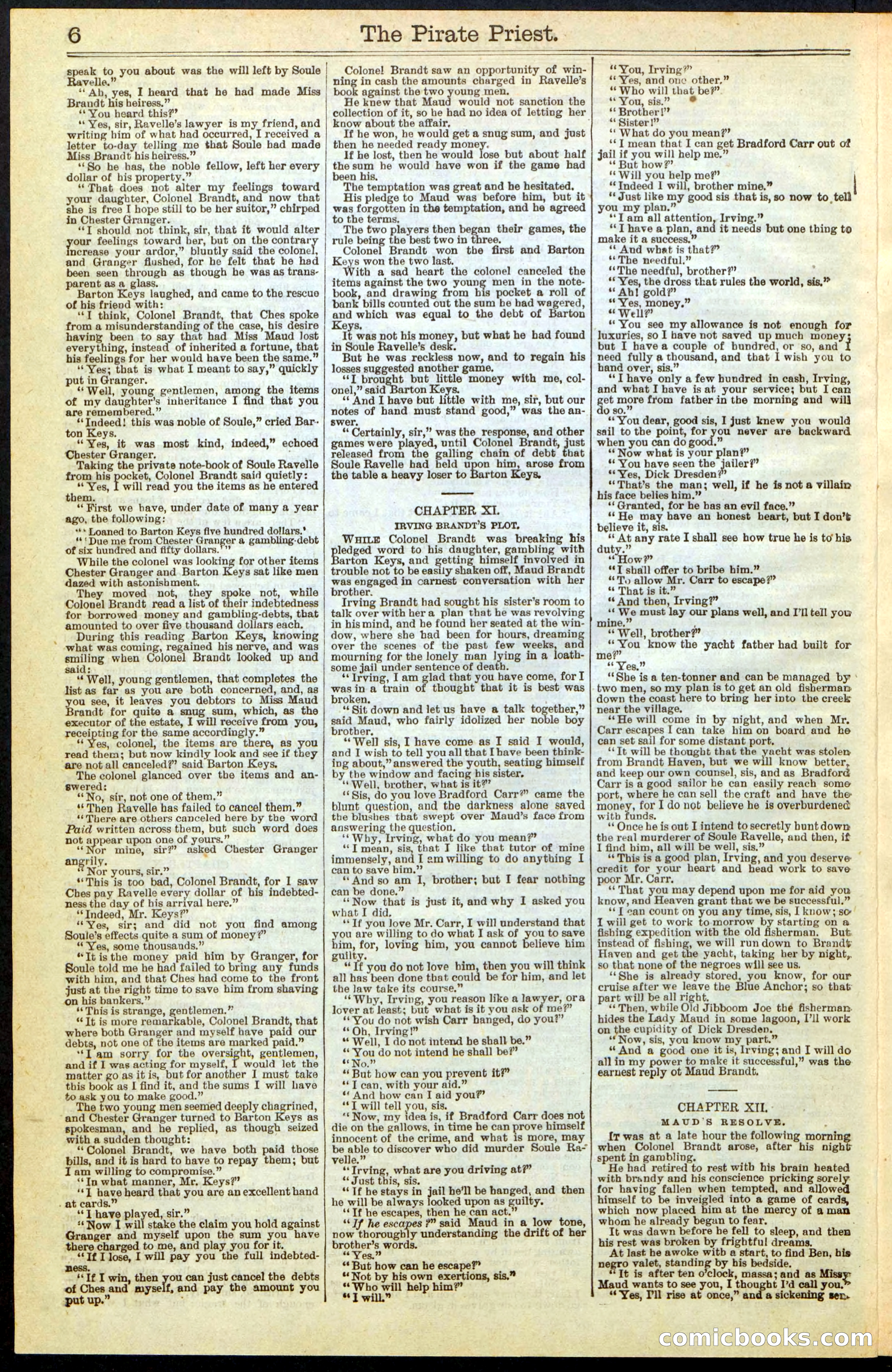
A restored page from Pulp Fiction, 1883. Page through the whole issue in the reader above.
📄 Transcribed text from this page (OCR, searchable)
Machine-transcribed from the original scan — historical spelling and the odd misread are preserved.
* ‘are not all canceled?’ said Barton 6 speak to you about was the will left by Soule velle.” ‘Ab, yes, Brandt his heiress.” ‘* You heard this?’ ‘* Yes, sir, Ravelle’s lawyer is my friend, and writing him of what had occurred, I received a letter to-day telling me that Soule had made Miss Brandt his heiress.” *‘So he has, the noble fellow, left her every dollar of his property.” “That does not alter my feelings toward your daughter, Colonel Brandt, and now that she is free I hope still to be her suitor,” chirped in Chester Granger. **T should not think, sir, that it would alter our feelings toward ber, but on the contrar nerease your ardor,” bluntly said the colonel, and Granger flushed, for be felt that he had been seen through as though be was as trans- parent as a glass. Barton Keys laughed, and came to the rescue of his frievd with: ‘I think, Colonel Brandt, that Ches spoke from a misunderstanding of the case, his desire having been to say that had Miss Maud lost everything, instead of inherited a fortune, that his feelings for her would have been the same.” ‘Yes; that is what I meant to say,” quickly put in Granger. ‘Well, young gentlemen, among the items of my daughter’s inheritance I find that you are remembered.” ‘*Tndeed! this was noble of Soule,” cried Bar. ton Keys. “Yes, it was most kind, indeed,” echoed Chester Granger. Taking the private note-book of Soule Ravelle from his pocket Colonel Brandt said quietly: es Yes, I will read you the items as he entered em. “First we bave, under date of many a year ago, the following: *** Loaned to Barton Keys five hundred dollars.’ ‘*' Due me from Chester Granger a gambling-debt of six bundred and fifty dollars."”’ While the colonel was looking for other items Chester Granger and Barton Keys sat like men dazed with astonishment. They moved not, they spoke not, while Colonel Brandt read a list of their indebtedness for borrowed money and gambling-debts, that amounted to over five thousand dollars each, During this reading Barton Keys, knowing what was coming, regained his nerve, and was ot when Colonel Brandt looked up and said: ““ Well, young gentlemen, that completes the list as far as you are both concerned, and, as ou see, it leaves you debtors to Miss Maud randt for quite a snug sum, which, as the executor of the estate, I will receive from you, receipting for the same accordingly.” ‘Yes, colonel, the items are there, as you read them; but now kindly look and see if they Keys, The colonel glanced over the items and an- swered: ‘“No, sir, not one of them,” ‘Then Ravelle has failed to cancel them.” ‘¢ There are others canceled here by the word Paid written across them, but such word does not appear upon one of yours.” ‘‘Nor mine, sir?’ asked Chester Granger angrily. * Nor yours, sir.” ‘This is too bad, Colonel Brandt, for 1 saw Ches pay Ravelle every dollar of his indebted- ness the day of his arrival bere.” ‘*Indeed, Mr. Keys?” “Yes, sir; and did not you find among Soule’s effects quite a sum of money?” “Yes, some thousands.” “Tt isthe money paid him by Granger, for Soule told me he had failed to bring any funds with him, and that Ches had come to the front just at the right time to save him from shaving on his bankers.” ‘This is strange, gentlemen.” ‘‘ It is more remarkable, Colonel Brandt, that where both Granger and myself have paid our debts, not one of the items are marked paid.” ‘I am sorry for the oversight, gentlemen, and if I was acting for myself, I would let the matter go as itis, but for another I must take this book as I find it, and the sums I will have to ask you to make good.” The two young men seemed deeply chagrined, ‘and Chester Granger turned to Barton Keys as spokesman, and he replied, as though seized with a sudden thought: ‘Colonel Brandt, we have both paid those bills, and it is hard to have to repay them; but I am willing to compromise.” ‘‘In what manner, Mr, Keys?’ ‘‘] have heard that you are an excellent hand _ at car cards.” Tree | pay played, sir.” ‘*‘ Now I will stake the claim you hold against Granger and myself upon the sum you have there cha to me, and play you for it. “Tf T lose, I will pay you the full indebted- mess. “If I win, then you can just cancel the debts of Ches and tf, and pay the amount you | I heard that he had made Miss | book against the two a —_—— nnn es i —_ The Pirate Priest. . oe — Colone! Brandt saw an opportunity of win- ning in cash the amounts charged in Ravelle’s oung men. He knew that Maud would not sanction the collection of it, so he had no idea of letting her know about the affair, If he won, he would get a snug sum, and just then he needed ready cana & If he lost, then he would lose but about half the sum he would have won if the game had been his. The temptation was great and he hesitated, His pledge to Maud was before him, but it was forgotten in the temptation, and he agreed to the terms, The two players then began their games, the rule being the best two in three. Colonel Brandt won tbe first and Barton Keys won the two last. With a sad heart the colonel canceled the items against the two young men in the note- book, and drawing from his pocket a roll of bank bills counted out the sum he had wagered, ae which was equal to the debt of Barton eys, It was not his iyi but what he had found in Soule Ravelle’s desk. But he was reckless now, and to regain his losses suggested another game, ce | prceee but little money with me, col- onel,” said on Keys. ‘‘ And I have but little with me, sir, but our notes of hand must stand good,” was the an- swer. “ Certainly, sir,” was the response, and other games were played, until Colonel Brandt, ne released from the galling chain of debt that Soule Ravelle bad held upon him, arose from the table a heavy loser to Barton Keys, CHAPTER XI. IRVING BRANDT’S PLOT, Wurte Colonel Brandt was breaking his ledged word to his daughter, gambling with rton Keys, and getting himself involved in trouble not to be easily shaken off, Maud Brandt was engaged in carnest conversation with her brother. Irving Brandt had sougbt his sister’s room to talk over with hera plan that he was revolving in his mind, and he found her seated at the win- dow, where she had been for hours, dreamin over the scenes of the past few weeks, an mourning for the lonely man lying in a loath- some jail under sentence of death. ‘Irving, I am glad that you have come, for I was in a train of thought that it is best was broken, ‘“‘ Sit down and let us have a talk together,” said Maud, who fairly idolized her noble boy brother. “Well sis, I have come as I said I would, and I wish to tell you all that [have been think- ing about,” answered the youth, seating himself by the window and facing his sister, ‘Well, brother, what is it?’ ‘Sis, do you love Bradford Carr” came the blunt question, and the darkness alone saved the blushes that swept over Maud’s face from answering the question, ‘Why, Irving, what do you mean?” ‘“‘T mean, sis, that I like that tutor of mine immensely, and I em willing to do anything I can to save him,” ‘‘And so am I, brother; but I fear nothing can be done.” ‘‘Now that is just it, and why I asked you what I did. ‘* Tf you love Mr. Carr, I will understand that you are willing to do what I ask of one to save him, for, loving him, you cannot believe him guilty. “Tf you do not love him, then you will think all has been done tbat could be for him, and let the law take its course.” ‘‘ Why, Irving, you reason like a lawyer, ora lover at least; but what is it you ask of me?” ‘You do not wish Carr banged, do you?” ** Oh, Irving!” * Well, I do not intend be shall be.” “You do not intend he shall be?” «c No.” ‘‘But how can you prevent it?” **T can, with your aid.” ** And how can I aid you?” ‘*T will tell you, sis. ‘‘ Now, my idea is, if Bradford Carr does not die on the gallows, in time he can prove himself innocent of the crime, and what is more, may be able to discover who did murder Soule Ra- velle.” “Irving, what are you driving at?” ** Just this, sis. “Tf he stays in — he'll be hanged, and then he will be always looked upon as guilty. ‘“Tf he escapes, then he can act.” ‘““ Tf he escapes ?” said Maud in a low tone, now thoroughly understanding the drift of her brother’s words. “ss Yes. ” ** But how can he escape?” “Not by his own exertions, sis,” ** Who will hel **T will.” p him?” ‘You, Irving?” ‘*- Yes, and one other,” * Who will that be?” You, sis.” ©© ** Brother!” “* Sister!” ‘What do you mean?” ‘*T mean that I can get Bradford Carr out of jail if you will help me.” ‘* But how?’ ‘Will you help me?” “Indeed I will, brother mine,” ** Just like my good sis that is, so now to tell you my plan.” ) **T am all attention, Irving.” **T have a plan, and it needs but one thing to make it a success,” ** And what is that?” **The needful,” ‘*The needful, brother?” ; ‘** Yes, the dross that rules the world, sis,” * Ah! gold?” ‘Yes, money.” “Well?” “You see my allowance is not enough for luxuries, so I have not saved up much money; but I havea couple of hundred, or so, and t need fully a thousand, and that I wish you to band over, sis.” “‘T have only a few hundred in cash, Irving, and what I have is at your service; but I can get more from father in the morning and wil] O 80. ‘You dear, good sis, I just knew you would sail to the point, for you never are backward when you can do good,” ** Now what is your plan?” ** You have seen the trl ** Yes, Dick Dresden?” “‘That’s the man; well, if he is not a villain his face belies him.” ‘‘ Granted, for he has an evil face.” ‘‘He may have an honest heart, but I don’t believe it, sis. ‘‘ At any rate I shall see how true he is to his duty.” “e How?’ **T shall offer to bribe him.” “T.) allow Mr. Carr to escape?” * That is it.” * And then, Irving?” 6 We must lay our plans well, and I’ll tell you e, UJ ‘Well, brother?” “You know the yacht father had built for me?” sé Yes.” ‘She is a ten-tonner and can be managed by ° two men, so my plan is to get an old fishermam down the coast here to bring her into the creek near the village. **He will come in by night, and when Mr. Carr escapes [can take him on board and he can set sail for some distant port, ‘Tt will be thought that the yacht was stolen from Brandt Haven, but we will know better, and keep our own counsel, sis, and as Bradford Carr is a good sailor he can easily reach some port, where he can sell the craft und have the money, for I do not believe he is overburdened witb funds. ‘* Once he is out I intend to secretly hunt down the real murderer of Soule Ravelle, and then, if I find bim, all will be well, sis.” ‘This is a good plan, Irving, and you deserve — credit for your heart and head work to save poor Mr. Carr. ‘* That you may depend upon me for aid you know, and Heaven grant that we be successful.” ‘*[ ean count on you any time, sis, | know; so’ I will get to work to morrow by starting on a fishing expedition with the old fisherman. But instead of fishing, we will rundown to Brand Haven and get the yacht, taking her by night,. so that none of the negroes will see us. ‘““She is already stored, you know, for our cruise after we leave the Blue Anchor; so that part wil) be all right, ‘‘Then, while Old Jibboom Joe thé fisherman. hides the Lady Maud in some lagoon, I’ll work on the cupidity of Dick Dresden. ‘** Now, sis, you know my part.” “And a good one it is, Irving; and I will do all in my power to make it successful,” was the earnest reply ot Maud Brandt, CHAPTER XIL - MAUD'’S RESOLVE. {r was at a late hour the following mornin when Colonel Brandt arose, after his alghe spent in gambling. He had retired to rest with his brain heated with brandy and his conscience pricking sorely for havivg fallen when tempted, and allowed himself to be qe into a game of cards, which now placed him at the mercy of a man whom he already begun to fear, It was dawn before be fell to sleep, and then his rest was broken by frightful! dreams. At last he awoke witb a start, to find Ben, his negro valet, standing by his bedside, It is after ten o’clock, massa; and as Maud wants to see you, I thought I’d call you. “Yes, Pll rise at once,” a sickening sen. scom Cc Ss) 0\(0\(0) ee ke ee * _ >. d es =