
Pulp Fiction, 1883 · page 5 of 32
Beadle's New York Dime Library No. 255 — page 5: what you’re looking at
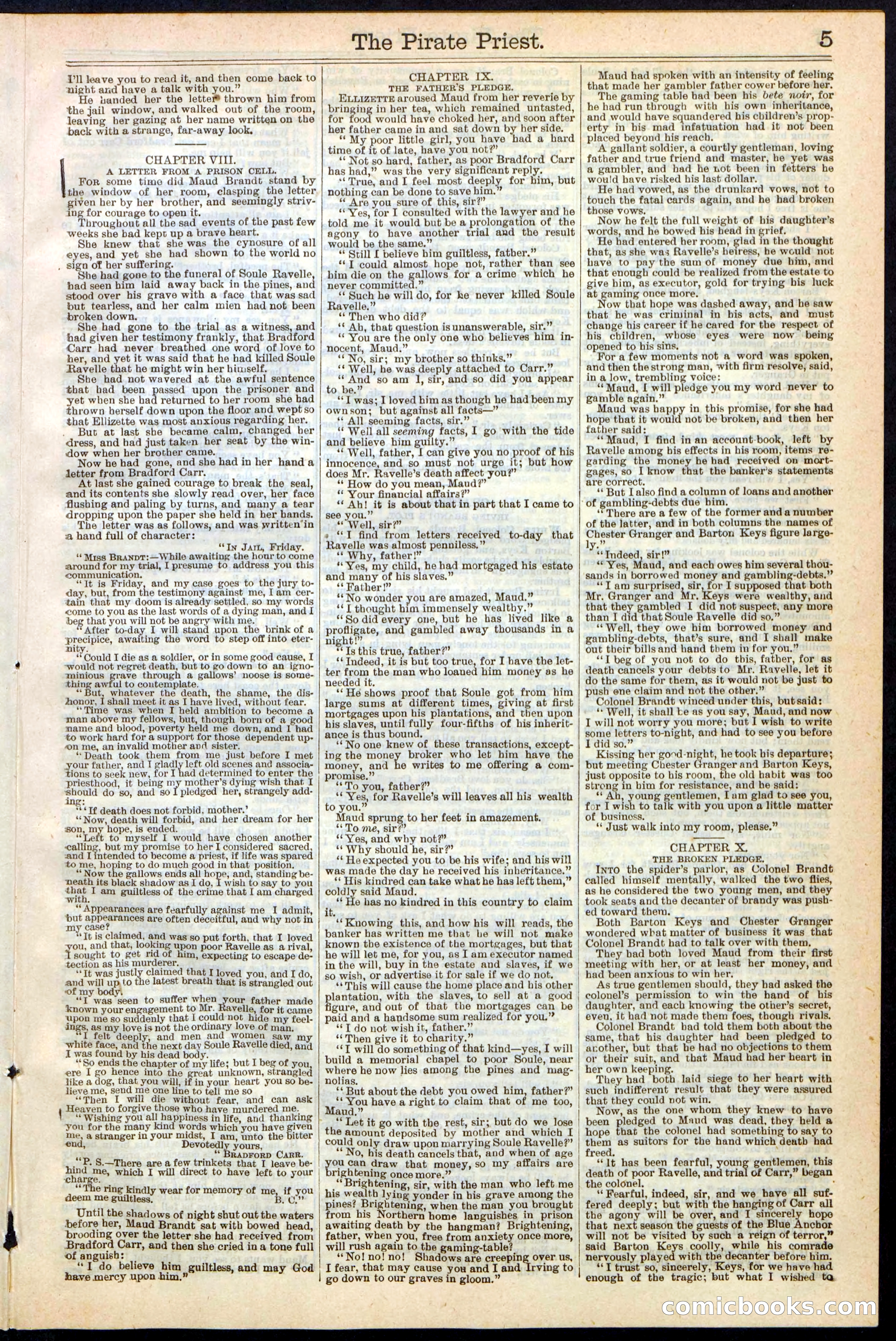
A restored page from Pulp Fiction, 1883. Page through the whole issue in the reader above.
📄 Transcribed text from this page (OCR, searchable)
Machine-transcribed from the original scan — historical spelling and the odd misread are preserved.
a — ‘ch The Pirate Priest. ——— Ill leave you to read it, and then come back to night and have a talk with you.” He handed her the letter thrown him from the jail window, and walked out of the room, leaving ber gazing at her name written on the back with a strange, far-away look, CHAPTER VIII. A LETTER FROM A PRISON CELL. For some time did Maud Brandt stand by the window of her room, clasping the letter given her by her brother, and seemingly striv- ing for courage to open it. Throughout all the sad events of the past few weeks she bad kept up a brave heart. She knew that she was the cynosure of all eyes, and yet she had shown to the world no _ sign of her suffering. She had gone to the funeral of Soule Ravelle, had seen him laid away back in the pines, and stood over his grave with a face that was sad but tearless, and her calm mien had not been broken down, She had gone to the trial as a witness, and had given her testimony frankly, that Bradford Carr had never breathed one word of love to her, and yet it was said that he had killed Soule Ravelle that he might win her himself. She had not wavered at the awful sentence that had been pases upon the prisoner and yet when she bad returned to her room she bad thrown herself down upon the floor and wept so that Ellizette was most anxious regarding her. But at last she became calm, changed ber dress, and had just taken her seat by the win- dow when her brother came. . Now he had gone, and she had in her hand a letter from Bradford Carr. At last she gained courage to break the seal, and its contents she slowly read over, her face flusbing and paling by turns, and many a tear dropping upon the paper she held in her bands. The letter was as follows, and was written’in a hand full of character: “In Jaru, Friday. ‘¢ Miss BRaANpT:—While awaiting the hour to come around for my trial, I presume to address you this communication. “it is Friday, and my case goes to the jury to- day, but, from the testimony against me, lam cer- tain that my doom is already settled, so my words come to you as the last words of a dying man, and I beg that you will not be angry with me. * After to-day I will stand upon the brink of a precipice, awaiting the word to step off into eter- nity. ** Could I die as a soldier, or in some good cause, I would not regret death, but to go down to an igno- minious grave through a gallows’ noose is some- thing awful to contemplate. “But, whatever the death, the shame, the dis- Aonor, I shall meet it as I have lived, without fear. “Time was when I held ambition to become a man above my fellows, but, though born of a good mame and blood, poverty held me down, and I had to work hard for a support for those dependent up- on me, an invalid mother and sister. ‘Death took them from me just before I met our father, and I oy eee old scenes and associa- ions to seek new, for I had determined to enter the priesthood, it being my mother’s dying wish that I should do so, and sol pledged her, strangely add- ing: ***T? death does not forbid, mother.’ ‘** Now, death will forbid, and her dream for her son, my hope, is ended. “Left to myself I would have chosen another calling, but my promise to her I considered sacred, and Lintended to become a priest, if life was spared to me, Repiog to do much good in that position. “ Now the gallows ends all hope, and, standing be- neath its black shadow as I do, I wish to say to you bea I am guiltless of the crime that I am charged “Appearances are fearfully against me I admit, buf appearances are often deceitful, and why not in my case? ‘It is claimed, and was so put forth, that I loved you, and that, looking upon poor Ravelle as a rival, sought to get rid of him, expecting to escape de- tection as his esa pst i “It was justly claimed that I loved you, and I do, fe vA to the latest breath that teutraigial out of m ie eds seen to suffer when fa father made known your engagement to Mr. Ravelle, for it came upon me so suddenly that I could not hide my feel- ings, as my love is not the ordinary love of man, “I felt deeply, and men and women saw my white face, and the next day Soule Ravelle died, and I was found by his dead body. ‘So ends the chapter of my life; but I beg of you ere I go hence into the great unknown, strangle like a dog, that you will, if in your heart you so be- lieve me, send me one line to tell me so “Then I will die without fear, and can ask Heaven to forgive those who have murdered me. “Wishing you all happiness in life, and thanking you for the many kind words which you have given me, a stranger in your midst, I am, unto the bitter end, paige": yours, 2 *“ BRADFORD CARR. P. S.—There are a few trinkets that I leave be- ate me, which I will direct to have left to your “the ring kindly wear for memo i deem me guiltless Se tie me _ Until the shadows of night shut out the waters before her, Maud Brandt re with bowed head, brooding Over the letter she had received from Bradford Carr, and then she cried in a tone full of anguish: ‘““I do believe him »Suiltless, and may God have mercy upon him, —.———— —_— —_— —_— -_———— ee — i010. —. evhmkm c= = | CHAPTER IX. THE FATHER’S PLEDGE. ELLIZETTE aroused Maud from her reverie by bringing in her tea, which remained untasted, for food would have choked her, and soon after her father came in and sat down by her side, * My poor little girl, you have had a hard time of it of late, have you not?” ‘‘ Not so hard, father, as poor Bradford Carr has had,” was the very significant reply. ‘True, and I feel most deeply for him, but nothing can be done to save him.” * Are you sure of this, sir?” “Yes, for I consulted with the lawyer and he told me it would but be a prolongation of the agony to have another trial and the result would be the same,” “Still [ believe him guiltless, father.” ‘‘T could almost hope not, rather than see him die on the gallows for a crime which he never committed.” ‘* Such he will do, for he never killed Soule Ravelle.” ‘Then who did? ‘¢ Ah, that question is unanswerable, sir.” “You are ie only one who believes him in- nocent, Maud.” ‘No, sir; my brother so thinks.” ‘‘ Well, he was deeply attached to Carr.” ** And so am J], sir, and so did you appear to be.” ‘I was; I loved him as though he had been my ownson; but against all facts—” ** All seeming facts, sir.” * Well all seeming facts, 1 go with the tide and believe him guilty.” ‘‘ Well, father, I can give you no proof of his innocence, and so must not urge it; but how does Mr. Ravelle’s death affect you?” ‘* How do you mean, Maud?” * Your financial affairs?’ ‘“‘ Ah! it is about that in part that I came to see you.” Well, sir?” » *T find from letters received to-day that Ravelle was almost penniless,” ‘* Why, father!” ‘Yes, my child, he had mortgaged his estate and many of his slaves.” ‘* Father!” ‘No wonder you are amazed, Maud.” ‘¢T thought him immensely wealthy.” “So did every one, but he has lived like a Peon ape, and gambled away thousands in a night! ‘*Ts this true, father?” ‘¢ Indeed, it is but too true, for I have the let- ter from the man who loaned him money as he needed it. ‘‘He6 shows proof that Soule got from him large sums at different times, giving at first mortgages upon his plantations, and then upon his slaves, until fully four-fifths of his inherit- ance is thus bound, ‘‘No one knew of these transactions, except- ing the money broker who let him have the money, and he writes to me offering a com- promise.” **To you, father?” ‘* Yes, for Ravelle’s will leaves all his wealth to you.” Maud sprung to her feet in amazement. ‘To me, sir?” ‘*' Yes, and why not?” ** Why should he, sir?” ‘** He expected you to be his wife; and his will was made the day he received his inheritance.” ‘*¢ His kindred can take what he has left them,” best said Maud. i ‘* He has no kindred in this country to claim i ‘‘Knowing this, and how his will reads, the banker has written me that be will not make known the existence of the mortgages, but that he will let me, for you, as I am executor named in the will, buy in the estate and slaves, if we so wish, or advertise it for sale if we do not, ‘*This will cause the home place and his other lantation, with the slaves, to sell at a good ware, and out of that the mortgages can be paid and a handsome sum realized for you,” ‘*T do not wish it, father.” ‘Then give it to charity.” ‘¢T will do something of that kind—yes, I will build a memorial chapel to poor Soule, near where he now lies among the pines and mag- nolias. ‘* But about the debt you owed him, father?” are ON have aright to claim that of me too, aud, ** Let it go with the rest, sir; but do we lose | the amount deposited by mother and which I could only draw upon marrying Soule Ravelle?” No, his death cancels that, and when of age yeu can draw that money, so my affairs are rightening once more.” _ Brightening, sir, with the man who left me his wealth lying yonder in his grave among the pines? Brightening, when the man you brought from his Northern home languishes in prison awaiting death by the hangman? Brightening, father, when you, free from anxiety once more, will rush again to the gaming-table? ‘‘No! no! no! Shadows are creeping over us, I fear, that may cause you and I and Irving to go down to our graves in gloom.” 4 Maud had spoken with an intensity of feeling that made her gambler father cower before her, The gaming table bad been his bete noir, for he had run through with his own inheritance, and would have squandered his cbildren’s prop- erty in his mad infatuation had it not been placed beyond his reach. A gallant soldier, a courtly gentleman, loving father and true friend and master, he yet was a gambler, and had he not been in fetters he wou!d have risked his last dollar. He had vowed, as the drunkard vows, not to touch the fatal cards again, and he had broken those vows, Now he felt the full weight of his daughter's words, and he bowed his head in grief. He had entered her room, glad in the thought that, as she was Ravelle’s heiress, he would not have to pay the sum of money due him, and that enough could be realized from the estate to give him, as executor, gold for trying bis luck at gaming once more. ow that hope was dashed away, and he saw that he was criminal in his acts, and must change his career if he cared for the respect of his children, whose eyes were now being opened to his sins, For a few moments not a word was spoken, and then the strong man, with firm resolve, said, in a low, trembling voice: “Maud, I will pledge you my word never to gamble again.” Maud was happy in this promise, for she had hope that it would not be broken, and then her father said: **Maud, I find in an account-book, left by Ravelle among bis effects in his room, items re- garding the money he had received on mort- gages, so I know that the banker's statements are correct. ‘‘ But Lalso find a column of loans and another ‘of gambling-debts due bim. ‘“There are a few of the former and a number of the latter, and in both columns the names of ie aig Granger and Barton Keys figure large- ” “Indeed, sir!” “Yes, Maud, and each owes him several thou- ‘sands in borrowed money and gambling-debts.” ‘“‘T am surprised, sir, for I supposed that both Mr. Granger and Mr. Keys were wealthy, and that they gambled I did not suspect, any more than I did that Soule Ravelle did so.” ‘Well, they owe him borrowed money and gambling-debts, that’s sure, and I shall make out their billsand hand them in for you,” ‘‘T beg of you not to do this, father, for as death cancels your debts to Mr. Ravelle, let it do the same for them, as it would not be just to push one claim and not the other.” Colonel Brandt winced under this, butsaid: ‘* Well, it shall be as you say, I will not worry you more; but I wish to write some letters to-night, and had to see you before I did so.” Kissing her ee ae he took his departure; but meeting Chester Granger and Barton Keys, just opposite to his room, the old habit was too strong in bim for resistance, and he said: ‘* Ah, young gentlemen, [am glad to see you, for I wish to talk with you upon a little matter of business. ‘* Just walk into my room, please.” CHAPTER X, THE BROKEN PLEDGE. Into the spider’s parlor, as Colonel Brandt called himself mentally, walked the two flies, as he considered the two young men, and they took seats and the decanter of brandy was push- ed toward them. Both Barton Keys and Chester sig eA wondered what matter of business it was that Colonel Brandt had to talk over with them, They bad both loved Maud from their first Maud, and now . meeting with her, or at least her money, and — had been anxious to win her. As true gentlemen should, they bad asked the colonel’s permission to win the hand of his daughter, and each knowing the other’s secret, even, it had not made them foes, though rivals. Colonel Brandt bad told them both about the same, that his daughter had been pledged to avother, but that he had no objections to them or their suit, and that Maud had her heart in her own keeping. They had both laid siege to her heart with such indifferent result that they were assured that they could not win. Now, as the one whom they knew to have been pledged to Maud was dead, they held a hope that the colonel had something to say to aa as suitors for the hand which deatb had freed. ‘ ‘‘It has been fearful, young death of poor Ravelle, and tri the colonel. “ Fearful, indeed, sir, and we have all suf- fered deeply; but with the hanging of Carr all the agony will be over, and I sincerely hope that next season the guests of the Blue Anchor will not be visited by such a reign of terror,” said Barton Keys coolly, while his comr nervously played with the decanter before him. ‘‘T trust so, sincerely, Keys, for we have enough of the tragic; but what I wished ta gentlemen, this of Carr,” began MIE NOO K<S,(e (E(0) (0)