
Pulp Fiction, 1883 · page 4 of 32
Beadle's New York Dime Library No. 255 — page 4: what you’re looking at
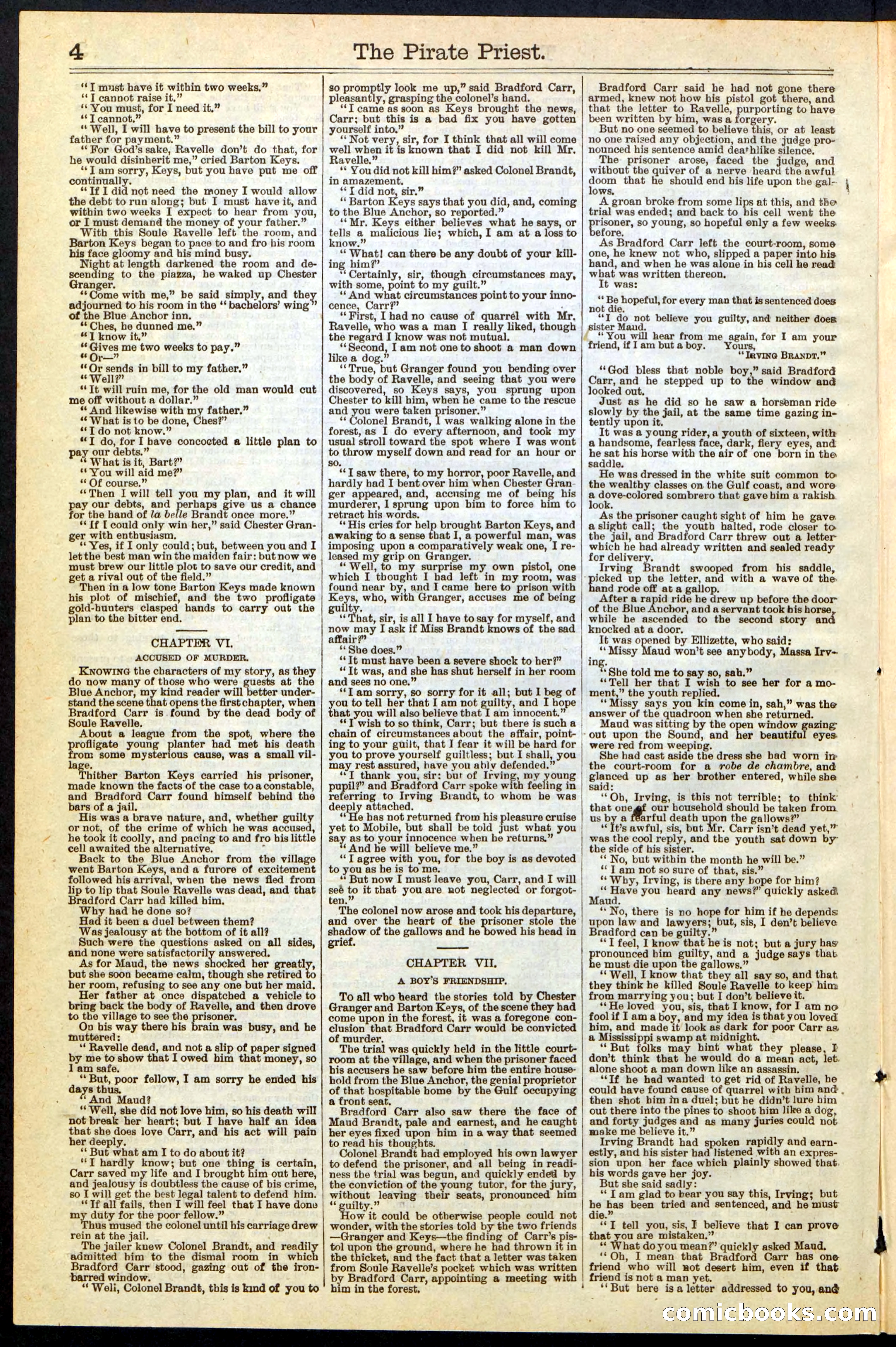
A restored page from Pulp Fiction, 1883. Page through the whole issue in the reader above.
📄 Transcribed text from this page (OCR, searchable)
Machine-transcribed from the original scan — historical spelling and the odd misread are preserved.
“ The Pirate Priest. **T must have it within two weeks,” **T cannot raise it,” ‘‘ You must, for I need it.” **T cannot,” ‘¢ Well, I will have to present the bill to your father for payment.” “For God’s sake, Ravelle don’t do that, for he would disinherit me,” cried Barton Keys. ‘*T am sorry, Keys, but you have put me off continually. ‘Tf I did not need the money I would allow the debt to run along; but I must have it, and within two weeks I expect to hear from you, or I must demand the money of your father.” With this Soule Ravelle left the room, and n Keys began to pace to and fro bis room his face gloomy and his mind busy. Night at length darkened the room and de- stending to the piazza, he waked up Chester Granger. **Come with me,” be said simply, and they adjourned to his room in the “‘ bachelors’ wing ” of the Blue Anchor inn. ** Ches, he dunned me.” os know it.” ma ms as me two weeks to pay. ‘Or sends in bill to my father.” “Well?” “Tt will ruin me, for the old man would cut me off without a dollar.” * And likewise with my father.” “What is to be done, Ches?” **T do not know.” “TI do, for I have concocted a little plan to pay our debts.” ‘* What is it, Bart?’ ‘You will aid me?’ ‘Of course.” ‘Then I will tell you my plan, and it will pay our debts, and perhaps give us a chance for the band of /a be/le Brandt once more.” ** ff [could only win her,” said Chester Gran- ger with enthusiasm. ** Yes, if I only could; but, between you and I let the best man win the maiden fair: butnow we must brew our little plot to save our credit, and get a rival out of the field.” Then in a low tone Barton Keys made known his plot of mischief, and the two profligate gold-buuters clasped hands to carry out the plan to the bitter end. CHAPTER VI. ACCUSED OF MURDER. EKnow1nG the characters of my story, as they do now many of those who were guests at the Blue Anchor, my kind reader will better under- stand the scene that opens the first chapter, when Bradford Carr is found by the dead body of Soule Ravelle. About a league from the spot, where the nag om pie, A mpl had met his death m some mysterious cause, was a small vil- lage. Thither Barton Keys carried his prisoner, made known the facts of the case toa constable, and Bradford Carr found himself behind the bars of a jail. His was a brave nature, and, whether guilty or not, of the crime of which he was accused, he took it coolly, and pacing to and fro bis little cell awaited the alternative. : Back to the Blue Anchor from the village went Barton Keys, and a furore of excitement followed his arrival, when the news fled from lip to lip that Soule Ravelle was dead, and that Bradford Carr bad killed him, Why had he done so? _ Had it been a duel between them? Was jealousy at the bottom of it all? Such were the questions asked on all sides, and none were satisfactorily answered. As for Maud, the news shocked her greatly, but she soon became calm, though she retired her room, refusing to see any one but her maid. Her father at once dispatched a vehicle to bring back the body of Ravelle, and then drove to the village to see the prisoner. On bis way there his brain was busy, and he muttered: ‘“* Ravelle dead, and not a slip of paper signed by me to show that I owed him that money, so am safe, “But, poor fellow, I am sorry he ended his days thus. ‘And Maud? __. “ Well, she did not love him, so his death will not break her heart; but I have half an idea that she does love Carr, and his act will pain her deeply. ** But what am I to do about it? Tt hardly know; but one mo is certain, Carr saved my life and I brought him out here, and jealousy is doubtless the cause of bis crime, so I will get the best legal talent to defend him. **Tf all fails, then I will feel that I have done my duty for the poor fellow.” us mused the colonel until his carriage drew rein at the jail. The jailer knew Colonel Brandt, and readil admitted him to the dismal room in whic Bradford Carr stood, gazing out of the iron- window. “‘ Weli, Colonel Brandt, this is kind of you to so promptly look me up,” said Bradford Carr, pleasantly, grasping the colonel’s hand. **T came as soon as Keys brought the news, Carr; but this is a bad fix you have gotten yourself into.” ‘** Not very, sir, for I think that all will come well when it is known that I did not kill Mr. Ravelle,” ** You did not kill him?” asked Colonel Brandt, in amazement. **T did not, sir.” ‘“ Barton Keys says that you did, and, coming to the Blue Anchor, so reported.” ‘*Mr. Keys either believes what he says, or tells a malicious lie; which, I am at a loss to know.” ‘What! can there be any doubt of your kill- ing him?’ ‘Certainly, sir, though circumstances may, with some, point to my guilt.” ‘* And what circumstances point to your inno- cence, Carr?’ , ‘First, [had no cause of quarrél with Mr, Ravelle, who wasa man I really liked, though the regard I know was not mutual. ss Second, I am not one to shoot a man down like a dog.” ‘*True, but Granger found you bending over the body of Ravelle, and seeing that you were discovered, so Keys says, you sprung upon Chester to kill him, when he came to the rescue and you were taken prisoner.” ** Colonel Brandt, | was walking alone in the forest, as I do every afternoon, and took my usual stroll toward the spot where I was wont to throw myself down and read for an hour or so. ‘IT saw there, to my horror, poor Ravelle, and hardly had I bent over him when Chester Gran- ger appeared, and, accusing me of being his murderer, I sprung upon bim to force him to retract his words. ‘“* His cries for help brought Barton Keys, and awaking to a sense that I, a powerful man, was imposing upon a comparatively weak one, I re- leased my grip on Granger. “ Well, to my : surprise my own pistol, one which I thought I had left in my room, was found near by, and I came here to prison with Keys, who, with Granger, accuses me of being | guilty. tf That, sir, is all I have 9 le myself, and now may I ask if Miss Brandt knows of the sad affair?” ** She does.” ‘“*It must have been a severe shock to her?” “Tt was, and she has shut herself in her room and sees no one.” ‘*T am sorry, so sorry for it all; but I beg of ou to tell her that I am not guilty, and I hope bat you will also believe that I am innocent.” **] wish to so think, Carr; but there is such a chain of circumstances about the affair, point- ing to your guilt, that I fear it will be hard for you to prove yourself guiltless; but I shall, you may rest assured, have you ably defended.” ‘“*T thank you, sir: but of Irving, my young pupil?” and Bradford Carr spoke w th fee ing in referring to Irving Brandt, to whom he was ee attached. ‘He bas not returned from his pleasure cruise yet to Mobile, but shall be told just what you say as to your innocence when be returns.” ‘ And he will believe me.” “‘T agree with you, for the boy is as devoted to you as he is to me. ** But now I must leave you, Carr, and I will seé to it that youare not neglected or forgot- ten. The colonel now arose and took his departure, and over the heart of the prisoner stole the shadow of the gallows and he bowed his head in grief. CHAPTER VII. A BOY’S FRIENDSHIP. To all who heard the stories told by Chester Granger and Barton Keys, of the scene they had come upon in the forest, it was a foregone con- clusion that Bradford Carr would be convicted of murder. The trial was quickly held in the little court- room at the village, and when the prisoner faced his accusers he saw before him the entire house- hold from the Blue Anchor, the genial proprietor of that hospitable home by the Gulf occupying a front seat, Bradford Carr also saw there the face of Maud Brandt, pale and earnest, and he caught her eyes fixed upon him in a way that seemed to read his thoughts. Colonel Brandt had employed his own lawyer to defend the prisoner, and all being in readi- ness the trial was begun, and quickly ended by the conviction of the young tutor, for the jury, rites jeaving their seats, pronounced him uilty. ow it could be otherwise people could not wonder, with the stories told by the two friends —Granger and Keys—the finding of Carr’s pis- tol ape the ground, where he had thrown it in the thicket, and the fact that a letter was taken from Soule Ravelle’s pocket which was written by Bradford Carr, appointing a meeting with him in the forest, ‘out upon the Sound, and Bradford Carr said he had not gone there armed, knew not how his pistol got there, and that the letter to Ravelle, purporting to have been written by him, was a forgery. But no one seemed to believe this, or at least no one raised any objection, and the judge pro- nounced his sentence amid deathlike silence. The prisoner arose, faced the judge, and without the quiver of a nerve heard the awful a that he should end his life upon the gal- ows, A groan broke from some lips at this, and the trial was ended; and back to his cell went the Senet, so young, so hopeful only a few weeks efore. As Bradford Carr left the court-room, some one, he knew not who, slipped a paper into his. hand, and when he was alone in his cell he read what was written thereon, It was: e x hopeful, for every man that is sentenced does not die. “I do not believe you guilty, and neither does sister Maud. ‘. “You will hear from me again, for I am your friend, iflambutaboy. Yours, “Tevine Branpt.” “God bless that noble boy,” said Bradford Carr, and he stepped up to the window and looked out, Just as he did so he saw a horseman ride slowly by the jail, at the same time gazing in- tently upon it, It was a young rider, a youth of sixteen, with a handsome, fearless face, dark, fiery eyes, and he sat his horse with the air of one born in the saddle. He was dressed in the white suit common to the wealthy classes on the Gulf coast, and wore - aaa sombrero that gave him a rakish ook. As the prisoner caught sight of him he gave a slight call; the youth halted, rode closer to the jail, and Bradford Carr threw out a letter which he had already written and sealed ready for delivery. Irving Brandt swooped from his saddle, ‘picked up the letter, and with a wave of the and rode off at a gallop. After a rapid ride he drew up before the door of the Blue Anchor, and a servant took bis horse while he ascended to the second story and knocked at a door. It was opened by Ellizette, who said: _ ‘Missy Maud won’t see anybody, Massa Irv~ ing. **She told me to say so, sah.” “Tell her that I wish to see her for a mo- ment,” the youth replied. ‘Missy says you kin come in, sah,” was the answer of the quadroon when she returned. Maud was sitting by the open window gazing er beautiful eyes were red from weeping. She had cast aside the dress she bad worn im the court-room for a robe de chambre, and —— up as her brother entered, while she said: ‘‘Ob, Irving, is this not terrible; to think that opeme our household should be taken from us by a f€arful death upon the gallows?” ‘““Tt’s awful, sis, but Mr. Carr isn’t dead yet,’” was the cool reply, and the youth sat down by the side of his sister. ** No, but within the month he will be.” ‘*T am not so sure of that, sis.” ‘Why, Irving, is there any bope for him? *‘ Have you heard any news?” quickly asked Maud. ‘* No, there is no hope for him if he depends upon law and lawyers; but, sis, I don’t believe Bradford can be guilty.” “*T feel, I know that he is not; but a jury hay prouaaaces him guilty, and a judge says that e must die upon the gallows,” ‘‘ Well, I know that they all say so, and that. they think he killed Soule Ravelle to keep him from marrying you; but I don’t believe it. ‘**He loved you, sis, that I know, for I am no fool if I am aboy, and my idea is that you loved him, and made it look as dark for poor Carr as a Mississippi swamp at midnight. ‘** But folks may hint what they please, P don’t think that he would do a mean act, let. alone shoot a man down like an assassin. “Tf he had wanted to get rid of Ravelle, he could have found cause of quarrel with him an@ . then shot him ina duel; but he didn’t lure him out there into the pines to shoot him like a dog, and forty judges and as many juries could not make me believe it.” Irving Brandt had spoken rapidly and earn- estly, and his sister had listened with an expres- sion upon her face which plainly showed that. his words gave her joy. But she said sadly: : ‘‘T am glad to bear tye say this, Irving; but as has been tried and sentenced, and he must ie. ‘‘T tell you, sis, I believe that I can prove that you are mistaken.” ** What do you mean?” quickly asked Maud, ‘*Oh, I mean that Bradford Carr has one friend who will not desert him, even if that friend isnota man yet. _ ' **But bere is a letter addressed to you, and (E(0) m * Eboo A €or