
Pulp Fiction, 1883 · page 3 of 32
Beadle's New York Dime Library No. 255 — page 3: what you’re looking at
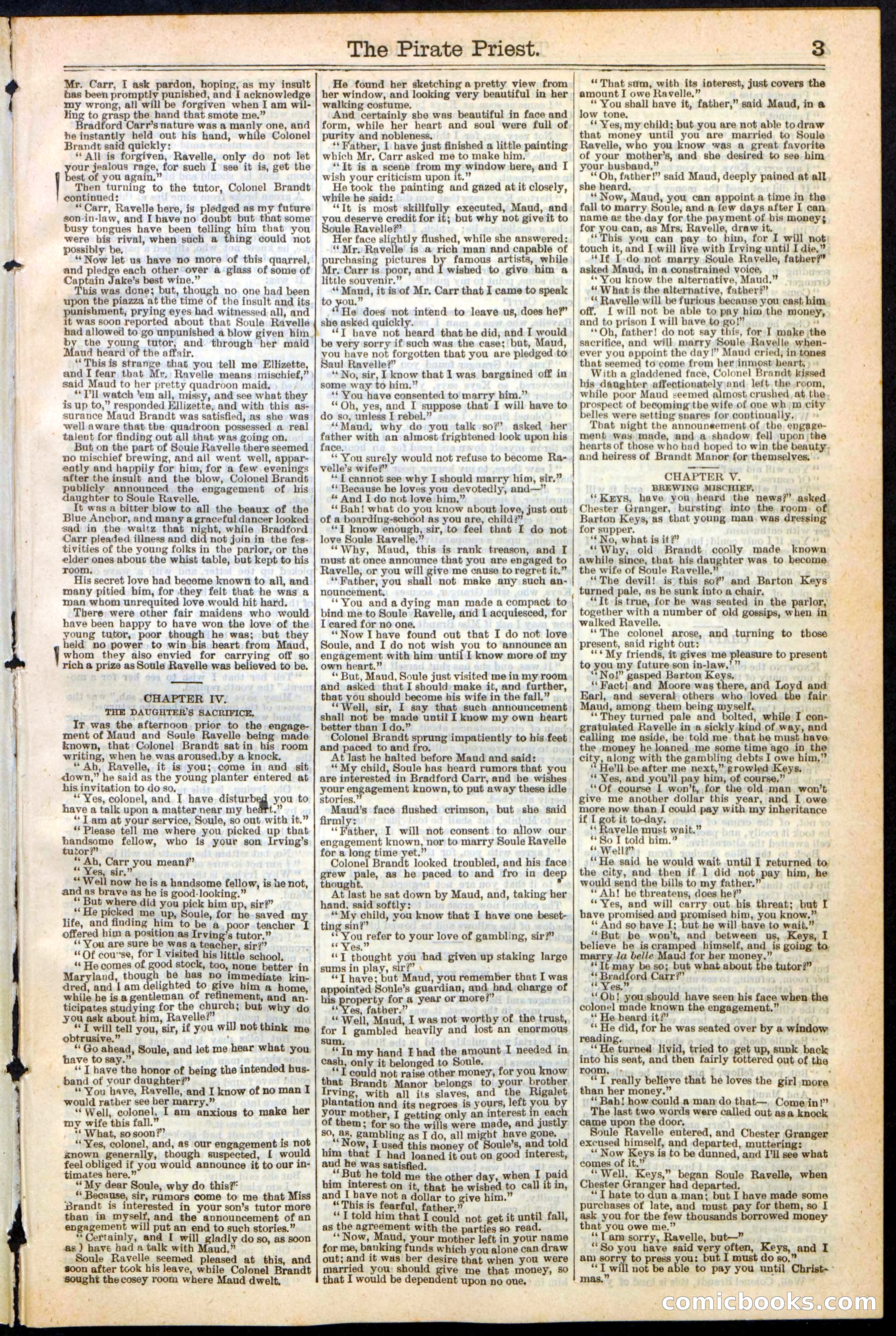
A restored page from Pulp Fiction, 1883. Page through the whole issue in the reader above.
📄 Transcribed text from this page (OCR, searchable)
Machine-transcribed from the original scan — historical spelling and the odd misread are preserved.
——_—_—— Mr. Carr, I ask pardon, hoping, as my insult has been promptly punished, and { acknowledge my wrong, all will be forgiven when I am wil- ling to grasp the hand that smote me.” radford Carr’s nature was a manly one, and he instantly held out his hand, while Colonel Brandt said quickly: ‘All is forgiven, Ravelle, only do not let our jealous rage, for such I see it is, get the est of you again,” Then turning to the tutor, Colonel Brandt continued: “Carr, Ravelle here, is pledged as my future son-in-law, and [have no doubt but that some’ busy tongues have been bias him that you were bis rival, when such a thing could not possibly be. ‘* Now let us have no more of this quarrel, o~ and pledge each other over a glass of some of Captain Falco's best wine.” : This was done; but, though no one had been upon the piazza af the time of the insult and its unishment, prying eyes bad witnessed all, and it was soon reported about that Soule Ravellé had allowed to go unpunished a blow given him by the young tutor, and through her maid Maud heard of the affair. “This is strange that you tell me Ellizette, and I fear that Mr, Ravelle means mischief,” said Maud to her pretty quadroon maid, _ “Pil watch ’em all, missy, and see what they is up to,” responded Ellizette, and with this as- surance Maud Brandt was satisfied, as she was well aware that the quadroon possessed a real - talent for finding out all that was going on. But on the part of Soule Ravelle there seemed no mischief brewing, and all went well, appar- eotly and happily for him, for a few evenings after the insult and the blow, Colonel Brandt publicly announced the engagement of his daughter to Soule Ravelle. It was a bitter blow to all the beaux of the Blue Ancbor, and many a graceful dancer looked | sad in the waltz that night, while Bradford ; Carr pleaded illness and did not join in the fes- tivities of the young folks in the parlor, or the elder ones about the whist table, but kept to his room. His secret love had become known to all, and Ran many pitied him, for they felt that he was a man whom unrequited love would hit hard. There were other fair maidens who would have been happy to have won the love of the young tutor, poor though he was; but the held no power to win his heart from Maud, whom they also envied for carrying off so rich a prize as Soule Ravelle was believed to be. | CHAPTER IV. THE DAUGHTER’S SACRIFICE, It was the afternoon prior to the engage- ment of Maud and Seule Ravelle being made known, that Colonel Brandt satin his room writing, when he was aroused.by a knock, “Ab, Ravelle, it is you; come in and sit <diown,” he said as the young planter entered at his invitation to do so, ** Yes, colonel, and I have disturbed you to have a talk upon a matter near my heaft.” ‘“*] am at your service, Soule, so out with it.” ** Please tell me where you picked up that handsome fellow, who is your son Irving’s tutor?” “Ah, Carr you mean?” ** Yes, sir.” ** Well now he is a handsome fellow, is he not, and as brave as he is good-looking.” *‘ But where did you pick him u , sir?” _“*He picked me up, Soule, for i saved my life, and finding him to be a poor teacher I offered him a position as Irving’s tutor.” ‘«-You are sure be was a teacher, sir?” “Of couse, for I visited his little school, ‘« He comes of good stock, too, none better in Maryland, though he has no immediate. kin- dred, and I am delighted to give him a home, while he isa gentleman of refinement, and an- ticipates studying for the church; but why do you ask about him, Ravelle?” | “T will tell you, sir, if you wil) not think me obtrusive.” “Go ahead, Soule, and let me hear what you have to say.” ; ‘‘T have the honor of being the intended hus- band of your daughter?” ' You have, Ravelle, and I know of no man I would rather see ber marry.” ‘* Well, colonel, I am anxious to make her my wife this fall.” ‘‘ What, so soon?” ‘Yes, colonel, and, as our engagement is not known generally, though suspected, [ would feel obliged if you would announce it to our in- timates here.” ; ** My dear Soule, why do this? ; _. * Because, sir, rumors come to me that Miss Brandt is interested in your son’s tutor more than in myself, and the announcement of an | engagement will put an end to such stories.” : ‘Certainly, and I will gladly do so, as soon as) have bad a talk with Maud,” Soule Ravelle seemed pleased at this, and . soon after took his leave, while CoJonel Brandt _ sought the cosey room where Maud dwelt, ’ 4 : ’ The Pirate Priest. He found her sketching a pretty view from her window, and looking very beautiful in her walking costume. And certainly she was beautiful in face and form, while her heart and soul were full of purity and nobleness, ; ‘* Father, | have just finished a little painting which Mr, Carr asked me to make him. ‘‘It is a scene from my window here, and [ wish your criticism upon it.” He took the painting and gazed at it closely, while he said: ‘“‘Tt is most skillfully executed, Maud, and you deserve credit for it; but why not giveit to Soule Ravelle?” Her face slightly flushed, while she answered: ‘Mr. Ravelle is a rich man and capable of ourchasing pictures by famous artists, while r. Carr is poor, and I wished to give him a little souvenir.” ‘‘ Maud, it isof Mr. Carr that I came to speak to you. d ‘He does not intend to leave us, does he?” she asked quickly. ‘‘T bave not heard that he did, and I would be very sorry if such was the case; but, Maud, you have not forgotten that you are pledged to Saul Ravelle?” ‘‘ No, sir, I know that 1 was bargained off in some way to him.” ‘¢ You have consented to marry him.” ** Oh, yes, and I suppose that I will have to do so, unless I rebel.” ‘‘Maud, why do you talk so?’ asked her father with an almost frightened look upon his face. ‘** You surely would not refuse to become Ra- velle’s wife?” ‘** I cannot see why I should marry him, sir.” ‘* Because he loves you devotedly, and—” “ And I do not love him,” ** Bah! what do you know about love, just out of a boarding-schoo! as you are, child?” **T know enough, sir, to feel that I do not love Soule Ravelle.” “Why, Maud, this is rank treason, and I must at once announce that you are engaged to Ravelle, or you will give me cause to regret it.” “Father, you shall not make any such an- nouncement, ‘You andadying man made a compact to bind me to Soule Ravelle, and I acquiesced, for I eared for no one. ‘*Now Ihave found out that I do not love Soule, and I do not wish you to announce an engagement with him until 1 know more of my own heart.” ** But, Maud, Soule just visited mein my room and asked that I should: make it, and further, that you should become his wife in the fall,” ‘“‘Well, sir, I say that such announcement shall not be made until I know my own heart better than I do.” Colonel Brandt sprung impatiently to his feet and paced to and fro. At last he halted before Maud and said: ‘* My child, Soule has heard rumors that you are interested in Bradford Carr, and he wishes your engagement known, to put away these idle stories.’ Maud’s face flushed crimson, but she said firmly: ‘““Pather, I will not consent to allow our engagement known, nor to marry Soule Ravelle for a long time yet.” ; Colonel Brandt looked troubled, and his face grew pale, as he paced to and fro in deep thought. At last he sat down by Maud, and, taking her hand, said softly: ‘*My child, you know that I have one beset- ting sin?” : You refer to your love of gambling, sir?” es Ps “ Y ‘‘T thought you had given up staking large sums in play, sir?” » “‘T have; but Maud, you remember that I was appointed Soule’s guardian, and had charge of his eget for a year or more? ‘Yes, father.” “Well, Maud, I was not worthy of the trust, for I gambled heavily and lost an enormous sum. ; ‘“‘In my hand Ehad the amount I needed in, cash, only it belonged to Soule. $2 could not raise other money, for you know that Brandt Manor belongs to your. brother Irving, with all its slaves, and the Rigalet plantation and its negroes is yours, left you by your mother, I getting only an interest in each of them; for so the wills were made, and justly 60, 8, gambling as I do, all might have gone, .. Now, L used this money of Soule’s, and told him that I had loaned it out on good interest, aud he was satisfied. | _“* But he told me the other day, when I paid him interest on it, that he wished to call it in, and I have not a dollar to give him.” “This is fearful, father,” ‘“*T told him that I could not get it until fall, as the agreement with the parties so read. ‘“Now, Maud, your mother left in your name for me, banking funds which you alone can draw out; and it was ber desire that when you were married you: should give me that money, 50 that I would be dependent upon no one, | 3 “That stm, with its interest, just covers the amount I owe Ravelle.” ** You shall have it, father,” said Maud, in a low tone. ** Yes, my child; but you are not able todraw that money until you are married to Soule Ravelle, who you know was a great favorite of your mother’s, and she desired to see him your busband,” “Oh, father!” said Maud, deeply pained at all she heard. ‘* Now, Maud, you can appoint a time in the fall to marry Soule, and a few days after I can name as the day for the payment of bis money; for you can, as Mrs, Ravelle, draw it. ‘*This you can pay to him, for I will not: touch it, and [ will live with Irving until I die,” “If I-do not marry Soule Ravelle, father?” asked Maud, in a constrained voice, ‘* You know the alternative, Maud,” ‘What is the alternative, father?” | ‘*« Ravelle will be furious because you cast: hi off. I will not be able to pay bim the money, and to prison I will have to go!” pp” ‘*Oh, father! do not say this, for I make the sacrifice, and will marry Soule Ravelle when- ever you appoint the day!” Maud cried; in tones that seemed to come from her inmost beart, ) » With a gladdened face, Colonel Brandt kissed his daughter affectionately and left the room, while poor Maud seemed almost crushed, at, the, prospect of becoming the wife of one wh m city belles were setting snares for continually, That night the announeement of the engage- ment was made, and a shadow fell upon the hearts of those who bad boped to win the beauty, and heiress of Brandt Manor for themselves. . — CHAPTER V. BREWING MISCHIEF, ‘‘K ys, have you beard the news?’. asked Chester Granger, bursting into the room. of Barton Keys, as that young man, was dressing for supper. ‘* No, what is it?’ ‘* Why, old Brandt coolly made known awhile since, that his daughter was to become the wife of Soule Ravelle,” “The devil! is this sof?’ and Barton Keys turned pale, as be sunk into a chair. “‘It is true, for he was seated in the together with a number of old gossips, w walked Ravelle. “The colonel arose, and turning to those present, said right out: , *** My friends, it gives me to you my future son in-law, ‘*No!l” gasped Barton Keys, r ‘* Fact} and Moore was there, and Loyd and Earl, and several others who loved the fair Maud, among them being myself, — ; ‘‘They turned pale and bolted, while I con- gratulated Ravelle in a sickly kind of. way, and calling me aside, be told me. that be must have. the money he loaned me some time ago in the city, along with the gambling debts I owe him,” * He'll be after me next,” growled Keys, | ** Yes, and you’ll pay him, of course,” ‘Of course L won’t, for the old man. won't give me another dollar this year, and I owe more now than I could pay with my inheritance if I got it to-day. ** Ravelle must wait.” ** So I told him.” * Well?” , **He said he would wait until I returned to: the city, and then if 1 did not pay him, he would send the bills to my father.” yer ‘Ah! he threatens, does he?” threat; but [ “Yes, and will carry out. bis have promised and promised him, you know,” ‘** And so have I; but be wil] bave to wail,” ‘*But be won’t, and between us, Keys, I believe he is cramped himself, and is going to marry Ja belle Maud for her money.” ‘Ti may beso; but what about the tutor?” if Hsontond Carr?’ | ‘ ‘Ob! youshould have seen his face when. the colonel made known the engagement.” ‘* He beard it?’ | ** He did, for he was seated over by a window reading. ‘He turned livid, tried to get up, sunk back into his seat, and then fairly tottered out of the room, > ta" “T really believe that he loves the girl more than her money.” . ‘‘ Bah! how could a man do that—, Come in!” The last two words were called out asa knock came upon the door, ‘> Soule Ravelle entered, and Chester Granger excused himself, and departed, muttering: *‘ Now Keys is to be dunned, and I'll see what ‘Well, Keys, an Soule Rav when Chester Granger aa apart sy ‘“‘T hate to dun a man; but I have made some purchases of late, and must pay for them, so I ask you for the few thousands borrowed money that you owe me.” ‘Lam sorry, Ravelle, but—” “So you have said very often, Keys, and I arlor, en in. pleasure to present ? : ‘ am sorry to press you: but I must do so,” “ I wi not be able to pay you until Christ-~ mas, po "com S (C JOCKS: CO