
Pulp Fiction, 1883 · page 2 of 32
Beadle's New York Dime Library No. 255 — page 2: what you’re looking at
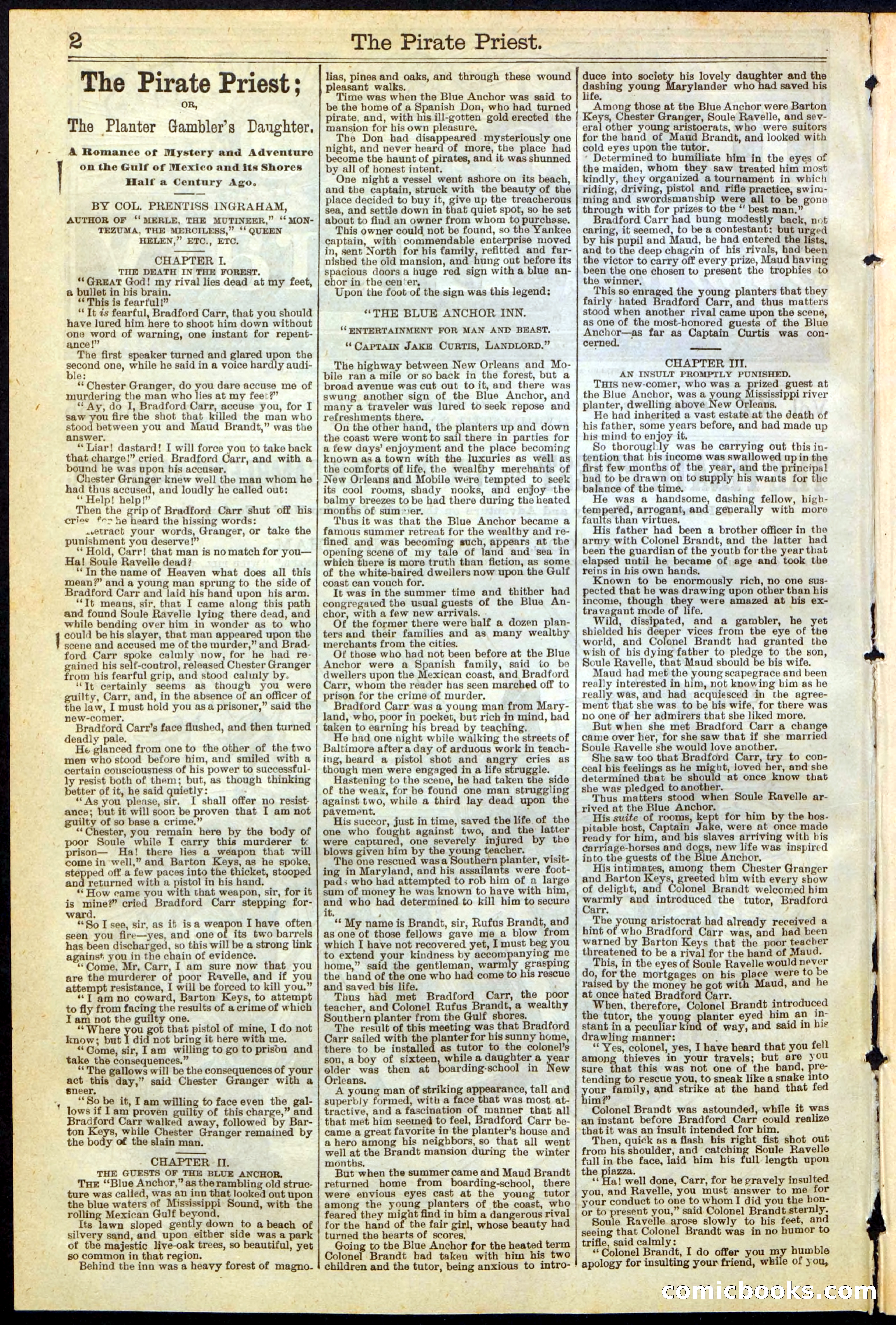
A restored page from Pulp Fiction, 1883. Page through the whole issue in the reader above.
📄 Transcribed text from this page (OCR, searchable)
Machine-transcribed from the original scan — historical spelling and the odd misread are preserved.
A 0 2 - The Pirate Priest. The Pirate Priest; The Planter Gambler’s Daughter. A Romance of Mystery and Adventure on the Gulf of Mexico and its Shores Half a Century Ago, BY COL. PRENTISS INGRAHAM, AUTHOR OF ‘‘ MERLE, THE MUTINEER,” ‘‘ MON- TEZUMA, THE MERCILESS,” ‘‘ QUEEN HELEN,” ETC., ETC, CHAPTER I. THE DEATH IN THE FOREST. **GREAT God! my rival lies dead at my feet, a bullet in bis brain. ** This is fearful!” “ Tt ¢s fearful, Bradford Carr, that you should have lured him here to shoot him down without one word of warning, one instant for repent- ance!” The first speaker turned and glared upon the peogne one, while he said in a voice hardly audi- @: ‘‘ Chester Granger, do you dare accuse me of murdering the man who lies at my fee?” ** Ay, do I, Bradford Carr, accuse you, for I saw you fire the shot that killed the man who stood between you and Maud Brandt,” was the answer. “Liar! dastard! I will force you to take back that charge!” cried Bradford Carr, and with a bound he was upon his accuser. Chester Granger knew well the man whom he had thus accused, and loudly he called out: ‘Help! help!” Then the grip of Bradford Carr shut off his cries fe~ he heard the hissing words: .etract your words, Granger, or take the punishment you deserve!” ** Hold, Carr! that man is no match for you— Ha! Soule Ravelle dead? **In the name of Heaven what does all this mean?’ and a young man sprung to the side of Bradford Carr and laid his hand upon his arm. “*It means, sir, that I came along this path and found Soule Ravelle lying there dead, and while bending over him in wonder as to who could be his slayer, that man appeared upon the scene and accused me of the murder,” and Brad- ford Carr ke calmly now, for he had re- gained his self-control, released Chester Granger from his fearful grip, and stood calinly by. “Tt certainly seems as though you were guilty, Carr, and, in the absence of an officer of the law, I must hold you asa prisoner,” said the new-comer. Bradford Carr’s face flushed, and then turned deadly pale. He glanced from one to the other of the two men who stood before him, and smiled with a certain cousciousness of his power to successful- ly resist both of them; but, as though thinking better of it, he said quietly: *‘ As you please, sir. I shall offer no resist- ance; but it will soon be proven that I am not mire of so base a crime.” ‘Chester, you remain here by the body of poor Soule while I carry this murderer ti prison— Ha! there lies a_weapon that will come in well,” and Barton Keys, as he spoke, stepped off a few paces into the thicket, stooped “<3 returned with a pistol in his hand. ** How came you with that weapon, sir, for it is mine?” cried Bradford Carr stepping for- ward. **So I see, sir, as if isa weapon I have often seen you fire—yes, and one of its two barrels has been discharged, so this will be a strong link against you in the chain of evidence. ‘“Come, Mr, Carr, I am sure now that you are the murderer of poor Ravelle, and if you attempt resistance, I will be forced to kill you.” **T am no coward, Barton Keys, to attempt to fly from facing the results of a crime of which I am not the guilty one. ‘“Where you got that pistol of mine, I do not know; but ¥ did not bring it here with me. “‘Gome, sir, Iam willing to go to prison and _ take the consequences.” . - “The gallows will be the consequences of your act this day,” said Chester Granger with a sneer, **So be it, I am willing to face even the gal- lows if lam proven guilty of this charge,” and Bradford Carr walked away, followed by Bar- ton are while Chester Granger remained by the body of the slain man. CHAPTER [1. THE GUESTS OF THE BLUE ANCHOR. Tue ‘Blue Anchor,” as therambling old struc- ture was called, was an inn that looked out upon the blue waters of mr Sound, with the rolling Mexican Gulf beyond, Its lawn sloped gently down to a beach of silvery sand, and upon either side was a park of the majestic live-oak trees, so beautiful, yet so common in that region. Behind the inn was a heavy forest of magno- lias, pines and oaks, and through these wound pleasant walks. Time was when the Blue Anchor was said to be the home of a Spanish Don, who had turned pirate, and, with his ill-gotten gold erected the mansion for his own pleasure, The Don had disappeared mysteriously one night, and never heard of more, the place had become the haunt of pirates, and it was shunned by all of honest intent. One night a vessel went ashore on its beach, and the captain, struck with the beauty of the place decided to buy it, give up the treacherous sea, and settle down in that quiet spot, so he set about to fiud an owner from whom to purchase. This owner could not be found, so the Yankee captain, with commendable enterprise moved in, sent North for his family, refitted and far- nished the old mansion, and bung out before its spacious doors a huge red sign with a blue an- chor in the cen‘er, Upon the foot of the sign was this legend: “THE BLUE ANCHOR INN. ‘¢ ENTERTAINMENT FOR MAN AND BEAST, ‘“‘CapTaIN JAKE CuRTIS, LANDLORD.” The highway between New Orleans and Mo- bile ran a mile or so back in the forest, but a broad avenue was cut out toit, and there was swung another sign of the Blue Anchor, and many a traveler was lured to seek repose and refreshments there. On the other hand, the planters up and down the coast were wont to sail there in parties for a few days’ enjoyment and the place becoming known as a town with the luxuries as well as the comforts of life, the wealfhy merchants of New Orleans and Mobile were tempted to seek its cool rooms, shady nooks, and enjoy the balmy breezes to be had there during the heated months of sum ~er. Thus it was that the Blue Anchor became a famous summer retreat for the wealthy and re- fined and was becoming such, appears at the opening scene of my tale of land and sea in which there is more truth than fiction, as some of the white-haired dwellers now upon the Gulf coast can vouch for. It was in the summer time and thither had congregated the usual guests of the Blue An- chor, with a few new arrivals. Of the former there were half a dozen plan- ters and their families and as many wealthy merchants from the cities. Of those who had not been before at the Blue Anchor were a Spanish family, said to be dwellers upon the Maxican coast, and Bradford Carr, whom the reader has seen marched off to prison for the crime of murder. Bradford Carr was a young man from Mary- land, who, poor in pocket, but rich in mind, bad taken to earning his bread by teaching. He had one night while walking the streets of Baltimore after a day of arduous work in teach- ing, heard a pistol shot and angry cries as though men were engaged in a life struggle. Hastening to the scene, he had taken the side of the weak, for he found one man strugglivg against two, while a third lay dead upon the pavement. i His succor, just in time, saved the life of the one who fought against two, and the latter were Sebulnes. one severely injured by the blows given him by the bins teacher. : The one rescued wasa Southern planter, visit- ing in Maryland, and bis assailants were foot- pads who had attempted to rob him of a large sum of money he was known to have with him, and who had determined to kill him to secure ‘“‘ My name is Brandt, sir, Rufus Brandt, and as one ot those fellows gave me a blow from which I have not recovered yet, I must beg you to extend your kindness by accompanying me home,” said the gentleman, warmly grasping the hand of the one who had come to his rescue and saved bis life. Thus had met Bradford Carr, the ra teacher, and Colonel Rufus Brandt, a wealthy Southern planter from the Gulf shores. The result of this meeting was that Bradford Carr sailed with the planter for his sunny home, there to be installed as tutor to the colonel’s sou, a boy of sixteen, while a daughter a a older was then at boarding-school in New Orleans. - A young man of striking appearance, tall and superbly formed, with a face that was most at- tractive, and a fascination of manner that all that met him seemed to feel, Bradford Carr be- came a great favorite in the planter’s house and a hero among his neighbors, so that all went well at the Brandt mansion during the winter months. But when the summer came and Maud Brandt returned home from boarding-school, there Were envious eyes cast at the young tutor among the young planters of the coast, who feared they might find in bim a dangerous rival for the hand of the fair girl, whose beauty had turned the hearts of scores, Going to the Blue Anchor for the heated term Colonel Brandt had taken with bim his two children and the tutor, being anxious to intro- duce into society his lovely isin ey and the a young Raevinudes who saved his ife. Among those at the Blue Anchor were Barton Keys, Chester Granger, Soule Ravelle, and sev- eral other young aristocrats, who were suitors for the hand of Maud Brandt, and looked with cold eyes upon the tutor. ‘ Determined to humiliate him in the eyes of the maiden, whom they saw treated him most kindly, they organized a tournament in which riding, driving, pistol and rifle practice, swim- ming and swordsmanship were all to be gone through with for prizes to the ‘' best man.” Bradford Carr had bung modestly back, not caring, it seemed, to be a contestant; but urged by his pupil and Maud, he had entered the lists, and to the deep chagrin of his rivals, had been the victor to carry off every prize, Maud having been the one chosen to present the trophies to the winner. This so enraged pod Seid planters that they fairly hated Bradford Carr, and thus matters stood when another rival came upon the scene, as one of the most-honored guests of the Blue ren Sm far as Captain Curtis was con- cerne CHAPTER IIT. AN INSULT PROMPTLY PUNISHED. THIS new-comer, who was a prized guest at the Blue Anchor, was a young Mississippi river planter, dwelling above New Orleans. He had inherited a vast estate at the death of his father, some years before, and had made up his mind to enjoy it. So thoroughly was he carrying out this in- tention that his income was swallowed up in the first few months of the year, and the principal bad to be drawn on to supply his wants for the balance of the time. He was a handsome, dashing fellow, higb- tempered, arrogant, and generally with more faults than virtues. His father had been a brother officer in the army with Colonel Brandt, and the latter had been the guardian of the youth for the year that elapsed until he became of age and took the reins in his own hands. Known to be enormously rich, no one sus- cted that he was drawing upon otber than his income, though they were amazed at his ex- travagant mode of life. , Wild, dissipated, and a gambler, he yet shielded his deeper vices from the eye of the world, and Colonel Brandt had granted the wish of his dying father to pledge to the son, Soule Ravelle, that Maud should be bis wife. Maud had met the young scapegrace and been really interested in him, not knowing bim as he really was, and had acquiesced in the agree- ment that she was to be bis wife, for there was no one of her admirers that she liked more, But when she met Bradford Carr a change came over her, for she saw that if she married Soule Ravelle she would love another. She saw too that Bradford Carr, try to con- ceal his feelings as he might, loved her, and she determined that be should at once know that she was pledged to another. Thus matters stood when Soule Ravelle ar- rived at the Blue Anchor. ; His suite of rooms, co for him by the hos- pitable bost, Captain Jake, were at once made ready for him, and bis slaves arriving with bis carriage-horses and dogs, new life was inspired into the guests of the Blue Anchor. His intimates, among them Chester Granger and Barton Keys, a him with every show of deligbt, and Colonel Brandt welcomed him weemnty and introduced the tutor, Bradford arr, The young aristocrat had already received a hint of who Bradford Carr was, and had been warned by Barton Keys that the poor teacher threatened to be a rival for the hand of Maud. This, in the eyes of Soule Ravelle would never do, for the mortgages on his place were to be raised by the money he got with Maud, and he at once hated Bradford Carr. . When, therefore, Colonel Brandt introduced the tutor, the young planter eyed bim an in- stant in a peculiar kind of way, and said in bis drawling manner: *“'Yes, colonel, yes, I have heard that you fell among thieves in your travels; but are you sure that this was not one of the band, pre- tending to rescue you, to sneak like a snake into our family, and strike at the hand that fed im Colonel Brandt was astounded, while it was an instant before Bradford Carr could realize that it was an insult intended for him. Then, quick as a flash bis right fist shot out from his shoulder, and catching Soule Ravelle full in the face, laid him his full length upon the piazza. ‘‘ Ha! well done, Carr, for he gravely insulted you, and Ravelle, you must answer to me for your conduct to one to whom I did you the bon- or to present you,” said Colonel Brandt sternly. Soule Ravelle arose slowly to his feet, and seeing that Colonel Brandt was in no humor to trifle, said calmly: “Colonel Brandt, I do offer you my humble apology for insulting your friend, while of you, COMIEDOOKS di ' ~ . aul ae | | |