
Pulp Fiction, 1883 · page 22 of 32
Beadle's New York Dime Library No. 255 — page 22: what you’re looking at
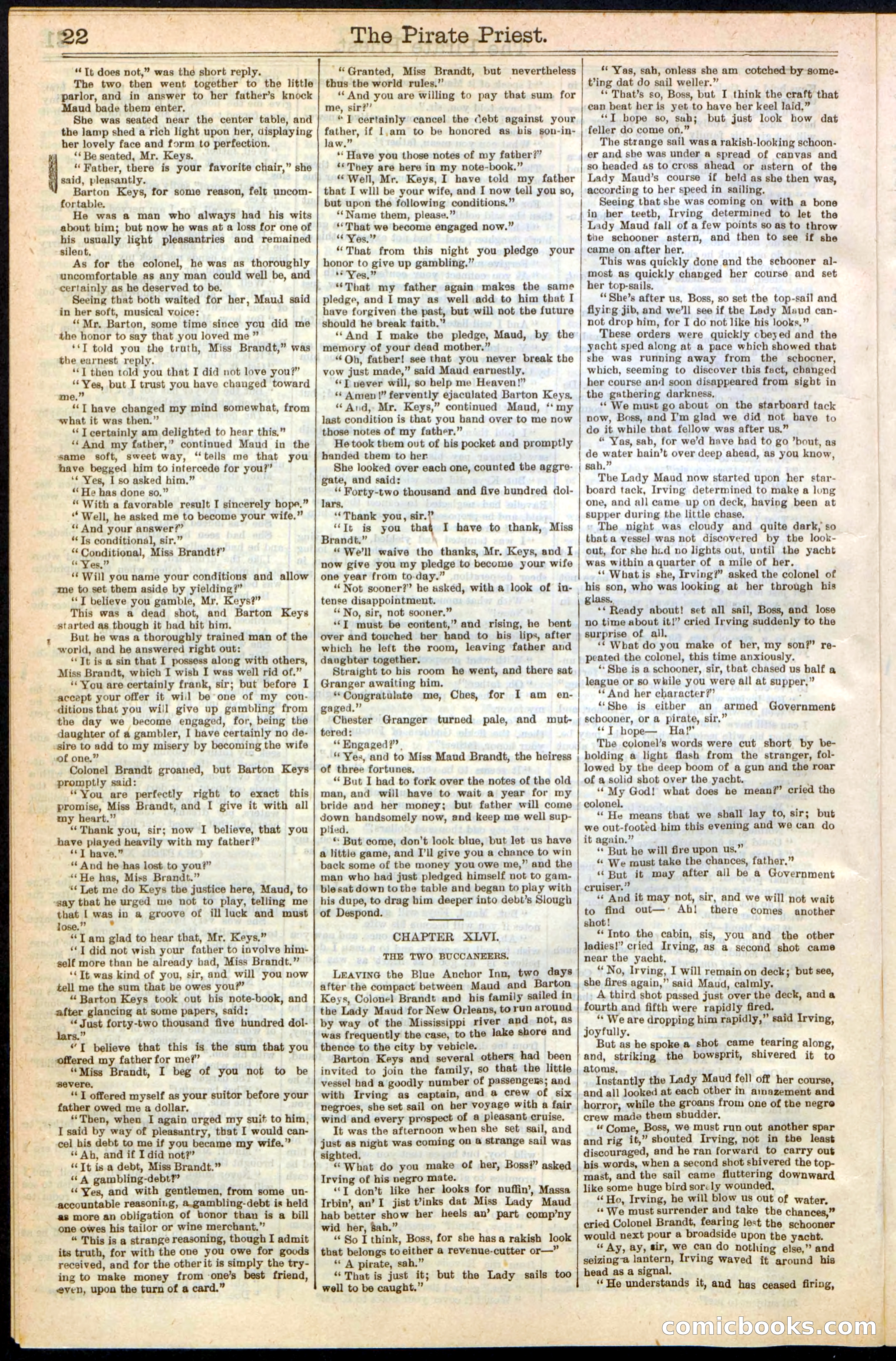
A restored page from Pulp Fiction, 1883. Page through the whole issue in the reader above.
📄 Transcribed text from this page (OCR, searchable)
Machine-transcribed from the original scan — historical spelling and the odd misread are preserved.
» - ~The Pirate Priest. ee ey ‘Tt does not,” was the short reply. The two. then went together to the little parlor, and in answer to her father’s knock Maud bade them enter, She was seated near the center table, and the lamp shed a rich light upon her, displaying her lovely face and form to perfection. ‘¢ Be seated, Mr. Keys. “Father, there is your favorite chair,” she said, pleasantly. Barton Keys, for some reason, felt uncom- fortable. He was a man who always had his wits about bim; but now he was at a loss for one of his usually light pleasantries and remained \ silent, As for the colonel, he was as thoroughly uncomfortable as any man could well be, and certainly as he deserved to be. Seeing that both waited for her, Maud said in her soft, musical voice: ‘Mr. Barton, some time since you did me the honor to say that you loved me” ‘*T told you the truth, Miss Brandt,” was the earnest reply. ‘“T then told you that I did not love you?” ‘‘ Yes, but I trust you have changed toward me,” ‘‘T have changed my mind somewhat, from what it was then.” ‘‘ T certainly am delighted to hear this,” ‘“‘ And my father,” continued Maud in the ‘game soft, sweet way, “tells me that you have begged him to intercede for you?” *¢ Yes, I so asked him.” ‘‘He has done so,” “With a favorable result I sincerely hope.” “Well, he asked me to become your wife.” ** And your answer?” “Ts conditional, sir.” “ Conditional, Miss Brandt?” “ Yes,” ‘* Will you name your conditions and allow me to set them aside by yielding?” oe “T believe you gamble, Mr, Keys?” This was a dead shot, and Barton Keys i! started as though it bad bit him. ; But he was a thoroughly trained man of the world, and he answered right out: ‘‘Tt is a sin that I possess along with others, ie Miss Brandt, which I wish I was well rid of.” I ‘‘- You are certainly frank, sir; but before I | accept your offer it will be one of my con- (| -ditions that you will give up gambling from | the day we become engaged, for, being the | daughter of a gambler, I have certainly no de- -sire to add to my misery by becoming the wife of one.” Colonel Brandt groaned, but Barton Keys promptly said: “You are perfectly right to exact this promise, Miss Brandt, and I give it with all ij ' my heart.” } “Thank you, sir; now I believe, that you i have played heavily with my father?” } ; ‘¢] have.” ! “‘ And he has lost to you?” “*He has, Miss Brandt.” *¢ Let me do Keys tbe justice here, Maud, to say that he urged me not to play, telling me that | was in a groove of ill luck and must » lose.” if ‘‘T am glad to hear that, Mr. Keys.” ‘1 did not wish your father to involve him- self more than be already bad, Miss Brandt.” ‘¢ Tt was kind of you, sir, and will you now _ tell me the sum that be owes you?” PDF's “ Barton Keys took out his note-book, and i) after glancing at some papers, said: “‘ Just forty-two thousand five hundred dol- ” /; “T believe that this is the sum that you ) offered my father for me?’ “Miss Brandt, I beg of you not to be severe. ‘*T offered myself as your suitor before your father owed me a dollar. 7. _. “Then, when I again urged my suit to him, ) I said by way of pleasantry, that I would can- ’ gel his debt to me if you became my wife.” Oy ‘“ Ah, and if I did not?” : ‘‘Tt is a debt, Miss Brandt.” Pm “A gambling-debt?” ‘Yes, and with gentlemen, from some un- accountable reasoning, a.gambling-debt is held | __ as more an obligation of bonor than is a bill one owes his tailor or wine merchant.” “ This is a strange reasoning, though I admit its truth, for with the one you owe for goods received, and for the other it is simply the try- ing to make money from -one’s best friend, ven, upon the turn of a card.” ee a “Granted, Miss Brandt, but nevertheless thus the world rules.” ‘‘ And you are willing to pay that sum for me, sir?’ *] certainly cancel the cebt against your father, if I,am to be honored as bis son-in- law.” ‘‘ Have you those notes of my father?’ ‘They are bere in my note-book.” ‘“Well, Mr. Keys, I have told my father that I wlll be your wife, and I now tell you so, but upon the following conditions.” ‘Name them, please.” ‘*That we become engaged now.” ‘C"ea:"? “That from this night you pledge your honor to give up gambling.” se Yes,” “That my father again makes the same pledge, and I may as well add to him that I have forgiven the past, but will not the future should he break faith.” ‘‘And I make the pledge, Maud, by the | memory of your dead mother.” “Oh, father! see that you never break the vow just made,” said Maud earnestly, ‘‘T wever will, so help me Heaven!” ‘¢‘ Amen!” fervently ejaculated Barton Keys, “ And, Mr. Keys,” continued Maud, ‘‘ my last condition is that you band over to me now those notes of my father.” He took them ovt of bis pocket and promptly handed them to her ** ‘Yas, sah, onless she am cotched by some- t’ing dat do sail weller.” ‘* That’s so, Boss, but I think the craft that ean beat her is yet to have her keel laid,” ‘“‘T bope so, sah; but just look how dat feller do come on.” The strange sail was a rakish-looking schoon- er and sbe was under a spread of canvas and so headed as to cross ahead or astern of the _Lady Maud’s course if held as she then was, according to her speed in sailing. Seeing that she was coming on with a bone in ber teeth, Irving determined to let the Lady Maud fall of a few points so as to throw the schooner astern, and then to see if she came on after her, This was quickly done and the sebooner al- most as quickly changed her course and set her top-sails. “‘She’s after us, Boss, so set the top-sail and flying jib, and we’ll see if the Lady Maud can- not drop him, for I do not like his looks,” These orders were quickly obeyed and the yacht sped along at a pace which showed that she was running away from the scbooner, which, seeming to discover this fact, changed her course and soon disappeared from sight in the gathering darkness, ‘‘ We must go about on the starboard tack now, Boss, and I’m glad we did not bave to do it while that fellow was after us.” “ ‘Yas, sah, for we’d have had to go ’bout, as de water hain’t over deep ahead, as you know, She looked over each one, counted the aggre- | sab.” gate, and said: ‘‘ Forty-two thousand and five hundred dol- lars, ‘*Tbhank you, sir.” “Tt is you thal I have to thank, Miss Brandt.” “We'll waive tho thanks, Mr. Keys, and I now give you my pledge to become your wife one year from to-day.” ‘““ Not sooner?” be asked, with a look of in- tense disappointment. ** No, sir, not sooner.” ‘‘T must be content,” and rising, he bent over and touched ber hand to his lips, after which he left the room, leaving father and daughter together. Straight to his room he went, and there sat Granger awaiting bim. “Congratulate me, Ches, for I am en- gaged.” Chester Granger turned pale, and mut- tered: rT Engaged ? * Yes, and to Miss Maud Brandt, the heiress of three fortunes. ‘** But I bad to fork over the notes of the old man, and will have to wait a year for my bride and her money; but father will come down handsomely now, and keep me well sup- plied. ‘‘ But come, don’t look blue, but let us have a little game, and I’ll give you a chance to win back some of the money you owe me,” and the man who had just pledged himself not to gam- ble sat down to the table and began to play with his dupe, to drag him deeper into debt’s Slough of Despond. CHAPTER XLVI. THE TWO BUCCANEERS. LEAVING the Blue Anchor Inn, two days after the compact between Maud and Barton Keys, Colonel Brandt and his family sailed in the Lady Maud for New Orleans, to run around by way of the Mississippi river and not, as was frequently the case, to the Jake shore and thence to the city by vebicle. Barton Keys and several others had been invited to join the family, 80 that the little vessel had a goodly number of passengers; and with Irving as captain, and a crew of six negroes, she set sail on her voyage with a fair wind and every prospect of a pleasant cruise. It was the afternoon when she set sail, and just as night was coming on & strange sail was sighted. “What do you make of her, Boss?” asked Irving of his negro mate. “IT don’t like her looks for nuffin’, Massa Irbin’, an’ I jist inks dat Miss Lady Maud hab better show her heels an’ part comp’ny wid her, bab.” ‘“‘ So I think, Boss, for she hasa rakish look that belongs to either a revenue-cutter or—” ‘A pirate, sah.” : ‘That is just it; but the Lady sails too well to be caught.” SS — The Lady Maud now started upon her star- board tack, Irving determined to make a long one, and all came up on deck, having been at supper during the little chase, The night was cloudy and quite dark, so that a vesse] was not discovered by the look- out, for she hid no lights out, until the yacht was within aquarter of a mile of her. ‘‘ Whatis she, Irving?” asked the colonel of his son, who was looking at her through his glass. ‘* Ready about! set all sail, Boss, and lose no time about it!” cried Irving suddenly to the surprise of all, ‘“ What do you make of ber, my son?’ re- peated the colonel, this time anxiously. ‘She is a schooner, sir, that chased us half a league or so while you were all at supper,” ** And her character?’ “She is either an armed Government schooner, or a pirate, sir,” ‘“‘T hope— Ha!” The colonel’s words were cut short by be- holding a light flash from the stranger, fol- lowed by the deep boom of a gun and the roar of a solid shot over the yacht. ' ‘‘ My God! what does he mean?” cried the colonel. ‘He means that we sball lay to, sir; but we out-footed him this evening and we can do it again.” ‘* But be will fire upon us,” ‘* We must take the chances, father,” ‘“ But it may after all be a Government cruiser.” ‘“‘ And it may not, sir, and we will not wait to find out—: Ab! there comes another shot! “Into the cabin, sis, you and the other Jadies!” cried Irving, as a second shot came near the yacht, “ No, Irving, I will remain on deck; but see, she fires again,” said Maud, calmly. A third shot passed just over the deck, anda fourth and fifth were rapidly fired. ‘ We are dropping him rapidly,” said Irving, joyfully. But as he spoke a shot came tearing along, and, striking the bowsprit, shivered it to atoms, Instantly the Lady Maud fell off her course, and all Jooked at each other in amazement and horror, while the groans from one of the negre crew made them sbudder. “ Come, Boss, we must run out another spar and rig it,” sbouted Irving, not in the least discouraged, and he ran forward to carry out his words, when a second shot shivered the top- mast, and the sail came fluttering downward like some huge bird sorely wounded, “ Ho, Irving, he will blow us out of water. “We must surrender and take the chances,” cried Colonel Brandt, fearing lest the schooner would next pour a broadside upon the yacht. “ Ay, ay, sir, we can do nothing else,” and seizinga lantern, Irving waved it around his head as a signal. ‘‘ He understands it, and has ceased firing, COMMU S) (0) JOO —-