
Pulp Fiction, 1883 · page 21 of 32
Beadle's New York Dime Library No. 255 — page 21: what you’re looking at
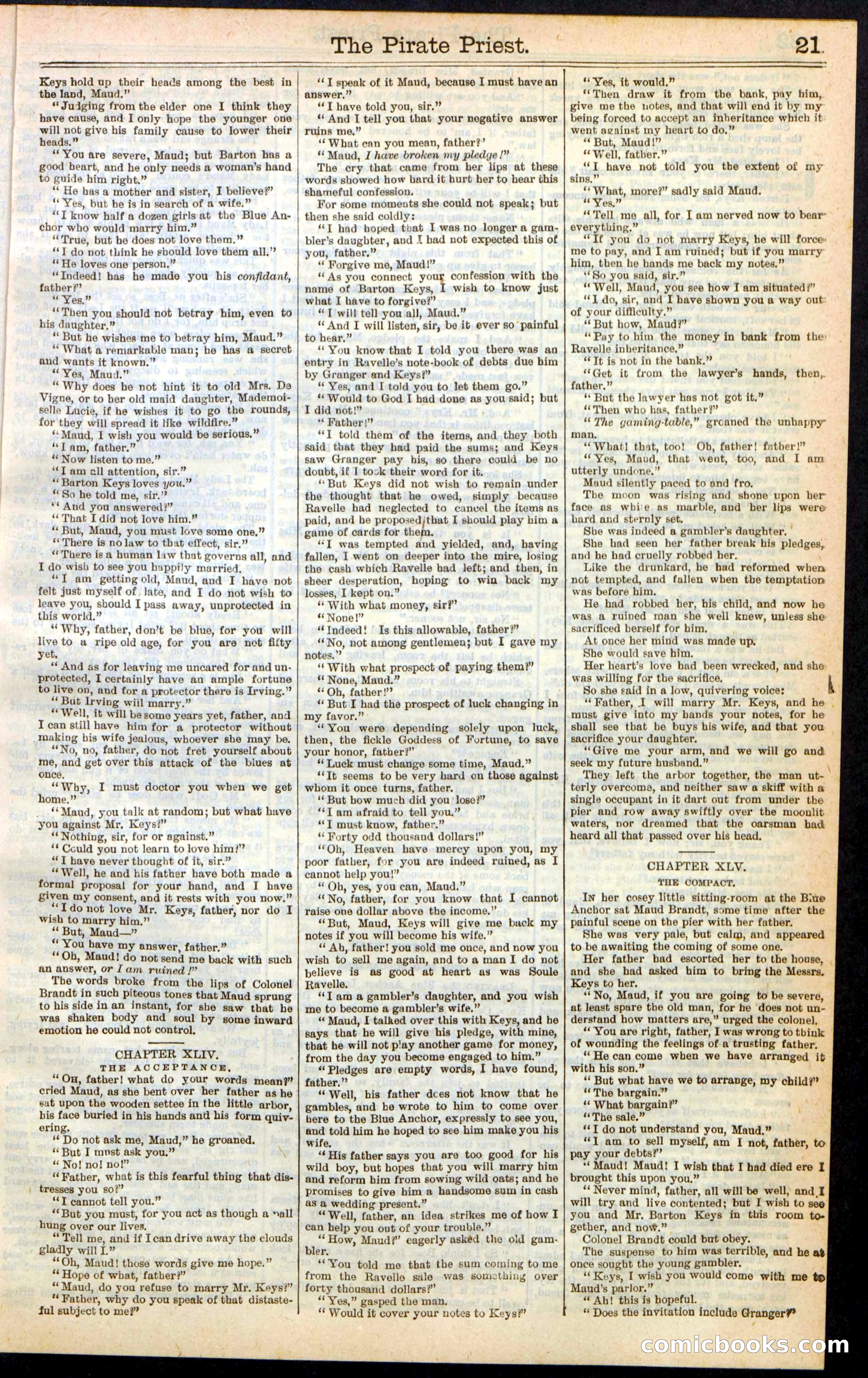
A restored page from Pulp Fiction, 1883. Page through the whole issue in the reader above.
📄 Transcribed text from this page (OCR, searchable)
Machine-transcribed from the original scan — historical spelling and the odd misread are preserved.
= Keys hold up their heads among the best in the land, Maud.” “ Judging from the elder one I think they have cause, and I only hope the younger one will not give his family cause to lower their heads.” “You are severe, Maud; but Barton has a good heart, and he only needs a woman’s hand to guide him right.” ** He bas a mother and sister, I believe?’ ‘Yes, but he is in search of a wife.” “T know half a dozen girls at the Blue An- chor who would marry him.” “True, but he does not love them,” ‘*T do not think he sbould love them all.” ‘* He loves one person.” “Indeed! has he made you his confidant, father?’ “ Yes.” ‘Then you should not betray him, even to his daughter,” *‘ But he wishes me to betray him, Maud.” * What a remarkable man; he has a secret aud wants it known.” * Yes, Maud.” “Why does he not hint it to old Mrs. De Vigne, or to ber old maid daughter, Mademoi- selle Lucie, if he wishes it to go the rounds, for they will spread it like wildfire.” ‘Maud, I wish you would be serious,” ‘*T am, father.” ** Now listen to me.” ‘*T am all attention, sir.” ‘Barton Keys loves you.” “So he told me, sir.” *“* And you answered?” ‘That I did not love him.” ‘But, Maud, you must love some one,” **There is no law to tbat effect, sir.” ** There is a human law that governs all, and I do wish to see you happily married, “T am getting old, Mand, and I have not felt just myself of late, and I do not wish to leave you, should I pass away, unprotected in this world,” “Why, father, don’t be blue, for you will live to a ripe old age, for you are not fifty yet. ** And as for leaving me uncared for and un- protected, I certainly have an ample fortune to live on, and for a protector there is Irving.” * But Irving wiil marry.” “Well, it will besome years yet, father, and I can still have him for a protector without making bis wife jealous, whoever she may be. “No, no, father, do not fret yourself about me, and get over this attack of the blues at once, “Why, I must doctor you when we get home.” ‘‘Manud, you talk at random; but what have you against Mr, Keys?” “Nothing, sir, for or against.” ** Could you not learn to love him?” “I have never thought of it, sir.” “Well, he and his father have both made a formal proposal for your hand, and I have £iven my consent, and it rests with you now.” “‘Ido not love Mr. Keys, father, nor do I wish to marry him.” ** But, Maud—” “You have my answer, father.” “Oh, Maud! do not send me back with such an answer, or Iam ruined !” Tbe words broke from the lips of Colonel Brandt in such piteous tones that Maud sprung to his side in an instant, for she saw that be was shaken body and soul by some inward emotion he could not control, CHAPTER XLIV. THE ACCEPTANCE, “On, father! what do your words mean?” cried Maud, as she bent over her father as he sat upon the wooden settee in the little arbor, bis face buried in his hands and his form quiy- ering. ‘Do not ask me, Maud,” he groaned. ‘‘But I must ask you.” ** No! no! no!” “Father, what is this fearful thing that dis- tresses you so?” “*T cannot tell you.” **But you must, for you act as though a all hung over our lives. “Tell me, and if Ican drive away the clouds gladly will I.” “Oh, Maud! those words give me hope.” “* Hope of what, father?” “Maud, do you refuse to marry Mr. Keys?” **Father, why do you speak of that distaste- ful subject to me?” The Pirate Priest. - ‘‘T speak of it Maud, because I must have an answer.” ‘‘T have told you, sir.” ‘* And I tell you that your negative answer ruins me,” ‘“ What can you mean, father?’ ‘‘ Maud, J have broken my pledge !” The cry that came from her lips at these words showed how bard it hurt her to hear this shameful confession. For some moments she could not speak; but then she said coldly: ‘‘T had boped that I was no longer a gam- bler’s daughter, and { had not expected this of you, father,” ‘‘ Forgive me, Maud!” ‘As you connect you name of Barton Keys, what I have to forgive?” “T will tell you all, Maud,” * And I will listen, sir, be it ever so painful to hear.” ‘You know that I told you there was an entry in Ravelle’s note-book of debts due him by Granger and Keys?” ** Yes, and I told you to Jet them go.” ** Would to God I had done as you said; but I did not!” “* Father!” “I told them of the items, and they both said that they had paid the sums; and Keys saw Granger pay his, so there could be no doubt, if I tock their word for if. ‘But Keys did not wish to remain under the thought that he owed, simply because Ravelle had neglected to canvel the items as paid, and he proposed)that I should play him a game of cards for them. ‘“‘T was tempted and yielded, and, having fallen, I went on deeper into the mire, losing the cash which Ravelle bad left; and then, in sheer desperation, hoping to win back my losses, I kept on.” ‘‘ With what money, sir?’ ** None!” ‘Indeed! Is this allowable, father?” ‘‘No, not among gentlemen; but I gave my notes.” ‘‘ With what prospect of paying them?’ ** None, Maud.” ** Oh, father!’ ‘‘ But I had the prospect of luck changing in my favor.” ‘*You were depending solely upon luck, then, the fickle Goddess of Fortune, to save your honor, father?” ‘Luck must change some time, Maud.” ‘‘Tt seems to be very hard on those against whom it once turns, father. ‘* But bow much did you lose?” **T am afraid to tell you,” ‘‘T must know, father,” “ Forty odd thousand dollars!” ‘‘Oh, Heaven have merey upon you, my poor father, for you are indeed ruined, as I cannot help you!” * Ob, yes, you can, Maud.” ‘No, father, for you know that I cannot raise one dollar above the income,” ‘‘But, Maud, Keys will give me back my notes if you will become his wife.” ** Ab, father! you sold me once, and now you wish to sell me again, and to a man I do not believe is as good at heart as was Soule Ravelle, ‘‘T am a gambler’s daughter, and you wish me to become a gambler’s wife.” ‘‘ Maud, I talked over this with Keys, and he says that he will give his pledge, with mine, that he will not p!ay another game for money, from the day you become engaged to him.” ‘Pledges are empty words, I have found, father.” ‘‘ Well, his father dces not know that he gambles, and he wrote to him to come over here to the Blue Anchor, expressly to see you, and told him he hoped to see him make you his wife, ‘‘ His father says you are too good for his wild boy, but hopes that you will marry him and reform bim from sowing wild oats; and he promises to give him a handsome sum in cash as a wedding present.” “Well, father, an idea strikes me of how I can help you out of your trouble.” e “How, Maud?” eagerly askéd the old gam. er. ‘You told me that the sum coming to me from the Ravello sale was something over forty thousand dollars?” “Yes,” gasped the man. ** Would it cover your notes to Keys?” confession with the wish to know just ‘ 21. ‘Yes, it would.” *‘Then draw it from the bank, pay him, give me the notes, and that will end it by my being forced to accept an inheritance which it went against my heart to do,” “ But, Maud!” “Well, father.” “T have not told you the extent of my sins,” ** What, more?” sadly said Maud. “ec Yes,” “Tell me all, for I am nerved now to bear everything.” “Tf you do not marry Keys, he will force: me to pay, and I am ruined; but if you marry him, then he bands me back my notes,” ‘*So you said, sir.” ** Well, Maud, you see how I am situated?” ‘1 do, sir, and I have shown you a way out: of your difficulty.” “But how, Maud?” “Pay to him the money in bank from the Ravelle inheritance,” “Tt is not in the bank.” ‘“‘Get it from the Jawyer’s hands, then,. father.” ‘* But the lawyer has not got it.” ‘Then who has, father?” “The gaming-table,” groaned the unhappy man, “What! that, too! Ob, father! father!” ‘Yes, Maud, that weot, too, and I am utterly undone.” | Maud silently paced to and fro. The moon was rising and shone upon her face as while as marble, and ber lips were bard and sternly set, Sbe was indeed a gambler’s daughter. | She had seen her father break his pledges, and he had cruelly robbed her, ‘ Like the drunkard, he had reformed when not tempted, and fallen when the temptation was before him. He had robbed her, bis child, and now he was a ruined man she well knew, unless she sacrificed herself for bim, At once her mind was made up, She would save him. Her heart’s love bad been wrecked, and she was willing for the sacrifice, h So she said in a low, quivering voice: a ‘Father, I will marry Mr. Keys, and he | must give into my bands your notes, for he ~ shall see that be buys his wife, and that you — sacrifice your daughter. | “Give me your arm, and we will go and seek my future husband.” They left the arbor together, the man ut- terly overcome, and neither saw a skiff with a single occupant in it dart out from under the pier and row away swiftly over the moonlit. waters, nor dreamed that the oarsman had heard all that passed over his head, \ CHAPTER XLV. THE COMPACT. In her cosey little sitting-room at the Bite Anchor sat Maud Brandt, some time after the — painful scene on the pier with her father, She was very pale, but calm, and appeared © to be awaiting the coming of some one, Her father had escorted her to the house, | and she had asked him to bring the Messrs, Keys to her. x ‘No, Maud, if you are going to be severe, at least spare the old man, for he does not un- derstand how matters are,” urged the colonel), ** You are right, father, I was wrong to think | of wounding the feelings of a trusting father. | “ He can come when we have arranged if with his son.” ; ‘‘ But what have we to arrange, my child?” “The bargain.” ‘‘ What bargain?” vet ‘‘The sale.” .: ‘‘T do not understand you, Maud.” — | “1 am to sell myself, am I not, father, to pay your debts?” j ‘Maud! Maud! I wish that I had died ere I brought this upon you,” ‘* Never mind, father, all will be well, and I will try and live contented; but I wish to see you and Mr. Barton Keys in this room to gether, and now.” . Colonel Brandt could but obey. 4 The suspense to him was terrible, and he once sought the young gambler, : ‘‘ Keys, I wish you would come with me to Maud’s parlor.” “Ah! this is hopeful. “ Does the invitation include Granger?* (E(6) JOOKS 4 m (C com