
Pulp Fiction, 1883 · page 23 of 32
Beadle's New York Dime Library No. 255 — page 23: what you’re looking at
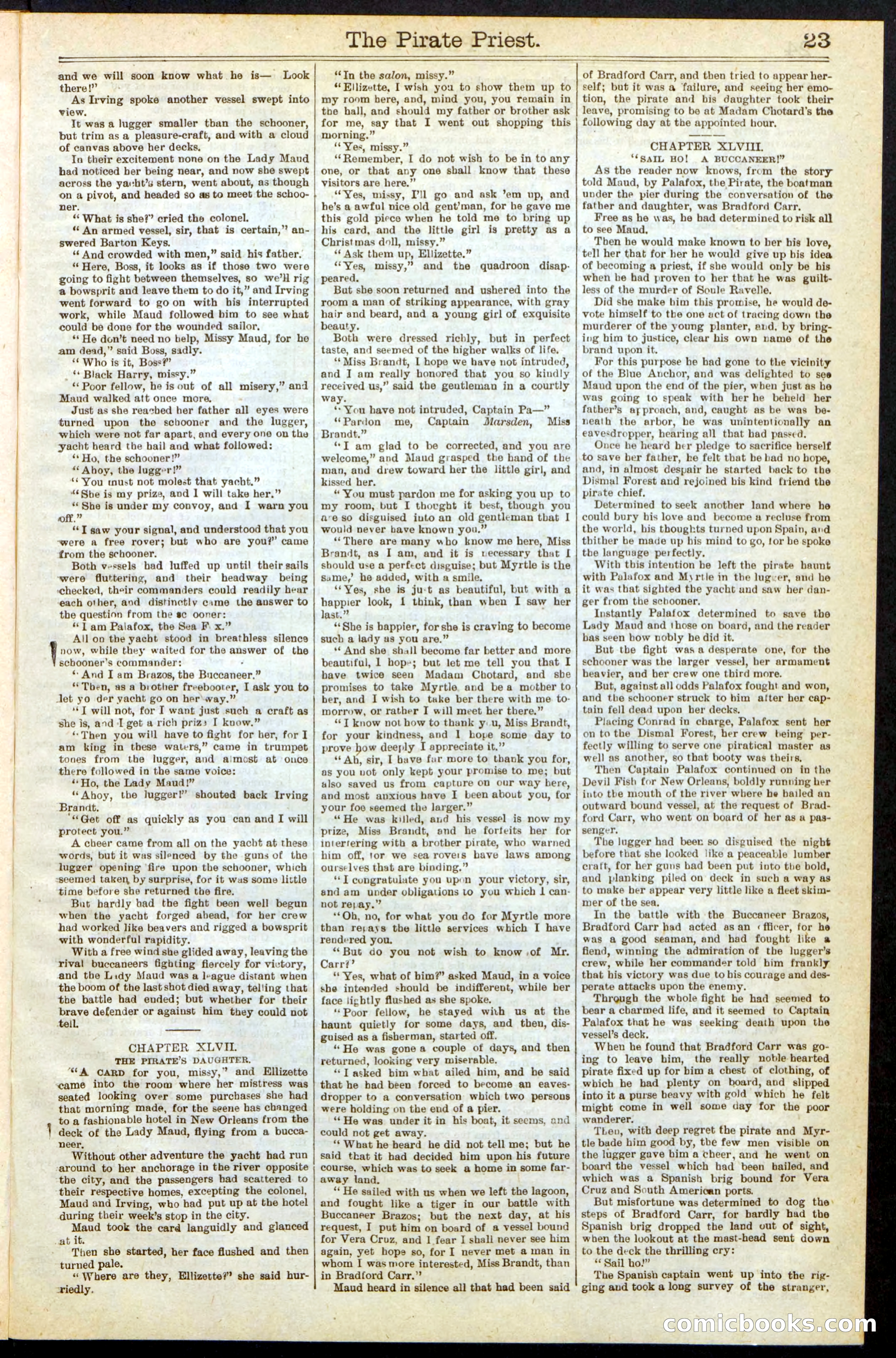
A restored page from Pulp Fiction, 1883. Page through the whole issue in the reader above.
📄 Transcribed text from this page (OCR, searchable)
Machine-transcribed from the original scan — historical spelling and the odd misread are preserved.
| — The Pirate Priest. 23 and we will soon know what he is— Look there!”’ As Irving spoke another vessel swept into view. Tt was a lugger smaller than the schooner, but trim as a pleasure-craft, and with a cloud of canvas above her decks. In their excitement none on the Lady Maud had noticed ber being near, and now she swept across the yarht’s stern, went about, as though on a pivot, and headed so as to meet the schoo- ner. ‘‘ What is she?” cried the colonel. ‘An armed vessel, sir, that is certain,’ an- swered Barton Keys. ‘¢ And crowded with men,” said his father. ‘‘ Here, Boss, it looks as if those two were going to fight between themselves, so we’l rig a bowsprit and leave them to do it,” and Irving went forward to goon with his interrupted work, while Maud followed bim to see what could be done for the wounded sailor, ‘‘ He don’t need no belp, Missy Maud, for he am dead,” said Boss, sadly. ** Who is it, Boss?” _* Black Harry, missy.” ‘* Poor fellow, he is out of all misery,” and Maud walked att once more, Just as she reacbed her father all eyes were turned upon the scbooner and the lugger, which were not far apart, and every one on the yacht heard the bail and what followed: ‘* Ho, the schooner!” ** Ahoy, the lugger!” ‘You must not molest that yacht.” ““Sbe is my prize, and | will take her,” ‘She is under my convoy, and I warn you off.” “T saw your signal, and understood that you ‘were a free rover; but who are you?’ came from the schooner. Both vessels bad luffed up until their sails ‘were fluttering, and their headway being ‘checked, their commanders could readily hear each other, and distinctly came the answer to the question from the sc ooner: ‘“l am Palafox, the Sea F\ x.” All on the yacht stood in breathless silence now, while they waited for the answer of the schooner's commander: . * And I am Brazos, the Buccaneer.” *Tben, as a brother freebooter, I ask you to Jet yo der yacht go on her way.” ‘*T will not, for I want just such a craft as she is, and I get a rich priz» I know.” ‘‘Then you will have to fight for her, for I am king in these waters,” came in trumpet tones from the lugger, and almost at once there followed in the same voice: ‘Ho, the Lady Maud!” “Ahoy, the lugger!” shouted back Irving Brandt, ‘Get off as quickly as you can and I will protect you.” A cheer came from all on the yacht at these — words, but it was silenced by the guns of the | lugger opening ‘fire upon the schooner, which ‘seemed taken, by surprise, for it was some little time before she returned the fire. But hardly bad the fight been well begun when the yacht forged abead, for her crew had worked like beavers and rigged a bowsprit with wonderful rapidity. With a free wind she glided away, leaving the rival buccaneers fighting fiercely for victory, and the Lidy Maud was a league distant when the boom of the last shot died away, telling that the battle had ended; but whether for their brave defender or against him they could not teil. CHAPTER XLVIZ. THE PIRATE’S DAUGHTER. ‘A CARD for you, missy,” and Ellizette came into the room where her mistress was seated looking over some purchases she had that morning made, for the seene has changed to a fashionable hotel in New Orleans from the deck of the Lady Maud, flying from a bucca- neer, Without other adventure the yacht had run around to her anchorage in the river opposite the city, and the passengers bad scattered to their respective homes, excepting the colonel, Maud and Irving, who had put up at the hotel during their week’s stop in the city. Maud took the card languidly and glanced at it. Then she started, her face flushed and then turned pale. “Where are they, Ellizette?’? she said hur- sriedly. rr LL TT ‘Tn the salon, missy.” * Ellizette, I wish you to show them up to my room here, and, mind you, you remain in tbe hall, and should my father or brother ask for me, say that I went out shopping this morning.” "Yes, missy.” ‘*Remember, I do not wish to be in to any one, or that any one sball know that these visitors are here.”’ “Yes, missy, Pll go and ask ’em up, and he’s a awful nice old gent’man, for he gave me this gold piece when he told me to bring up his card, and the little girl is pretty as a Christmas doll, missy.” ‘‘ Ask them up, Ellizette.” ‘Yes, missy,” and the quadroon disap- peared. But she soon returned and ushered into the room a man of striking appearance, with gray hair and beard, and a young girl of exquisite beauty. Both were dressed richly, but in perfect taste, and seemed of the higher walks of life. ‘** Miss Brandt, L hope we have not intruded, and I am really honored that you so kindly received us,” said the gentleman in a courtly way. ‘- You have not intruded, Captain Pa—” ‘Pardon me, Captain Marsden, Miss Brandt.” “T am glad to be corrected, and you are welcome,” and Maud grasped the hand of the man, and drew toward her the little girl, and kissed her. “You must pardon me for asking you up to my room, but I thovght it best, though you are so disguised into an old gentleman that I would never bave known you.” ‘“‘There are many who know me here, Miss Brandt, as I am, and it is vecessary that I should use a perfect disguise; but Myrtle is the same,’ he added, with a smile. ‘* Yes, she is ju:t as beautiful, but with a happier look, 1 think, than when I saw her last.” ‘She is bappier, for she is craving to become such a lady as you are.” ** And she shall become far better and more beautiful, 1 hope; but let me tell you that I bave twice seen Madam Chotard, and sbe promises to take Myrtle. and bea mother to ber, and I wish to take ber there with me to- morrow, or rather I will meet her there.” ‘“*T know not how to thank yu, Miss Brandt, for your kindness, and | hope some day to prove how deeply I appreciate it,” ‘* Ab, sir, I bave fur more to thank you for, as you vot only kept your promise to me; but also saved us from capture on our way bere, and most anxious have I been about you, for your foe seemed the larger.” “He was killed, and his vessel is now my prize, Miss Brandt, and he forteits her for interfering with a brother pirate, who warned him off, tor we sea rovers bave laws among ourselves that are binding.” “T congratulate you upon your victory, sir, and am under obligations to you which | can- not repay.” ‘*Oh, no, for what you do for Myrtle more than repays the little services which I have rendered you. “But do you not wish to know,of Mr. Carr?’ ‘Yes, what of bim?”’ asked Maud, in a voice she intended should be indifferent, while ber face lightly flushed as she spoke. ‘‘Poor fellow, be stayed with us at the haunt quietly for some days, and then, dis- guised as a fisherman, started off. “He was gone a couple of days, and then returned, looking very miserable. ‘“‘T asked bim what ailed him, and he said that he had been forced to become an eaves- dropper to a conversation which two persons were holding on the end of a pier. “He was under it in his boat, it seems, and | could not get away. ** What he beard he did not tell me; but he said that it bad decided him upon his future course, which was to seek a home in some far- away land. ** He sailed with us when we left the lagoon, and fought like a tiger in our battle with Buccaneer Brazos; but the next day, at his request, I put him on board of a vessel bound for Vera Cruz, and | fear I shall never see him again, yet hops so, for I never met a man in whom I was more interested, Miss Brandt, than in Bradford Carr.” Maud heard in silence all that had been said of Bradford Carr, and then tried to appear her- self; but it was a failure, and seeing her emo- tion, the pirate and bis daughter took their leave, promising to be at Madam Chotard’s the following day at the appointed hour, CHAPTER XLVIII. **SsIL HO! A BUCCANEER!” As the reader now knows, from the story told Maud, by Palafox, the Pirate, the boatman under the pier during the conversation of the father and daughter, was Bradford Carr, Free as he was, he bad determined to risk all to see Maud, Tben he would make known to ber bis love, tell her that for her he would give up bis idea of becoming a priest, if she would only be his when be had proven to her that he was guilt- less of the murder of Soule Ravelle. Did she make him this promise, he would de- vote himself to the one act of tracing down the murderer of the young planter, and, by bring- ing him to justice, clear his own name of the brand upon it. For this purpose he had gone to the vicinity of the Blue Anchor, and was delighted to see Maud upon the end of the pier, when just as he was going to speak with her he beheld her father’s ay proach, and, caught as be was be- neath the arbor, be was unintentionally an eavesdropper, hearing all that had passed. Once he heard ber pledge to sacrifice herself to save ber father, he felt that be bad no hope, and, in almost despair he started back to the Dismal! Forest and rejoined bis kind friend the pirate chief. Determined to seek another land where he could bury bis love and become a recluse from the world, bis thoughts turned upon Spain, and thither be made up his mind to go, tor be spoke the language perfectly. With tbis intention be left the pirate haunt with Palafox and Myrtle in the lugeer, and he it was that sighted the yacht and saw her dan- ger from the scbooner. Instantly Palafox determined to save the Lady Maud and those on board, and the reader bas seen bow nobly he did it. But the fight was a desperate one, for the schooner was the larger vessel, her armament beavier, and ber crew one third more. But, against all odds Palafox fought and won, and the schooner struck to bim alter her cap- tain fell dead upon ber decks. Placing Conrad in charge, Palafox sent her on to the Dismal Forest, her crew being per- fectly willing to serve one piratical master as well as another, so that booty was theirs, Then Captain Palafox continued on in the Devil Fish for New Orleans, boldly running her into the mouth of the river where he bailed an outward bound vessel, at the request of Brad- ford Carr, who went on board of her as a pas- senger, The lugger had beer so disguised the night before that she looked like a peaceable lumber craft, for her guns bad been put into the bold, and planking piled on deck in such a way as to make ber appear very little like a fleet skim- mer of the sea, In the battle with the Buccaneer Brazos, Bradford Carr had acted as an < fficer, for he was a good seaman, and had fought like a fiend, winning the admiration of the lugger’s crew, while her commander told bim frankly that his victory was due to bis courage and des- perate attacks upon the enemy. Through the whole fight he had seemed to bear a charmed life, and it seemed to Captain Palafox that he was seeking death upon the vessel’s deck, When he found that Bradford Carr was go- ing to leave him, the really noble hearted pirate fixed up for bim a chest of clothing, of which he bad plenty on board, and slipped into it a purse beavy with gold which he felt might come in well some day for the poor wanderer. . ThLev, with deep regret the pirate and Myr- tle bade him good by, the few men visible on the lugger gave bim a cheer, and he went on board the vessel which had been hailed, and which was a Spanish brig bound for Vera Cruz and South American ports. But misfortune was determined to dog the» steps of Bradford Carr, for bardly had the Spanish brig dropped the land out of sight, when the lookout at the mast-head sent down to the deck the thrilling cry: ** Sail ho!” The Spanish captain went up into the rig- ging and took a long survey of the stranger, ¢€oim S) (C (E(o) JOO