
Pulp Fiction, 1883 · page 17 of 32
Beadle's New York Dime Library No. 245 — page 17: what you’re looking at
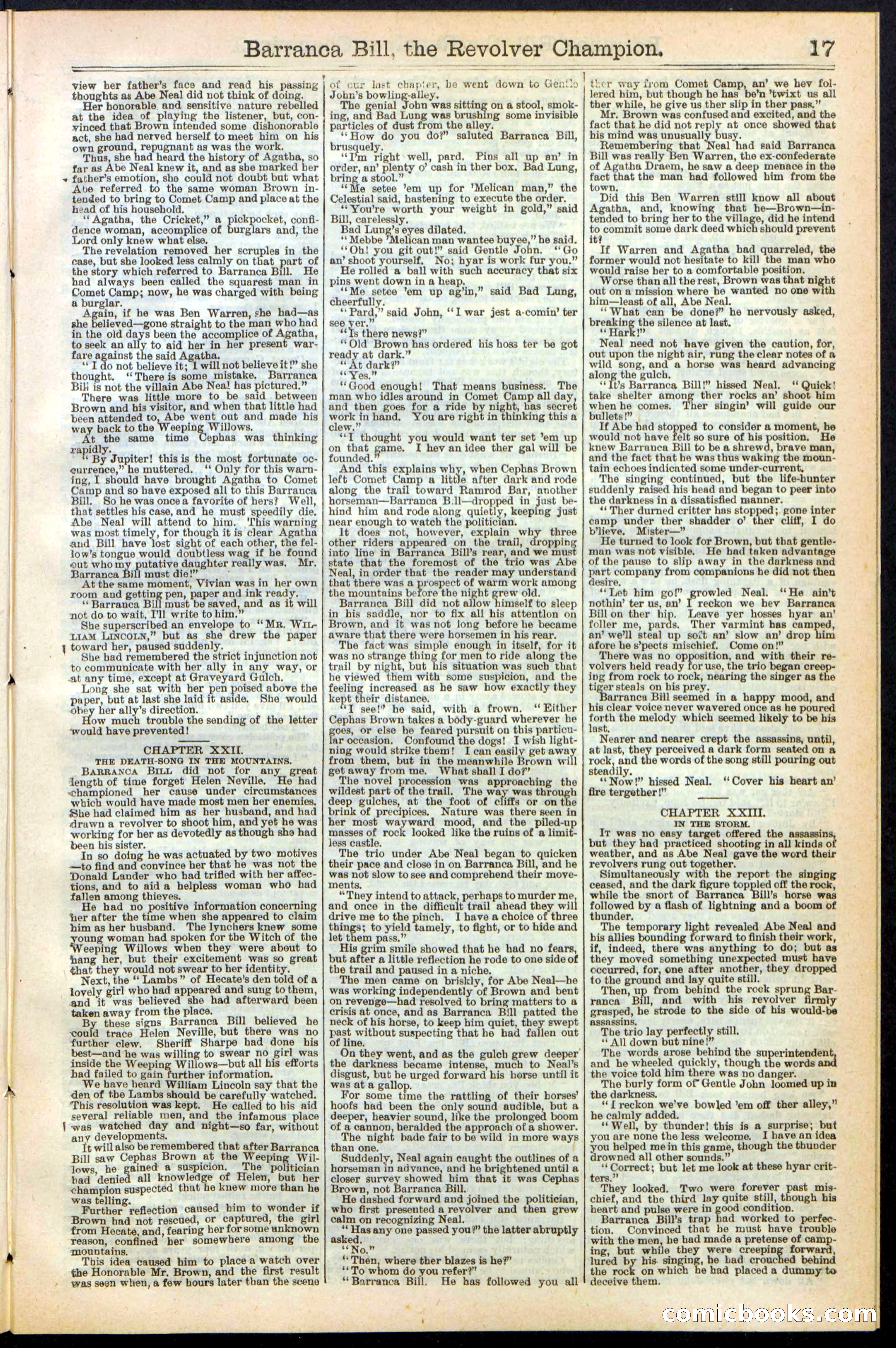
A restored page from Pulp Fiction, 1883. Page through the whole issue in the reader above.
📄 Transcribed text from this page (OCR, searchable)
Machine-transcribed from the original scan — historical spelling and the odd misread are preserved.
ee eel | 4 view her father’s face and read his passing thoughts as Abe Neal did not think of doing. Her bonorable and sensitive nature rebelled at the idea of playing the listener, but, con- yvinced that Brown intended some dishonorable act, she had nerved herself to meet him on his own ground, repugnant as was the work. Thus, she had heard the history of Agatha, so far as Abe Neal knew it, and as she marked ber father’s emotion, she could not doubt but what Abe referred to the same woman Brown in- tended to bring to Comet Camp and place at the head of his household. ‘Agatha, the Cricket,” a eo ocket, confi- dence woman, accomplice of burglars and, the Lord only knew what else. The revelation removed her scruples in the ease, but she looked less calmly on that part of the story which referred to Barranca Bill. He had always been called the squarest man in Comet Camp; now, he was charged with being a burglar. Again, if he was Ben Warren, she had—as she Beeved—gone straight to the man who had in the old days been the accomplice of Agatha, to seek an ally to aid her in her present war- fare against the said Agatha. ‘“*I do not believe it; 1 will not believe it!” she thought. ‘There is some mistake. Barranca Bil is not the villain Abe Nea! has pictured.” There was little more to be said . between Brown and his visitor, and when that little had been attended to, Abe went out and made his way back to the Weeping, Willows. At the same time Cephas was thinking rapidly. . ; ‘ By Jupiter! this is the most fortunate oc- eurrence,” he muttered. ‘* Only for this warn- ing, I should have brought Agatha to Comet Camp and so have exposed all to this Barranca Bill. So he was oncea favorite of hers? Well, that settles his case,and he must speedily die. Abe Neal will attend to him. ‘This warning was most timely, for though it is clear Agatha aud Bill have lost sight of each other, the fel- low’s tongue would doubtless wag if he found out whomy putative daughter really was, Mr. Barranca Bill must die!” ; At the same moment, Vivian was in her own room and getting pen, paper and ink ready. | ‘* Barranca Bill must be saved, and as it will not do to wait, I'll write to him.” She superscribed an envelope to “ Mr. WIL- LIAM LINCOLN,” but as she drew the paper { toward her, paused suddenly. Sbe had remembered the strict injunction not to communicate with her ally in any way, or at any time, except at Graveyard Gulch, Long she sat with her pen poised above the paper, but at last she laid it aside. She would obey her ally’s direction. 2 much trouble the sending of the letter ‘would have prevented! CHAPTER XXII. THE DEATH-SONG IN THE MOUNTAINS. BARRANCA Brut did not for any_ great length of time forget Helen Neville. He had championed her cause under circumstances which would have made most men her enemies, She had claimed bim as her busband, and had drawn a revolver to shoot him, and yet he was working for her as devotedly as though sho had been his sister. In so doing he was actuated by two motives —to find and convince her that he was not the Donald Lander who had trifled with her affec- tions, and to aid a helpless woman who had fallen among thieves. / He had no positive information concerning wher after the time when she appeared to claim him as her husband. The lynchers knew some oung woman had spoken for the Witch of the Weeping Willows when they were about to hang her, but their excitement was so great ¢hat they would not swear to her identity. Next, the “‘ Lambs” of Hecate’s den told of a lovely girl who bad appeared and sung to them, and it was Serena vs had afterward been taken away from the place. B etal signs Barranca Bill believed he could trace Helen Neville, but there was no further clew. Sheriff Sharpe had done his best—and he was willing to swear no girl was inside the Weeping Willows—but all his efforts had failed to gain further information. We have heard William Lincoln say that the den of the Lambs should be carefully watched. ‘This resolution was kept. He called to his aid several reliable men, and the infamous place | was watched day and night—so far, without any developments. it will also be remembered that after Barranca Bill saw Cephas Brown at the Weeping Wil- lows, he gained a suspicion. The politician had denied all knowledge of Helen, but her champion suspected that he knew more than he was telling. ; I Further reflection caused him to wonder if Brown had not rescued, or captured, the girl from Hecate, and, fearing her for some unknown reason, confined her somewhere among the mountains. This idea caused him to place a watch over ¢he Honorable Mr, Brown, and the first result was seen when, a few hours later than the scene Barranca Bill, the Revolver Champion, a ee ee ee + t ' ” | of cur last chapter, he went down to Gentio Jobn’s bowling-alley. The genial John was sitting on a stool, smok- ing, and Bad Lung was brushing some invisible particles of dust from the alley. ‘‘How do you do?” saluted Barranca Bill, brusquely, ‘T’m right well, pard, Pins all up an’ in order, an’ plenty o’ cash in ther box. Bad Lung, bring a stool.” ; ‘‘Me setee ’em up for ’Melican man,” the Celestial said, hastening to execute the order. “You're worth your weight in gold,” said Bill, carelessly, Bad ngs eyes dilated, ** Mebbe *Melican man wantee buyee,” he said. ‘Oh! you git out!” said Gentle John. “Go an’ shoot yourself, No; byar is work fur you.” He rolled a ball with such accuracy that six pins went down in a heap. ‘*Me setee ’em up ag’in,” said Bad Lung, cheerfully. **Pard,” said John, ‘I war jest a-comin’ ter see yer,” **Ts there news?” **Old Brown has ordered his hoss ter be got ready at dark.” “At dark?” i) Yes. ” ‘Good enough! That means business. The man who idles around in Comet Camp all day, and then goes for a ride by night, bas secret psgeedg” hand, You are right in thinking this a clew.” “*T thought you would want ter set ’em up on that game. I hey an idee ther gal will be founded. And this explains ways when Cephas Brown left Comet Camp a little after dark and rode along the trail toward Ramrod Bar, another horseman—Barranca B.li—dropped in just be- hind him and rode along quietly, keeping just near enough to watch the politician. It does not, however, explain aa three other riders appeared on the trail, droppin into line in Barranca Bill’s rear, and we mus state that the foremost of the trio was Abe Neal, in order that the reader may understand that there was a prospect of warm work among the mountains before the night grew old. Barranca Bill did not allow himself to sleep in his saddle, nor to fix all his attentlon on Brown, and it was not long before he became aware that there were horsemen in his rear. The fact was simple enough in itself, for it was no strange eng! for men to ride along the trail by night, but his situation was such that he viewed them with some suspicion, and the feeling increased as he saw how exactly they kept their distance. ‘IT see!” he said, with a frown, “Either Cephas Brown takes a body-guard wherever he oes, or else he feared pursuit on this particu- ar occasion, Confound the dogs! I wish light- ning would strike them! I can easily get awa from them, but in the meanwhile Brown will get away from me. What shall I do?” The novel procession was approaching the wildest part of the trail. The way was through deep gulches, at the foot of cliffs or on the brink of precipices, Nature was there seen in her most wayward mood, and the piled-up masses of rock looked like the ruins of a limit- less castle. The trio under Abe Neal began to quicken their pace and close in on Barranca Bill, and he was not slow to see and comprehend their move- ments. “They intend to attack, perhaps to murder me and once in the difficult trail ahead they will drive me to the pinch. I have a choice of three things; to yield tamely, to fight, or to hide and let them pass.” His grim smile showed that he had no fears, but after a little reflection he rode to one side of the trail and paused in a niche. The men came on briskly, for Abe Neal—he was working independently of Brown and bent on revenge—had resolved to bring matters to a crisis at once, and as Barranca Bill patted the neck of his horse, to keep him quiet, they swept port without suspecting that he had fallen out of line. On they went, and as the gulch grew deeper the darkness became intense, much to Neal’s disgust, but he urged forward his horse until it was at a gallop. For some time the rattling of their borses’ hoofs had been the er sound audible, but a deeper, heavier sound, like the prolonged boom of a cannon, heralded the approach of a shower. The night bade fair to be wild in more ways than one. | Suddenly, Neal again caught the outlines of a horseman in advance, and he brightened until a closer survey showed bim that it was Cephas Brown, not Barranca Bill. He dashed forward and joined the politician, who first presented a revolver and then grew calm on recognizing Neal. ** Has any one passed you?” the latter abruptly asked. te No,” “Then, where ther blazes is he?” ‘To whom do you refer?” *Barranca Bill, He has followed you all 17 — ther way trom Comet Camp, an’ we hev fol- lered him, but though he has be’n ’twixt us all ther while, be give us ther slip in ther pass,” Mr. Brown was confused and excited, and the fact that he did not reply at once showed that his mind was pee enally uRy. Remembering that Neal had said Barranca Bill was really Ben Warren, the ex-confederate of Agatha Draem, he saw a deep menace in the fact that the man had followed him from the town. Did this Ben Warren still know all about | Agatha, and, knowing that he—Brown—in- tended to bring her to the village, did he intend to commit some dark deed which should prevent it? If Warren and Agatha had quarreled, the former would not hesitate to kill the man who would raise her to a comfortable position. Worse than all the rest, Brown was that night out on a mission where he wanted no one with him—least of all, Abe Neal. ‘“What can be done?” he nervously asked, breaking the silence at last. sc Har he Neal need not have given the caution, for, out upon the night air, rung the clear notes of a wild song, and a horse was heard advancing along the gulch. ‘‘It’s Barranca Bill!” hissed Neal. ‘ Quick! take shelter among ther rocks an’ shoot him when he comes. Ther singin’ will guide our bullets!” If Abe had stopped to consider a moment, he would not have felt so sure of his position. He knew Barranca Bill to be a shrewd, brave man, and the fact that he was thus waking the moun- tain echoes indicated some under-current, The singing continued, but the life-hunter suddenly raised his head and began to peer into the darkness in a dissatisfied manner. ‘* Ther durned critter has stopped; gone inter camp under ther shadder o’ ther cliff, I do b’lieve. Mister—” He turned to look for Brown, but that gentle- man was not visible. He had taken advantage of the pause to slip away in the darkness and eee company from companions he did not then esire, ‘Leb him go!” growled Neal. “He ain’t nothin’ ter us, an’ I reckon we hev Barranca Bill on ther hip. Leave yer hosses hyar an’ foller me, pards, Ther varmint bas camped, an’ we'll steal up sovt an’ slow an’ drop him afore he s’pects mischief. Come on!” There was no i feo and with their re- volvers held ready for use, the trio began creep- ing from rock to rock, nearing the singer as the tiger steals on his prey. rranca Bill seemed in a happy mood, and his clear voice never wavered once as he poured heap the melody which seemed likely to be his ast. Nearer and nearer crept the assassins, until, at last, they perceived a dark form seated on a rock, and the words of the song still pouring out steadily. “Now !” hissed Neal. ‘‘Cover his heart an’ fire tergether |” CHAPTER XXIII. IN THE STORM. It was no easy target offered the assassin but they had practiced shooting in all kinds o weather, and as Abe Neal gave the word their revolvers rung out together. Simultaneously with the report the singing ceased, and the dark figure nels off the rock, while the snort of Barranca Bill’s horse was followed by a flash of lightning and a boom of thunder. The temporary light revealed Abe Neal and his allies bounding forward to finish their work, if, indeed, there was anything to do; but as they moved something une ted must have occurred, for, one after anotber, they dropped to the ground and lay quite still. Then, up from behind the rock sprung Bar- ranca Bill, and with his revolver ly grasped, he strode to the side of his would-be assassins, J The trio lay perfectly still. ‘** All down but nine!” The words arose behind the su gine 5 pr | and he wheeled quickly, though the words the voice told him there was no danger. The burly form of Gentle John loomed up in the darkness. “fT reckon we've bowled ’em off ther alley,” he calmly added. ‘*Well, by thunder! this is a surprise; but you are none the less welcome, I have an idea you helped mein this game, though the thunder drowned all other sounds.” 6 Correct; but let me look at these hyar crit- ters. They looked. Two were forever past mis- chief, and the third lay quite still, though his heart and pulse were in good condition. Barranca Bill’s trap bad worked to perfec- tion. Convinced that he must have trouble with the men, he bad made a pretense of camp- ing, but while they were creeping forw lured by his singing, he bad crouc the rock on which he had placed a dummy to deceive them. ; t ed behind | « . ’ - ~ . SS EE a a . ee. ‘ - ; = aes ¢ es eee AMIE LOCI) (C c (0) ~€O S =P)