
Pulp Fiction, 1883 · page 16 of 32
Beadle's New York Dime Library No. 245 — page 16: what you’re looking at
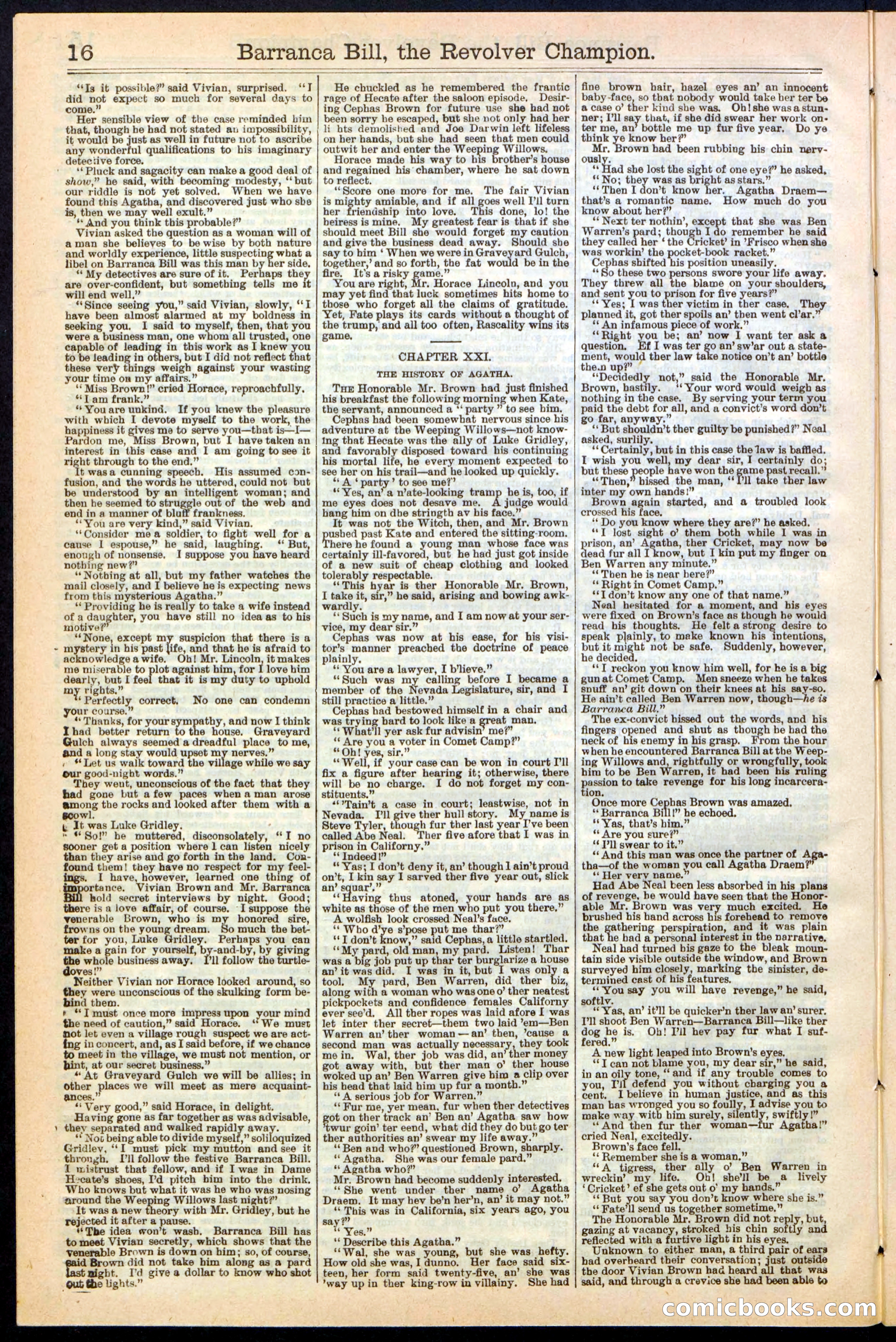
A restored page from Pulp Fiction, 1883. Page through the whole issue in the reader above.
📄 Transcribed text from this page (OCR, searchable)
Machine-transcribed from the original scan — historical spelling and the odd misread are preserved.
~~ 5 rma hold secret interviews by night. out the lights.” 16 ‘‘Ts it possible?” said Vivian, surprised. ‘‘] did not expect so much for several days to come.” Her sensible view of the case reminded bim that, though he had not stated au impossibility, it would be just as well in future not to ascribe any wonderful qualifications to his imaginary detective force. ‘* Pluck and sagacity can make a good deal of show,” he said, with becoming modesty, “ but our riddle is not yet solved. When we have found this Agatha, and discovered just who sbe is, then we may well exult.” * And you think this probable?” Vivian asked the question as a woman will of aman she believes to be wise by both nature and worldly experience, little suspecting what a libel on Barranca Bill was this man by her side. ** My detectives are sure of it. Perhaps they are over-confident, but sometbing tells me it will end well,” “Since seeing you,” said Vivian, slowly, “I have been almost alarmed at my boldness in seeking you. I said to myself, then, that you were a business man, one whom all trusted, one capable of leading in this work as I knew you to be leading in others, but I did not reflect that these very things weigh against your wasting your time on my affairs.” ‘* Miss Brown!” cried Horace, reproachfully. “T am frank.” * You are unkind. If you knew the pleasure with which I devote myself to the work, the happiness it gives me to serve you—tbat is—I— Pardon me, Miss Brown, but I have taken an interest in this case and I am going to see it right through to the end.” It wasa cunning speech. His assumed con- fusion, and the words he uttered, could not but be understood by an intelligent woman; and then he seemed to struggle out of the web and end in a manner of bluff frankness. ‘You are very kind,” said Vivian. ‘‘Consider me a soldier, to fight well for a cause I espouse,” he said, laughing. ‘“ But enough of nonsense, I suppose you have heard nothing new?” ** Nothing at all, but my father watches the mail closely, and I believe he is expecting news from this mysterious Agatha.” ** Providing he is really to take a wife instead ofa daughter, you have still no idea as to his motive? “‘None, except my suspicion that there is a Be, in his past lite, and that he is afraid to acknowledge a wife. Ob! Mr. Lincoln, it makes me miserable to rn against him, for I love him dearly, but I feel that it is my duty to uphold my rights,” ‘ Perfectly correct, your course.” “Thanks, for your = gr tr and now I think Ihad better return to the house. Graveyard Gulch always seemed a dreadful place to me, and a long stay would upset my nerves.” » Let us walk toward the village while we say our good-night words.” They weut, unconscious of the fact that they had gone but afew paces when a man arose ig the rocks and looked after them with a scowl. y It was Luke Gridley. * Sol” be muttered, disconsolately, “I no sooner get a position where 1 can listen nicely than they arise and go forth in the land. Con- found them! they have no respect for my feel- I have, however, learned one thing of Vivian Brown and Mr. Barranca Good; there is a love affair, of course. I suppose the venerable Brown, who is my honored sire, frowns on the young dream. So much the bet- ter for you, Luke Gridley. Perhaps you can make a se for yourself, by-and-by, by giving the _— e business away. I'll follow the turtle- es Neither Vivian nor Horace looked around, so they me unconscious of the skulking form be- them. + “T must once more impress upon your mind the need of caution,” said Horace. “We must t let even a village rough suspect we are act- g in concert, and, as I said before, if we chance to meet in the village, we must not mention, or hint, at our secret business.” “At Graveyard Gulch we will be allies; in other places we will meet as mere acquaint- ances.’ : ‘‘ Very good,” said Horace, in delight. Having gone as far together as was advisable, they separated and walked sc tog oer: ‘* Not being able to divide myself,” soliloquized Gridley, ‘‘I must pick my mutton and see it thronzh, Tl follow the festive Barranca Bill. I wistrust that fellow, and if I was in Dame Heeate’s shoes, ’'d pitch bim into the drink. Who knows but what it was he who was nosing around the Weeping Willows last night?’ It was a new theory with Mr. Gridley, but he rejected it after a pause. ‘The idea won’t wash. Barranca Bill has to meet Vivian secretly, which shows that the venerable Brown is down on him; so, of course, ee did not take him along as a pard might. I'd give a dollar to know who shot ee ee —_ ee — No one can condemn 7 Barranca Bill, the Revolver Champion. eee ———— — = He chuckled as he remembered the frantic rage of Hecate after the saloon episode, Desir- ing Cephas Brown for future use she had not been sorry he escaped, but she not only had her li hts demolished and Joe Darwin left lifeless on her hands, but she had seen that men could outwit her and enter the Weeping Willows. Horace made his way to his brother’s house and regained his chamber, where he sat down to reflect. ‘“Score one more for me. The fair Vivian is mighty amiable, and if all goes well I'll turn her friendship into love. This done, lo! the beiress is mine. My greatest fear is that if she should meet Bill she would forget my caution and give the business dead away. Should she say to bim ‘ When we were in Graveyard Gulch, together,’ and so forth, the fat would be in the fire. It'sarisky game.” You are right, Mr. Horace Lincoln, and you may yet find that luck sometimes hits home to those who forget all the claims of gratitude. Yet, Fate plays its cards without a thought of the trump, and all too often, Rascality wins its game, CHAPTER XXI. THE HISTORY OF AGATHA, TuE Honorable Mr. Brown had just finished his breakfast the following morning when Kate, the servant, announced a “‘ party ” to see bim, Cephas had been somewhat nervous since his adventure at the Weeping Willows—not know- ing that Hecate was the ally of Luke Gridley, and favorably disposed toward his continuing his mortal lite, he every moment expected to see her on his trail—and he looked up quickly. ‘‘ A ‘party’ to see me?” ‘Yes, an’ a n’ate-looking tramp he is, too, if me eyes does not desave me, judge would hang him on dbe stringth av his face.” It was not the Witch, then, and Mr. Brown ushed past Kate and entered the sitting-room. here he found a young man whose face was certainly ill-favored, but he had just got inside of a new suit of cheap clothing and looked tolerably respectable. ‘‘This hyar is ther Honorable Mr. Brown, I take it, sir,” he said, arising and bowing awk- wardly. ** Such is my name, and I am now at your ser- vice, my dear sir.” ! Cephas was now at his ease, for his visi- as manner preached the doctrine of peace plainly, ‘** You are a lawyer, I b’lieve.” “Such was my calling before I became a member of the Nevada Legislature, sir, and I still practice a little.” Cephas had bestowed himself in a chair and was trying bard to look like a great man. What'll yer ask fur advisin’ me?” ‘*‘ Are you a voter in Comet Camp?” * Oh! yes, sir.” “Well, if your case can be won in court I'll fix a figure after hearing it; otherwise, there will be no charge. I do not forget my con- stituents.” ; ‘“Tain’t a case in court; leastwise, not in Nevada. I'll give ther hull story. My name is Steve Tyler, t es, fur ther last year I’ve been called Abe Neal. her five afore that I was in prison in Californy.” l ** Indeed “Yas; I don’t deny it, an’ though | ain’t proud on’t, I kin say I sarved ther five year out, slick an’ squar’,” ‘Having thus atoned, your hands are as white as those of the men who put you there,” A wolfish look crossed Neal’s face. ‘* Who ht s’pose put me thar?” ‘*T don’t know,” said Cephas, a little startled. ‘My pani, old man, my pard. Listen! Thar was a big job put up thar ter burglarize a house an’ it was did. I was in it, but I was only a tool. My pard, Ben Warren, did ther biz, along with a woman who was one o’ ther neatest pickpockets and confidence females Californy ever see’d, All ther ropes was laid afore [ was let inter ther secret—them two laid ’em—Ben Warren an’ ther woman—dan’ then, ’cause a second man was actually necessary they took mein. Wal, ther job was did, an ther money got away with, but ther man o’ ther house woked up an’ Ben Warren give him a clip over his head that laid him up fur a month.” ** A serious job for Warren.” ‘Fur me, yer mean, fur when ther detectives got on ther track an’ Ben an’ Agatha saw how twur goin’ ter eend, what did they do but go ter ther authorities an’ swear my life away.” ‘‘ Ben and who?” questioned Brown, sharply. “ Agatha. She was our female pard.” ** Agatha who?” . Mr. Brown had become suddenly interested. ‘She went under ther name o’ Agatha Draem. It may hev be’n her’n, an’ it may not.” ‘‘ This was in California, six years ago, you say ” “"¥ ok” ‘‘ Describe this Agatha.” ‘“Wal, she was young, but she was hefty. How old she was, I dunno. Her face said six- teen, her form said twenty-five, an’ she was ’way up in ther king-row in villainy. She had —y fine brown hair, hazel eyes an’ an innocent baby-face, so that nobody would take ber ter be a case o’ ther kind she was. Ob!she wasa stun- ner; [ll say that, if she did swear her work on-« ter me, an’ bottle me up fur five year, Do ye think ye know her?” Mr. Brown had been rubbing his chin nerv- ac ‘** Had she lost the sight of one eye?’ he asked, ** No; they was as bright as stars.” ‘Then I don’t know her. Agatha Draem— that’s a romantic name. How much do you know about her?’ ** Next ter nothin’, except that she was Ben Warren’s pard; though Ido remember he said they called her ‘ the Cricket’ in ’Frisco when she was workin’ the pocket-book racket.” Cephas shifted his position uneasily. ** So these two egigey swore your life away. They threw all the blame on your shoulders, and sent you to prison for five years?” ‘* Yes; I was ther victim in ther case, They planned it, got ther spoils an’ then went cl’ar, ** An infamous piece of work.” “Right you be; an’ now I want ter ask a question, Ef I was ter go an’ sw’ar out a state- ment, would ther law take notice on’t an’ bottle the.o up?” **‘Dec see not,” said the Honorable Mr. Brown, bastily. ‘‘ Your word would weigh as nothing in the case. By serving your term you paid the debt for all, and a convict’s word don’t go far, anyway.” ‘* But shouldn’t ther guilty be punished?” Neal asked, surlily. ‘* Certainly, but in this case the law is baffled. I wish you well, my dear sir, I certainly do; but these people have won the game past recall.” “Then,” bissed the man, ‘‘T’ll take ther law inter my own hands!” Brown again started, and a troubled look crossed his face, ‘* Do you know where they are?” he asked. **T lost sight o’ them both while I was in orison, an’ Agatha, ther Cricket, may now be ead fur all I know, but I kin put my finger on Ben Warren any minute.” ‘*Tben he is near here?” “Right in Comet Camp.” **T don’t know any one of that name.” Neal hesitated for a moment, and his eyes were fixed on Brown’s face as though he would read his thoughts. He felt astrong desire to speak plainly, to make known his intentions, but it might not be safe. Suddenly, however, he decided. ‘*T reckon you know him well, for he is a big gunat Comet Camp. Men sneeze when he takes snuff an’ git down on their knees at his say-so. He ain’t called Ben Warren now, though—he is Barranca Bill.” The ex-convict hissed out the words, and his fingers opened and shut as though he bad the neck of his enemy in his grasp. From the hour when he encountered Barranca Bill at the Weep- ing Willows and, rightfully or wrongfully, took him to be Ben Warren, it had been bis ruling men to take revenge for his long incarcera- on, Once more Cephas Brown was amazed, **Barranca Bill!” he echoed. ‘Yas, that’s him.” ** Are you sure?” ‘“¢ Pll swear to it.” ‘‘ And this man was once the partner of Aga- tha—of the woman you call Agatha Draem ‘* Her very name. Had Abe Neal been less absorbed in his plans of revenge, be would have seen that the Honor- able Mr. Brown was very much excited. He brushed his hand across his forehead to remove the gathering perspiration, and it was plain that he bad a personal interest in the narrative, Neal had turned bis gaze to the bleak moun- tain side visible outside the window, and Brown surveyed him closely, marking the sinister, de- termined cast of his features, “You say you will have revenge,” he said, softlv. “Yas, an’ it’ll be quicker’n ther Jaw an’ surer, I'll shoot Ben Warren—Barranca Bill—like ther dog he is. Ob! Dil hev pay fur what I suf- fered.” A new light leaped into Brown's eyes, ‘“‘T can not blame you, my dear sir,” he said, in an oily tone, ‘‘and if any trouble comes to you, Til defend you without charging you a cent. I believe in human justice, and as thi man bas wronged you so foully, I advise you to make way witb him surely, si esis Aga ” ‘“‘And then fur ther woman—fur Agatha!” cried Neal, excitedly. Brown’s face fell. ‘‘ Remember she is a woman,” ‘“‘A tigress, ther ally o’ Ben Warren in wreckin’ my life. Ob! she'll be a_ lively ‘Cricket’ ef she gets out o' my hands.” ‘¢ But you say you don’t know where she is.” ‘‘ Fate’ll send us together sometime,” The Honorable Mr, Brown did not reply, but, gazing at vacancy, stroked his chin softly and reflected with a furtive light in his eyes, Unknown to either man, a third pair of ears bad overbeard their conversation; just outside the door Vivian Brown haa heard that was said, and through a crevice she had been able to comicboo Ps