
Pulp Fiction, 1883 · page 7 of 32
Beadle's Dime Library No. 237 — page 7: what you’re looking at
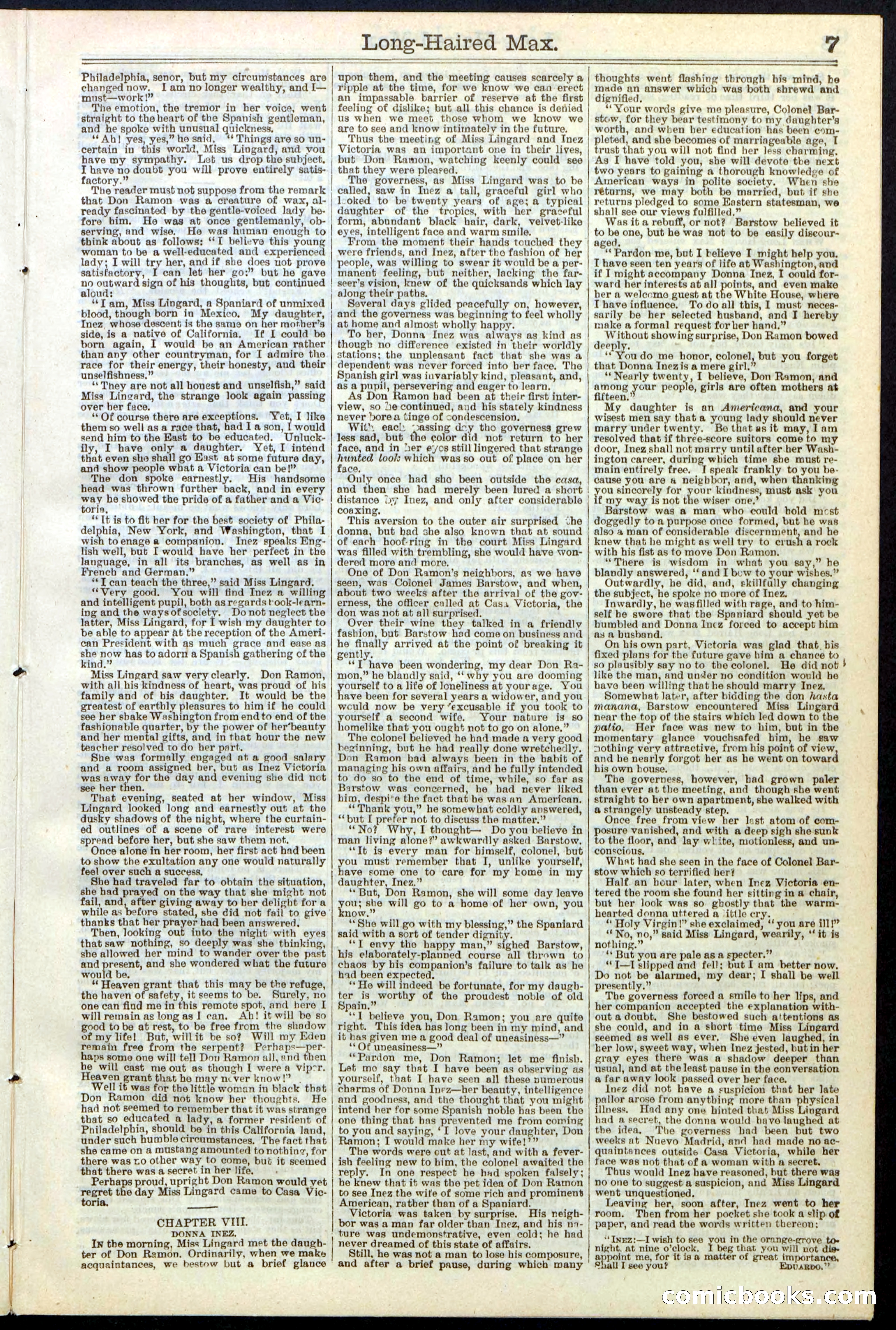
A restored page from Pulp Fiction, 1883. Page through the whole issue in the reader above.
📄 Transcribed text from this page (OCR, searchable)
Machine-transcribed from the original scan — historical spelling and the odd misread are preserved.
——- Philadelphia, senor, but my circumstances are changed now. Iam no longer wealthy, and I— must—work!” The emotion, the tremor in her voice, went straight to the heart of the Spanish gentleman, and he spoke with unusual quickness, ‘*Ah! yes, yes,” he said. ‘* Things are so un- certain in this world, Miss Lingard, and vou have my sympathy. Let us drop the subject. I have no doubt you will prove entirely satis- factory.” The reader must not suppose from the remark that Don Ramon was a creature of wax, al- ready fascinated by the gentle-voiced lady be- fore him. He was at once gentlemanly, ob- serving, and wise. He was human enough to think about as follows: “‘I believe this young woman to be a well-educated and experienced lady; I will try her, and if she does uot prove satisfactory, I can let her go:” but he gave no outward sign of his thoughts, but continued aloud: ‘‘T am, Miss Lingard, a Spaniard of unmixed blood, though born in Mexico. My daughter, Inez whose descent is the same on her mother’s side, is a native of California. If I could be born again, I would be an American rather than any other countryman, for I admire the race for their energy, their honesty, and their unselfishness,” “They are not all honest and unselfish,” said Miss Lingard, the strange look again passing over ber face. ‘* Of course there are exceptions. Yet, I like them so well as a race that, had I a son, | would send him to the East to be educated. Unluck- ily, I have only a daughter. Yet, I intend that even she shall go East at some future day, and show people what a Victoria can be!” The don spoke earnestly. His handsome head was thrown further back, and in every way he showed the pride of a father and a Vic- toria, “It is to fit her for the best society of Phila- delphia, New York, and Washington, that I wish toenage a companion. Inez speaks Eng- lish well, but I would have her perfect in the language, in all its branches, as well as in Frencb and German.” **T can teach the three,” said Miss Lingard. “Very good. You will find Inez a willing and intelligent pupil, both as regards took-learn- ing and the waysofsociety. Donot neglect the latter, Miss Lingard, for I wish my daughter to be able to appear at the reception of the Ameri- can President with as much grace and ease as oe now has to adorn a Spanish gathering of the nd.’ Miss Lingard saw very clearly. Don Ramon, with all his kindness of heart, was proud of his family and of bis daughter. It would be the greatest of earthly pleasures to him if he could see her shake Washington from end to end of the fashionable quarter, by the power of her*beauty and her mental gifts, and in that hour the new teacher resolved to do her part. She was formally engaged at a good salary and a room assigned her, but as Inez Victoria was away for the day and evening she did not see her then. That evening, seated at her window, Miss Lingard looked long and earnestly out at the dusky shadows of the night, where the curtain- ed outlines of a scene of rare interest were spread before her, but she saw them not, Once alone in her room, her first act had been to show the exultation any one would naturally feel over such a success. She had traveled far to obtain the situation, she had prayed on the way that she might not fail, and, after giving away to her delight for a while as before stated, she did not fail to give thanks that her prayer had been answered. Then, looking out into the night with eyes that saw nothing, so deeply was she thinking, she allowed her mind to wander over the past resent, and she wondered what the future would be. , “Heaven grant that this may be the refuge, the haven of safety, it seems to be. Surely, no one can find me in this remote spot, and here I will remain as long asI can. Ab! it will be so good to be at rest, to be free from the shadow of my life! But, willit be so? Will my Eden remain free from the serpent? Perhaps—per- haps some one will tell Dov Ramon all, and then he will cast me out as though | were a Vipcr. Heaven prant that he may mver know!” | Well it was for the little woman in black that Don Ramon did not know her thoughts. He had not seemed to remember that it was strange that so educated a lady, a former resident of Philadelphia, should be in this California land, under such humble circumstances, The fact that she came on a mustang amounted to nothing, for there was to other way to come, but it seemed that there was a secret in her life, , Perhaps proud, upright Don Ramon would yet regret the day Miss Lingard came to Casa Vic- toria. CHAPTER VIII. DONNA INEZ, In the morning, Miss Lingard met the daugh- ter of Don Ramon. Ordinarily, when we make acquaintances, we bestow but a brief glance Long-Haired Max. @ upon them, and the meeting causes scarcely a | thoughts went flashing through his mind, he ripple at the time, for we know we can erect made an answer which was both shrewd and an impassable barrier of reserve at the first | dignified, feeling of dislike; but all this chance is denied “Your words give me pleasure, Colonel Bar- us when we meet those whom we know we | stow, for they bear testimony to my daughter’s are to see and know intimately in the future. worth, and when ber education has been com- Thus the meeting of Miss Lingard and Inez | pleted, and she becomes of marriageable age, T Victoria was an important one in their lives, but Don Ramon, watching keenly could see that they were pleaved. The governess, as Miss Lingard was to be called, saw in Inez a tall, graceful girl who l-oked to be twenty years of age; a typical daughter of the tropics, with her graceful form, abundant black hair, dark, velvet-like eyes, intelligent face and warm smile, From the moment their hands touched they were friends, and Inez, after tho fashion of her people, was willing to swear it would be a per- manent feeling, but neither, lacking the far- seer’s vision, knew of the quicksands which lay _ along their paths. Several days glided peacefully on, however, and the governess was beginning to feel wholly at home and almost wholly happy. To her, Donna Inez was always as kind as thougb no difference existed in their worldly stations; the unpleasant fact that she was a dependent was never forced into ber face, The Spanish girl was invariably kind, pleasant, and, as a pupil, silage and eager to learn. As Don Ramon bad been at their first inter- view, so Je continued, and his stately kindness never bore a tinge of condescension. With each passing dey tho governess grew less sad, but the color did not return to her face, and in her e¢/os still lingered that strange Sapa look: which was so out of place on her ace, Ouly once had sho been outside the casa, and then she had merely been lured a short distance by Inez, and only after considerable coaxing, This aversion to the outer air surprised the donna, but bad she also known that at sound of each hoof-ring in the court Miss Lingard was filled with trembling, she would have won- dered more and more. One of Don Ramon’s neighbors, as we have seen, was Colonel James Barstow, and when, about two weeks after the arrival of the gov- erness, the officer called at Casa Victoria, the don was not at all surprised. Over their wine they talked in a friendly fashion, but Barstow had come on business and he eye arrived at the point of breaking it rently. m P have been wondering, my dear Don Ra- mon,” he blandly said, ‘‘ why you are dooming pour to a life of loneliness at yourage. You ave been for several years a widower, and you would now be very “excusable if you took to eb te a second wife. Your nature is so 1omelike that you ought not to go on alone,” The colonel believed he had made a very good heginning, but he had really done wretchedly. Don Ramon bad always been in the habit of managing his own affairs, and he fully intended to do so to the end of time, while, so far as Barstow was concerned, he bad never liked him, despite the fact that he was an American. “Thank you,” he somewhat coldly answered, “but [ prefer not to discuss the matter.” “No? Why, I thought— Do you believe in man living alone?” awkwardly asked Barstow, ‘It is every man for himself, colonel, but you must remember that I, unlike yourself, ave some one to care for my tome in my daughter, Inez.” ‘“But, Don Ramon, she will some day leave ou; she will go to a home of her own, you now.” **She will go with my blessing,” the Spaniard said with a sort of Natideor dignity. **T envy the happy man,” sizhed Barstow, his elaborately-planned course all thrown to chaos by his companion’s failure to talk as he had been expected, “*He will indeed be fortunate, for my daugb- ter is worthy of the proudest noble of old Spain.” “I believe you, Don Ramon; you are quite right. This idea has long been in my mind, and it has given me a good deal of uneasiness—” ‘**Of uneasiness—” “Pardon me, Don Ramon; let me finish. Let mo say that I have been as observing as yourself, that I have seen all these numerous charms of Donna Inez—her beauty, intelligence and goodness, and the thought that you might intend her for some Spanish noble has been the one thing that bas prevented me from coming to you and saying, ‘I love your daughter, Don mon; I would make her my wife!’” The words were out at last, and with a fever- ish feeling new to him, the colonel awaited the reply. In one respect he had spoken falsely; he knew that it was the pet idea of Don Ramon to see Inez the wife of some rich and prominent American, ratber than of a Spaniard. Victoria was taken by surprise. His neigh- bor was a man far older than Inez, and his no- ture was undemonstrative, even cold: he had never dreamed of this state of affairs. Still, he was not a man to lose his composure, and after a brief pause, during which many | ——— — eee o_o trust that you will not find her less charming, As I have told you, she will devote the next two years to gaining a thorough knowledge of American ways in polite society. When she réturns, we may both be married, but if she returns pledged to some Eastern statesman, we shall see our views fulfilled,” Was it a rebuff, or not? Barstow believed it to he one, but he was not to be easily diseour- aged, ** Pardon me, but I believe T ol bey help you. T have seen ten years of life at Washington, and if I might accompany Donna Inez, I could for- ward her interests at all pret and even make her a welcome guest at the White House, where T have influence. Todo all this, 1 must neces- sarily be her selected husband, and I hereby make a formal request for ber hand.” 7 Ww ge showing surprise, Don Ramon bowed eeply. ‘* You do me honor, colonel, but you forget that Donna Inezis a mere girl.” ** Nearly twenty, I believe, Don Ramon, and among your people, girls are often mothers at fifteen.’ My daughter is an Americana, and your wisest men say that a young lady should never marry under twenty. Be thatasit may, lam resolved that if three-score suitors come to my door, Inez shall not marry until after her Wash- ington career, during which time she must re- main entirely free. I speak frankly to you be- cause you are a neigbbor, and, when thanking you sincorely for your kindness, must ask you f my way is not the wiser one,’ Barstow was a man who could hold most doggedly to a purpose once formed, but he was also a man of considerable discernment, and he knew that be might as well try to erush a rock with his fist as to move Don Ramon. “There is wisdom in what you say,” he blandly answered, ‘‘ and I bow to your wishes.” Outwardly, he did, and, ekillfaully changing the subject, he spoke no more of Inez. Inwardly, he was filled with rage, and to him- self he swore that the Spaniard should yet be humbled and Donna Incz forced to accept him as a busband. On his own part, Victoria was glad that. bis fixed plans for the future gave him a chance to so plausibly say no to the colonel. He did not like the man, and under no condition would he have been willing that he should marry Inez, Somewhat Jater, after bidding the don hasta manana, Barstow encountered Miss Lingard near the top of the stairs which led down to the patio, Her face was new to him, but in the momentary glance vouchsafed him, he saw nothing very attractive, from his point of view and he nearly forgot her as he went on towar his own house. The governess, however, had grown paler than ever at the meeting, and though she went straight to her own apartment, she walked with a@ strangely unsteady wae Once free from view her lest atom of com- posure vanished, and with a deep sigh she sunk to the floor, and lay white, motionless, and un- conscious, What had she seen in the face of Colonel Bar- stow which so terrified her? Half. an bour later, when Inez Victoria en- tered the room she found her sitting in a chair, but her look was so ghostly that the warm- hearted donna uttered a jibtle ery. : “ Holy Virgin!” she exclaimed, ‘‘ you are ill!” ‘No, no,” said Miss Lingard, wearily, “‘ it is nothing.” as a specter.” ‘** But you are pale 6 **T—I slipped and fell; but I am better now. Do not be alarmed, my dear; [ shall be well presently.” The governess forced a smile to her lips, and her companion accepted the explanation with- out a doubt, She bestowed such attentions as she could, and in a short time Miss Lingard seemed as well as ever, She even laughed, in her low, sweet way, when Inez jested, butin her gray eyes there was a shadow deeper than usual, and at the least pause in the conversation a far away look passed over her face. Inez did not have a suspicion that her late allor arose from anytbing more than eee illness. Had any one hinted that Miss Lingard had a secret, the donna would bave laughed at the idea, The governess bad been but two weeks at Nuevo Madrid, and had made no ac- quaintances outside Casa Victoria, while her face was not that of a woman with a secret. Thus would Inez have reasoned, but there was no one to suggest a suspicion, and Miss Lingard went unquestioned. Leaving her, soon after, Inez went to her room. Then from her pocket she took a slip of paper, and read the words written thereon; ‘**Inez:—I wish to see a in the orange-rrove to- night, at nine o'clock, beg that you will not dis. appoint me, for it is a matter of great importance, Shall I see you? Epuanvo.” ~ NiGDoOO (C SiG igo — —s