
Pulp Fiction, 1883 · page 6 of 32
Beadle's Dime Library No. 237 — page 6: what you’re looking at
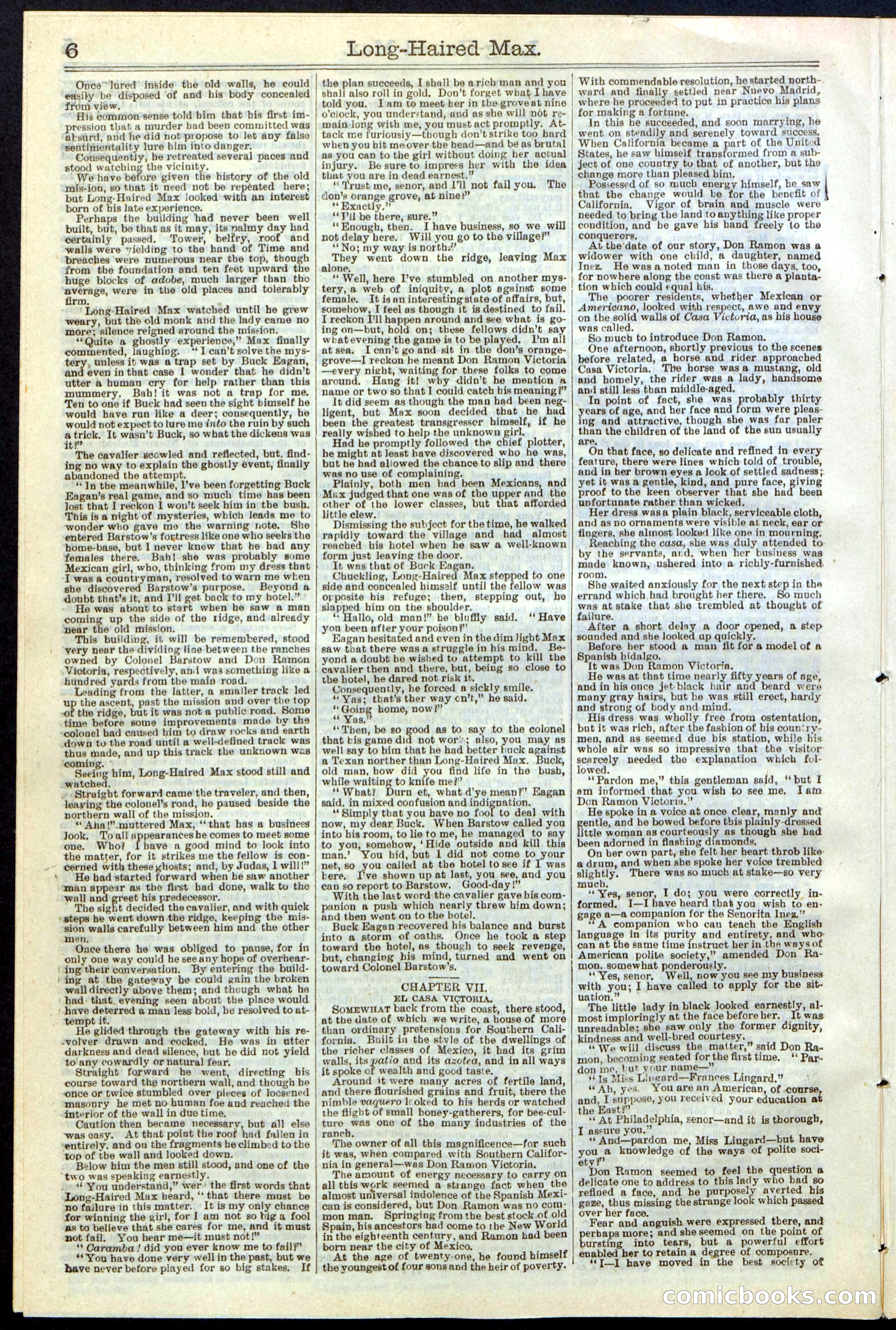
A restored page from Pulp Fiction, 1883. Page through the whole issue in the reader above.
📄 Transcribed text from this page (OCR, searchable)
Machine-transcribed from the original scan — historical spelling and the odd misread are preserved.
"A s 6 Long-Haired Max. Once lured inside the old walls, be could easily be disposed of and his body concealed fron view. His common-sense pression that a murder bad been committed was atsurd, and he did not propose to let any false ‘sentimentality lure him into danger. Consequently, be retreated several paces and stood watching the vicinity. We have before given the history of the old mis-ion, so that it need not be repeated here; but Long-Haired Max Jooked with an interest born of bis late experience. Perhaps the building had never been well built, but, be that as it may, its palmy day had cértainly passed. Tower, belfry, roof and walls were yielding to the hand of Time and breaches were numerous near the top, though from the foundation and ten feet upward the huge blocks of adobe, much larger than tho ct were in the old places and tolerably m. Long-Haired Max watched until he grew weary, but the old monk and the lady came no more; silence reigned around the mission. ‘“Quite a ghostly experience,” Max finally commented, laughing. “1 can’t solve the mys- tery, unless it was a trap set by Buck Eagan, and even in that case | wonder that he didn’t utter a human cry for help rather than this mummery. Bah! it was not a trap for me, Ten to one if Buck had seen the sight bimself he would have run like a deer; consequently, he would not expect to lure me into the ruin by such a trick. It wasn’t Buck, so what the dickens was The cavalier scowled and reflected, but, find- ing no way to explain the ghostly event, finally abandoned the attempt. ‘In the meanwhile, I’ve been forgetting Buck Eagan’s real game, and so much time has been lost that I reckon I won’t seek him in the bush. This is a night of mysteries, which leads me to wonder who gave me the warning note. She entered Barstow’s fortress like one who seeks the home-base, but I never knew that he had any females there. Bah! she was probably sume Mexican girl, who, thinking from my dress that ‘I was a countryman, resolyed to warn me when she discovered Barstow’s purpose. Beyond a doubt that’s it, and I’ll get back to my hotel.” He was about to stert when he saw a man coming up the side of the ridge, and already near the old mission. This building, it will be remembered, stood very near the dividing line between the ranches owned by Colonel Barstow and Don Ramon Victoria, respectively, and was something like a htindred yards from the main road. Leading from the latter, a smaller track led up the ascent, past the mission and over the top ot the ridge, but it was not a public road. Some time before some improvements made by the colonel bad caused him to draw rocks and earth down tou the road until a well-defined track was thus made, and up this track the unknown was coming. ° coe him, Long-Haired Max stood still and watched. _ Straight forward came the traveler, and then, leaying the colonel’s road, he paused beside the northern wall of the mission. “ Aha!” muttered Max, ‘‘that has a business Jook. Toall ove he comes to meet some one, Who? [have a good mind to look into the matter, for it strikes me the fellow is con- - gerned with these yhosts; and, by Judas, 1 will!” He bad started forward when he saw another ™man ponent as the first bad done, walk to the wall an ep his predecessor. The sight decided the cavalier, and with quick «steps he went down the ridge, keeping the mis- sion walls carefully between him and the other men. Once there he was obliged to pause, for in only one way could he see any hope of overhear- ‘ing their conversation, By entering the build- ‘ing at the gateway he could gain the broken wall directly above them; and though what he ‘had: that_evening seen about the place would _ | have deterred a man less bold, be resolved to at- tempt it. He glided through the gateway with his re- -volver drawn and cocked. He was in utter darkness and dead silence, but he did not yield to any cowardly or natural fear, Straight forward he went, directing bis course toward the northern wall, and though be once or twice stumbled over pieces of loosened masonry he met no buman foe and reached the interior of the wall in due time, Caution then became necessary, but al] else was casy. At that point the roof had fallen in ‘entirely, and on the fragments he climbed to the top of tbe wall and looked down. Below him the men still stood, and one of the ‘two was speaking earnestly. “ You understand,” wer» the first words that Long-Haired Max beard, ‘that there must be ‘no failure in this matter. It is my only chance for winning the girl, for 1 am not so big a fool as to believe that she cares for me, and it must not fail. You hear me—it must not!” ** Caramba ! did you ever know me to fail?” ‘You have done very well in the past, but we have never before played for so big stakes, If the plan succeeds, I shall be arich man and you shall also roll in gold. Don’t forget what I have told you. Iam to meet ber in the grove at nine told bim that bis first im- | o'clock, you understand, and as she will not re- main long with me, you must act promptly. At- tack me furiousiy—tbough don’t strike too bard when you hit me over the bead—and be as brutal as you can to the girl without doing her actual injury. Be sure to impress her with the idea that you are in dead earnest.” “Trust me, senor, and I'll not fail you. The don’s orange grove, at nine?’ ** Exactly.” ‘*)il be there, sure.” ‘*Bnough, then. I have business, so we will not delay here. Will you go to the village?” ‘*No; my way is north?’ They went down. the ridge, leaving Max one, ‘‘ Well, here I’ve stumbled on another mys- tery, a web of iniquity, a plot against some female. It isan interesting state of affairs, but, somehow, I feel as though it is destined to fail. I reckon [ll happen around and see what is go- ing on—but, hold on; these fellows didn’t say whatevening the game is to be played. I’m all at sea, I can’t go and sit in the don’s orange- grove—I reckon he meant Don Ramon Victoria —every night, waiting for these folks to come around. Hang it! why didn’t he mention a name or two so that I could catch bis meaning?” It did seem as though the man had been neg- ligent, but Max soon decided that he had been the erg transgresser himself, if he really wished to help the unknown girl. Had he promptly followed the chief plotter, he might at Jeast have discovered who he was, but he had aliowed the chance to slip and there was no use of complaining, Plainly, both men had been Mexicans, and Mux judged that one was of the upper and the other of the lower classes, but that afforded little clew. Dismissing the subject for the time, he walked rapidly toward the village and had almost reached his hotel when he saw a well-known form just leaving the door. It was that of Buck Eagan. Chuekling, Long-Haired Max stepped to one side and concealed himself until the fellow was opposite his refuge; then, stepping out, he slapped him on the shoulder. ** Hallo, old man!” be bluffly said, you been after your poison?’ Eagan hesitated and even in the dim Jight Max saw that there wasa struggle in his mind. Be- yond a doubt be wished to attempt to kill the cavalier then and there, but, being so close to the hotel, he dared not risk if, Consequently, he forced a sickly smile. “Yas; that’s ther way on’t,” he said. Going home, now?’ ‘t Yas, ‘“Then, be so good as to say to the colonel that bis game did not wor’; also, you may as well say to him that he had better huck against a Texan norther than Long-Haired Max. Buck, old man, bow did you find life in the busb, while waiting to knife me?” ‘*What? Durn et, what d’ye mean?’ Eagan said, in mixed confusion and indignation. “Simply that you have no fool to deal with now, my dear Buck. When Barstow called you into his room, to lie to me, he managed to say to you, somehow, ‘Hide outside and kill this man,’ You hid, but 1 did not come to your net, 60 you called at the hotel tosee if I was bere. I’ve shown up at last, you see, and you can so woven to Barstow. Good-day!” With the last word the cavalier gave his com- panion a push which nearly threw him down; and then went on to the botel. Buck Eagan recovered his balance and burst into a storm of oaths. Once he took a step toward the hotel, as though to seek revenge, but, changing his mind, turned and went on toward Colonel Barstow’s. CHAPTER VII. EL CASA VICTORIA, SomEWwHAT back from the coast, there stood, at the date of which we write, a house of more than ordinary pretensions for Southern Cali- fornia. Built in the stvle of the dwellings of the richer classes of Mexico, it had its grim walls, its patio and its azotea, and in all ways it spoke of wealth and good taste. Around it were many acres of fertile land, and there flourished grains and fruit, there the nimble vaquero lcoked to his herds or watched the flight of small honey-gatherers, for bee-cul- ture was one of the many industries of the ranch, The owner of all this magnificence—for such it was, when compared with Southern Califor- nia in general—was Don Ramon Victoria. The amount of energy necessary to carry on all this work seemed a strange fact when the almost universal indolence of the Spanish Mexi- can is considered, but Don Ramon was no com- mon man. Springing from the best stock of old Spain, his ancestors had come to the New World in the eighteenth century, and Ramon bad been born near the city of Mexico, At the age of twenty-one, he found himself the youngest of four sons and the heir of poverty. ‘* Have | With commendable resolution, he started north- ward and finally settled near Nuevo Madrid, where he proceeded to put in practice his plans for making a fortune. In this he succeeded, and soon marrying, he went on steadily and serenely toward success, When California became a part of the United States, he saw himself transformed from a sub- ject of one country tu that of another, but the cbange more than pleased bim. Possessed of so much energy himself, he saw that the change would be for the benefit of California, Vigor of brain and muscle were needed to bring the land to anything like proper condition, and he gave his band freely to the conquerors, At the'date of our story, Don Ramon was a widower with one child, a daughter, named Inez. He wasa noted man in those days, too, for nowhere along the coast was there a planta- tion which could equal bis. The poorer residents, whether Mexican or Americano, looked with respect, awe and envy on the solid walls of Casa Victoria, as his house was called. So much to introduce Don Ramon. One afternoon, shortly previous to the scenes before related, a horse and rider approached Casa Victoria. The borse wasa pURtAng, old and homely, the rider was a lady, handsome and still less than middle-aged. In point of fact, she was ebsegay thirty years of age, and her face and form were pleas- ing and attractive, though she was far paler than the children of the land of the sun usually e, On that face, so delicate and refined in every feature, there were lines which told of trouble, and in her brown eyes a Jook of settled sadness ;. yet it was a gentle, kind, and pure face, giving roof to the keen observer that she had been unfortunate rather than wicked. Her dress wasa plain black, serviceable cloth, and as no ornaments were visible at neck, ear or fingers, she almost looked like one in mourning. Reaching the casa, she was duly attended to by the servants, and, when her business was made known, ushered into a richly-furnished room, She waited anxiously for the next step in the errand which had brought her there. much was at stake that she trembled at thought of failure. After a short delay a door opened, a step sounded and she looked ap quickly. Before her stood a man fit for a model of a Spanish hidalgo. It was Don Ramon Victoria. He was at that time nearly fifty years of age, and in his once jet-black hair and beard were many gray bairs, but he was still erect, hardy and strong of body and mind. His dress was wholly free from ostentation, but it was rich, after the fashion of bis coun‘ry- men, and as seemed due bis station, while his whole air was so impressive that the visitor scarcely needed the explanation which fol- lowed. ‘‘Pardon me,” this gentleman said, ‘but I am informed that you wish to see me, Iam Don Ramon Victoria.” He spoke in a voice at once clear, manly and entle, and he bowed before this amp y-dressed ittke woman as courteously as though she bad been adorned in flashing diamonds, On ber own part, she felt her heart throb like a drum, and when she spoke her voice trembled slightly, There was so much at stake—so very much, ‘Yes, senor, I do; you were correctly in- formed. I—I have heard that you wish to en- gage a—a companion for the Senorita Inez.” ‘A companion who can teach the English language in its purity and entirety, and who can at the same time instruct her in the ways of American polite society,” amended Don Ra- mon. somewhat ponderously. | ‘Yes, senor, Well, now you see my business with you; I have called to apply for the sit- uation.” The little lady in black looked earnestly, al- most imploringly at the face beforeher. It was sareadehlan she saw only the former dignity, kindness and well-bred courtesy. ‘‘ We will discuss the matter,” said Don Ra. mon, becoming seated for the first time, ‘‘ Par- don ine, but your name—” ‘Ig Miss Lineard—Frances Lingard.” “Ah, yes. You are an American, of .course and, I suppose, you received your education at the East?” k ‘‘ At Philadelphia, senor—and it is thorough, I assure you.” ‘* And—pardon me, Miss Lingard—but have be knowledge of the ways of polite soci- ety Don Ramon seemed to feel the question a delicate one to address to this lady who bad so averted his refined a face, and he panpesely. hich od which pass gaze, thus missing the strange loo over her face. ‘Fear and anguish were expressed there, and erbaps more; and she seemed on the point of burstiag into tears, but a powerful effort enabled her to retain a degree of composure. ‘TJ have moved in the best society of GOmIicdoo S) (E (0)