
Pulp Fiction, 1883 · page 8 of 32
Beadle's Dime Library No. 237 — page 8: what you’re looking at
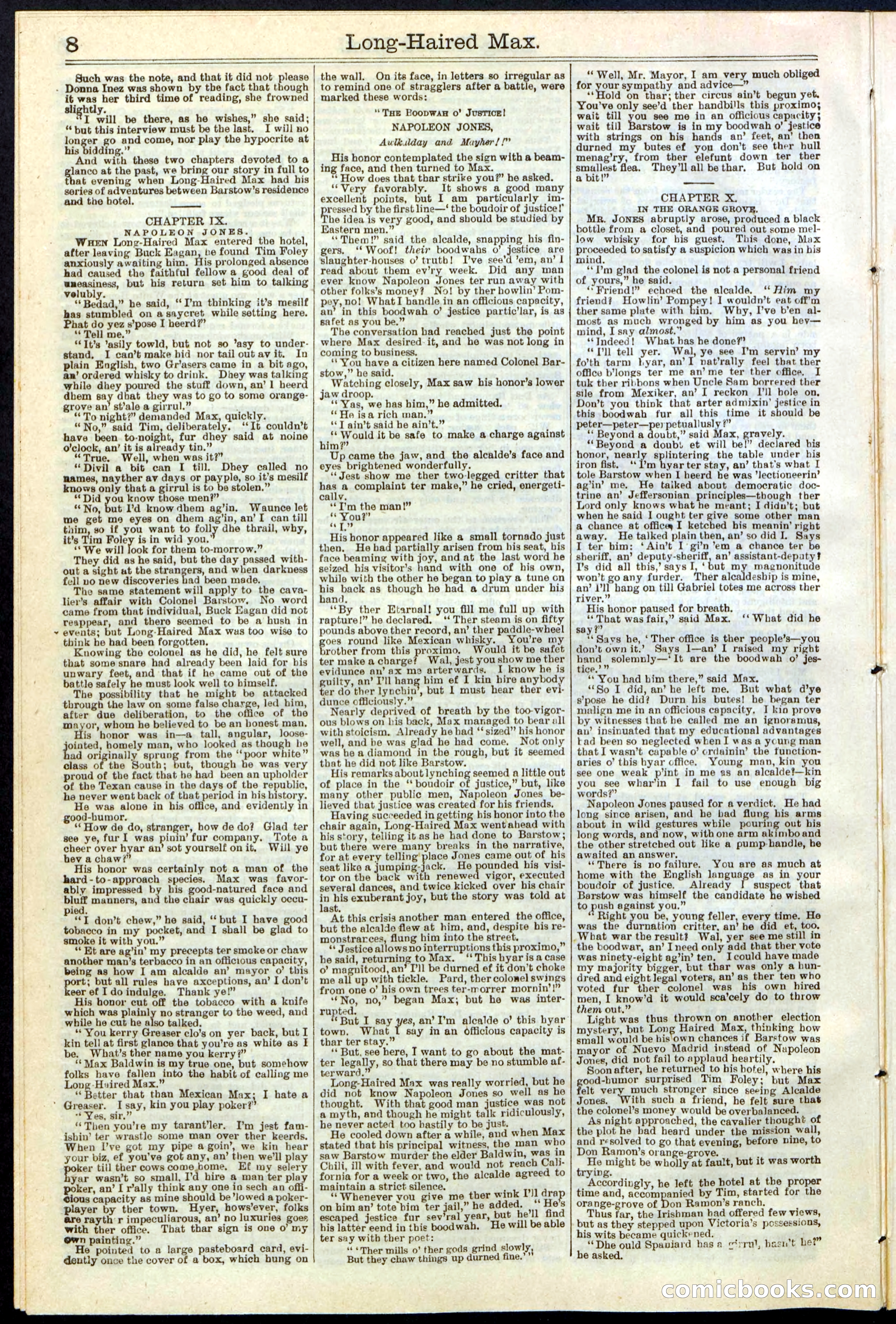
A restored page from Pulp Fiction, 1883. Page through the whole issue in the reader above.
📄 Transcribed text from this page (OCR, searchable)
Machine-transcribed from the original scan — historical spelling and the odd misread are preserved.
— eee _-——-— ~——-—oe | : é 8 Such was the note, and that it did not lease . Donna Inez was shown by the fact that though it was her third time of reading, she frowned | marked these words: 4 slightly. I will be there, as he wishes,” she said; “ but this interview must be the last. I will no longer go and come, nor play the hypocrite at his bidding.” And with these two chapters devoted toa ace at the past, we bring our story in full to that evening when Long-Haired Max had bis series of adventures between Barstow’s residence and the botel. CHAPTER IX. NAPOLEON JONES. Wren Long-Haired Max entered the hotel, after leaving Buck Eagan, te found Tim Foley anxiously awaiting him. His prolonged absence had caused the faithful fellow a good deal of uneasiness, but his return set him to talking velubly. ‘‘ Bedad,” he said, “I’m thinking it’s mesilf has stumbled on asaycret while setting here. Phat do yez s’pose I heerd?” ‘** Tell me.” **Tt’s ’asily towld, but not so ’asy to under- stand, I can’t make bid nor tail outavit. In plain English, two Gr’asers came in a bit ago, an’ ordered whisky to drink. Dhey was talking while dhey poured the stuff down, an’ 1 heerd dbem bay dhat they was to go to some orange- grove an’ st’ale a girrul.” . “To night?” demanded Max, quickly. “No,” said Tim deliberately, “Tt couldn’t have been to-noight, fur dhey said at noine o'clock, an’ it is already tin.” “True. Well, when was it?” “Divil a bit can I till. Dhey called no names, nayther av days or payple, so it’s mesilf knows only that a girrul is to be stolen.” ““Did you know those men?” ‘No, but ’'d know dbem ag’in. Waunce let me get me eyes on dhem ag’in, an’I can till thim, so if you want to folly dhe thrail, why, it’s Tim Foley is in wid you.’ ‘* We will look for them to-morrow.” They did as he said, but the day passed with- out a sight at the strangers, and when darkness fell vo new discoveries bad been made, The same statement will apply to the cava- lier’s affair with Colonel Barstow. No word came from that individual, Buck Eagan did not reappear, and there seemed to be a hush in events; but Long-Haired Max was too wise to think be had been forgotten, Knowing the colonel as he did, he felt sure that some snare had already been laid for bis unwary feet, and that if he came out of the battle safely he must look well to himself, The possibility that he might be attacked through the law on some false charge, led him, after due deliberation, to the office of the mayor, whom he believed to be an bonest man, His honor was in—a tall, angular, loose- We homely man, who looked as though he ad originally mprung from the ‘poor white” class of the South; but, though be was very proud of the fact that be had been an upholder of the Texan cause in the days of the republic, he never went back of that period in his history. He was alone in his office, and evidently in good-humor. ‘‘ How de do, stranger, how de do? Glad ter seo ye, fur I was pinin’ fur company. Tote a cheer over hyar an’ sot yourself on it, Will ye hev a chaw?’ His honor was certainly not a man of the -to-approach species. Max was favor- ably impressed by his good-natured face and bluff manners, and the chair was quickly oecu- pied. *“*T don’t chew,” he said, *‘ but I have good tobacco in my pocket, and I shall be glad to smoke it with you.” “Et are ag’in’ my precepts ter smoke or chaw another man’s terbacco in an officious capacity, being as how I am alcalde an’ mayor o’ this aia but all rules have axceptions, an’ I don’t eer ef Idoindulge. Thank ye!” His honor cut off the tobacco with a knife which was plainly no stranger to the weed, and while he cut he se talked. “You kerry Greaser clo'’s on yer back, but I kin tell at first glance that you’re as white as I be. What’s ther name you kerry?” ‘Max Baldwin is my true one, but somehow folks have fallen into the habit of calling me Long -Huired Max,” ‘Better that than Mexican Max; I hate a ' Greaser. I say, kin you play poker?” ** Yes, sir. ‘Then you’re my tarant’ler. I’m jest fam- ishin’ ter wrastle some man over ther keerds., When I’ve got my pipe a goin’, we kin hear your biz, ef you've got any, an’ then we'll play poker till ther cows come.bome, Ef my selery yar wasn’t so small, I’d bire a man ter play poker, an’ I r’ally think any one in sech an offi- cious capacity as mine should be’lowed a poker- player by ther town. Hyer, hows’ever, folks are rayth r impeculiarous, an’ no luxuries goes with ther office. That thar sign is one 0’ my own painting.” He pointed to a large pasteboard card, evi- dently once the cover of a box, which bung on Long-Haired Max. the wall. On its face, in letters so irregular as to remind one of stragglers after a battle, were “THe Boopwau o’ Justice! NAPOLEON JONES, Aulkilday and Mayher!/ !” His honor contemplated the sign with a beam- ing face, and then turned to Max. * How doves that thar strike you?” he asked. ‘*Very favorably. It shows a good many excellent points, but I am _ particularly im- presen by the first line—‘ the boudoir of justice!’ he idea is very good, and should be studied by Eastern men.” ‘‘Them!” said the alcalde, snapping his fin- gers. ‘‘ Woof! their boodwahs o’ jestice are slaughter-houses o’ truth! I’ve see’d ’em, an’ 1 read about them ev’ry week. Did any man ever know Napoleon Jones ter run away with other folks’s money? No! by ther howlin’ Pom- pey, no! WhatI bandle in an officious capacity, an’ in this boodwah o’ jestice partic’lar, is as safet as you be.” The conversation bad reached just the point where Max desired-it, and he was not long in coming to business. ‘You have a citizen here named Colonel Bar- stow,” he said. Watching closely, Max saw his honor’s lower jaw droop. ‘‘ Yas, we has him,” he admitted. “He isa rich man.” ‘‘T ain’t said he ain’t.” ra Would it be safe to make a charge against m? Up came the jaw, and the alcalde’s face and eyes brightened wonderfully. ‘Jest show me ther two-legged critter that nae a complaint ter make,” he cried, energeti- callv, ‘*T’m the man!” Your: cs I,” His honor appeared like a small tornado just then. He bad partially arisen from his seat, bis face beaming with joy, and at the last word he seized his visitor’s hand with one of his own, while with the other he began to play a tune on as ax as though he had a drum under bis and, ‘*By ther Etarnal! you fill me full up with rapture!” he declared. ‘‘ Ther steam is on fifty pounds above ther record, an’ ther paddle-wheel oes round like Mexican whisky. You're my rother from this proximo, Would it be safet ter make acbarge? Wal, jest youshow me ther evidunce an’ ax me arterwards. know he is guilty, an’ I'll hang him ef I kin hire anybody ter do ther lynehin’, but 1 must hear ther evi- dunce officiously.” Nearly deprived of breath by the too-vigor- ous blows on his back, Max managed to bear all with stoicism. Already he had “sized” his honor well, and be was glad he had come, Not only was be a diamond in the rough, but it seemed that he did not like Barstow. His remarks about lynching seemed a little out of place in the “boudoir of justice,” but, like many other public men, Napoleon Jones_be- lieved that justice was created for his friends, Having succeeded in getting his honor into the chair again, Long-Haired Max wentahead with his story, telling it as he had done to Barstow; but there were many breaks in the narrative, for at every telling’ place Jones came out of his seat like a jumping-jack. He pounded his visi- tor on the back with renewed vigor, executed several dances, and twice kicked over his chair = his exuberant joy, but the story was told at ast. At this crisis another man entered the office, but the alealde flew at him, and, despite bis re- monstrarces, flung him into the street. “ Jestice allows no interruptions this proximo,” he said, returning to Max. ‘This hyar isa case o’ magnitood, an’ I’ll be durned ef it don’t choke me all up with tickle. Pard, ther colonel swings from one o’ his own trees ter-morrer morpin’!” ‘‘No, no,” began Max; but he was inter- rupted. ‘But I say yes, an’ I’m alcalde o’ this hyar town. What 1 say in an Officious capacity is thar ter stay.” ‘* But, see here, I want to go about the mat- ter legally, so that there may be no stumble af- terward.” Long-Haired Max was really worried, but he did not know Napoleon Jones so well as he thought. With that good man {ustics was not a myth, and though he might talk ridiculously, he never acted too hastily to be just. He cooled down after a while, and when Max stated that his principal witness, the man who saw Barstow murder the elder Baldwin, was in Chili, ill with fever, and would not reach Cali- fornia for a week or two, the alcalde agreed to maintain a strict silence. . “Whenever you give me ther wink I 1 drap on him an’ tote bim ter jail,” he added. | He's escaped jestice fur sev’ral year, but he’ll find his latter eend in this boodwah, He will be able ter say witb ther poet: ‘“*Ther mills 0’ ther gods grind slowly, But they chaw things up durned fine. ee ee et pee eer ee. “Well, Mr. Mayor, I am very much obliged for your sympathy and advice—” ‘*Hold on thar; ther circus ain’t begun yet. You’ve only see’d ther handbills this proximo; wait till hes see me in an Officious capacity; wait till Barstow is in my boodwah o’ jestice with strings on his hands an’ feet, an’ then durned my butes ef you don’t see ther bull menag’ry, from ther elefunt down ter ther oe flea. They’llall bethar, But hold on a bit CHAPTER X., IN THE ORANGE GROVE, Mr. Jones abruptly arose, produced a black bottle from a closet, and poured out some mel- low whisky for bis guest. This done, Max pracdedes to satisfy a suspicion which was in his mind. ‘*’m glad the colonel is not a personal friend of yours,” he said. “Friend!” echoed the alcalde. “ Him my friend? Howlin’ Pompey! I wouldn’t eat off’m ther same plate with bim. Why, I’ve b’en al- most as much wronged by him as you bhey— mind, I say almost.” ‘*Indeed! What has he done?” “[}l tell yer. Wal, ye see I’m servin’ my fo’th tarm hyar, an’I nat’rally feel that ther office b’longs ter me an’ me ter ther office. I tuk ther ribbons when Uncle Sam borrered ther sile from Mexiker, an’ I reckon I'l bole on, Don’t you think that arter admixin’ jestice in cog boodwah fur pa hs time it should be peter—peter—pey petuallusly ?’ “ Beyond a subt,” said Max, gravely. ‘Beyond a doubt et will be!” declared his honor, nearly splintering the table under his iron fist. ‘ Pm lear ter stay, an’ that’s what I tole Barstow when I heerd he was ’lectioneerin’ ag’in’ me. He taiked about democratic doc- trine an’ Jeffersonian principles—though ther Lord only knows what he meant; I didn’t; but when he said I ougbt ter give some other man a chance at offices I ketched bis meanin’ right away. He talked plain then, an’so did I. Says I ter bim: ‘Ain’t I gi’n ’em a chance ter be sheriff, an’ deputy-sberiff, an’ assistant-depaty? I’s did all this,’ says I, ‘but my magnonitude won’t goany furder. Ther alcaldesbip is mine, an’ 1’ll hang on till Gabriel totes me across ther river.” His honor paused for breath. ‘‘That was fair,” said Max. say?” ‘‘Savs he, ‘ Ther office is ther people’s—you don’t own it.’ Says Il—an’ I raised my right hand solemnly—‘It are the boodwah o’ jes- tice.’” ‘* You had bim there,” said Max. ‘‘So I did, an’ he left me. But what d’ye s’pose he did? Durn his butes! he began ter malign me in an officious capacity, I kin prove by witnesses that he called me an ignoramus, an’ insinuated that my educational advantages tad been so neglected when I was a young man that I wasn’t capable o’ crdainin’ the function- aries 0’ this byar office. Young man, kin you see one weak p’int in me as an alcalde?—kin you see whar’in I fail to use enough big words?” Napoleon Jones paused for a verdict. He had long since arisen, and he bad flung bis arms about in wild gestures while pouring out his long words, and now, with one arm akimbo and the other stretched out like a pump-handle, he awaited an answer, ‘‘There is no failure. You are as much at home with the English language as in your boudoir of justice. Already suspect that Barstow was himself the candidate he wished to push against you.” “ Right ya be, young feller was the durnation critter, an’ he di ‘* What did he every time. He d et, too, _Wbat war the result? Wal, yer see me still in the boodwar, an’ I need only add that ther vote was ninety-eight ag’in’ ten, Icould have made my majority bigger, but thar was only a hun- dred and eight Jegal voters, an’ as ther ten who voted fur ther colonel was his own hired men, I know’d it would sca’cely do to throw them out.” . Light was thus thrown on another election mystery, but Lon Haired Max, thinking how small would be his‘own chances if Barstow was mayor of Nuevo Madrid instead of Napoleon Jones, did not fail to applaud heartily, Soon after, he returned to his hote], where his ood-humor surprised Tim Foley; but Max elt very_much stronger since seeing Alcalde Jones. ith such a friend, he felt sure that the colonel’s money would be overbalanced. As night approached, the cavalier thought of the plot he bad heard under the mission wall, and resolved to go that evening, before nine, to Don Ramon’s orange-grove. : He might be wholly at fault, but it was worth rying. Accordingly, he left the hotel at the proper time and, accompanied by Tim, started for the orange-grove of Don Ramon’s ranch, Thus far, the Irishman had offered few views, but as they stepped upon Victoria’s possessions, his wits became quickrned. a ‘“Dhe ould Spaviard has a ctrrul, basn’t Let he asked. —— Goim S) (C JOO (E(0) La eS em