
Pulp Fiction, 1877 · page 22 of 28
Beadle's New York Dime Library, No. 23 — page 22: what you’re looking at
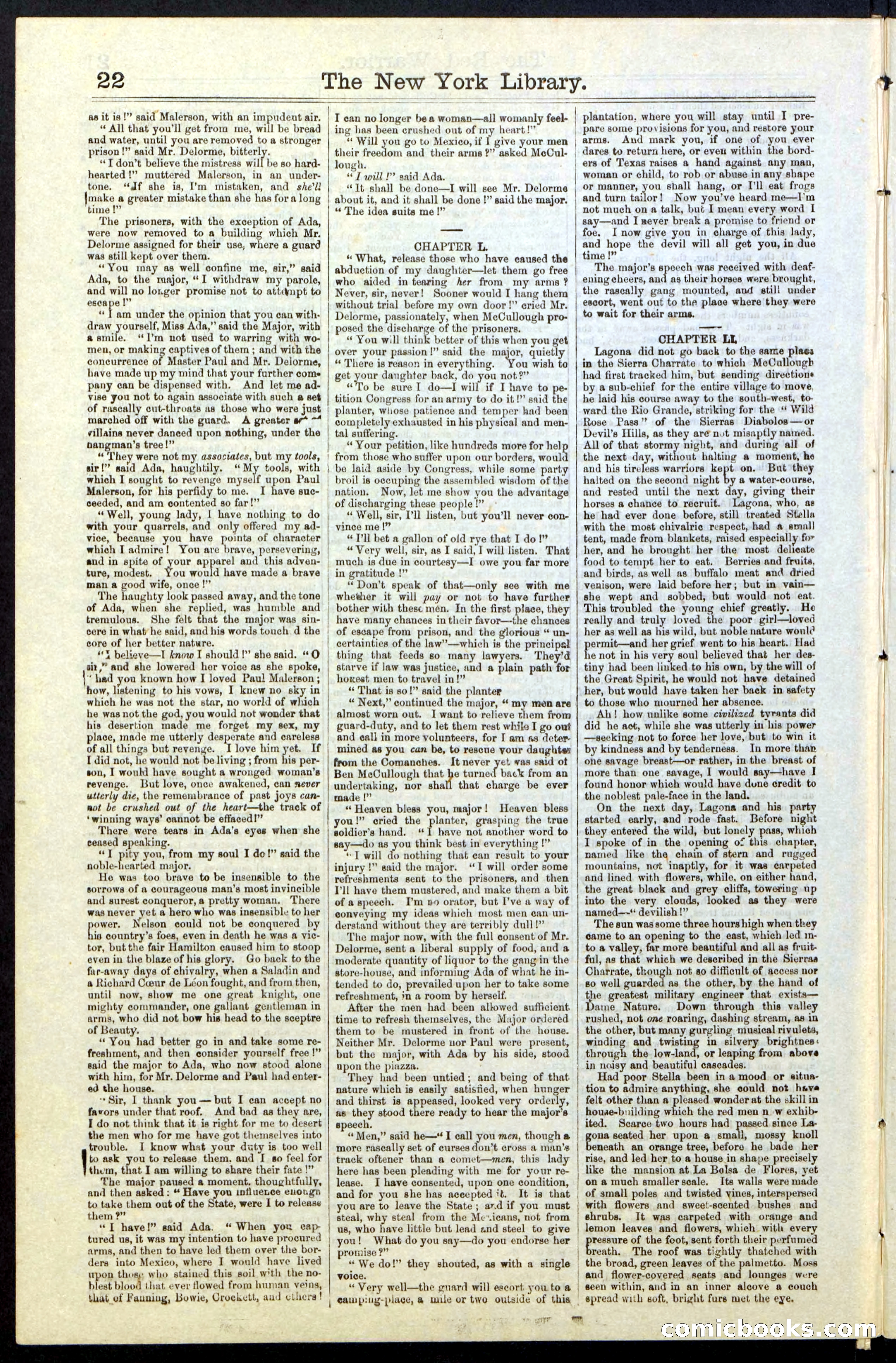
A restored page from Pulp Fiction, 1877. Page through the whole issue in the reader above.
📄 Transcribed text from this page (OCR, searchable)
Machine-transcribed from the original scan — historical spelling and the odd misread are preserved.
22 . . . ‘ad . Ld Md as it is!” said Malerson, with an impudent air. | I ean no longer be a woman—all womanly feel- “ All that you'll get from me, will be bread and water, until you are removed to a stronger prison !” said Mr. Delorme, bitterly. “T don’t believe the mistress will be so hard- hearted!” muttered Malerson, in an under- tone. “Jf she is, I’m mistaken, and she’l! feats a greater mistake than she has fora long time !” The prisoners, with the exception of Ada, were now removed to a building which Mr. Delorme assigned for their use, where a guard was still kept over them. “You may as well confine me, sir,” said Ada, to the major, “I withdraw my parole, and will no longer promise not to attdmpt to esca FS ™ “ T am under the opinion that you can with- draw yourself, Miss Ada,” said the Major, with asmile. “I’m not used to warring with wo- men, or making captives of them ; and with the econeurrence of Master Paul and Mr. Delorme, have made up my mind that your further come pany can be dispensed with. And let me ad- vise you not to again associate with such @ set of rascally cut-throats as those who were just marched off with the guard. A greater ar* ~ villains never danced upon nothing, under the bangman’s tree!” “ They were not my associates, but my tools, sir!” said Ada, haughtily. “My tools, with which I sought to revenge myself upon Paul Malerson, for his perfidy to me. I have suc- ceeded, and am contented so far!” “Well, young lady, | have nothing to do with your quarrels, and only offered my ad- vice, because you have points of character which I admire! You are brave, persevering, and in spite of your apparel and this adven- ture, modest. You would have made a brave man a good wife, once !” The haughty look passed away, and the tone of Ada, when she replied, was humble and tremulous. She felt that the major was sin- cere in what’ he said, and his words touch d the core of her better nature. “% believe—I know I should!” she said. “O sit,” and she lowered her voice as she spoke, “had you known how I loved Pau! Malerson ; how, listening to his vows, I knew no sky in which he was not the star, no world of which he was not the god, you would not wonder that his desertion made me forget my sex, my place, made me utterly desperate and careless of all things but revenge. 1 love him yet. If I did not, he would not be living ; from his per- son, I would have sought a wronged woman’s revenge. But love, once awakened, can never utterly die, the remembrance of past joys can- not be crushed out of the heart—the track of ‘winning ways’ cannot be effaced!” There were tears in Ada’s eyes when she ceased speaking. “T pity you, from my soul I do!’ said the AN net major. He was too brave to be insensible to the sorrows of a courageous man’s most invincible and surest conqueror, a pretty woman. There was never yet a hero who was insepsible to her pewet, elson could not be conquered by is country’s foes, even in death he was a vic- tor, but the fair Hamilton caused him to stoop even in the blaze of his glory. Go back to the far-away days of chivalry, when a Saladin and a Richard Cur de Léon fought, and from then, until now, show me one great knight, one mighty commander, one gallant gentleman in arms, who did not bow his head to the sceptre of Beauty. “You had better go in and take some re- freshment, and then consider yourself free !” said the major to Ada, who now stood alone with him, for Mr. Delorme and Paul had enter- ed the house. + Sir, I thank you—but I can accept no favors under that roof. And bad as they are, I do not think that it is right for me to ca the men who for me have got themselves into trouble. I know what your duty is too well to ask you to release them. and I so feel for them, that I am willing to share their fate !” The major paused a moment, thoughtfully, and then asked: “ Have you influence evongn to take them out of the State, were I to release them ?” “T have!” said Ada. “ When yor cap tured us, it was my intention to have procured arms, and then to have led them over the bor- ders into Mexico, where I would have lived pon those who stained this soil with the no- blest blood that ever flowed from human veins, that of Fauning, Bowie, Crockett, aud cihers! | The ; New York Libra ing has been crushed out of my heart!” “ Will you go to Mexico, if I give your men their freedom and their arms ?” asked MeCul- lough. * T will !’’ said Ada. “It shall be done—I will see Mr. Delorme about it, and it shall be done !” said the major. “ The idea suits me !” CHAPTER L. ‘“ What, release those who have caused the abduction of my daughter—let them go free who aided in tearing her from my arms ? Never, sir, never! Sooner would I hang them without trial before my own door!” cried Mr. Delorme, passionately, when McCullough pro- posed the discharge of the prisoners. “ You will think better of this when you get over your passion!” said the major, quietly “« There is reason in everything. You wish to get hi danghter back, do you not?” “To be sure I do—I will if I have to pe- tition Congress for an army to do it!” said the planter, whose patience and temper had been completely exhausted in his physical and men- tal suffering. “ Your petition, like hundreds more for hel from those who suffer upon our borders, souk be laid aside by Congress, while some party broil is occuping the assembled wisdom of the nation. Now, let me show you the advantage of discharging these people !” “ Well, sir, I’ll listen, but you’ll never con- vince me !” “ T’ll bet a gallon of old rye that I do!” “Very well, sir, as I said, I will listen. That much is due in courtesy—I owe you far more in gratitude !” “Don't speak of that—only see with me whether it will pay or not to have further bother with these men. In the first place, they have many chances in their favor—-the chances of escape from prison, and the glorious “ un- certainties of the law”—which is the principal thing that feeds so many lawyers. They’d starve if law was justice, and a plain path for honest men to travel in!” “ That is so!” said the planter “ Next,” continued the major, “ my men are almost worn out. I want to relieve them from guard-duty, and to let them rest while I go out and call in more volunteers, for I am ss deter- mined as you can be, to rescue your daughter from the Comanches. It never yet vas said ot Ben McCullough that be turned back from an undertaking, nor shall that charge be ever made !” “ Heaven bless you, major! Heaven bless you!” eried the planter, grasping the true soldier’s hand. “1 have not another word to say—do as think best in everything !” * T will do nothing that ean result to your injury !” said the major. “TI will order some refreshments sent to the prisoners, and then I'll have them mustered, and make them a bit of aspeech. I’m no orator, but I’ve a way of conveying my ideas which most men can un- derstand without they are terribly dull!” The major now, with the full consent of Mr. Delorme, sent a liberal supply of food, and a moderate quantity of liquor to the gang in the store-house, and informing Ada of what he in- tended to do, prevailed upon her to take some refreshment, in a room by herself. After the men had been allowed sufficient time to refresh themselves, the Major ordered them to be mustered in front of the house. Neither Mr. Delorme uor Paul were present, but the major, with Ada by his side, stood upon the piazza. They had been untied; and being of that nature which is easily satistied, when hunger and thirst is appeased, looked very orderly, as they stood there ready to hear the major’s speech. “Men,” said he—* I call you men, though a more rascally set of curses don’t cross a man’s track oftener than a comet—men, this lady here has been pleading with me for your re- lease. I have consented, upon one condition, and for you she has aceepted ‘t. It is that you are to leave the State; ardif you must steal, why steal from the Me«icans, not from us, who have little but lead and steel to give you! What do you say—do you endorse her promise ?” “ We do!” they shouted, as with a single voice. “ Very well—the guard will escort you to a caupiug-place, @ mile or two outside of this ry. plantation, where you will stay until I pre- pare some provisions for you, and restore your arms. And mark you, if one of you ever dares to return here, or evert within the bord- | ers of Texas raises a hand against any man, ™ woman or child, to rob or abuse in any shape or manner, you shall hang, or [ll eat frogs and turn tailor! Now you’ve heard me—I'm not much on a talk, but I mean every word I say—and I never break a promise to friend or foe. I now give you in charge of this lady, and hope the devil will all get you, in due time !” The major’s speech was received with deaf- ening cheers, and as their horses were brought, the raseally gang mounted, and still under escort, went out to the place where they were to wait for their arms. CHAPTER LL Lagona did not go back to the same placa in the Sierra Charrate to which MeCallough had first tracked him, but sending directions by a sub-chief for the entire village to move, he laid his course away to the south-west, to- ward the Rio Grande, striking for the “ Wild Rose Pass” of the Sierras Diabolos —or Devil’s Hills, as they are nut misaptly named. All of that stormy night, and during all of the next day, without halting a moment, he and his tireless warriors kept on. But they halted on the second night by a water-course, and rested until the next day, giving their horses a chance to recruit. Lagona, who, ae he had ever done before, still treated Stella with the most chivalrie respect, had a amall tent, made from blankets, raised especially for her, and he brought her the most delicate food to tempt her to eat. Berries and fruits, and birds, as well as buffalo meat and dried venison, were laid before her; but im vain— she wept and sobbed, but would not eat. This troubled the young chief greatly. He really and truly loved the poor girl—loved her as well as his wild, but noble nature would peer her grief went to his heart. Had 1e not in his very soul believed that her des- tiny had been linked to his own, by the will of the Great Spirit, he would not have detained her, but would have taken her back in safety to those who mourned her absence. Ah! how unlike some civilized tyrants did did he act, while she was utterly im his power —secking not to force her love, but to win it by kindness and by tenderness. In more than one savage breast—or rather, in the breast of more than one savage, I would say—have I found honor which would have dune eredit to the noblest pale-face in the land. On the next day, Lagona and his party started early, and rode fast. Before night they entered the wild, but lonely pass, which I spoke of in the opening of this chapter, named like the chain of stern and rugged mountains, not inaptly, for it was carpeted and lined with flowers, while, on either hand, the great black and grey cliffs, towering up into the very clouds, looked as they were named—~* devilish !” The sun was some three hours high when they came to an opening to the east, which led m- to a valley, far more beautiful and all as fruit- ful, as that which we deseribed in the Sierraa Charrate, though not so difficult of access nor so well guarded as the other, by the hand of the greatest military engineer that exists— Dame Nature. Down through this valley rushed, not one roaring, dashing stream, as in the other, but many gurgling musical rivulets, winding and twisting in silvery brightnes: through the low-land, or leaping from above in noisy and beautiful cascades. Had poor Stella been in a mood or situa- tion to admire anything, she could not have felt other than a pleased wonder at the skill in house-building which the red men nw exhib- ited. Scarce two hours had pees since La- pons seated her upon a small, mossy knoll eneath an orange tree, before he bade her rise, and led her to a house in shape precisely hike the mansion at La Bolsa de Flores, yet on a much smallerseale. Its walls were made of small poles and twisted vines, interspersed with flowers and sweet-scented bushes and shrubs. It was carpeted with orange and lemon leaves and flowers, which with every preemies of the foot, sent forth their perfumed reath. The roof was tightly thatched with the broad, green leaves of the palmetto. Moss and flower-covered seats and lounges were seen within, and in an inner alcove a couch spread wiih soft, bright furs met the eye. i t—es— Gomilcboo cS (E(o)