
Pulp Fiction, 1877 · page 21 of 28
Beadle's New York Dime Library, No. 23 — page 21: what you’re looking at
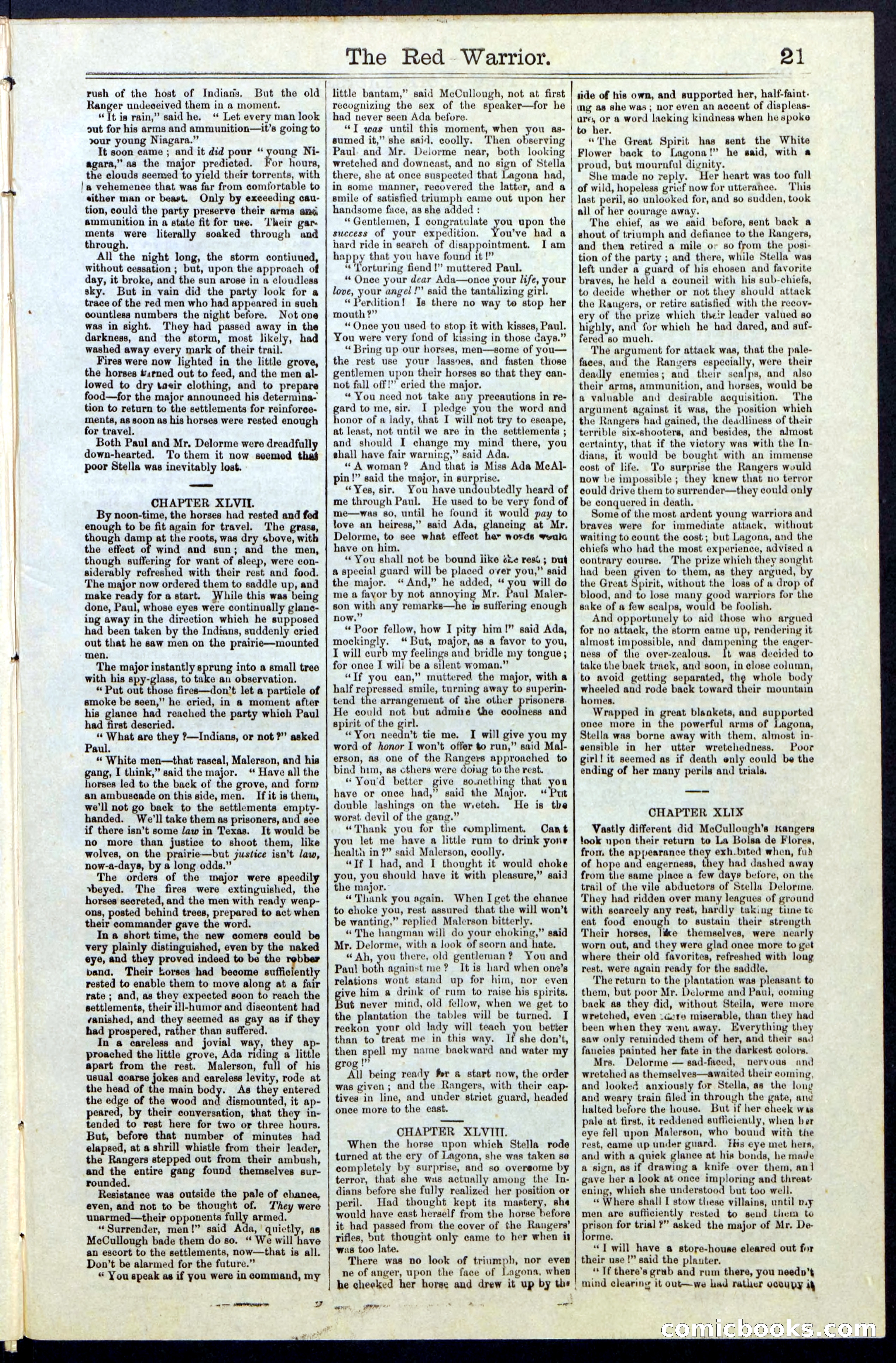
A restored page from Pulp Fiction, 1877. Page through the whole issue in the reader above.
📄 Transcribed text from this page (OCR, searchable)
Machine-transcribed from the original scan — historical spelling and the odd misread are preserved.
——E——EE rush of the host of Indians, But the old Ranger undeceived them in a moment. “Tt is rain,” said he. “ Let every man look out for his arms and ammunition—it’s going to your young Niagara.” It soon came ; and it did pour “ young Ni- agara,” as the major predicted. For hours, the clouds seemed to yield their torrents, with 'a vehemence that was far from comfortable to either man or beast. Only by exceeding cau- tion, could the party preserve their arms ang ammunition in a state fit for ure. Their gar ments were literally soaked through and through. All the night long, the storm contiuued, without cessation ; but, upon the approach of day, it broke, and the sun arose in a cloudless sky. But in vain did the party look for a trace of the red men who had appeared in such countless numbers the night before. Not one was in sight. They had passed away in the darkness, and the storm, most likely, had washed away every mark of their trail. Fires were now lighted in the little grove, the horses turned out to feed, and the men al- lowed to dry vasir clothing, and to prepare food—for the major announced his determina- tion to return to the settlements for reinforce- ments, as soon as his horses were rested enough for travel. Both Paul and Mr, Delorme were dreadfully down-hearted. To them it now seemed thas poor Stella was inevitably lost. CHAPTER XLVII. By noon-time, the horses had rested and fed enough to be fit again for travel. The grasa, though damp at the roots, was dry sbove, with the effect of wind and sun; and the men, though suffering for want of sleep, were con- siderably refreshed with their rest and food. The major now ordered them to saddle up, and make ready for a start. While this was being done, Paul, whose eyes were continually glane- ing away in the direction which he supposed had been taken by the Indians, suddenly cried out that he saw men on the prairie—mounted men. The major instantly sprung into a small tree with his spy-glass, to take an observation. * Put out those fires—don’t let a particle of smoke be seen,” he cried, in a moment after his glance had reached the party which Paul had first descried. “ What are they ?—Indians, or not ?” asked Paul. “ White men—that rascal, Malerson, and hia gang, I think,” said the major. “ Have all the horses led to the back of the grove, and form an ambuseade on this side, men. If it is them, we'll not go back to the settlements empty- handed. We’ll take them as prisoners, and see if there isn’t some /aw in Texas. It would be no more than justice to shoot them, like wolves, on the prairie—but justice isn’t law, now-a-days, by a long odds.” The orders of the major were speedily Ybeyed. The fires were extinguished, the horses secreted, and the men with ready weap- ons, posted behind trees, prepared to act when their commander gave the word. In a short time, the new comers could be very plainly distinguished, even by the naked eye, and they proved indeed to be the x Pe band. Their Lorses had become sufficiently rested to enable them to move along at a fair rate ; and, as they expected soon to reach the settlements, their ill-humor and discontent had eanished, and they seemed as gay as if they had prospered, rather than suffered. In a careless and jovial way, they 7 proached the little grove, Ada riding a little apart from the rest. Malerson, full of his usual coarse jokes and careless levity, rode at the head of the main body. As they entered the me of the wood int dismounted, it ap- peared, by their conversation, that they in- tended to rest here for two or three hours. But, before that number of minutes had elapsed, at a shrill whistle from their leader, the Rangers stepped out from their ambush, and the entire gang found themselves sur- rounded. Resistance was outside the pale of chance, even, and not to be thought of. They were unarmed—their opponents fully armed. “Surrender, men!” said Ada, quietly, as McCullough bade them do so. “ We will have an escort to the settlements, now—that is all. Don't be alarmed for the future.” “ You speak as if you were in command, my The Red W arrior. little bantam,” said McCullough, not at first recognizing the sex of the speaker—for he had never seen Ada before. “T was until this moment, when you as- sumed it,” she said, coolly. Then observing Paul. and Mr. Delorme near, both looking wretched and downeast, and no sign of Stella there, she at once suspected that Lagona had, in some manner, recovered the latter, and a smile of satisfied triumph came out upon her handsome face, as she added : “Gentlemen, I congratulate you upon the success of your expedition. You've had a hard ride in search of disappointment. I am happy that you have found it!” * ‘Torturing fiend!” muttered Paul. “ Onee your dear Ada—once your life, your love, your angel!” said the tantalizing girl. “Perdition! Is there no way te stop her mouth ?” “Once you used to stop it with kisses, Paul. You were very fond of kissing in those days.” “ Bring up our horses, men—some of you— the rest use your Jassoes, and fasten those gentlemen upon their horses so that they can- not fall off!” cried the major. “ You need not take any precautions in re- gard to me, sir. I pledge you the word and honor of a lady, that I will not try to eseape, at least, not until we are in the settlements ; and should I change my mind there, you shall have fair warning,” said Ada, “A woman? And that is Miss Ada McAl- pin!” said the major, in surprise. “Yes, sir. You have undoubtedly heard of me through Paul. He used to be very fond of me—was so, until he found it would pay to love an heiress,” said Ada, glancing at Mr. Delorme, to see what effect her words wsula have on him. “ You shall not be bound like the reas; put a special guard will be placed over you,” said the major. “And,” he added, “ ie will do me a fayor by not annoying Mr. Paul Maler- son with any remarke—he I suffering enough now.” “ Poor fellow, how I pity him!” said Ada, mockingly. “ But, major, as a favor to you, I will curb my feelings and bridle my tongue ; for once I will be a silent woman.” “Tf you can,” muttered the major, with a half repressed smile, turning away to superin- tend the arrangement of the other prisoners. He could not but admire the coolness and spirit of the girl. “Yon needn’t tie me. I will give you m word of honor I won't offer to run,” said Mal- erson, as one of the Rangers approached to bind him, as cthers were dog to the rest. “Youd better give something that you have or once had,” said the Major. “ Put double lashings on the wretch. He is the worst, devil of the gang.” “Thank you for the eompliment. Cant ou let me have a little rum to drink yone Health in ?” said Malerson, coolly. “Tf I had, and I thought it would choke you, you should have it with pleasure,” said the major. “Thank you again. When I get the chanve to choke you, rest assured that the will won’t be wanting,” replied Malerson bitterly. “The hangman will do your choking,” said Mr. Delorme, with a look of seorn and hate. “Ah, you there, old gentleman? You and Paul both against me? It is hard when one’s relations wont stand up for him, nor even ive him a drink of rum to raise his spirits. ut never mind, old fellow, when we get to the plantation the tables will be turned. I reckon your old lady will teach you betiter than to treat me in this way. If she don’t, then spell my name backward and water my grog !”’ All being are | fer a start now, the order was given; and the Rangers, with their cap- tives in line, and under strict guard, headed once more to the east. CHAPTER XLVITI. When the horse upon which Stella rode turned at the ery of Lagona, she was taken se completely by surprise, and so overeome by terror, that she was actually among the In- dians before she fully realized her position or peril. Had thought kept its mastery, she would have cast herself from the horse before it had passed from the cover of the Rangers’ rifles, but thought only came to her when it wis too late. There was no look of see 3g nor even ne of anger, upon the face of Lagona, when he cheeked her horse and drew it up by the a. «4 -——— qr), | erewr= 21 side of his own, and supported her, half-faint- ing as she was; nor even an accent of displeas- ure, or a word lacking kindness when he spoke to her. “The Great Spirit has sent the White Flower back to Lagona!” he said, with a proud, but mournful dignity. She made no reply. Her heart was too full of wild, hopeless grief now for utterance. This last peril, 80 unlooked for, and so sudden, took all of her courage away. The chief, as we said before, sent back a shout of triumph and defiance to the Rangers, and then retired a mile or so from the posi- tion of the party ; and there, while Stella was left under a guard of his chosen and favorite braves, he held a council with his sub-chiefs, to decide whether or not they should attack the Rangers, or retire satisfied with the recov- ery of the prize which their leader valued so highly, and for which he had dared, and suf- fered so much. The argument for attack was, that the pale- faces, and the Ranvers especially, were their deadly enemies; and their sealps, and also their arms, ammunition, and horses, would be a valuable and desirable acquisition. The argument against it was, the position which the Rangers had gained, the deadliness of their terrible six-shootera, and besides, the almost certainty, that if the victory was with the In- dians, it would be bought with an immense cost of life. To surprise the Rangers would now be impossible ; they knew that no terror could drive them to surrender—they could only be conquered in death. Some of the most ardent young warriors and braves were for immediate attack, without waiting to count the cost; but Lagona, and the chiefs who had the most experience, advised a contrary course. The prize which they sought had been given to them, as they argued, by the Great Spirit, without the loss of a drop of blood, and to lose many good warriors for the sake of a few scalps, would be foolish. And Denatatedly to aid those who argued for no attack, the storm came Up, rendering it almost impossible, and dampening the eager- ness of the over-zealous. I was decided to take the baek track, and soon, in close column, to avoid getting separated, the whole body wheeled and rode back toward their mountain homes, Wrapped in great blsakets, and supported once more in the powerful arms of Tanent, Stella was borne away with them, almost in- sensible in her utter wretchedness. Poor girl! it seemed as if death enly could be the ending of her many perils and trials. CHAPTER XLI¥ Vastly different did McCullough’s Kangera took upon their return to La Bolsa de Flores, from the appearance a exh.bited when, fud of hope and eagerness, they had dashed away from the same place a few days before, on the trail of the vile abductors of Scella Delorine, They had ridden over many leagues of ground with scarcely any reat, hardly taking time to eat food enough to sustain their strength Their horses, Tae themselves, were nearly worn out, and they were glad once more to get where their old favorites, refreshed with long rest, were again ready for the saddle, The return to the plantation was pleasant to them, but poor Mr. Delurme and Paul, coming back as they did, without Steila, were more wretched, even -Gore miserable, than they had been when they went away. Everything they saw only reminded them of her, and their sad fancies painted her fate in the darkest colors. Mrs. Delorme — sad-faced, nervous and wretched as themselves—awaited their coming, and looked anxiously for Stella, as the long and weary train filed in through the gate, and halted befure the house. But if her cheek was pale at first, it reddened sufficiently, when ber eye fell upon Malerson, who bound with the rest, came up under guard. This eye met hers, and with a quick glance at his bonds, he made a sign, as if drawing a knife over them, anl gave her a look at once imploring and threat ening, which she understood but too well. ‘Where shall | stow these villains, until p.y men are sufficiently rested to send them to rison for trial ?” asked the major of Mr. De- orme., “1 will have a store-house cleared out fir their use !” said the planter. ‘Tf there’s grub and rum there, you needn't , mind clearing it out—we had rather oooupy iq Gomicbooks (E(0)