
Pulp Fiction, 1877 · page 23 of 28
Beadle's New York Dime Library, No. 23 — page 23: what you’re looking at
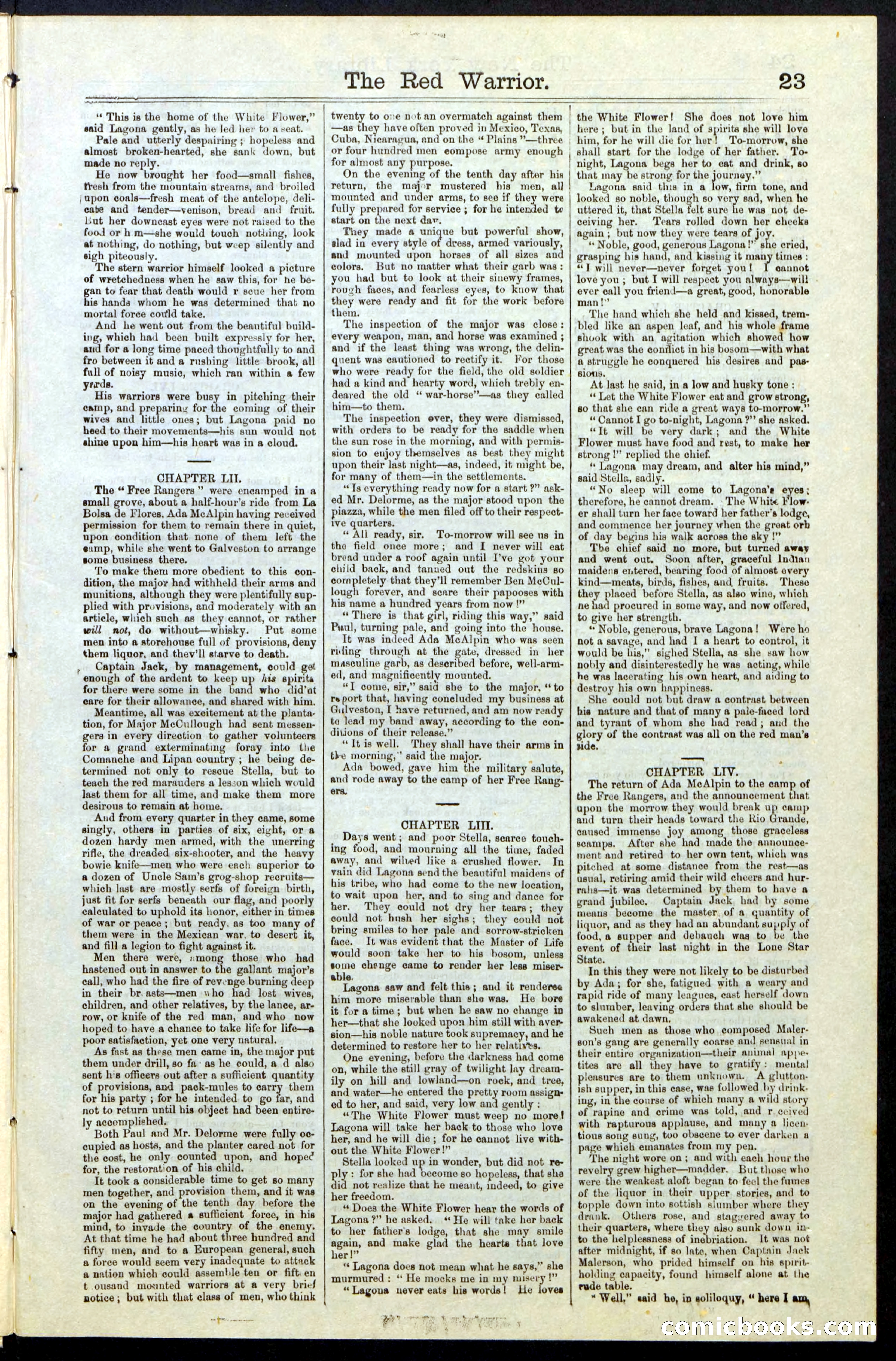
A restored page from Pulp Fiction, 1877. Page through the whole issue in the reader above.
📄 Transcribed text from this page (OCR, searchable)
Machine-transcribed from the original scan — historical spelling and the odd misread are preserved.
~— —— — Te et tee ~ ee ‘ This is the home of the White Flower,” said Lagona gently, as he led her to a xveat. Pale and utterly despairing ; hopeless and almost broken-hearted, she sank down, but made no reply. He now brought her food—small fishes, fresh from the mountain streams, and broiled }upon coals—fresh meat of the antelope, deli- cabe and tender—venison, bread and fruit. Lut her downeast eyes were not raised to the food or h m—she would touch nothing, look at nothing, do nothing, but weep silently and sigh piteously. The stern warrior himself looked a picture of wretchedness when he saw this, for he be- gan to fear that death would r seue her from his hands whom he was determined that no mortal foree could take. And he went out from the beautiful build- ing, which had been built expressly for her, aud for a long time paced thoughtfully to and fro between it and a rushing little brook, all full of noisy music, which ran within a few yerds. His warriors were busy in pitching their eamp, and prepariny for the coming of their wives and little ones; but Lagona paid no heed to their movements—his sun would not shine upon him—his heart was in a cloud. CHAPTER LI. The “ Free Rangers” were eneamped in a small grove, about a half-hour’s ride from La Bolsa de Flores, Ada McAlpin having received permission for them to remain there in quiet, upon condition that none of them left the ¢ump, while she went to Galveston to arrange some business there. ‘To make them more obedient to this con- dition, the major had withheld their arms and munitions, although they were plentifully sup- plied with provisions, and moderately with an article, which such as they cannot, or rather will not, do without—whisky. Put some men into a storehouse full of provisions, deny them liquor, and thev’ll starve to death. Captain Jack, by management, could ge enough of the ardent to keep up his spirita for there were some in the band who did’at eare for their allowance, and shared with him. Meantime, all was excitement at the planta- tion, for Major McCullough had sent messen- gers in every direction to gather volunteers for a grand exterminating foray into the Comanche and Lipan country ; he being de- termined not only to rescue Stella, but to teach the red marauders a lesson which would Jast them for all time, and make them more desirous to remain at home. And from every quarter in they came, some singly, others in parties of six, eight, or a dozen hardy men armed, with the unerring rifle, the dreaded six-shooter, and the heavy bowie knife—men who were each superior to a dozen of Uncle Sam’s grog-shop reeruits— which last are mostly serfs of foreign birth, just fit for serfs beneath our flag, and poorly calculated to uphold its honor, either in times of war or peace ; but ready, as too many of them were in the Mexican war, to desert it, and fill a legion to fight against it. Men there were, :mong those who had hastened out in answer to the gallant major’s eall, who had the fire of revenge burning deep in their br. asts—men who had lost wives, children, and other relatives, by the lance, ar- row, or knife of the red man, and who now hoped to have a chance to take life for life—a poor satisfaction, yet one very natural, As fast as these men came in, the major put them under drill, so fa: as he could, a d also sent h’s officers out after a sufficient quantity of provisions, and pack-mules to carry them for his party ; for be intended to go far, and not to return until his object had been entire- ly accompliehed, Both Paul and Mr. Delorme were fully oe- cupied as hosts, and the planter cared not for the cost, he only counted upon, and hoped for, the restoration of his child, It took a considerable time to get so many men together, and provision them, and it was on the evening of the tenth day before the major had gathered a sufficient foree, in his mind, to invade the country of the enemy. At that time he had about three hundred and fifty men, and to a European general, such a force would seem very inadequate to attack a nation which could assemble ten or fift. en t ousand mounted warriors at a very brief notice; but with that class of men, who think oo t Oe er The twenty to one not an overmatch against them —as they have often proved in Mexico, Texas, Cuba, Niecarayua, and on the “ Plains ”—three or four hundred men eompose army enough for almost any purpose. On the evening of the tenth day after his return, the major mustered bis men, all mounted and under arms, to see if they were fully prepared for service ; for he intended to start on the next dav. They made a unique but powerful show, slad in every style of dress, armed variously, and mounted upon horses of all sizes and colors. But no matter what their garb was: you had but to look at their sinewy frames, rouvzh faces, and fearless eyes, to know that they were ready and fit for the work before them. The inspection of the major was close: every weapon, man, and horse was examined ; and if the least thing was wrong, the delin- quent was cautioned to rectify it. For those who were ready for the field, the old soldier had a kind and hearty word, which trebly en- deared the old “ war-horse’—as they called him—to them. The inspection ever, they were dismissed, with orders to be ready for the saddle when the sun rose in the morning, and with permis- sion to enjoy themselves as best they might upon their last night—as, indeed, it might be, for many of them—in the settlements. “Ts everything ready now for a start ?” ask- ed Mr. Delorme, as the major stood upon the piazza, while the men filed off to their respect- ive quarters. “ All ready, sir. To-morrow will see us in the field onee more; and I never will eat bread under a roof again until I’ve got your child back, and tanned out the redskins go completely that they’ll remember Ben McCul- lough forever, and seare their papooses with his name a hundred years from now!” “There is that girl, riding this way,” said Puul, turning pale, and going into the house. It was indeed Ada MecAlpin who was seen rifling through at the gate, dressed in her masculine garb, as daavived before, well-arm- ed, and magnificently mounted. “I come, sir,” said she to the major, “ to re port that, having coneluded my business at Gulveston, I have returned, and am now ready te lead my band away, according to the con- ditions of their release.” “It is well. ‘They shall have their arms in the morning,” said the major. i Ada bowed, gave him the military salute, and rode away to the camp of her Free Rang- ers. , CHAPTER LIT. Days went; and poor Stella, searee touch- ing food, and mourning all the time, faded away, and wilved like a erushed flower. In vain did Lagona send the beautiful maidens of his tribe, who had come to the new location, to wait upon her, and to sing and dance for her. They could not dry her tears; they could not bush her sighs; they could not bring smiles to her pale and sorrow-stricken face. It was evident that the Master of Life would soon take her to his bosom, unless tome chenge came to render her less miser- able. Lagona saw and felt this; and it renderee him more miserable than she was, He bore it for a time; but when he saw no change in her—that she looked upon him still with aver- sion—his noble nature took supremacy, and he determined to restore her to her relatives. One evening, before the darkness had come on, while the still gray of twilight lay dream- ily on hill and lowland—on rock, and tree, and water—he entered the pretty room assigns ed to her, and said, very low and gently : “The White Flower must weep no more! Lagona will take her back to those who love her, and he will die; for he cannot live with- out the White Flower!” Stella looked up in wonder, but did not re- ly : for she had become so hopeless, that she aid not realize that he meant, indeed, to give her freedom. “ Does the White Flower hear the words of Lagona ?” he asked. ‘ He will take her back to her father’s lodge, that she may smile again, and make glad the hearts that love her!” ‘* Lagona does not mean what he says,” she murmured : “ He mocks me in my misery !” “Lagona never eats his words! He loves a wer it’ % nr by neers ~~ a Pe - —E 23 the White Flower! She does not love him here; butin the land of spirits she will love him, for he will die for her! To-morrow, she shall start for the lodge of her father. To- night, Lagona begs her to eat and drink, so that may be strong for the domi hl Lagona said this in a low, firm tone, and looked so noble, though so very sad, when he uttered it, that Stella felt sure he was not de- ceiving her. Tears rolled down her cheeks again; but now they were tears of Joy. * Noble, good, generous Lagona!” she cried, grasping his hand, and kissing it many times ; “T will never—never forget you! cannot love you; but I will respect you always—will ever call you frientd—a great, good, honorable man!" The hand whieh she held and kissed, trem- bled like an aspen leaf, and his whole frame shuok with an agitation which showed how great was the coniict in his bosom—with what a struggle he conqnered his desires and pas- sions. At last he said, in a low and husky tone : “Let the White Flower eat and grow strong, so that she can ride a great ways to-morrow.” “ Cannot I go to-night, Lagona ?”’ she asked. “Tt will be very dark; and the White Flower must have food and rest, to make her strong !”’ replied the chief. «* Lagona may dream, and alter his mind,” said Stella, sadly. “No sleep will come to Lagona’s eyes; therefore, he cannot dream. The White Flow: er shall turn her face toward her father's lodge, and commence her journey when the great orb of day begins his walk across the sky !” Tbe chief said no more, but turned away and went out. Soon after, graceful Indian maidens entered, bearing food of almost every kind—meats, birds, fishes, and fruits. These they “bet before Stella, as alao wine, which ne had procured in some way, and now offered, to give her strength. * Noble, generous, brave Lagona! Were ho not a savage, and had I a heart to control, it would be his,” sighed Stella, as she saw how nobly and disinterestedly he was acting, while he was lacerating his own heart, and aiding to destroy his own happiness. She could pot but draw a contrast between his nature and that of many a pale-faced lord and tyrant of whom she had read; and the glory of the contrast was all on the red man’s side, eee | CHAPTER LIV. The return of Ada McAlpin to the camp of the Free Rangers, and the announcement that upon the morrow they would break up camp and turn their heads toward the Rio Grande, caused immense joy among those graceless scamps. After she had made the announce- ment and retired to her own tent, which was pitched at some distance from the rest—as usual, retiring amid their wild cheers and hur- ralis—it was determined by them to have a grand jubilee, Captain Jack had by some means become the master of a quantity of liquor, and as they had an abundant supply of food, a supper and debauch was to be the event of their last night in the Lone Star State. In this they were not likely to be disturbed by Ada; for she, fatigued with a weary and rapid ride of many leagues, cast herself down to slumber, leaving orders that she should be awakened at dawn, Such men as those who composed Maler- gon’s gang are generally coarse and sensual in their entire organization—their animal ap)e- tites are all they have to gratify: mental lensures are to them unknown. A glutton. ish supper, in this case, wae followed by drink. ing, in the course of which many a wild story of rapine and crime was told, and r. ceived ith rapturous applause, and many a licen- tious song sung, too obscene to ever darken a page which emanates from my pen. The night wore on; and with each hour the revelry grew higher—madder. But those who were the weakest aloft began to feel the fumes of the liquor in their upper stories, and to topple down into sottish slumber where they drank. Others rose, and stagvered away to their quarters, where they also sunk down in- to the helplessness of inebriation. It was not after midnight, if so late, when Captain Jack Malerson, who prided himself on his spuirit- holding capacity, found himself alone at the rude table. “Well,” said he, in soliloquy, “ here I au, e > <S Gomichboo (E(0)