
Pulp Fiction, 1877 · page 20 of 28
Beadle's New York Dime Library, No. 23 — page 20: what you’re looking at
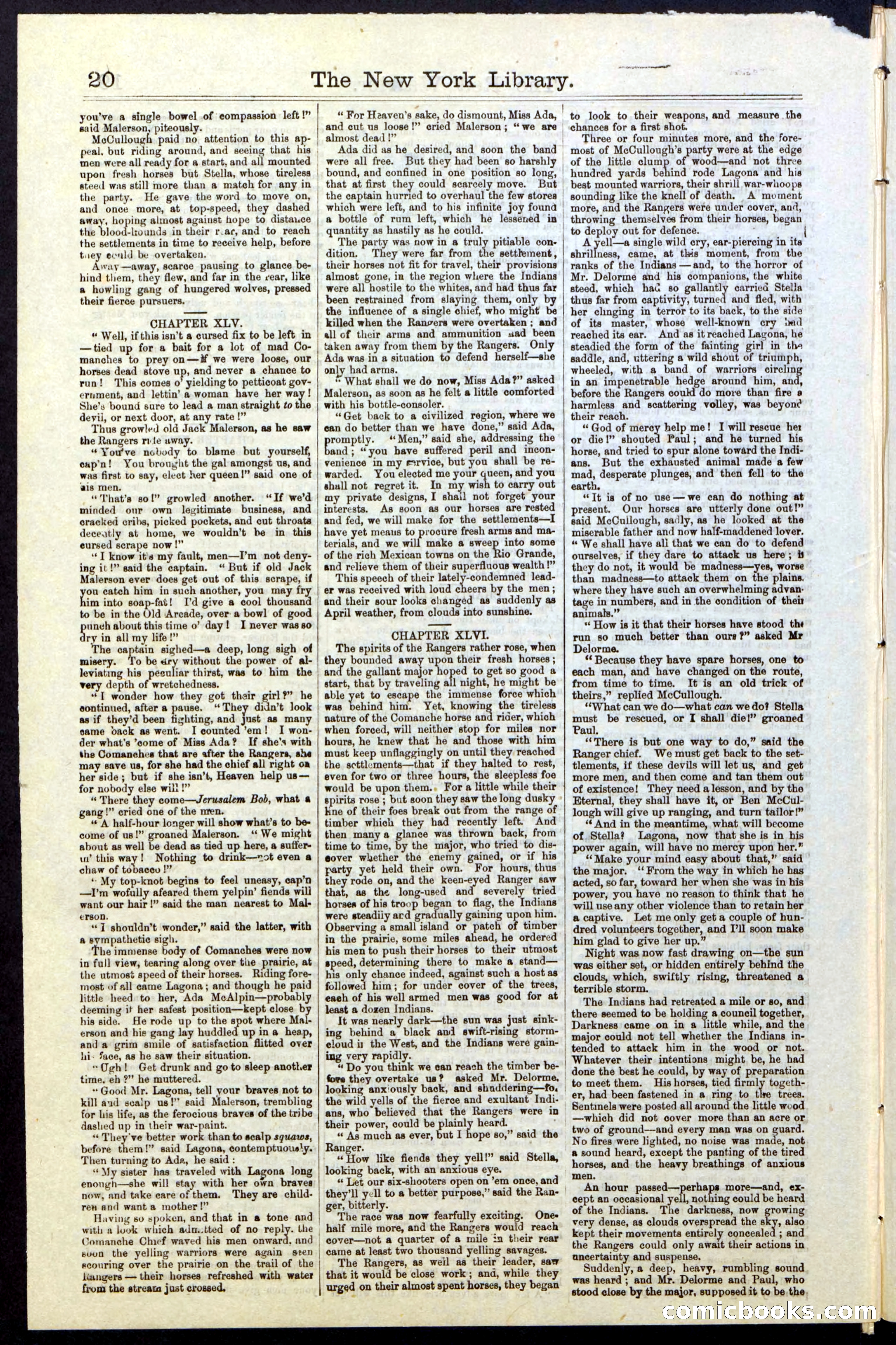
A restored page from Pulp Fiction, 1877. Page through the whole issue in the reader above.
📄 Transcribed text from this page (OCR, searchable)
Machine-transcribed from the original scan — historical spelling and the odd misread are preserved.
20 you’ve a single bowel of compassion left !” said Malerson, piteously. McCullough paid no attention to this ap- peal, but riding around, and seeing that his men were all ready for a start, and all mounted upon fresh horses but Stella, whose tireless steed was still more than a mateh for any in the party. He gave the word to move on, and once more, at top-speed, they dashed away, hoping almost against hope to distance the blood-lrounds in their r.ac, and to reach the settlements in time to receive help, before tuey eculd be overtaken. Away—away, scarce pausing to glance be- hind them, they flew, and far in the ear, like a howling gang of hungered wolves, pressed their fierce pursuers. CHAPTER XLV. “ Well, if this isn’t a cursed fix to be left in —tied up for a bait for a lot of mad Co- manches to prey on—if we were loose, our horses dead stove up, and never a chance to run! This comes o’ yielding to petticoat gov- ernment, and lettin’ a woman have her way! She’s bound sure to lead a man straight to the deyii, or next door, at any rate !” Thus growled old Jack Malerson, as he saw the Rangers riie uway. “You've nobody to blame but yourself, cap’n! You brought the gal amongst us, and was first to say, elect her queen!” said one of ais men. “'That’s so!” growled another. ___ re ee + “If we'd | and cut us loose!” cried Malerson; “we are almost dead !” Ada did as he desired, and soon the band were all free. But they had been so harshly bound, and confined in one position so long, that at first they could scarcely move. But _ the captain hurried to overhaul the few stores | which were left, and to his infinite joy founda a bottle of rum left, which he lessened in quantity as hastily as he could. The party was now in a truly pitiable con- dition. They were far from the settlement, their horses not fit for travel, their provisions almost gone, in the region where the Indians were all hostile to the whites, and had thus far been restrained from slaying them, only by the influence of a single chief, who might be killed when the Rangers were overtaken ; and all of their arms and ammunition uad been taken away from them by the Rangers. Only Ada was in a situation to defend herself—she only had arms. “ What shall we do now, Miss Ada?” asked Malerson, as soon as he felt a little comforted with his bottle-consoler. “Get back to a civilized region, where we can do better than we have done,” said Ada, ae ge “Men,” said she, addressing the and; “you bave suffered peril and incon- venience in my service, but you shall be re- warded. You elected me your queen, and you | shall not regret it. In my wish to carry out my private designs, I shail not forget your minded our own legitimate business, and | interests. As soon as our horses are rested cracked cribs, picked pockets, and cut throats deceatly at home, we wouldn’t be in this eursed serape now !” “1 know it's my fault, men—I’m not deny- ing it!” said the captain. “ But if old Jack Malerson ever does get out of this scrape, if oe eatch him in such another, you may f im into soap-fat! I'd give a cool thousand to be in the Old Arcade, over a bowl of good eae about this time o’ day! I never was so ry in all my life!” he captain sighed—a deep, long sigh of misery. ‘To be na without the power of al- leviating his peculiar thirst, was to him the very depth of wretchedness. “T wonder how they got their girl?” he sontinued, after a pause, “They didn’t look as if they’d been fighting, and just as many came back as went. I counted’em! I won- der what's "come of Miss Ada? If she's with the Comanches that are after the Rangers, she may save us, for she had the chief all right on her side; but if she isn’t, Heaven help us— for nobody else wil: !” “There they come—Jerusalem Bob, what a gang!” cried one of the nren. “A half-hour longer will show what’s to be- come of us!” groaned Malerson. ‘“ We might about as well be dead as tied up here, a suffer- ui’ this way! Nothing to drink—»ot even a chaw of tobacev !” ‘My top-knot begins to feel uneasy, cap’n —I’m wofully afeared them yelpin’ fiends will want our hair!” said the man nearest to Mal- erson. “7 shouldn’t wonder,” said the latter, with & sympathetic sigh. The immense body of Comanches were now in full view, tearing along over tie prairie, at the utmost speed of their horses. Riding fore- most of all eame Lagona; and though he paid little heed to her, Ada McAlpin—probably deeming it her safest position—kept close b his side. He rode up to the et where Mal- erson and hie gang lay huddled up in a heap, anda grim smile of satisfaction flitted over hi: face, as he saw their situation. “Ogh! Get drunk and go to sleep another time, eh ?” he muttered. * Good Mr. Lagona, tell your braves not to kill aud sealp us!’ said Malerson, trembling for lis life, as the ferocious braves of the tribe daslied up in their war-paint. “ They've better work than to scalp squaws, before them!” said Lagona, contemptuouely. Then turning to Ada, he said : “My sister has traveled with ona long enongh—she will stay with her own braves now, and take eare of them. They are child- ren and want a mother!” Having so spoken, and that in a tone and | and fed, we will make for the settlements—I have yet meaus to procure fresh arms and ma- terials, and we will make a sweep into some of the rich Mexican towns on the Rio Grande, and relieve them of their superfluous wealth !” This speech of their lately-condemned lead- er was received with loud cheers by the men; and their sour looks changed as suddenly as April weather, from clouds into sunshine. CHAPTER XLVI. . The spirits of the Rangers rather rose, when they bounded away upon their fresh horses ; ind the gallant major hoped to get so good a start, that by traveling all night, he might be able yet to escape the immense force which was behind him. Yet, knowing the tireless nature of the Comanche horse and rider, which when forced, will neither stop for miles nor hours, he knew that he and those with him must keep unflaggingly on until they reached the scttlements—that if they halted to rest, even for two or three hours, the sleepless foe would be upon them., For a little while their spirits rose ; but soon they saw the long dusky kne of their foes break out from the range of timber which they had recently left. And then many a glance was thrown back, from time to time, by the major, who tried to dis- eover whether the enemy gained, or if his party yet held their own. For hours, thus they rode on, and the keen-eyed Ranger saw that, as the long-used and severely tried horses of his troop began to flag, the Indians were steadily ard gradually gaining upon him. Observing a small island or patch of timber in the prairie, some miles ahead, he ordered his men to push their horses to their utmost speed, determining there to make a stand— his only chance indeed, against such a host as followed him; for under cover of the trees, each of his well armed men was good for at least a dozen Indians. It was nearly dark—the sun was just sink- ing behind a black ani ewift-rising storm- cloud in the West, and the Indians were gain- ing very rapidly. a’ Doran think we can reach the timber be- fore they overtake us? asked Mr. Delorme, looking anxiously back, and shuddering—fo, the wild yells of the fierce and exultant Indi- ans, who believed that the Rangers were in their power, could be plainly heard. “ As much as ever, but I hope so,” said the Ranger. “ How like fiends they yell!” said Stella, looking back, with an anxious eye. “ Let our six-shooters open on ’em once, and ee there seemed to be holdi | | | they'll yell to a better purpose,” said the Ran- | ger, bitterly. The race was now fearfully exciting. Ones with a look which adm.tted of no reply. the half mile more, and the Rangers would reach Comanche Chief waved his men onward, and | cover—not a quarter of a mile :a their rear svun the yelling warriors were again seen | came at least two thousand yelling savages. scouring over the prairie on the trail of the kiangers — their horses refreshed with water from the streata just crossed, The Rangers, as weil as their leader, saw that it would be close work; and, while they urged on their almost spent horses, they began to look to their weapons, and measure the chances for a first shot. Three or four minutes more, and the fore- most of McCullough’s party were at the edge of the little clump of wood—and not three hundred yards behind rode Lagona and his best mounted warriors, their shrill war-whoops sounding like the knell of death. A moment more, and the Rangers were under cover, and, throwing themselves from their horses, began to deploy out for defence. A yor single wild cry, ear-piercing in its shrillness, came, at this moment, from the ranks of the Indians —and, to the horror of Mr. Delorme and his companions, the white steed, which hac so gallantly carried Stella thus far from captivity, turned and fled, with her clinging in terror to its back, to the side of its master, whose well-known cry wad reached its ear. And as it reached Lagona, he steadied the form of the fainting girl in the saddle, and, uttering a wild shout of triumph, wheeled, with a band of warriors circlin in an impenetrable hedge around him, and, before the Rangers couki do more than fire » harmless and scattering volley, was beyon¢ their reach. “ God of ear help me! I will reseue her or die!” shouted Paul; and he turned his horse, and tried to spur alone toward the Indi- ans. But the exhausted animal made a few mad, desperate plunges, and then fell to the earth. “Tt is of no use—we can do nothing at present. Our horses are utterly done out!” said McCullough, sadly, as he looked at the miserable father and now half-maddened lover. “ We shall have ali that we can do to defend ourselves, if they dare to attack us here; is they do not, it would be madness—yes, worse than madness—to attack them on the plains. where they have such an overwhelming advan- tage in numbers, and in the condition of thei animals.” * How is it that their horses have stood the run so much better than ours?” asked Mr Delorme. *‘ Because they have spare horses, one to each man, and have changed on the route, from time to time. It is an old trick of theirs,” replied McCullough. ‘“‘What can we do—what can we do? Stella er be rescued, or I shall die!” groaned aul, ‘There is but one way to do,” said the Ranger chief. We must get back to the set- tlements, if these devils will let us, and get more men, and then come and tan them out of existence! They need a lesson, and by the Eternal, they shall have it, or Ben McCul- lough will give up ranging, and turn tailor!” ‘¢ And in the meantime, what will become of Stella? Lagona, now that she is in his power again, will have no mercy upon her.” ‘“Make your mind easy about that,” said the major. ‘From the way in which he has acted, so far, toward her when she was in his power, you have no reason to think that he will use any other violence than to retain her a captive. Let me only get a couple of hun- dred volunteers together, and I’ll soon make him glad to give her up.” Night was now fast drawing on—the sun was either set, or hidden entirely behind the clouds, which, swiftly rising, threatened a terrible storm. The Indians had retreated a mile or so, and a council together, Darkness came on in a little while, and the major could not tell whether the Indians in- tended to attack him in the wood or not. Whatever their intentions might be, he had done the best he could, by way of preparation to meet them. His horses, tied firmly togeth- er, had been fastened in a ring to thee trees. Sentinels were posted all around the little wood —which did not cover more than an acre or two of ground—-and every man was on guard. No fires were lighted, no noise was made, not a sound heard, except the panting of the tired horses, and the heavy breathings of anxious men. An hour passed—perhaps more—and, ex- cept an occasional aed ing could be heard of the Indians. The darkness, now growing very dense, as clouds overspread the sky, also kept their movements entirely Renecgielt ; and the Rangers could only await their actions in uncertainty and suspense, Suddenly, a aes heavy, rumbling sound. was heard ; . Delorme and Paul, who aniicel exeye) / (E(0) (E <S (E(0) |