
Pulp Fiction, 1877 · page 11 of 28
Beadle's New York Dime Library, No. 23 — page 11: what you’re looking at
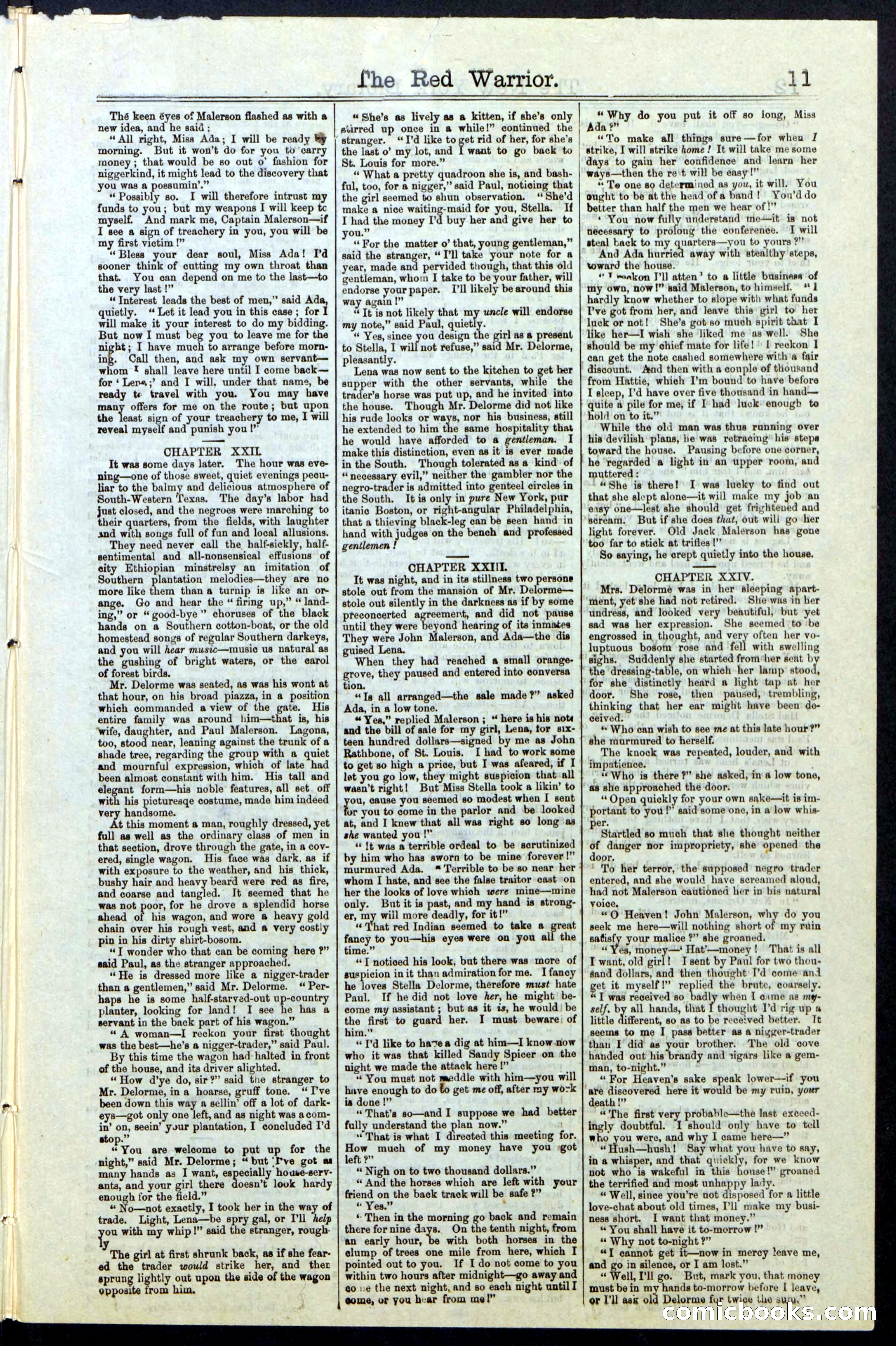
A restored page from Pulp Fiction, 1877. Page through the whole issue in the reader above.
📄 Transcribed text from this page (OCR, searchable)
Machine-transcribed from the original scan — historical spelling and the odd misread are preserved.
_— = Thé keen éyes of Malerson flashed as with a new idea, and he said; “All right, Miss Ada; I will be ready @ morning. But it won't do for you to carry money ; that would be so out o’ fashion for niggerkind, it might lead to the discovery that you was a possumin’.” “Possibly so. I will therefore intrust my funds to you; but my weapons I will keep tc myself. And mark me, Captain Malerson—f I see a sign of treachery in you, you will be my first victim !” “Bless your dear soul, Miss Ada! Id sooner think of cutting my own throat than that. You can Sapend on me to the last—to the very last !” “Interest leads the best of men,” said Ada, quietly. “ Let it lead you in this case ; for I will make it your interest to do my bidding. But now I must beg you to leave me for the night; I have much to arrange before morn- ing. Call then, and ask my own servant— whom © ghall leave here until I come back— for ‘ Lere;’ and I will, under that name, be ready te travel with you. You may have many offers for me on the route; but upon the least sign of your treachery to me, I will reveal myself and punish you !” CHAPTER XXIL It was some days later. The hour was eve- ning—one of those sweet, quiet evenings pecu- liar to the balmy and delicious atmosphere of South-Western Texas. The day’s labor had just closed, and the negroes were marching to their quarters, from the fields, with iatightet and with songs full of fun and local allusions. They need never call the half-sickly, half- sentimental and all-nonsensical effusions of city Ethiopian minstrelsy an imitation of Southern plantation melodies—they are no more like them than a turnip is like an or ange. Go and hear the “ firing up,” “land- ing,” or “good-bye” choruses of the black hands on a Southern cotton-boat, or the old homestead songs of regular Southern darkeys, and you will hear music—music us natural as the gushing of bright waters, or the carol of forest birds. Mr. Delorme was seated, as was his wont at that hour, on his broad piazza, in a position which commanded a view of the gate. His entire family was around him—that is, his ‘wife, daughter, and Paul Malerson. Lagona, too, stood near, leaning against the trunk of a shade tree, regarding the group with a quiet and mournful expression, which of late had been almost constant with him. His tall and elegant form—his noble features, all set off with his picturesge costume, made him indeed vers handsome. t this moment a man, roughly dressed, yet full as well as the ordinary class of men in that section, drove through the gate, in a cov- ered, single wagon. His face was dark, as if with exposure to the weather, and his thick, bushy hair and heavy beard were red as fire, and coarse and tangled. It seemed that he was not poor, for he drove a splendid horse ahead of his wagon, and wore a heavy gold chain over his rough vest, and a very costly pin in his dirty shirt-bosom. “T wonder who that can be coming here ?” said Paul, as the stranger approached. “He is dressed more like a nigger-trader than a gentlemen,” said Mr. Delorme. “ Per- haps he is some half-starved-out Up cpaueey planter, looking for land! I see he has a servant in the back part of his wagon.” “ A woman—lI reckon your first thought was the best—he’s a nigger-trader,” said Paul. By this time the wagon had halted in front of the house, and its driver alighted. “How d’ye do, sir?” said tie stranger to Mr. Delorme, in a hoarse, gruff tone. “ I’ve been down this way a sellin’ off a lot of dark- eys—got only one left, and as night was acom- in’ on, seein’ your plantation, I concluded I'd sto Od “You are welcome to put up for the night,” said Mr. Delorme; “but ‘Ive got as many hands as I want, especially house-serv- ants, and your girl there doesn’t look hardy enough for the field.” “ No—not exactly, I took her in the way of trade. Light, Lena—be spry gal, or I'll help yon with my whip!” said the stranger, rough. The girl at first shrunk back, as if she fear- ed the trader would strike her, and ther sprung lightly out upon the side of the wagon opposite from him, a “She’s as lively as a kitten, if she’s only suirred up once in a while!” continued the stranger. “I'd like to get rid of her, for she’s the last o’ my lot, and YT waiid to go back to St. Louis for more.” “ What a pretty quadroon she is, and bash- ful, too, for a nigger,” said Paul, noticing that the girl seemed to shun observation. ‘She'd make a nice waiting-maid for you, Stella. If I had the money rd buy her and give her to ou.” sit: For the matter o’ that, young gentleman,” said the stranger, “I'll take your note for a year, made and pervided though, that this old gentleman, whom I take to be your father, will endorse your paper. I'll likely be around this way again!” “Tt is not likely that my uncle will endorse my note,” said Paul, quiet y: “ Yes, since you design the girl as a present to Stella, I will not refuse,” said Mr. Delorme, pleasantly. Lena was now sent to the kitchen to get her supper with the other servants, while the trader’s horse was put up, and he invited into the house. Though Mr. Delorme did not like his rude looks or ways, nor his business, still he extended to him the same hospitality that he would have afforded to a gentleman. I make this distinction, even as it 1s ever made in the South. Though tolerated as a kind of “ necessary evil,” neither the gambler nor the negro-trader is admitted into genteel circles in the South. It is only in pure New York, pur itanie Boston, or right-angular Philadelphia, that a thieving blick-leg ean be seen hand in hand with judges on the bench and professed gentlemen ! CHAPTER XXIIL It was night, and in its stillness two persone stole out from the mansion of Mr. Delorme— stole out silently in the darkness as if by some preconcerted my Tt and did not pause until they were beyond hearing of its inmates They were John Malerson, and Ada—the dis guised Lena. When they had reached a small orange- grove, they paused and entered into conversa tion. “Ts all arranged—the sale made?” asked Ada, in a low tone. “Yes,” replied Malerson; “ here is his nots and the bill of sale for my girl, Lena, for six- teen hundred dollars—signed by me as John Rathbone, of St. Louis. I had to work some to get so high a price, but I was afeared, if I let you go low, they might suspicion that all wasn’t right! But Miss Stella took a likin’ to ou, cause you seemed so modest when I sent ur you to come in the parlor and be looked at, and I knew that all was right so long as she wanted you !" “ {t was a terrible ordeal to be scrutinized by him who has sworn to be mine forever!” murmured Ada. Terrible to be so near her whom I hate, and see the false traitor cast on her the looks of love which were mine—mine only. But it is past, and my hand is strong- er, my will more deadly, for it!” “That red Indian seemed to take a wpe fancy to you—his eyes were on you the time.” “T noticed his look, but there was more of suspicion init than admiration for me. I fancy he loves Stella Delorme, therefore must hate Paul. If he did not love her, he might be- come my assistant ; but as it ts, he would | be the first to guard her. I must beware: of him.” “T’d like to havea dig at him—I know now who it was that killed Sandy Spicer on the night we made the attack here !” “You must not eta with him—you will have enough to do to get me off, after my work is dune |” “That's so—and I suppose we had better fully understand the plan now.” “That is what I directed this meeting for. i much of my money have you got e Sa “Nigh on to two thousand dollars.” “ And the horses which are left with your friend on the back track will be safe ?” & Yes.”’ . : ‘Then in the morning go back and remain there for nine days. On the tenth night, from an early hour, with both horses in the clump of trees one mile from here, which I pointed out to you. If I do not come to you within two hours after midnight—go away and co :e the next night, and so each night untill come, or you hear from me!” fhe Red Warrior. 11 “Why do you put it off so long, Miss Ada %” “To make all things sure—for when J strike, I will strike home! It will take mesome days to gain her confidence and learn her ways—then the re°t will be easy!” “Te one so determined as you, it will. You ought to be at the head ofa band! Yon'ddo better than half the men we hear of!” ‘ You now fully understand me—it is not necessary to Hert fe the conferenee. I will steal back to my quarters—you to yours ?” And Ada hurried away with stealthy steps, wward the house. “T wonkon J’l) atten’ to a little business of my own, now!” said Malerson, to himeelf. “1 hardly know whether to slope with what funds I’ve got from her, and leave this girl to her luck or not! She’s got so much spirit that I like her—I wish she liked me as well. She should be my chief mate for life! I reckon I can get the note cashed somewhere with a fair discount. Asnd then with a couple of thousand from Hattie, which I’m bound to have before I sleep, I'd have over five thousand in hand— quite a pile for me, if I had luck enough to hold on to it.” While the old man was thus running over his devilish plans, he was retracing’ his steps toward the house. Pausing before one corner, he regarded a light in an upper room, and uttered : ~“She is there! I was lueky to find out that she glept alone—it will make my job an ersy one—lest she should get frightened and ‘scream. But if she does that, out will go her light forever. Old Jack Malerson has gone too far to stick at trifles |” So saying, he crept quietly into the house. CHAPTER XXIV. Mrs. Delormé was in her sleeping apart- ment, yet’ she had not retired. Slie was in her undress, and looked very beautiful, but yet sad was her expression. She seemed to be engrossed in thought, and vet often her vo- luptuous bosom rose and fell with swelling sighs. Suddenly she started from*her seat b the dressing-table, on which her lamp sri for she distinctly heard a light tap at her door. She rose, then paused, trembling, thinking that her ear might have been de- ceived. * Who can wish to see me at this late hour?” she murmured to herself. The knock was repeated, louder, and with impatience. ; . “Who is there ?” she asked, in a low tone, as she approached the door. “Open quickly for your own sake—it is im- portant to you !”’ said some one, in a low whis- r Startled so much that she thought neither danger nor impropriety, she opened the oor, ~! To her terror, the supposed negro trader entered, and she would have screamed aloud, had not Malerson cautioned her in bis natural yoice, | “© Heaven! John Malerson, why do you seek me here—will nothing short of my ruin satisfy your malice ?” she groaned. “ Yes, money—' Hat’—money! That is all I want, old zirl | I sent by Paul for two thou- éand dollars, and then thought I’d come and get it myself!” replied the brute, coarsely. I was received so badly when I cime as mg- self, oy all hands, that I thought I’d rig up a little different, so as to be received better. It seems to me I pass better as a nigwer-trader than I did as your brother. The old cove handed out his brandy and sigars like a gem- man, to-night.” “For Heaven's sake speak lower—-if you ‘are discovered here it would be my ruin, your “The first very probable—the last exceed- ingly doubtful. I should only have to tell who you were, and why I came here—” " Hush—hush ! Say what you have to say, in a whisper, and that quickly, for we know not who is wakeful in this house!” groaned the terrified and most unhappy lady. “ Well, since you're not disposed for a little love-chat about old times, I'll make my busi- ness short. I want that money.” “ You shall have it to-morrow !” “ Why not to-night ?” “TI cannot get it—now in mercy leave me, and go jn silence, or I am lost.” “ Well, ’ll 0. But, mark you, that money must bein m ds to-morrow before | leave, or I'll ask old Delorme for twice the sum,” as vcomicbooks (e(e)