
Pulp Fiction, 1877 · page 12 of 28
Beadle's New York Dime Library, No. 23 — page 12: what you’re looking at
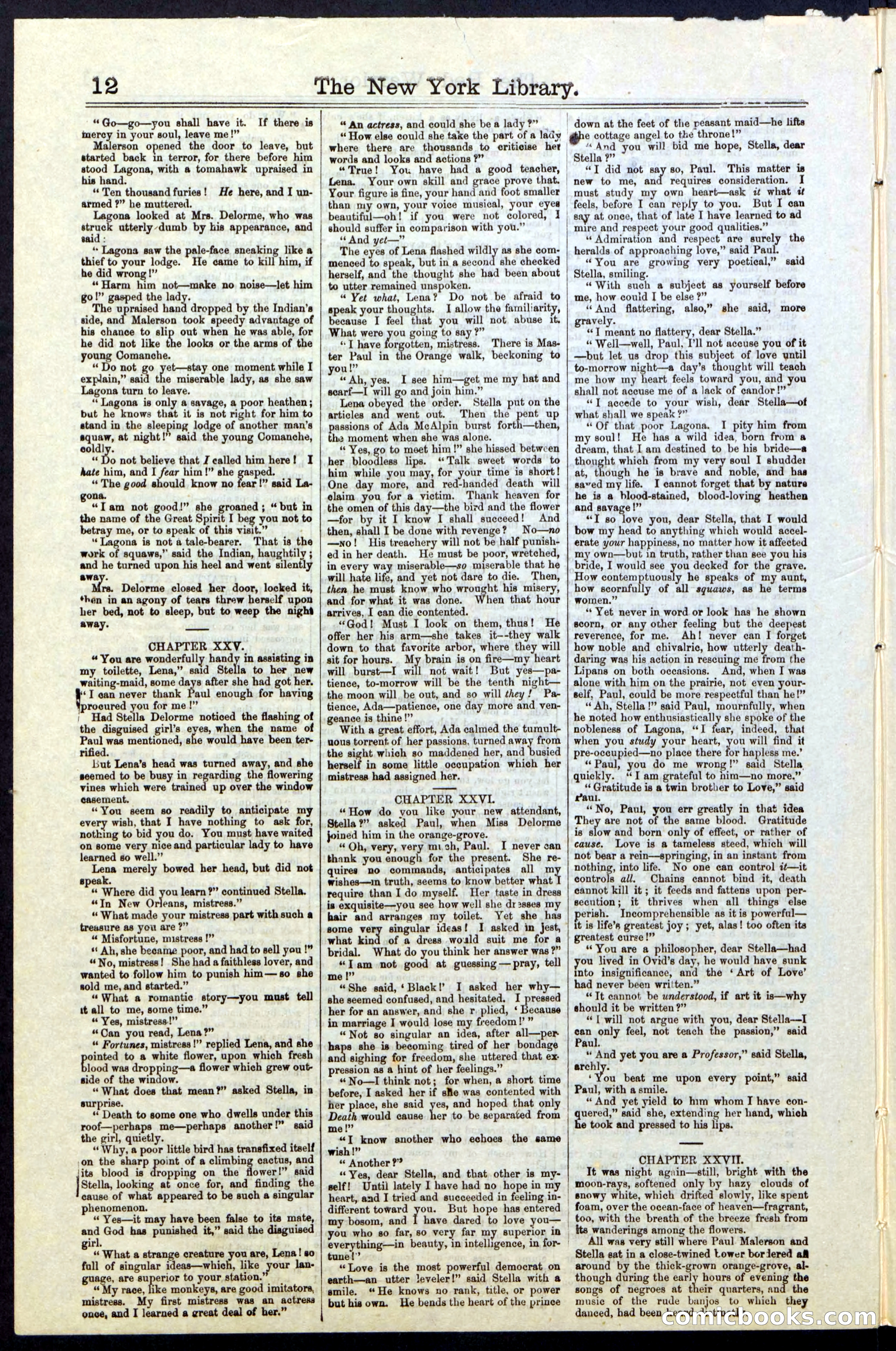
A restored page from Pulp Fiction, 1877. Page through the whole issue in the reader above.
📄 Transcribed text from this page (OCR, searchable)
Machine-transcribed from the original scan — historical spelling and the odd misread are preserved.
12 “ Go—go—you shall have it. If there is merey in your soul, leave me!” Malerson opened the door to leave, but started back in terror, for there before him stood Lagona, with a tomahawk upraised in his hand. “ Ten thousand furies ! armed ?” he muttered. sagons looked at Mrs. Delorme, who was age utterly -dumb by his appearance, and sald : “ Lagona saw the pale-face sneaking like a thief to your lodge. He came to kill him, if he did wrong !”’ “Harm him not—make no noise—let him go!” gasped the lady. The upraised hand dropped by the Indian’s side, and Malerson took speedy advantage of his chance to slip out when he was able, for he did not like the looks or the arms of the young Comanche. “Do not go yet—stay one moment while I explain,” said the miserable lady, as she saw Lagona turn to leave. ‘‘ Lagona is only a savage, a poor heathen; but he knows that it is not right for him to stand in the sleeping lodge of another man’s pater ny at night!” said the young Comanche, coldly. 3 Do not believe that J called him here! I hate him, and I fear him!” she gasped. “The good should know no fear!” said La- gona. “Tam not good!” she groaned; “but in the name of the Great Spirit I beg you not to betray me, or to speak of this visit.” “Lagona is not a tale-bearer. That is the work of squaws,” said the Indian, haughtily ; and he turned upon his heel and went silently away. ’ Mrs. Delorme closed her door, locked it, then in an agony of tears threw herself upon her bed, not to sleep, but to weep the night away. He here, and I un- CHAPTER XXYV. “You are wonderfully handy in assisting in my toilette, Lena,” said Stella to her new waiting-maid, some days after she had got her. ‘T ean never thank Paul enough for having rocured you for me !”’ Had Stella Delorme noticed the flashing of the disguised girl’s eyes, when the name of Paul was mentioned, she would have been ter- rified. but Lena’s head was turned away, and she seemed to be busy in remariing the flowering vines which were trained up over the window casement, “You seem so readily to anticipate my every wish, that I have nothing to ask for, nothing to bid you do. You must have waited on some very nice and particular lady to have learned so well.” Lena merely bowed her head, but did not speak. “ Where did you learn?” continued Stella. “In New Orleans, mistress.” “ What made your mistress part with such a treasure as you are ?” “ Misfortune, mistress !” “ Ah, she became poor, and had to sell you !” “No, mistress! She had a faithless lover, and wanted to follow him to punish him—so she sold me, and started.” “What a romantic story—you must tell it all to me, some time.” “ Yes, mistress!” “Can you read, Lena?” “ Fortunes, mistress!” replied Lena, and she ointed to a white flower, upon which fresh fines was dropping—a flower which grew out- side of the window. “ What does that mean?’ asked Stella, in surprise. ’ “ Death to some one who dwells under this roof—perhaps me—perhaps another!” said the girl, quietly. “Why, a poor little bird has transfixed itself ‘on the sharp point of a climbing cactus, and ‘its blood is dropping on the flower!” said |Stella, looking at once for, and finding the cause of what appeared to be such a singular phenomenon. “ Yes—it may have been false to ite mate, “ God has punished it,” said the disguised irl. g “ What a strange creature you are, Lena! so fall of singular ideas—which, like your Jan- guage, are erpenes to your station. “My race, like monkeys, are good imitators, mistress. My first mistress was an actresa once, and I learned a great deal of her.” “ An actress, and could she be a lady ?” “ How else could she take the part of a lady where there are thousands to criticise het words and looks and actions ?” “True! You have had a good teacher, Lena. Your own skill and grace prove that. | Your figure is fine, your hand and foot smaller than my own, your voice musical, your eyes | beautiful—oh! if you were not colored, 1 should suffer in comparison with you.” “* And yet—” The eyes of Lena flashed ae as she com- menced to speak, but in a second she checked herself, and the thought she had been about to utter remained unspoken. “ Yet what, Lena? Do not be afraid to speak your thoughts. I allow the familiarity, because I feel that you will not abuse it, What were you going to say ?” ‘“T have forgotten, mistress. There is Mas- ter Paul in the Orange walk, beckoning to ou!” we Ah, yes. I see him—get me my hat and scarf—I will go and join him.” Lena obeyed the order. Stella put on the articles and went out. Then the pent up passions of Ada McAlpin burst forth—then, tha moment when she was alone. “ Yes, go to meet him!” she hissed between her eediaes lips. “Talk sweet words to him while you may, for your time is short! One day more, and red-handed death will claim you fur a victim. Thank heaven for the omen of this day—the bird and the flower —for by it I know I shall succeed! And then, shall I be done with revenge? No—no —no! His treachery will not be half punish- ed in her death. He must be poor, wretched, in every way miserable—so miserable that he will hate life, and yet not dare to die. Then, then he must know who wrought his misery, and for what it was done. hen that hour arrives, I can die contented. “God! Must I look on them, thus! He offer her his arm—she takes it--they walk down to that favorite arbor, where they will sit for hours. My brain is on fire—my heart will burst—I will not wait! But yes—pa- tience, to-morrow will be the tenth night— the moon will be out, and so will they! Pa- tience, Ada—patience, one day more and ven- geance is thine!” With a great effort, Ada calmed the tumult- uous torrent of her passions, turned away from the sight which so maddened her, and busied herself in some little occupation which her mistress had assigned her. CHAPTER XXVI. “How do you like your new attendant, Stella?” asked Paul, when Miss Delorme ined him in the orange-grove. “ Oh, very, very mich, Paul. I never can thank you enough for the present. She re- quires no commands, anticipates all m wishes—im truth, seems to know better what require than I do myself. Her taste in dress is exquisite—you see how well she dr2sses my hair and arranges my toilet. Yet she has gome ve what kind of a dress would suit me for a bridal. What do you think her answer was ?” “Tam not good at guessing —pray, tell me |” “She said, ‘Black!’ I asked her why— she seemed confused, and hesitated. I pressed her for an answer, and she r. plied, ‘ Because in marriage I would lose my freedom!’ ” “Not so singular an idea, after all—per haps she is becoming tired of her bondage pe sighing for freedom, she uttered that ex. pression as a hint of her feelings.” “ No—I think not; for when, a short time before, I asked her if she was contented with her place, she said yes, and hoped that only Death would cause her to be separated from me!” “TI know another who echoes the same wish!” “ Another ?” “Yes, dear Stella, and that other is my- self! Until lately I have had no hope in my heart, and I tried and succeeded in feeling in- different toward you. But hope has entered my bosom, and I have dared to love you— you who go far, so very far my superior in everything—in beauty, in intelligence, in for- tune!” “Love is the most powerful democrat on earth—an utter leveler!” said Stella with a smile. “He knows no rank, title, or power but his own. He bends the heart of the prince singular ideas! I asked in jest, — The New York Library. down at the feet of the peasant maid—he lifts e cottage angel to the throne!” “And you will bid me hope, Stella, dear Stella ?” “T did not say so, Paul. This matter is new to me, and requires consideration. I must study my own heart—ask i what « feels, before I can reply to you. But I can say at once, that of late I have learned to ad mire and respect your good qualities.” “ Admiration and respect are surel heralds of approaching love,” said Paul. “You are growing very poetical,” said Stella, smiling. “With such a subject as yourself before me, how could I be else ?” “And flattering, also,” she said, more gravely. 7] meant no flattery, dear Stella.” “ Well—well, Paul, I’ll not accuse you of it —but let us drop this subject of love yntil to-morrow night—a day’s thought will teach me how my PE feels toward you, and you shall not accuse me of a lack of candor!” “T aecede to your wish, dear Stella—of what shall we speak ?” “Of that poor Lagona. I pity him from my soul! He has a wild idea, born from a dream, that I am destined to be his bride—a thought which from my very soul I shudder at, though he is brave and noble, and has saved my life. I cannot forget that by nature he is a blood-stained, blood-loving heathen and savage!” “T so love you, dear Stella, that I would bow my head to anything which would accel- erate your happiness, no matter how it affected my own—but in truth, rather than see you his bride, I would see you decked for the grave. How contemptuously he speaks of my aunt, how scornfully of all sguaws, as he terms women.” ‘* Yet never in word or look has he shown scorn, or any other feeling but the deepest reverence, for me. Ah! never can I forget how noble and chivalric, how utterly death- daring was his action in rescuing me from the Lipans on both occasions. And, when I was alone with him on the prairie, not even your- self, Paul, could be more respectful than he!” “ Ah, Stella!” said Paul, mournfully, when he noted how enthusiastically she spoke of the nobleness of Lagona, “I fear, indeed, that when you study your heart, you will find it pre-oceupied—no place there for hapless me.’ “Paul, you do me wrong!” said Stella quickly. “Iam grateful to him—no more,” “ Gratitude is a twin brother to Love,” said the ul. “No, Paul, you err greatly in that idea They are not of the same blood. Gratitude is slow and born only of effect, or rather of cause. Love is a tameless steed, which will not bear a rein—springing, in an instant from nothing, into life. No one can control it— it controls all. Chains cannot bind it, death cannot kill it; it feeds and fattens upon per- secution; it thrives when all things else erish. Incomprehensible as it is powerfal— t is life’s greatest joy; yet, alas! too often its greatest curse!” “You are a philosopher, dear Stella—had ou lived in Ovid's day, he would have sunk into insignificance, and the ‘Art of Love’ had never been wri'ten.” “Tt cannot be understood, if art it is—why should it be written ?” “| will not argue with you, dear Stella—I oon only. feel, not teach the passion,” said aul. “ And yet you are a Professor,” said Stella, agi ‘You beat me upon every point,” said Paul, with a smile. “And yet yield to him whom I have con- bagel said she, extending her hand, which e took and pressed to his lips. CHAPTER XXVII. Tt was night again—still, bright with the moon-rays, softened only by hazy clouds of snowy white, which drifted slowly, like spent foam, over the ocean-face of heaven—fragrant, too, with the breath of the breeze fresh from its wanderings among the flowers. All was very still where Paul Malerson and Stella sat in a close-twined Lower bordered aff around by the thick-grown orange-grove, al- though during the early hours of evening the songs of negroes at their quarters, and the music of the rude banjos to which they (3 dined, tad ban 2Fo¥ FAS 00 “SEO