
Pulp Fiction, 1877 · page 10 of 28
Beadle's New York Dime Library, No. 23 — page 10: what you’re looking at
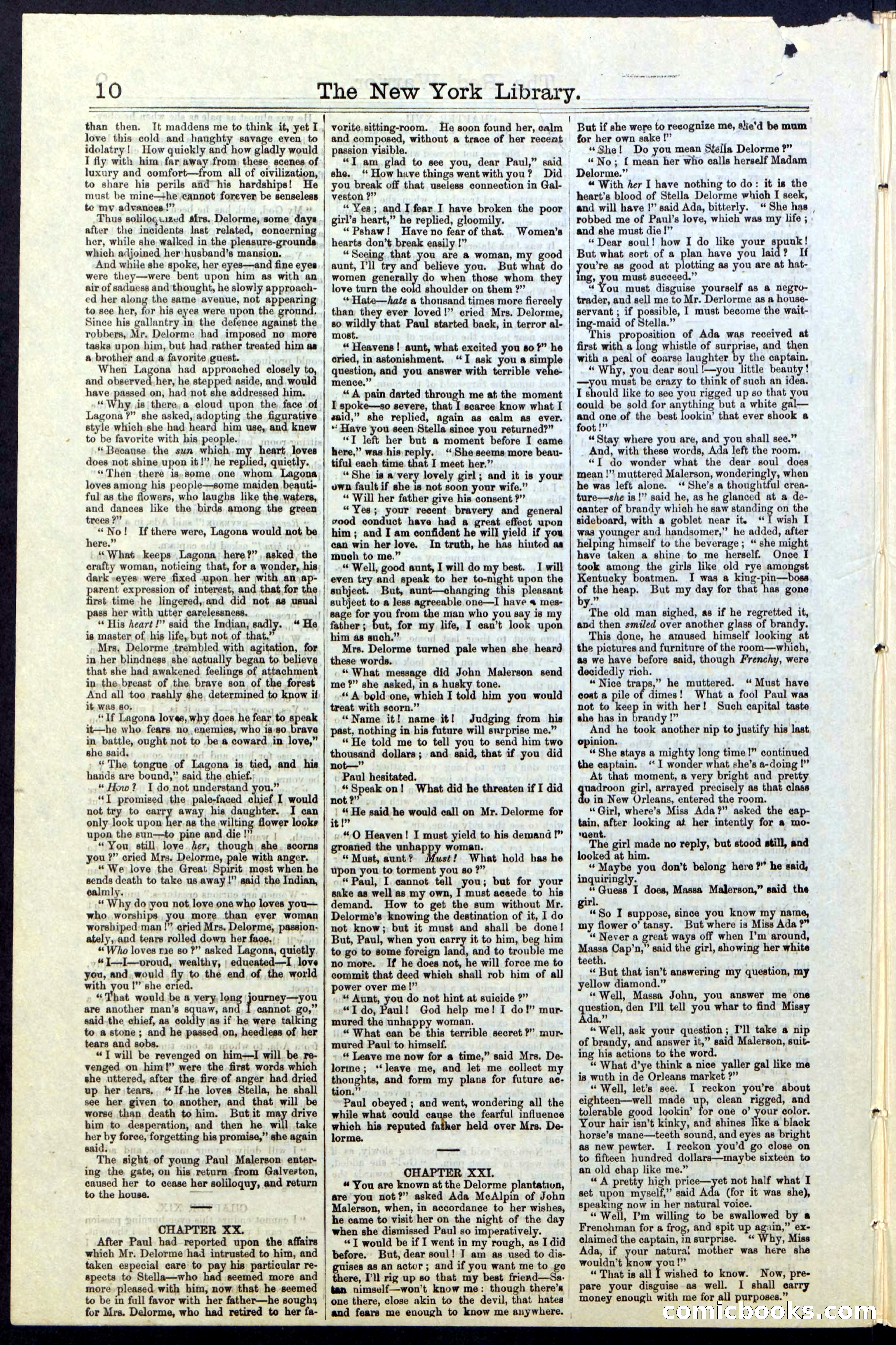
A restored page from Pulp Fiction, 1877. Page through the whole issue in the reader above.
📄 Transcribed text from this page (OCR, searchable)
Machine-transcribed from the original scan — historical spelling and the odd misread are preserved.
ore | , . . . | than then. It maddens me to think it, yet I) vorite.sitting-room. He soon found her, calm love this cold and hanghty savage even to idolatry! _ How quickly and how gladly would I fly with him far away from, these scenes of luxury and comfort—from all of civilization, to share his perils and hie hardships! He must be mine—he cannot forever be senseless te mv advances!” . Thus solilog.azed airs. Delorme, some days after the incidents last related, concerning her, while she walked in the pleasure-grounds which adjoined her husband’s mansion. And while she spoke, her eyes—and fine eyes were they—were bent upon him as with an air of saduess and thought, he slowly approach- ed her along the same avenue, not appearin to see her, for his eyes were upon the ground, Since his gallantry im the defence against the robbers, Mr. Delorme had imposed no more tasks upon him, but had rather treated him as a brother and a favorite guest. When Lagona had approached closely to, and observed. her, he stepped aside, and woul have passed on, had not she addressed him. ‘ Why is there,a cloud upon the, face of Lagona ?” she asked, adopting the figurative style which she had heard him use, and knew to be favorite with his. people. * Becanse the sun which. my heart, loves does not shine upon it!” he replied, quietly. “Then there is.some one whom Lagona loves among his people—some maiden beauti- ful as the flowers, who laughs like the waters, and dances like the birds among the green trees ?” ) “No! Ifthere were, Lagona would not be here.” “What keeps Lagona’ here?” asked. the crafty woman, noticing that, for a wonder, his dark »eyes were fixed pon. her with an ap- rag expression of interest, and that for the rst time he lingered, and did not as usual pass her with utter carelessness, “His heart!’ said the Indian, sadly. “ He is master of his life, but not of that.’ Mrs, Delorme trembled with agitation, for in her blindness she actually began to believe that she had awakened feelings of attachment in. the. breast of the brave son of the forest And all too rashly she determined to know if it WAS 80, ei J ene | “If Lagona loves, why does he fear to speak it—he who fears no enemies, who isso. brave in battle, ought not to be a coward, in love,” she said, | . “The tongue of Lagona is tied, and his hands are bound,” said the chief. “ How? I do not understand you.” “I promised the pale-faced chief I would not try to carry away his daughter. I can only look upon her.as the wilting flower looke upon the sun—to pine anddie!”, ; “You still, love her, though she. scorns you ?” eried Mrs. Delorme, pale with anger. “We love the Great Spirit most when he sends death to take us away!” said the Indi calmly. “Why do you not love one who loves you— who worships you more than ever woman worshiped man !” cried Mrs. Delorme, passion- ately, and tears rolled down her face,,, |; “Who loves me so ?”’ asked Lagona, quietly. .“T—I—oroud, wealthy, | educated—I_ love you, and would fly to the end of the world with you !” she cried. “That would be a very, long ourney—you are another man’s squaw, an cannot. go,” said.the chief, as coldly as if he were talking to a stone; and he passed on, heedless of her tears and sobs. nig tay Reree ar yr “TJ will be revenged on him+I will be re- ven on him!” were the first words which she uttered, after the fire of anger had dried up her tears, “If he loves Stella, he shall see her given to another, and that will be worse than death tohim. But it may drive him to desperation, and then he will take ur by force, forgetting his promise,” she again The sight of young Paul Malerson enter- ing the gate, on his return from Galverton, caused her to cease her soliloquy, and return to the house. am CHAPTER XX. After Paul had reported upon the affairs — Mr. esa had sore to ee and en especial care to pay his particular re- spects 16 Bicllensavhe ed anaieg more and more pleased with him, now that he seemed — to be in fall favor with her father—he sough3 — for Mrs. Delorme, who had retired to her fa- The New York Library. and composed, without a trace of her recent passion visible. | pas am glad to see you, dear Paul,” said she. veston ?” “ Yes; and I fear I have broken the poor girl’s heart,” he replied, gloomily. “Pshaw! Have no fear of that. Women’s hearts don’t break easily !” “ Seeing that gon are & woman, my good aunt, I'll try and believe you. But what do women generally do when those whom they love turn the cold shoulder on them ?” “Hate—hate a thousand times more fiercely than they ever loved!” cried Mrs. Delorme, so wildly that Paul started back, in terror al- most. “ Heavens! aunt, what excited you so?” he cried, in astonishment. “I ask you a simple question, and you answer with terrible om mence.” “A pain darted through me at the moment I ee severe, that I scarce know what I aaid,” she replied, again as calm as ever. “ Have you seen Stella since you returned?” ‘“T left her but a moment before I came here,” was his reply. ‘She seems more beau- tiful each time that I meet her.” “She is a very lovely girl; and it is your uwn fault if she is not soon your wife.” “Will her father give his consent ?” “Yes; your recent bravery and general rood conduct have had a great effect upon him ; and I am confident he will yield if you can win her love. In truth, he has hinted as much to me.” “ Well, good aunt, I will do my best. I will even try and speak to her to-night upon the subject. But, aunt—changing this pleasant subject to a less agreeable one—I have 4 mes- ‘| sage for you from the man who you say is my father; but, for my life, I can’t look upon him as such.” Mrs. Delorme turned pale when she heard these words. “What message did John Malerson send me ?” she asked, in a ny tone. ‘A bold one, which I told him you would treat with scorn.” “Name it! name it! Judging from his past, nothing in his future will surprise me.” “He told me to tell you to send him two thousand dollars; and said, that if you did not—” Paul hesitated. “ Speak on! What did he threaten if I did not?” . _ said he would call on Mr. Delorme for it : . “O Heaven! I must yield to his demand |” groaned the weeny woman. “ Must, aunt ? ust! What hold has he upon you to torment you so ?” “Paul, I cannot tell you; but for your sake as well as my own, I must aceede to his demand. How to get the sum without Mr. Delorme’s knowing the destination of it, I do not know; but it must and shall be done! But, Paul, when you carry it to him, beg him to go to some foreign and to trouble me no more. If he does not, he will force me to commit that deed which shall rob him of all _ power over me!” * Aunt, you do not hint at suicide ?” “T do, Paul! God help me! I do!” mur- mured the unhappy woman. “ What can be this terrible secret ?” mur- mured Paul to himself. “ Leave me now for a time,” said Mrs. De- lorme ; *‘ leave me, and let me collect my thoughts, and form my plane for future ac- tion.” Paul obeyed ; and went, wondering all the while what could cause the fearful influence e his reputed father held over Mrs. De- orme. CHAPTER XXI. “ You are known at the Delorme plantatiun, are you not?” asked Ada McAlpin of John Malerson, when, in accordance to her wishes, he came to visit her on the night of the day when she dismissed Paul so imperatively. “TI would be if I went in my rough, as I did before. But, dear soul! I am as used to dis- ises as an actor; and if you want me to go ere, Pll rig up so that my best hiaiate tan nimself—won't know me: though there’s one there, close akin to the devil, that hates and fears me enough to know me anywhere. | “‘ How have things went with you? Did— you break off that useless connection in Gal- : | heart’s blood of Stella Delorme which I seek, But if she were to recognize me, she’d be mum for her own sake !” “She! Do you mean Stella Delorme ?” “No; { mean her who calls herself Madam Delorme.” “ With her I have nothing to do: it is the “ She has and will have |!’ said Ada, bitterly. robbed me of Paul’s love, which was my life ; | and she must die!” “Dear soul! how I do like your spunk! But what sort of a pian have you laid? If ou’re as good at plotting as you are at hat- ing, you must succeed.” “You must disguise yourself as a negro- trader, and sell me to Mr. Derlorme as a house- servant ; if possible, I must become the wait- ing-maid of Stella.” his proposition of Ada was received at first with a aa whistle of surprise, and then with a peal of coarse laughter by the captain. “ Why, you dear soul !—you little beauty! —you must be crazy to think of such an idea. I dhodid like to see you rigged up so that you could be sold for anything but a white gal— and one of the best lookin’ that ever shook a foot !” “Stay where you are, and you shall see.” And, with these words, Ada left the room. “I do wonder what the dear soul does mean !”’ muttered Malerson, wonderingly, when he was left alone. “ She’s a thoughtful crea- ture—she is!” said he, as he glanced at a de- canter of brandy which he saw standing on the sideboard, with a goblet near it, “I wish I was younger and handsomer,” he added, after helping himself to the beverage; “ she might have taken a shine to me herself. Once I took among the girls like old rye amongst Kentucky boatmen. I was a king-pin—boss ra the heap. But my day for that has gone The old man sighed, as if he regretted it, apd then smiled over another glass of brandy. This done, he armused himself looking at the pictures and furniture of the room—which, as we have before said, though Frenchy, were decidedly rich. “Nice traps,” he muttered. “ Must have cost a pile of dimes! What a fool Paul was not to keep in with her! Such capital taste she has in brandy !” And he took another nip to justify his last opinion. “She stays a mighty long time!” continued the captain. “1 wonder what she’s a-doing !” At that moment, a very nit and pretty uadroon girl, arrayed precisely as that class a in New Orleans, entered the room. “Girl, where’s Miss Ada?” asked the eap- tain, after looking at her intently for a mo- ‘aent. The girl made no reply, but stood still, and looked at him. , “ Maybe you don’t belong here ?” he said, inquiringly. “ Guess I does, Massa Malerson,” said the girl. “So I suppose, since you know my name, my flower o’ tansy. But where is Miss Ada ” “ Never a great ways off when I’m around, Massa Cap’n,” said the girl, showing her white teeth. “ But that isn’t answering my question, my yellow diamond.” ‘Well, Massa John, you answer me one uestion, den I’ll tell you whar to find Missy da.”’ “Well, ask your question; I'll take a nip of brandy, and answer it,” said Malerson, suit- ing his actions to the word. | “ What d’ye think a nice yaller gal like me is wuth in de Orleans market ?” “ Well, let’s see. I reckon you're about po fo homme made up, clean rigged, and tolerable good lookin’ for one o’ your color. Your hair isn’t kinky, and shines lke a black horse’s mane—teeth sound, and eyes as bright as new pewter. I reckon you'd go close on to fifteen hundred dollars—maybe sixteen to an old chap like me.” “A pretty high price—yet not half what I set upon myself,” said Ada (for it was she), speaking now in her natural voice. “Well, I’m willing to be swallowed by a Frenchman for a frog, and spit up sain, ex- claimed the captain, insurprise. ‘“ Why, Miss Ada, if your natural mother was here she wouldn’t know you!” “ That is all I wished to know. Now, pre- pare your disguise as well. I shall money enough with me for all rene Gomicdvoed cS (E(0) mil)