
Pulp Fiction, 1882 · page 6 of 32
Beadle's Dime Library No. 211 — page 6: what you’re looking at
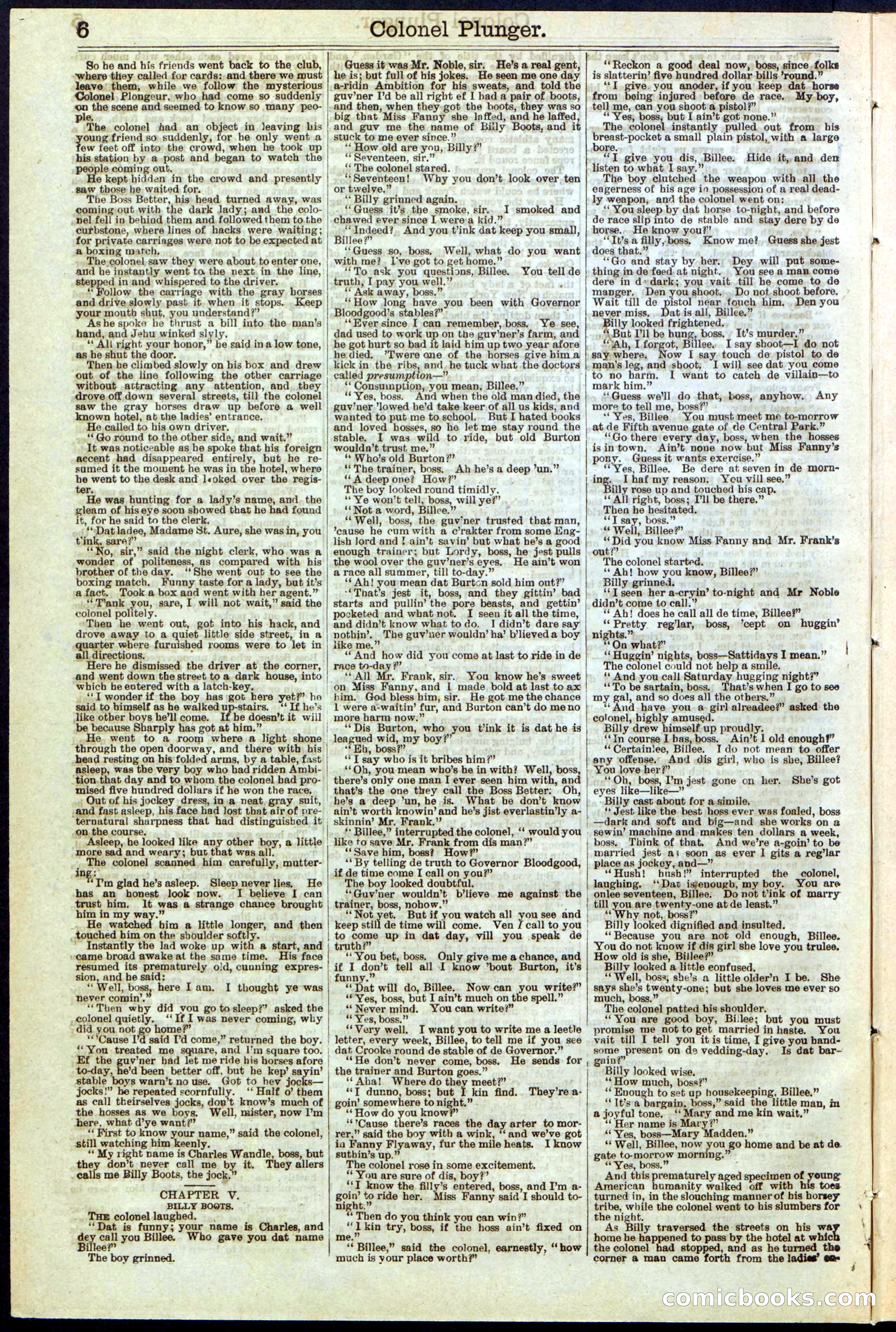
A restored page from Pulp Fiction, 1882. Page through the whole issue in the reader above.
📄 Transcribed text from this page (OCR, searchable)
Machine-transcribed from the original scan — historical spelling and the odd misread are preserved.
So he and his friends went back to the club, where they called for cards: and there we must leave’ them, while we follow the mysterious Colonel Plongeur, who had come so suddenly on the scene and seemed to know so many peo- le, “4 The colonel had an object in leaving his oung friend so suddenly, for he only went a ew feet off into the crowd, when he took up his station by a post and began to watch the people coming out. e kept hidden in the crowd and presently saw those he waited for. The Boss Better, his head. turned away, was coming out with the dark Jady; and the colo- | _nel fell in behind them and followed them to.the | curbstone, where lines of hacks were waiting; for private carriages were not to be expected at a boxing match, The.colonel. saw they were about to enter one, | ard he instantly went toa. the next in the line, stepped in and whispered to the driver. “Follow the carriage with the gray borses and drive slowly past. it. when it stops. Keep your mouth shut, you understand?” Ashe spoke he thrust a bill into the man’s hand, ain Jehu winked slyly, ‘** All right your honor,” be said ina low tone, as be shut the door. Then he climbed slowly on his box and drew out of the line following the other carriage without attracting any attention, and. they ve off down several streets, till the colonel saw the gray horses draw up before a well known hotel, at the ladies’ entrance. He called to his own driver. | ‘‘Go round to the other side, and wait.” It was noticeable as be spoke that his foreign accent had disappeared entirely, but he re- sumed it the mowent he was in the hotel, where he went to the desk and l«oked over the regis- ter. He was hunting for a lady’s name, and the gleam of his eye soon showed that he had found it, for he said to the clerk, ‘Dat ladee, Madame St. Aure, she wasin, you tink, sare?” ‘No, sir,” said the night clerk, who was a wonder of politeness, as compared with his brother of the day. ‘She went out to see the boxing match. Funny taste for a lady, but it’s afact. Took a box and went with her agent.” ‘Tank you, sare, I will not wait,” said the colonel politely. ‘Then he went out, got into his hack, and drove away to a quiet little side street, in a ter where furnished rooms were to let in all directi ns a te) . Here he dismissed the driver at the corner, and went down the street to a dark house, into which he entered with a latch-key. _ ‘I wonder if the boy has got here yet?’ hoe said to himself as he walked ppapaine. ‘If he’s like otber boys he’ll come. If he doesn’t it will be because Sharply has got at him.” | _He. went to a room where a light shone through the open doorway, and there with his head resting on his folded arms, by a table, fast ‘asleep, was the very boy who had ridden Ambi- _tion.that day and to whom the colonel bad pro- mised five hundred dollars if he won the race, , Out of his jockey dress, ina neat. gray suit, ; fast asleep, his face had lost that air of pre- ternatural sharpness that had distinguished it | Bape course. r sleep, he looked like any other boy, a little | more sad and weary; but that was all. The colonel scanned him carefully, mutter- Em glad he’s asleep. Sleep never lies, He an honest look now. I believe I can ust him. It was a strange chance brought my way.” . He wat tog bim a little longer, and then touched him on the sboulder softly. Instantly the lad woke up with a start, and came broad awake at the same time. His face resumed its prematurely o!d, cuuning expres- sion, and he said: * Well, boss, here Lam. I thought ye was never comin’. “Then why did vou gotosleep?”’ asked the _colonel quietly, ‘‘If I was never coming, why -did you not go home?’ —— ‘**Cause I’d said [’'d come,” returned the boy. ” von treated me re, and I’m square too. | | e | gor net had let me ride his horses afore to-day, he’d been better off, but he kep’ sayin’ stable ‘boys warn’t no use. Got to hev jocks— jocks!” he repeated scornfully. ‘‘ Half o’ them as call theirselves jocks, don’t know’s much of the hosses as we boys. Well, mister, now I’m here, what d’ye want?” ‘“‘ Kirst to know your name,” said the colonel, still watching him keenly. “My right name is Charles Wandle, boss, but they don’t never call me by it, They allers calls me Billy Boots, the jock,” CHAPTER V. BILLY BOOTS. — we cD colonel laughed. “Dat is funny; your name is Charles, and | , ger Sor you Billee. Who gave you dat name | The boy grinned. Colonel Plunger. | Guess it was Mr. Noble, sir. He’s a real gent, | he is; but full of his jokes. He seen me one day e a-ridin Ambition for his sweats, and told the guv’ner I’d be all right ef I had a pair of boots, and then, when they got the boots, they was so big that Miss Fanny she laffed, and he laffed, and guy me the name of Biily Boots, and it stuck to me ever since.” ‘‘ How old are you, Billy?” ** Seventeen, sir.” ‘* The colonel stared. “Seventeen! Why you don’t look over. ten or twelve,” ‘“ Billy grinned again. *‘Guess it’s the smoke, sir.. I smoked and chawed ever since IL wereva kid.” ‘Indeed? And you t’ink dat keep you smal), Billee?”’ ‘‘Guess so, boss, Well, what do you want with me? lve got to get home.” ‘*To ask you questions, Billee. You tell de truth, I pay you well.” : ** Ask away, boss.” “‘How Jong have you been with Governor Bloodgood’s stables?” | ‘*Ever since I can remember, boss, Ye see, dad used to work up on the guy’ner’s farm, and he got burt so bad it laid bim up two year afore he died. *Twere one of the horses give hima kick in the ribs, and, he tuck what the doctors called presumption—” ** Consumption, you mean, Billee.” **'Yes, boss. And when the old man died, the | guv’ner ‘lowed he’d take keer of all us kids, and wanted to put me to school. But I hated books | and loved hosses, so he let me stay round the | stable. I was wild to ride, but old Burton wouldn’t trust me.” ** Who’s old Burton?’ ‘The trainer, boss. Ah he’s a deep ’un.” ‘* A deep one? How?” The boy looked round timidly. ‘Ye won’t tell, boss, will ye?’ ‘‘ Not a word, Billee.” ‘Well, boss, the guv’ner trusted that man, ’cause he cum with a c’rakter from some Eng- lish Jord and [ ain’t savin’ but what he’s a good enough trainer; but Lordy, boss, he jest pulls the wool over the guv’ner’s eyes. He ain’t won a race all summer, till to-day.” ‘* Ah! you mean dat Burton sold him out?’ “*That’s jest it, boss, and they gittin’ bad starts and pullin’ the pore beasts, and gettin’ | pocketed and what not. I seen it all the time, and didn’t know what todo. I didn’t dare say The guv’ner wouldn’ ha’ b’lieved a boy race to-day ?”’ ** All . Frank, sir. You know he’s sweet on. Miss Fanny, and | made bold at last to ax him. God bless him, sir. He got me the chance 1 were a-waitin’ fur, and Burton can’t do meno _ more harm now.” ‘*Dis Burton, who you tink it is dat he is leagued wid, my boy?” ** Eh, boss?” , ‘TI say who is it bribes him?’ ‘Oh, you mean who’s he in with? Well, boss there’s only one man I ever seen him with, and that’s the one they call the Boss Better: Oh, | he’s a deep ’un, he is. What he don’t know ain’t worth knowin’ and he’s jist everlastin’ly a- skinnin’ Mr. Frank.” * Billee,” interrupted the colonel, ‘‘ would you like to save Mr, Frank from dis man?” ‘*Save him, boss? How?” ‘* By telling de truth to Governor Bloodgood, if de time come I call on you?” The boy looked doubtful. ““Guy’ner wouldn’t b’lieve me against the | trainer, boss, nohow.” “Not yet. But if you watch all you see and | keep still de time will come. Ven / call to you | to come up in dat day, vill you speak de | truth?’ ‘‘ You bet, boss. Only give me a chance, and if I don’t tell all I know "bout Burton, it’s funny.” | } “Dat will do, Billee.. Now can you write?” ‘Yes, boss, but I ain’t much on the spell.” “Never mind. You can write?” “Yes, boss.” y well, I want you to write me a leetle EEE | letter, every week, gard to tell me if you see dat Crooke round de stable of de Governor.” ‘“*He don’t never come, boss, the trainer and Burton goes.” ‘* Aha! Where do they meet?” ‘*T dunno, boss; but 4 kin find. They’re a- | goin’ somewhere to night.” ‘* How do te know?” ‘*’Cause there’s races the day arter to mor- rer,” said the boy with a wink, ‘‘and we’ve got ia Fanny Flyaway, fur the mile heats. I know suthin’s up. The colonel rose in some excitement. ** You are sure of dis, boy?” **T know the filly’s entered, boss, and I’m a- face ride her. Miss Fanny said I should to- night. *“* Then do you think you can win?” i kin try, boss, if the hoss ain’t fixed on me, ‘* Billee,” said the colonel, earnestly, ‘how much is your place worth?” Sj He sends for , **Reckon a good deal now, boss, since, folke is slatterin’ five hundred dollar bills ’round.” “I give. you anoder, if you keep dat horse from being injured before de race. My boy, tell me, can you shoot a pistol?” ** Yes, boss, but I ain’t got none.” The colonel instantly pulled out. from his emg Spee a small plain pistol, with a large re. “TI give you dis, Billee. Hide it, and den listen to what I say.” The boy clutched the weapon with all the eagerness of his age in possession of a real dead- ly weapon, and the colonel went on: ‘‘ You sleep by dat horse to-night, and before de race slip into de stable and stay dere by de horse.. He know you?” ‘“‘Tt’s a filly, boss, Know me? Guess she jest does that.” ; “Go and stay by her. Dey will put some- thing in de feed. at night. You see a man.come dere in d» dark; you vait till he come to de Sa manger. Den you shoot... Do not. shoot before. Wait till de pistol near touch him, . Den you | never miss. Dat is all, Billee,” illy looked frightened, .* But [ll be hung, boss, It’s murder,” ‘“Ah, I forgot, Billee.. I say shoot—I do not say where. Now I say touch de pistol to de man’s leg, and shoot, I will see dat you come to no harm. I want to catch de villain—to mark him.” ‘‘Guess we'll do that, boss, amyhow. Any more to tell me, boss?’ ‘Yes, Billee You must meet me to-morrow at de Fifth avenue gate of de Central Park.” “Go there every day, boss, when the hosses isintown. Ain’t none now but Miss Fanny’s pony. Guess it wants exercise.” ‘Yes, Billee. Be dere at seven in de morn- ing I haf my reason. Ycu vill see,” illy rose up and touched his cap. | ‘* All right, boss; Pll be there.” | Then he hesitated. **T say, boss.” “ Well, Billee?” “Did you know Miss Fanny and Mr. Frank's out?” The colonel started, ‘* Ah! how you know, Billee?” Billy grinned. ‘‘T seen her a-cryin’ to-night and Mr Noble didn’t come to call.” ‘* Ah! does he call all de time, Billee?”’ ‘Pretty reg’lar, boss, ’cept on huggin’ nights.” ‘On what?” ‘‘ Huggin’ nights, boss—Sattidays I mean.” e colonel could not help a smile. ‘* And you call Saturday hugging night?” ‘To be sartain, boss. That’s when I go to see my gal, and so does all the others.” ‘‘And have you a girl alreadee?” asked the colonel, highly amused. Billy drew himself up proudly. ‘‘In course I bas, boss. Ain’t 1 old enough?” ‘“‘Certainlee, Billee. I do not mean to offer any Offense. And dis girl, who is she, Billee? You love her?” ‘*Oh, boss, ’m jest gone on her. She’s got eyes like—like—” Billy cast about for a simile. '* Jest like the best hoss ever was foaled, boss —dark and soft and big—and she works on a sewin’ machine and. makes ten dollars a week, boss, Think of that. And we’re a-goin’ to be married jest a; soon as ever I gits a reg’lar place as jockey, and—” “Hush! hush!” interrupted the colonel, laughing. ‘‘Dat isjenougb, my boy. You are onlee seventeen, Billee. Do not t’?ink of marry till you. are twenty-one at de least.” ‘*Why not, boss?” Billy looked dignified and insulted. ‘‘Because you are not old enough, Billee. ‘You do not know if dis girl she love you trulee. How old is she, Billee?” Billy looked a little eonfused. ‘* Well, boss; she’s a little older’n I be. She says she’s twenty-one; but she loves me ever so much, boss.” The colonel patted his shoulder, ‘You are good boy, Billee; but you must promise me not to get married in haste. You vait till I tell yon itis time, I give you band- ete proeus on de vedding-day. Is dat bar- gain Billy looked wise, ‘* How much, boss?” , “Enough to set up housekeeping, Billee,” ‘ It's ‘helical boss,” said the little man, m a joyful tone. ‘‘Mary and me kin wait,” ‘‘ Her name is Mary?” ‘Yes, boss—Ma adden.” , ‘¢ Well, Billee, now you go home and be at de gate to-morrow mo ng.” ‘ PRL Si Ae fic specimen of n s prematurely aged imen oung American Se atialee walked off with his toes turned in, in the slouching manner of his horsey pape wie the colonel went to his slumbers for the night. As Billy traversed the streets on his wa home he happened to pass by the hotel at whi the colonel stopped, and as he turned the corner @ man came forth from the ladies’ ea- JOO (ECO) m (SC ‘SiGO