
Pulp Fiction, 1882 · page 5 of 32
Beadle's Dime Library No. 211 — page 5: what you’re looking at
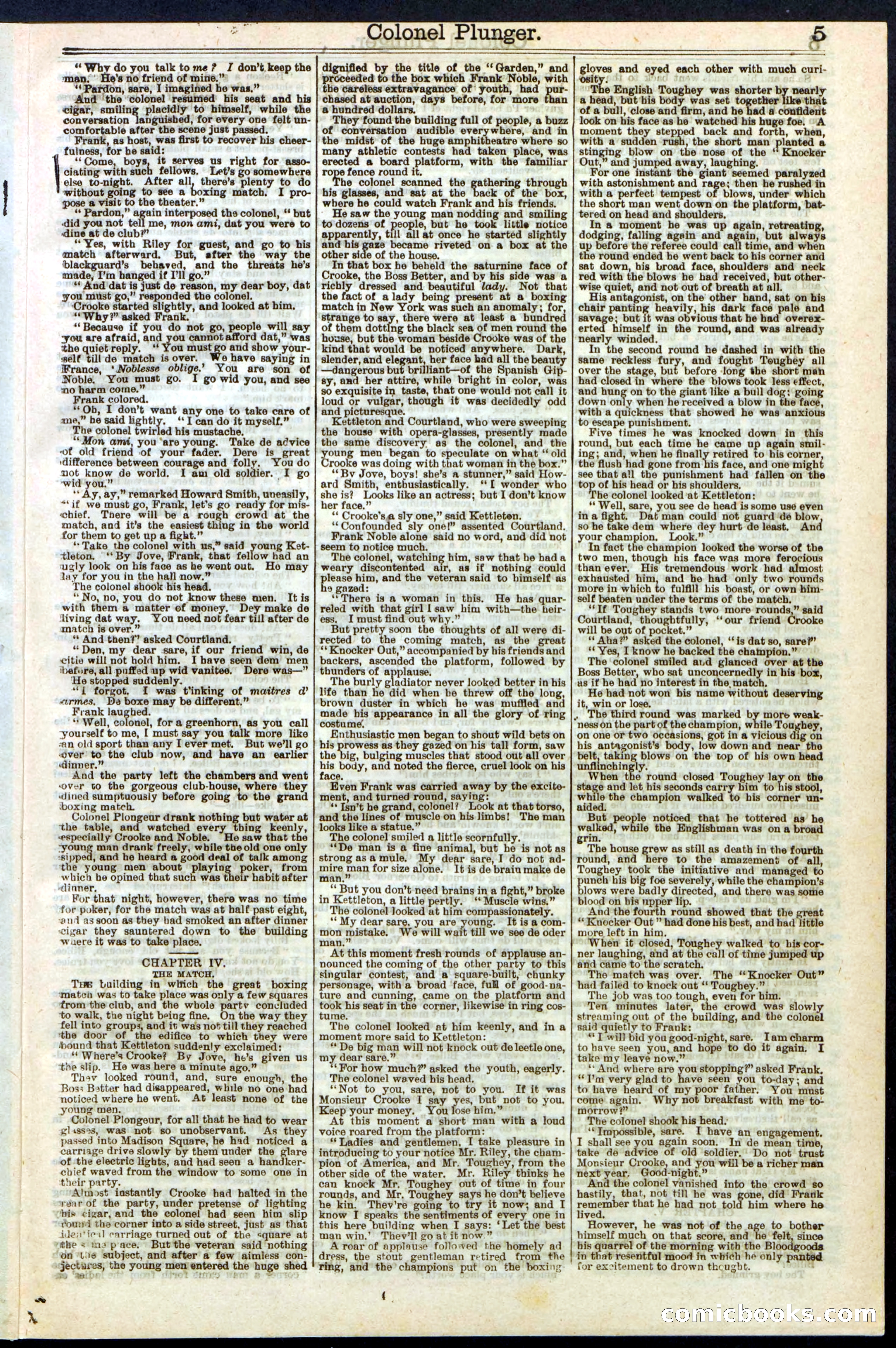
A restored page from Pulp Fiction, 1882. Page through the whole issue in the reader above.
📄 Transcribed text from this page (OCR, searchable)
Machine-transcribed from the original scan — historical spelling and the odd misread are preserved.
a “Why do you talk tome? I don’t keep the man. He's no friend of mine.” ‘* Pardon, sare, I imagined he was,” And ‘the ‘colonel resumed his seat and his cigar, sere placidly to himself, while the conversation languished, for every one felt un- comfortable after the scene just passed. Frank, as host, was first to recover his cheer- fulness, for be said: ‘“‘Come, boys, it serves us right for asso- ciating with such fellows. Let's go somewhere else to-night. After all, there’s plenty to do ‘without going to see a boxing match. I pro- pose a visit to the theater.” ‘* Pardon,” again interposed ths colonel, “ but did you not tell me, mon ami, dat you were to dine at de club?” “Yes, with Riley for guest, and go to his amatch afterward. But, after the way the ‘blackguard’s behaved, and the threats he’s made, I’m hanged if I'll go.” “ And dat is just do reason, my dear boy, dat ‘you must go,” responded the colonel. ‘Crooke started slightly, and looked at him, “Why?” asked Frank. ‘Because if you do not go, people will say ‘you are afraid, and you cannot afford dat,” was the quiet reply. ‘* You must go and show your- self tillde match is over. 6 have saying in France, ‘Noblesse oblige.’ You are son of Noble. You must go. I go wid you, and see no harm come.” Frank colored. “Ob, I don’t want any one to take care of me,” be said lightly. ‘I can do it myself.” The colonel twirled his mustache. ‘“*Mon ami, you ‘are young. Take de advice of old friend of your fader. Dere is great difference between courage and folly. You do mot know de world. I am old soldier. I go ‘wid you.” ‘* Ay, ay,” remarked Howard Smith, uneasily, “if we must go, Frank, let’s go ready for mis- whief. There will be a rough crowd at the match, and it’s the easiest thing in the world for them to get up a fight.” ‘Take the colonel with us,” said young Ket- ‘tleton. ‘“* By Jove, Frank, that fellow had an ugly look on his face as he went out. Hoe may lay for you in the hall now.” The colonel shook his head. “No, no, you do not know these men. It is with them a matter of money. Dey make de living dat way. You need not fear till after de match is over.” ** And then?” asked Courtland. “Den, my dear sare, if our friend win, de cities will not hold him. I have seen dem men ‘before, all puffed up wid vanitee. Dere was—” ‘He stopped suddenly. “1 forgot. I was t‘inking of maitres d’ <trmes, Dea boxe may be different.” - Frank laughed. ‘** Well, colonel, for a greenhorn, as you call yourself to me, [ must say you talk more like -an old sport than any Tever met. But we'll go ver to the club now, and have an earlier dinner,” And the party left the chambers and went over to the gorgeous club-house, where they dined sumptuously before going to the grand ‘boxing match. Colonel Plongeur drank ee | but water at ‘the table, and watched every thing keenly, especially Crooke and Noble. He saw that the ‘young man drank freely, while the old one only ‘sipped, and he heard a good deal of talk among ‘the young men about playin peo from which be opined that such was their habit after dinner, For that night, however, there was no time for poker, for the match was at half past eight, | ‘aud as soon as they bad smoked an after dinner cigar they sauntered down to the building wuere it was to take place. CHAPTER IV. THE MATCH, Tre building in which the great boxing ‘match was to take place was only a few squares trom the club, and the whole partv concluded to walk, the night being fine. On the way they fell into groups, and it was not till they reached ‘the door of the edifice to which they were ‘ound that Kettleton suddenly exclaimed: ‘* Where’s Crooke? By Jove, he’s given us the slip. He was here a minute ago.” Thoav looked round, and, sure enough, the Boss Batter had disappeared, while no one had noticed where he went. At least none of the young men. Colonel Plongeur, for all that he had to wear glasses, was not so unobservant. As they passed into Madison Square, he had noticed a carriage drive slowly by them under the glare of the electric lights, and had seen a handker- cbief waved from the window to some one in their party. Almost instantly Crooke had balted in the rear of the party, under pretense of lighting ‘bis cigar, and the colonel had seen him slip ‘oud the corner into a side street, just as that idej;*iesl carriage turned out of the square at ‘the s tao pace, But the veteran said nothing on ‘Las subject, and after a few aimless con- “jectures, the young men entered the huge shed obey | Colonel Plunger. dignified by the title of the ‘‘Garden,” and preceeded to the box which Frank Noble, with the careless extravagance of’ youth, had - chased at auction, days before, for more @ hundred dollars. ; They found the building full of people, a buzz of conversation audible everywhere, and in the midst of the huge amphitheatre where so many athletic contests had taken place, was erected a board platform, with the familiar rope fence round it. he colonel scanned the gathering through his glasses, and sat at the back of the box, where he could watch Frank and his friends. He saw the young man nodding and smiling to dozens of people, but he took little notice apparently, till all at once he started slightly and his gaze became riveted on a box at the other side of the house. In that box he beheld the saturnine face of Crooke, the Boss Better, and by his side was a mf dressed and beautiful lady. Not that the fact of alady being present at a boxing match in New York was such an anomaly; for strange to re there were at least a hundred of them dotting the black sea of men round the house, but the woman beside Crooke was of the kind that would be noticed anywhere. Dark, slender, and elegant, her face had all the beauty —dangerous but brilliant—of the Spanish Gip- sy, and her attire, while bright in color, was so exquisite in taste, that one would not call it loud or vulgar, though it was decidedly odd and picturesque. Kettleton and Courtland, who were sweeping the house with opera-glasses, presently made the same discovery as the colonel, and the boi men began to speculate on what “ old rooke was doing with that woman in the box.” “*By Jove, boys! she’s a stunner,” said How- ard Smith, enthusiastically. ‘I wonder who she is? Looks like an actress; but I don’t know her face.” ‘** Crooke’sa sly one,” said Kettleten. ‘*Confounded sly one!” assented Courtland. Frank Noble alone said no word, and did not seem to notice much. The colonel, watching him, saw that he hada weary discontented air, as if nothing could pa him, and the veteran said to bimself as 9 gazed: ‘*There is a woman in this. He has quar- reled with that girl saw him with—the heir- ess. I must find out why.” But pretty soon the thoughts of all were di- rected to the coming match, as the great ‘**Knocker Out,” accompanied by his friends and backers, ascended the platform, followed by thunders of applause. The burly gladiator never looked better in his life than he did when be threw off the long, brown duster in which he was muffled and made bis appearance in all the glory of ring costume, Enthusiastic men began to shout wild bets on his rye as they gazed on his tall form, saw the big, bulging muscles that stood out all over his body, and noted the flerce, cruel look on his face. Even Frank was carried away by the excite- ment, and turned round, saying: ‘** Isn’t he grand, colonel? Look at that torso, and the lines of muscle on his limbs! The man looks like a statue.” The colonel smiled a little scornfully. “De man is a fine animal, but he is not as strong as a mule, My pret sare, I do not ad- mire man for size alone. It is de brain make de man. _ “ But you don’t need brains in a fight,” broke in Kettleton, a little pertly. ‘Muscle wins,” The colonel looked at him compassionately. ‘* My dear sare, you are Foune. It is a com- mon mistake. e will wait till we see de oder man. At this moment fresh rounds of applause an- nounced the coming of the other party to this singular contest, and a square-built, chunky aang: sa with a broad face, full of good-na- ture and cunning, came on the platform and took his seat in the corner, likewise in ring cos- tume. The colonel looked at him keenly, and in a moment more said to Kettleton: * De big man will not knock out de leetle one, my dear sare.” * ‘For how much?” asked the youth, eagerly. The colonel waved his head. ‘“Not to you, sare, not to you. If it was Monsieur Crooke I say yes, but not to you. Keep your money. You lose him,” At this moment a short man with a loud voice roared from the platform: “Tadies and gentlemen, I take pleasure in introducing to your notice Mr. Riley, the cham- pion of America, and Mr. Toughey, from the other side of the water. Mr. Riley thinks he can knock Mr. Toughey out of time in four rounds, and Mr, Toughey says he don’t believe he kin. Thev’re going to try it now; and I know I gan the sentiments of every one in this here building when I says: ‘Let the best man win.’ Thev’ll go at it now.” A roar of applause followed the homely ad dress, the stout gentleman retired from the ring, and the’ champions put on the boxing { . The third round was marked b ness on the part of the champion, while Toughey, n . ? gloves and eyed each other with much curi- ‘The English Toughey was shorter p Mead a head, but his body was set me et ‘that of a bull, close and firm, and he had a confident look on his face as he watched his huge foe. A moment they step back and forth, when, with a sudden rush, the short man planted a stinging blow on tbe nose of the ‘ Knockeér Out,” and jumped away, laughing. For one instant the giant seemed paralyzed with astonishment and rage; then he rushed in with a perfect tempest of blows, under which the short man went down on the platform, bat- tered on head and shoulders, In a8 moment he was up again, retreating, dodging, falling again and Be pe! but always up before the referee could time, and when the round ended he went back to his corner and sat down, his broad face, shoulders and neck red with the blows he had received, but other- wise quiet, and not out of breath at all. His antagonist, on the other hand, sat on his chair panting heavily, his dark face pale and savage; but it was obvious that he had overex- erted himself in the round, and was already nearly winded. In the second round he dashed in with the same reckless fury, and fought Toughey all over the stage, but before long the short man had closed in where the blows took less effect, and hung on to the giant like a bull dog: going down only when he received a blow in the face, with a quickness that showed he was anxious to escape punishment. Five times he was knocked down in this round, but each time he came up again smil- ing; and, when he finally retired to his corner the flush had gone from his face, and one might see that all the punishment had fallen on the 4 4 of his head or his shoulders, he colonel looked ‘at Kettleton: ** Well, sare, you see de head is some use even in a fight. Dat man could not guard dé blow so he take dem where dey hurt de least. And your champion. Look.” In fact the champion looked the worse of the two men, though his face was more ferocious than ever. His tremendous work had almost exhausted him, and he had only two rounds more in which to fulfill his boast, or own him- self beaten under the terms of the match. ‘*If Toughey stands two more rounds,” said Courtland, thoughtfully, ‘‘our friend ke will be out of pocket.” ** Aha?” asked the colonel, “is dat so, sare?” ** Yes, I know he backed the champion.” The colonel smiled aud glanced over at the Boss Better, who sat ey oo nes 4 in his box, as if he had no interest in the match. : He had not won his name without deserving it, win or lose, more weak- on one or two occasions, got in a vicious oO his antagonist’s body, low down and near the belt ope blows on the top of his own head unflinchin y: When the round closed Toughey lay on the stage and let his seconds carry him to his stool, a os the champion walked to his corner un- But ee noticed that he tottered as he walked, while the Englishman was on a broad grin. The house grew as still as death in the fourth round, and here to the amazement of all, Toughey took the initiative and managed to oe his big foe severely, while the champion’s lows were badly directed, and there was sotiie blood on bis mpper lip. And the fourth round showed that the er “Kuocker Out ” had done his best, and had little more left in him. | Wa When it closed, Toughey walked to bis co ner laughing, and at the call of time jumped and came to the scratch. The match was over. The “Knocker Out” had failed to knock out “* Toughey.” » The job was too tough, even for him. Ten minutes later, the crowd was slow] streaming out of the building, and the colonel said quietly to Frank: “T will bid you good-night, sare. Iam charm to have seen you, and hope to do it again. I take my leave now.” ‘* And where are — stopping?” asked Frank. *“T’m very glad to have seen you to-day; and to have heard of my r father. You must come again. Why not breakfast with me to- morrow?” | The colonel shook his head. ; ‘“Tmpossible, sare. I have an engagement. I shall see you again soon. In de mean time, take de advice of old soldier.’ Do not trust Monsieur Crooke, and you will be a richer man next year. Good-night.” 4 And the colonel vanished into the crowd so hastily, that, not till he was gone, did Frank rene that he had not told him where he ved, However, he was not of the age to bother himself much on that score, and he felt, since bis quarrel of the morning with the Bl oods in that resentful mood in which he only panted for excitement to drown thcugbt. : MIC OOO KS COME (E()