
Pulp Fiction, 1882 · page 7 of 32
Beadle's Dime Library No. 211 — page 7: what you’re looking at
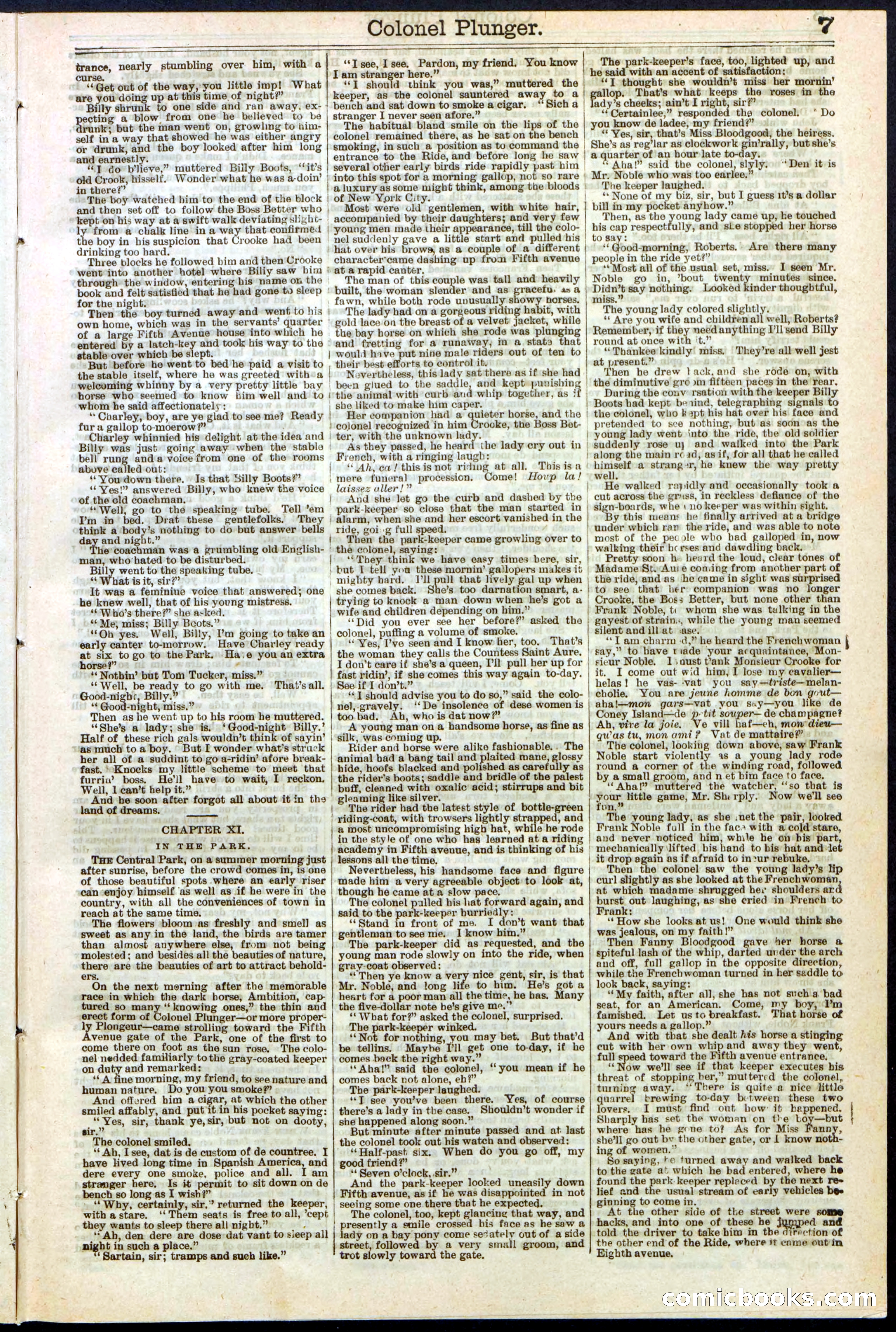
A restored page from Pulp Fiction, 1882. Page through the whole issue in the reader above.
📄 Transcribed text from this page (OCR, searchable)
Machine-transcribed from the original scan — historical spelling and the odd misread are preserved.
eet trance, nearly stumbling over him, with a curse. ‘¢Get out of the way, you little imp! What are you doing up at this time of night?” Billy shrunk to one side and ran away, ex- cting a blow from one he believed to be nk; but the man went on, growling to him- self in a way that showed he was either angry or ‘drunk, and the boy looked after him long and earnestly. “J do b’lieve,” muttered Billy Boots, ‘‘it’s oi] Crook, hisself. Wonder what he was a-doin’ in there?’ The boy watched him to the end of the block and then set off to follow the Boss Better who kept on his way at a swift walk deviating slight- ly from a chalk line in a way that confirmed the boy in bis suspicion that Crooke had been drinking too bard. Three blocks he followed bim and then’ Crooke went into another hotel where Biliy saw bir | through the window, entering bis name on the book and felt satisfied that he had gone tu sleep for the night. ' built, the woman slender and as Then the boy turned away and went to his | own home, which was in the servants’ quarter of a large Fifth Avenue house into which he entered by a latch-key and took his way to the stable over which be slept. But before he went to bed he paid a visit to | the stable itself, where he was greeted with a | welcoming whinny by a very pretty little bay horse who seemed to know him well and to whom he said affectionately: “Charley, boy, are ye glad to see me? Ready fur a gallop to-moerow?” , Charley whinnied his delight at the idea and Billy was just going away when the stable bell rung anda voice from one of the rooms above called out: ‘“Youdown there. Is that Silly Boots?” ‘‘Yes!” answered Billy, who knew the voice of the old coachman. ‘“ Well, go to the speaking tube. Tell ’em I’m in bed. Drat these gentlefolks. The think a body’s nothing to do but answer bel day and night.” e’coachman was a grumbling old English- | the colonel, saying: man, who hated to be disturbed. Billy went to the speaking tube. “What is it, sir?” It was a feminine voice that answered; one he knew well, that of his young mistress. ‘© Who’s there?” she asked. ‘* Me; miss; Billy Beots.” ‘Ob yes. early canter to-morrow. Have Charley ready at a go to the Park. Hae you an extra orse , ‘Nothin’ but Tom Tucker, miss.” Well, be ready to go with me. That’s all. Good-nighr, Billy. ‘Ge night, miss.” Then as he went up to his room he muttered. ‘‘She’s a lady; she is. ‘Good-night Billy.’ Half of these rich gals wouldn’t thin as much toa boy. But I wonder what's struck her all of a suddint to goa-ridin’ afore break- fast. Knocks my little scheme to meet that furrio’ boss. He'll have to wait, I reckon. Well, 1 can’t help it.” And he soon after forgot all about it in the land of dreams. CHAPTER XI. IN THE PARK. Tue Central Park, on a summer ere just after sunrise, before the crowd comes in, is one of those beautiful spots where an early riser can ‘enjoy himself ‘as well as if he were in the country, with all the conveniences of town in reach at the same time. The flowers bloom as freshly and smell] as sweet as any in the land, the birds are tamer than almost anywhere else, from not being molested; and besides all the beauties of nature, there are the beauties of art to attract behold- ers. On the next merning after the memorable race in which the dark borse, Ambition, cap- ‘knowing ones,” the thin and erect form of Colonel Plunger—or more proper- ly Plongeur—came strolling toward the Fifth venue gate of the Park, one of the first to anne ae — ae the sun rose. The colo- nel nedded familiarly tothe gray-coated k r on duty and remarked: aan o oT + e morning, my friend, to see nature and human nature, Do you you smoke?” And offered him a cigar, at which the other smiled affably, and put it in his pocket saying: _'' Yes, sir, thank ye, sir, but not on dooty, sir. The colonel smiled. ‘‘ Ah, I see, dat is de custom of de countree. I have lived long time in Spanish America, and dere every one smoke, police and all. [ am stranger here. Is it permit to sit down on de bench so long as I wish?” “Why, certainly, sir,” returned the keeper, i ‘‘Them seats is free to all, ’cept they wants to sleep there all night.” ¢ ‘*Ah, den dere are dose dat vant to sleep all night in such a place.” ‘Sartain, sir; tramps and such like.” } colonel recognized in him Well, Billy, ’'m going to take an | colonel, puffing a volume of smoke. | of sayin’ | silk, was coming up. \ trot slowly tow Colonel Plunger. 4 The park-keeper’s face, too, lighted up, and he said with an accent of satisfaction: “JT thought she wouldn’t miss her mornin’ lop. Tbat’s what keeps the roses in the ady’s cheeks; ain’t I right, sir?’ - ‘ ' re} a ‘“T see, I see, Pardon, my friend. You know I am stranger here.” ‘‘] should think you was,” muttered the keeper, as the colonel sauntered away to a bench and sat down to smoke a cigar. “Sicha stranger I never seen afore.” Certainlee,” responded the colonel. The habitual bland smile on the lips of the | you know de ladee, my friend?” colonel remained there, as he sat onthe bench | “ Yes, sir, that’s Miss Bloodgood, the heiress. smoking, in such a position as to command the | She’s as reg’lar as clockwork gin’rally, but she’s entrance to the Ride, and before long he saw | a quarter of an hour late ay. several other early birds ride rapidly past him | _‘“ Aha!” said the colonel, slyly. “Den it is into this spot for a morning gallop, not so rare | Mr. Noble who was too earlee. ; a luxury as some might think, among the bloods | The keeper laughed. | of New York City. ‘‘ None of my biz, sir, but I guess 1t’s a dollar Most were old gentlemen, with white hair, | bill my pocket anyhow.” accompanied by their daughters; and very few Then, as the young lady came up, ke touched young men made their appearance, till the colo- | his cap respectfully, and sLe stopped her horse nel suddenly gave a little start and pulled his | to say: hat over bis brows, as a couple of a different ‘‘@Qood-morning, Roberts.. Are there many character‘came dashing up from Fifth avenue | people in the ride yet?” at a rapid canter. ‘* Most all of the usual set, miss. I seen Mr. The man of this couple was tall and heavily | Noble go in, ’bout_ twenty minutes since. racefu. as a | Didn’tsay nothing. Looked kinder thougbtful, fawn, while both rode unusually showy horses. | miss.” The lady had on a gorgeous riding habit, with The young lady colored slightly. gold lace on the breast of a velvet jacket, while “ Are you wife and children all well, Roberts? the bay horse on which she rode was plunging | Remember, if mer. need anything I'll send Billy and fretting for a runaway; in a stata that | round at once with ‘t.” would have put nine male riders out of ten to “Thankee kindly’ miss. They’re all well jest their best efforts to control ib. at present.” ; Navertheless, this lady sat'there asifshe had | Then he drew | ack,and she rode on, with been glued to the saddle, and kept punishing | the diminutive gro »m fifteen paces in the rear. the animal with curb and whip together, as f | During the conv rsation with the keeper Billy she liked to make him caper. | Boots had kept benind, telegraphing signals to Her companion had a quieter horse, and the | the colonel, who k apt his hat over his face and rooke, the Boss Bet- pretended to sce nothing, but as soon as the young lady went into the ride, the old soldier suddenly rose uj and walked into the Park along the main rc ad, asif, for all that he called = ee a strang+r, he knew the way pretty well. He walked raj;idly and occasionally took a cut across the gruss, in reckless defiance of the sign-boards, whe 1 no keeper was within sight, By this means he finally arrived at a bridge under which ran the ride, and was able to note most of the pecole who bad galloped in, now walking their hc rses and dawdling back. Pretty soon h- hesrd the loud, clear tones of Madame St. Aue coning from another part of the ride, and as he came in sight was surprised to see that her companion was no longer Crooke, the Bos; Better, but none other than Frank Noble, ti whom she was tulking in the gayest of strain, while the young man seemed silent and ill at ase. “Yes, I’ve seen and I know her, too, That’s ‘*T am charm -d,” he heard the French woman the woman they calls the Countess Saint Aure. | say,” to have tiade your acquaintance, Mon- I don’t care if she’s a queen, I'll pull her up for | sicur Noble. 1; aust tank Monsieur Crooke for fast ridin’, if she comes this way again to-day. | it. I come out wid him, I lose my cavalier— See if I don’t.” helas! he vas- -vat you say—triste—melan- ‘«T should advise you to do so,” said the colo- | cholie. You are jeune homme de bon gout— nel,-gravely. ‘‘De insolence of dese women is | aha!—mon A ary pe you say—you like de too bad. Ab, who is dat now?” Coney Island—de p-tit sou de champagne? A young man on a handsome horse, as fine as | Ah, vive la joie. Ve vill haf—eh, mow diew— qwastu, monami? Vat de mattaire? The colonel, looking down above, saw Frank Noble start violently as a young lady rode round a corner of the winding road, followed by a small groom, and n et him face to face, “Aha!” muttered the watcher, ‘‘so that is roms little game, Mr. Sh: rply. Now we'll see on, ine The young may, as she .net the pair, looked Frank Noble full in the faca with a cold stare, and never noticed him, while he on bis p mechanically lifted his hand to bis hat and-le it drop again as if afraid to incur rebuke, © Then the colonel saw the young lady’s lip curl slightly as she looked at the Frenchwoman at which madame shrugged her shoulders ar burst out laughing, as she cried in French to an . ‘* How she looks at us! One would think she was jealous, on my faith!” | Then Fanny Bloodgood gave Aer horse a spiteful lash of the whip, darted urder the arch and off, full gallop in the opposite direction, while the Frenchwoman turned in her saddle to look back, saying: “My faith, after all, she has not such a bad seat, for an American. Come, my boy, I’m famished. Let us to breakfast. That horse of yours needs a gallop.” 713 : And with that she dealt his horse a stinging cut with her own whipand away they went, full toward the Fifth avenue entrance, “Now we'll see if that keeper executes bis threat of stopping her,” muttered the colonel, turning away. ‘There is quite a nice little quarrel brewing to-day between these two lovers. I must find out how: it bheppened, Sharply has set the woman on the Loy—but where has he gene to? As for Miss mny> she'll go out by the other gate, or 1 know noth- ing of women.” o saying, te turned away and walked back to the gate at which he bad entered, where he found the a keeper repleced by the next ree lief and the usual stream of early vehicles bee einnieg to come in. At the other side of the street were some hacks, and into one of these he ad and told the driver to take him in the direction of the other end of the Ride, where it came out in Highth avenue, ee ter, with the unknown or As they passed, he heard the lady cry out in French, with a ringing laugh: ‘“ Ah, ea! this is not riding at all. mere funeral procession. Come! laissez aller!” And she let go the curb and dashed by the | park-keeper so close that the man started in alarm, when she and her escort vanished in the ride, goi .g full speed. Then the park-keeper came growling over to This is a | Hovp la! “They think we have easy times bere, sir, but IT tell you these mornin’ gallopers makes it — mighty bard. JT ll pull that lively gal up when she comes back. She’s too darnation smart, a- trying to knock a man down when he’s got a wife and children depending on him.” “Did you ever see her before?’ asked the Rider and borse were alike fashionable. . The animal bad a bang tail and plaited mane, glossy hide, hoofs blacked and polished as carefully as the rider’s boots; saddle and bridle of the palest buff, cleaned with oxalic acid; stirrups and bit gleaming like silver. The rider had the latest style of bottle-green riding-coat, with trowsers lightly strapped, and a most uncompromising high hat, while he rode in the style of one who has learned at a riding academy in Fifth avenue, and is thinking of his lessons all the time. Nevertheless, his handsome face and figure made him a very agreeable object: to look at, though he came ata slow pace, The colonel — his hat forward again, and said to the park-keeper ye ‘Stand in front of me. I don’t want that gentleman to see me. I know him.” The park-keeper did as requested, and the young man rode slowly on into the ride, when gray-coat observed: “Then ye know a very nice gent, sir, is that Mr. Noble, and long life to bim. He’s gota heart for a poor man all the time, he bas, Many the five-dollar note be’s give me.” ‘‘ What for?” asked the colonel, surprised. The npveeen ool winked. ‘Not for nothing, you may bet. But that’d be tellins. Maybe I'll get one to-day, if he comes back the right way.” ‘*Ahal” said the colonel, “you mean if he comes back not alone, eb?” The park-keeper laughed. ‘*T see you’ve been there. Yes, of course there’s a lady in the case. Shouldn’t wonder if she happened along soon.” But minute after minute passed and at last the ope — my pag and a alf-past six. en do you go ofl, my good friend?” “« Seven o'clock, sir.” And the park-keeper looked uneasily down Fifth avenue, as if he was disappoin in not seeing some one there that he expected. The colonel, too, kept glancing that way, and resently a smile crossed bis face as he saw a dy on a bay pony come setately out of a side street, followe = a very small groom, and the gate. 7 — ——— oe, EONNIE OXOOKS (E()