
Pulp Fiction, 1882 · page 4 of 32
Beadle's Dime Library No. 211 — page 4: what you’re looking at
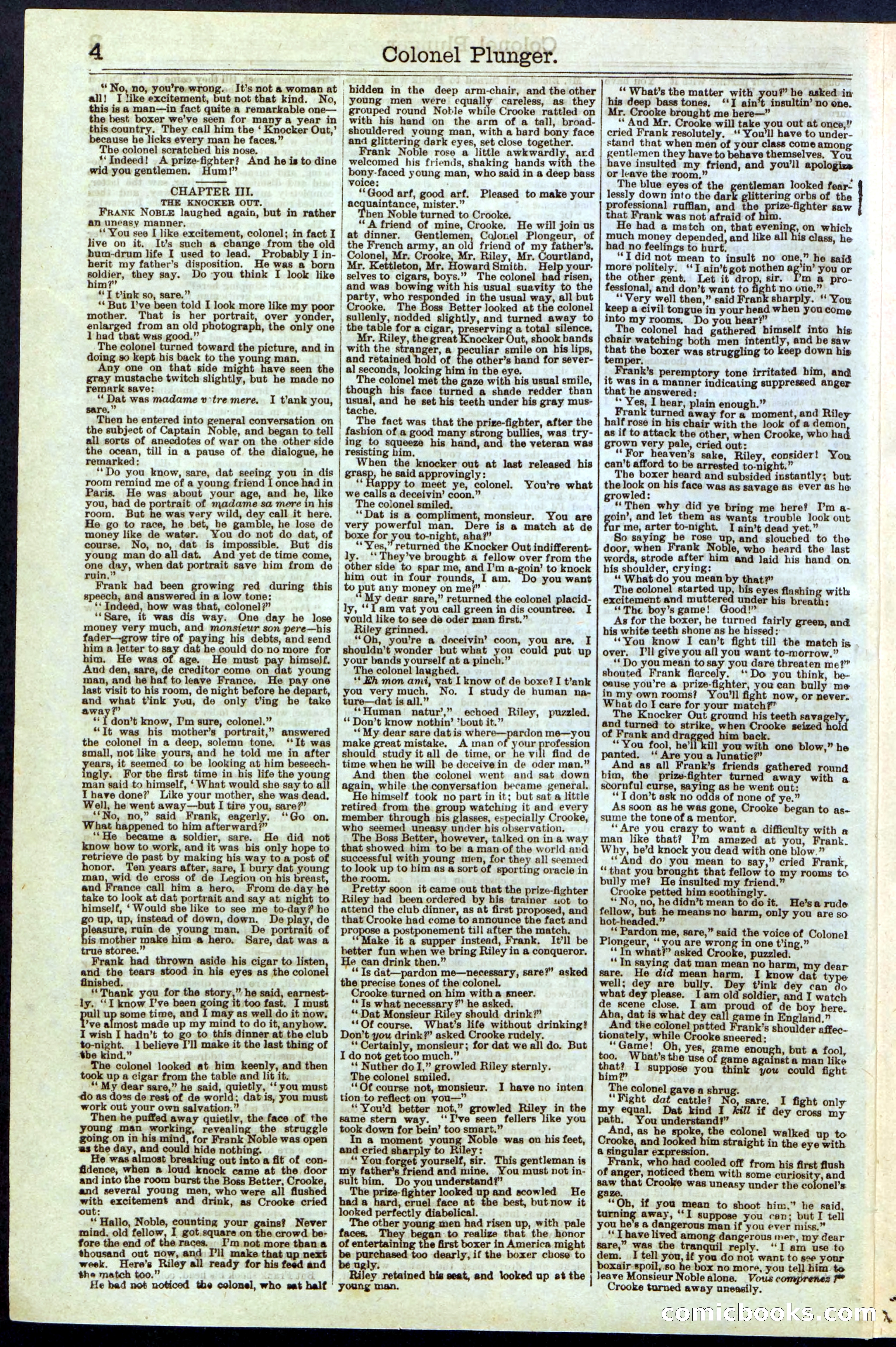
A restored page from Pulp Fiction, 1882. Page through the whole issue in the reader above.
📄 Transcribed text from this page (OCR, searchable)
Machine-transcribed from the original scan — historical spelling and the odd misread are preserved.
£ Colonel Plunger. sss AA AAA ATA all! I like excitement, but not that kind. No, this is a man—in fact quite a remarkable one— the best boxer we’ve seen for many a year in this country. They call him the ‘ Knocker Out,’ because he licks every man he faces,” The colonel scratched his nose. *‘ Indeed! A prize-fighter? And he is to dine wid you gentlemen. Hum!” CHAPTER III. THE KNOCKER OUT. FRANK NOBLE laughed again, but in rather an uneasy manner. ** You see I like excitement, colonel; in fact I live on it. It’s such a change from the old bum-drum life I used to lead. Probably I in- herit my father’s disposition. He was a born sr they say. Do you think I look like im ‘I tink so, sare.” “But I’ve been told I look more like my poor ees ae is og Egress Meg gpd en rom an old photograph, the o one 1 had that wus good.” . The colonel turned toward the picture, and in doing 30 kept his back to the young man. Any one on that side might have seen the gray mustache twitch slightly, but he made no remark save: “4 Dat was madame v°tre mere. I t’ank you, Then he entered into general conversation on the subject of Captain Noble, and began to tell all sorts of anecdotes of war on the other side the ocean, till in a pause of the dialogue, he remarked: **Do you know, sare, dat aeons you in dis room remind me of a young friend I once had in Paris. He was about your age, and he, like you, had de portrait of madame sa mere in his room. But he was very wild, dey call it here. He go to race, he bet, he gamble, he lose de money like de water. You do not do dat, of course, No, no, dat is impossible. But dis young man doalldat. And yet de time come, one day, when dat portrait save him from de ruin,’ Frank had been frowns red during this speech, and answered in a low tone: ‘* Indeed, how was that, colonel?” ‘* Sare, it was dis way. One day he lose money very much, and monsieur son pere—his fader—grow tire of paying his debts, and send him a letter to say dat he could do no more for him. He was of age. He must pay himself. And den, sare, de creditor come on dat young man, and he haf to leave France. He pay one last visit to his room, de night before he depart, and what tink you, de only ting he take ge 78 **} don’t know, I’m sure, colone).” “Tt was his mother’s portrait,” answered the colonel in a deep, solemn tone, “It was small, not like yours, and he told me in after ears, it seemed to looking at him beseech- ly. For the first time in his life the rng man said to himself, ‘ What would she say to al I have done?’ Like your mother, she was dead, Well, he went away—but I tire you, sare?’ ‘*No, no,” said Frank, engenig: “Go on. What happened to him afterward?” ‘*He became a soldier, sare. He did not know how to work, and it was his only hope to retrieve de past by making his way to a post of honor. Ten years after, sare, I bury dat young man, wid de cross of de Legion on his breast, and France call him a hero, From de day he take to look at dat portrait and say at night to himself, ‘Would she like to see me to-day? he go up, up, instead of down, down. De play, de leasure, ruin de young man. De portrait of pis mother make him a hero. Sare, dat was a true storee.” : Frank had thrown aside his cigar to listen and the tears stood in his eyes as the colonel finished. “Thank you for the story,” he said, earnest- ly. “I know P’ve been going it too fast. I must a up some time, and I may as well do it now, ’ve almost made up my mind to do it, anyhow. I wish I hadn’t to go to this dinner at the club Sealant. 1 believe I'll make it the last thing of tbe kind.” The cvlonel looked at him keenly, and then took up a cigar from the table and lit it. ‘“* My dear sare,” he said, Sen ‘* you must do as doss de rest of de world; datis, you must work out your own salvation.” Then he puffed away quietly, the face of the young man working, revealing the struggle going on in his mind, for Frank Noble was open as the day, and hide nothing. He was almost breakiug out into a fit of con- fidence, when a loud knock came at the door and into the room burst the Boss Better, Crooke and several young men, who were all flushed with excitement and drink, as Crooke cried out: ‘Hallo, Noble, counting your gains? Never mind. old fellow, I got.square on the crowd be- fore the end of the races. I’m not more than a thousand out now, and I'll make that up next week. Here’s Riley all ready for his and the match too.” He bad not noticed the colonel, who sat half , No, no, you're wrong. It’s not & woman at ! hidden in the deep arm-chair, and the other ‘* What’s the matter with you?” he asked in his deep bass tones. ‘‘I aint insultin’ no one. Mr. Crooke brought me bere—” ‘* And Mr. Crooke will take you out at once,” cried Frank resolutely. ‘‘ You'll have to under- stand that when men of your class come among gentlemen they have to behave themselves, You bave insulted my friend, and you'll apologize or leave the room,” ‘ The blue eyes of the gentleman looked fear- lessly down into the dark glittering orbs of the professional ruffian, and the ee saw that Frank was not afraid of him. He had a mstch on, that evening, on which | young men were equally careless, as they | grouped round Noble while Crooke rattled on with his hand on the arm of a tall, broad- shouldered young man, with a bard bony face and glittering dark eyes, set close together. nk Noble rose a little awkwardly, ard | welcomed his friends, shaking hands with the | bony-faced young man, who said in a deep bass voice: “Good arf, good arf. Pleased to make your eos mister.” ben Noble turned to Crooke, “A friend of mine, Crooke. He will join us at dinner. Gentlemen, CoJonel Plongeur, of | much money depended, and like all his class, he _ the French army, an old friend of my father’s. | had no feelings to burt, | Colonel, Mr. Crooke, Mr. Riley, Mr. Courtland, I did not mean to insult no one,” he said Mr. Kettleton, Mr. Howard Smith. Help your- selves to ci boys.” The colonel bad risen, and was bowing with his usual suavity to the party, who responded in the usual way, all but Crooke. The Boss Better looked at the colonel sullenly, nodded slightly, and turned away to more politely. ‘I ain’t got nothen oh you or the other gent. Let it drop, sir. I’m a pro- fessional, and don’t want to fight no one.” “Very well then,” said Frank sharply. ‘‘ You keep a civil tongue in your head when you come into my rooms. Do you hear?” the table for a cigar, ern a total silence. | The colonel had gathered himself into hig Mr. Riley, the great Knocker Out, shook bands | chair watching both men sve» and be saw e with the stranger, a iar smile on his lips, ep down his and retained hold of the other’s hand for sever- al seconds, looking him in the eye. The colonel met the gaze with his usual smile, though his face turned a shade redder than a , and he set his teeth under bis gray mus- cne, The fact was that the prize-figbter, after the | fashion of a good many strong bullies, was try- ing to squeeze his hand, and the veteran was that the boxer was struggling to temper. Frank’s peremptory tone irritated him, and it was in a manner indicating suppressed anger Spry ae * tes, 1 hear, plain enough.” Frank turned er for “) moment, and Rile half rose in his chair with the look of a demon as if to attack the other, when Crooke, who ha grown very pale, cried out: ——_—_ resisting him. ‘For heaven’s sake, Riley, consider! You When the knocker out at last released his | can’t afford to be arrested to-night.” grasp, he said approvingly: The boxer heard and stibelded instantly; but 4 the male on his face wag as savage as ever as he owled: ‘Then why did ye bring me here? I’m a- oin’, and let them as wants trouble look out ppy to meet ye, colonel. You’re what we Calls a deceivin’ coon.” The colonel smiled, ‘Dat is a compliment, monsieur. You are | very powerful man. Dere is a match at de | fur me, arter to-night. I ain’t dead yet.” boxe for you to-night, aha?’ So saying be rose up, and sloucbed to the ‘*'Yes,” returned the Knocker Out indifferent- | door, when Frank Nob @, who heard the last words, strode after him his shoulder, crying: ‘‘ What do you mean by that?” The colonel started up, bis eyes flashing with excitement and muttered under his breath: ‘““The boy’s game! Good!” As for the boxer, he turned fairly green, and his white teeth shone as he hissed: ‘You know I can’t fight till the match is over. I'll give you all you want to-morrow.” ly. ‘*They’ve brought a fellow over from the and Jaid his hand on other side to spar me, and I’m a-goin’ to knock him out in four rounds, I am. you want to put any money on me?” “My dear sare,” returned the colonel placid- ly, ‘‘1 am vat you call green in dis countree. vould like to see de oder man first.” Riley grinned. ‘Oh, you’re a doceivin’ coon, you are, I shouldn’t wonder but what en could put up ch. your bands yourself at a pin **Do you mean to say you dare threaten me?” The colonel laughed. shouted Frank fiercely. ‘*Do you think, be- Eh mon ami, vat I know of de boxe? I t’ank you very much. No. I study de human na- ure—dat is all.” ‘‘Human natur’,” echoed Riley, puzzled. ** Don’t know nothin’ *bout it.” “My dear sare dat is where—pardon me—you make great mistake, A man of your profession should study it all de time, or he vill find de time when he will be deceive in de oder man.” And then the colonel went and sat down again, while the conversation became general. He himself took no part in it; but sat a little retired from the group watching it and every member through his glasses, especially Crooke, who seemed or under bis observation. The Boss Better, however, talked on in a way that showed him to be a man of the world and successful with young mien, for they all seemed to look up to him as a sort of sporting oracle in the room. Pretty soon it came out that the prize-fighter Riley had been ordered by his trainer sot to attend the club dinner, as at proposed, and that Crooke had come ¥ ho pe esp A —_ and ro a tponement tilla 6 ma 3 Make it @ supper instead, Frank. It’ll be better fun when we bring Riley in a conqueror. cause you’re a prize-fighter, you can bully me in my own rooms? You'll fight now, or never. What do I care for your match?” The Knocker Out ground his teeth ovens! and turned to strike, when Crooke seized hold of Frank and drasmed him back. “You fool, he'll kill you with one blow,” he panted. ‘‘ Are you a Junatic?” And as all Frank’s friends gathered round him, the prize-fighter turned away with a scornful curse, saying as he went out: ‘“*T don’t ask no odds of none of ye.” As soon as he was gone, Crooke began to as- sume the tone of a mentor. ‘“‘Are you crazy to want a difficulty with a man like that? I’m amezed at you, Frank. Why, be’d knock you dead with one blow.” _ ‘“And do you mean to say,” cried Frank, “that you brought that fellow to my rooms to bully me? He insulted my friend.” Crooke petted bim soothingly. ** No, po he didn’t mean to doit. He’sa rude fellow, he means no harm, only you are so hot-headed.” ** Pardon me, sare,” said the voice of Colone) Plongeur, ‘‘ you are wrong in one ting.” ‘‘ In what?” asked Crooke, puzzled. can drink then.” ‘In saying dat man mean no harm, m MM, Is dat—pardon me—necessary, sare?’ asked | sare. He did mean harm, I know ‘aah ae the precise tones of the colonel. well; dey are bully. Dey tink dey can ao what dey please. I am Crooke turned on him witha sneer. de scene close. I am old soldier, and I “Ts what necennney ?’ he asked, . watch ur roud of de boy here. “Dat Monsie ey should drink?” Aha, dat is what dey call game in England.” ‘‘Of course. What's life without drinking! | And the colonel patted Frank’s shoulder affec- Don’t you drink?’ asked Crooke rudely. tionately, while Crooke sneered: “Certainly, monsieur; for dat we all do. But I do not get too much.” ‘* Nuther doI,” growled Riley sternly. The colonel smiled. “‘Of course not, monsieur. I have no inten tion to reflect on you—” ; “You'd better not,” growled Riley in the same stern way. ‘‘I’ve seen fellers like you took down for bein’ too smart.” : In a moment young Noble was on his feet, and cried sharply to Riley: “ You forget yourself, sir. This gentleman is + father’s dand mine, You must not in- sult him. Do you understand?” The fighter looked ens scowled He had a cruel face at the best, but now it looked perfectly diabolical. The other young men had risen up, with pale faces, The began to realize that the honor of entertaining e first boxer in America might be purchased too dearly, if the boxer chose to be ugly. ' Riley retained his seat, and looked up st the young man. ‘““Game! Oh, yes, game enough. but fool too. What's the use of game ayniont a man like ae I suppose you think you could fight. The colonel gave a shrug. "Fight data No sar my equal. Dat kind I Kill path. You underien = — 6, the colonel walked up to . and looked him straight in the eye with ngu on. Frank, who had cooled off from his first flush of anger, noticed them with some curiosit ,and pow t Crooke was uneasy under the colonel’s “Ob, if you mean to shoot him.” he said, turning away, ‘I suppose you cen; but I tell you he’s a dangerous man if you ever miss.” _‘*T have lived among dangerous mer, my dear sare,” was the tranquil reply. “I am use to dem. I tell you, if you do not want to sse your boxair-spoil,.so he box no more, you tell him to l Jeave Monsieur Noble alone. Vows comy pad Crooke tarned away uneasily. e. I fight onl if dey cross my bt ed cS (ECO) Ecomileboo