
Pulp Fiction, 1882 · page 3 of 32
Beadle's Dime Library No. 211 — page 3: what you’re looking at
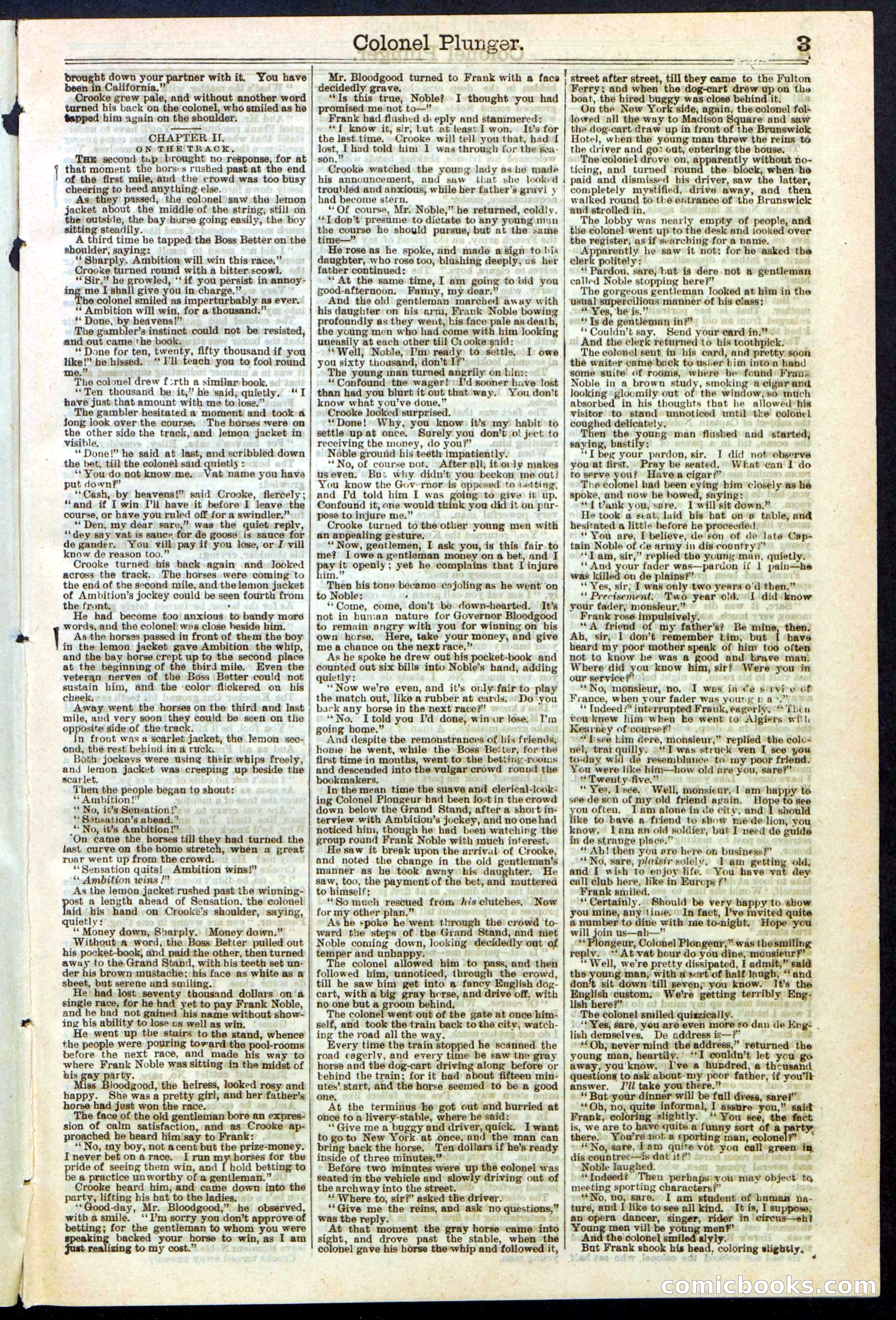
A restored page from Pulp Fiction, 1882. Page through the whole issue in the reader above.
📄 Transcribed text from this page (OCR, searchable)
Machine-transcribed from the original scan — historical spelling and the odd misread are preserved.
-—— a ee, brought down your partner with it. You have boca California.” Crooke grew pale, and without another word turned his back on the colonel, who smiled as he tapped him again on the shoulder. CHAPTER II. ON THE'TRACK, THE second tap: brought no response, for at that moment the horses rushed past at the end of the first mile, aud the crowd was too busy cheering to heed anything else. As: they passed, the colonel saw the lemon jacket about the middle of the string; still on the outside, the bay hurse going easily, the boy sitting steadily. A third time he tapped the Boss Better on the shoulder, saying: ‘* Sbarply. Ambition will win this race,” Crooxe turned round with a bitter:scowl. ‘* Sir,” he growled, ‘‘if you persist in annoy- ing me I shall give : en in charge.” | ‘he colonel smiled as imperturbably as ever. ‘* Ambition will win, for a thousand.” ‘* Done, by heavens!” The gambler’s instinct could not be resisted, and out came the book, ‘Done for ten, twenty, fifty thousand if you like!” he hissed. “* Pll teach you to fool round me.” The colonel drew f>rth a similar book. ‘*Ten thousand be it,” he said, quietly, “I have just that amount with me to lose.” The gambler hesitated a moment and took a jong look over the course. The horses were on the other side the track, and lemon jacket in visible, “Done!” he said at last; and scribbled: down the bet, till the colonel said qnietly : ‘*You do not know me. Vat name you hava put down?’ ‘‘Cash, by heavens!” said Crooke, flercely ; ‘‘and if I win Pll have it before I leave the course, or have you ruled off for a swindler.” ‘*Den, my dear sare,” was the quiet reply, ‘‘dey say vat is sauce for de goose is sauce for de gander, You vill pay if you lose, or J vill know de reason too.” Crooke turned bis back again and. looked across the track. The horses were coming to the end of the second mile, and the lemon jacket of Ambition’s jockey could be seen fourth from the front. ‘ He had become too anxious to bandy more words, and the colonel was close heside him. As the horses passed in front of them the boy in the lemon jacket gave Ambition the whip, and the bay horse crept up to the second place at the beginning of the third mile. Even the veteran neryes of the Boss Better could not sustain him, and the color flickered on _ his cheek, Away went the horses on the third and last mile, and very soon they could be seen on the opposite side of the track. n front was a searlet jacket, the lemon sec- ond, the rest behind in a ruck, Both jockeys were using their whips freely, and lemon jacket was creeping up beside the scarlet. Then the people began to shout: ** Ambition!” ‘** No, it’s Sensation |” ‘* Sansation’s abead.” _ No, it’s Ambition!” On came the horses til] they had turned the jast curve on the home stretch, when a great ruar went up from the crowd. ‘‘Sensation quits! Ambition wins!” ‘Ambition wins !” As the lemon jacket rushed past the wiuning- ost a length ahead of Sensation, the colonel aid his hand on Crooke’s shoulder, saying, quietly: | ‘** Money down, Sharply. Money down.” Without a word, the Boss Better pulled out his pocket-book, and paid the other, then turned away to the Grand Stand, with his teeth set un- der his brown mustache; his face as white as a sheet, but serene and smiling. _He had lost seventy thousand dollars on a single race, for he had yet to pay Frank Noble, and he had not name without show- ing his ability to lose us well as win. He went up the stairs to the stand, whence the people were pouring toward:the pool-rooms before the next race, and made his way ‘to where Frank Noble was sitting in the midst of a arty. , ; ss Bloodgood, the heiress, looked rosy and happy. She was a pretty girl, and her father’s horse had just won the race, The face of the old gentleman bore an expres- sion of calm satisfaction, and as Crooke ap- proached he heard him'say to Frank: ; ‘No, my boy, not acent but the prize-money. I never bet on arace. I run my horses for the pace of seeing therm win, and I hold betting to a practice unworthy of a gentleman.” Crooke heard him, and came down into the party, lifting his hat to the ladies. ‘*Good-day, Mr. Bloodgood,” he observed, withasmile. ‘‘I’m sorry you don’t approve of betting; for the gentleman to whom you were ing backed your horse to win, as I am izing to my cost.” —- TTT LT TT decidedly grave. ‘Is this true, Noble? I thought you had | promised me not to—” Frank bad flushed di eply and stammered: **{ know it, sir, but at leass I won. It’s for the last.time. Crooke will tell you that, had I lost, I had told him 1 was through for the sea- son. Crooke watched the young lady as he made his announcement, and saw that she lookrd troubled and anxious, while her father’s gravi \ had become stern, ‘Of course, Mr. Noble,” he returned, cold!y. ‘*T don’t’ presume to dictate to any young man the course he shoyld pursue, but at the same time—” He rose as he spoke, and made a sign to his daughter, who rose too, blushing deeply, 2s her father continued: ‘At the same time, I am going to vid you good-afternoon. Fatiny, my dear.” And the old gentleman marched away with his daughter on his arm, Frank Noble bowing profoundly as they went, his face pale as death, the young men who had come with him looking uneasily at each other tiil Ci ooke said: ‘Well, Noble, Pm ane to settle. I owe you sixty thousand, don’t I?’ The young inan turned angrily on bin: ‘‘Confound the wager! I'd sooner huve lost than had you blurt it out that way. You don’t know what you’ve done.” Crooke looked surprised. **Done! Why, you know it’s my habit to settle up at once. Surely you don’t o! ject to receiving the money, do you?” Noble ground his teeth impatiently. ‘No, of course not. Afterall, it only makes useven. Bu: why didn’t you beckon me out? You know the Governor is opposed to Letting, and [d told him I was going to give iv up. Confound it, one would think you did it on pur- pose to injure me.” Crooke turoed to the other young men with an appealing gesture. ** Now, gentlemen, I ask you, is this fair.to me? lI owea gentleman money on a bet, and I pay it openly; yet he complains that I injure im.’ Then his tone became cajoling as he went on to Noble: ‘ ‘*‘Come, come, don't be down-hearted. It’s not in human nature for Governor Bloodgood to remain angry with you for wioning on bis own horse. Here, take your money, and give me a chance on the next race.” As he spoke he drew out his pocket-book and a out six bills into Noble’s hand, adding quietly: ‘‘ Now we’re even, and it’s only fair to play the match out, like a rubber at cards. “Do you back any horse in the next race?’ ‘*No. Itold you I’d done, win ur lose. going home.” Aad despite the remonstrances of bis friends, home he went, while the Boss Be‘ter, for the first time in months, went to the betting-roems and descended into the vulgar crowd round the bookmakers. In the mean time the suave and clerical-look- ing Colonel Plongeur bad been Jost in the crowd down below the Grand Stand; after a short in- terview with Ambition’s jockey, and no one had noticed him, though he had been watching the group round Frank Noble with much interest. He saw it break upon the arrival of Crooke, and noted the change in the old gentleman's manner as he took away his daughter. He saw, too, the payment of the bet, and muttered to bimself; “So much rescued from his clutches, _Now for my other plan.” As he spoke he went through the crowd to- ward the steps of the Grand Stand, and niet Noble coming down, looking decidedly out of temper and unhappy. ~ | The colonel allowed him to pass, and then followed him, unnoticed, through the crowd, till he saw him get into a fancy English dozg- cart, with a big gray horse, and drive off. with no one but a groom behind, ' The colonel went out of the gate at once him- self, and took the train back to the citv, watch- ing the road all the way. is very time the train stopped he scanned the road eagerly, and eyery time he saw the gray horse and the dog-cart driving along before or bebind the train; for it bad about fifteen min- utes’ start, and the horse seemed to be a good one. ¥ At the terminus he got out and burried at once to a livery-stable, where he said: ‘Give me a buggy and driver, quick. I want to goto New York at once, and the man can bring back the horse. Ten dollars if he’s ready inside of three minutes.” ; Before two minutes were up the colonel was seated in the vehicle and slowly driving out of the archway into the street. = “Where to, sir?’ asked the driver. © ‘*Give me the reins, and ask no questions,” was the reply. hs Ts a At that moment the gray horse came into sight, and drove past the stable, when the colonel gave his horse the-whip and followed it, I'm 8 ay mee street after street, till they came to the Fulton Ferry; and when the dog-cart drew up on the boat, the hired buggy was close behind it. ; Oa the New York side, again, the colonel fol- lowed all the way to Madison Square and saw the dog-cart draw up in front of the Brunswick Hotel, when the young man threw the reins to the driver and go> out, entering the house. The colonel drove on, apparently without no- ticing, and turned round the block, when he paid and dismissed bis driver, saw the latter, —-s ' completely mystified, drive away, and then walked round to the entrance of the Brunswick adie heteeene ! f people, and e lobby was nearly empty o opie, an the colonel went up to the desk and iooued over the register, as if searching for a name. ee he saw it not; for he asked the clerk politely: ‘** Pardon, sare, but is dere not a gentleman called Noble stopping here?” un The gorgeous gentleman looked at him in the usual supercilious manner of his class: “6 Yes, ‘he is.” ‘Is de gentleman in?” **Couldn’t say. Send your ard in.” And the clerk returned to bis toothpick. The colonel sent in his card, and pretty soon the waiter came beck to user bim into hand some suite of rooms, where be found Fran» Noble in a brown study, smoking a cigarand looking gloomily out of the window,so much absorbed in his thoughts that he allowed»his visitor to stand unnoticed until tke colonel unas delicately, ; Then the young man flushed and started; saying, bastily: ‘*T beg your pardon, sir. you at first. Pray be seated. What can I do to serve you! Havea cigar?” ft The colonel had epee 2 bim closely as he spoke, and now he bowed, saying: “[ Vank you, 'sare. I willsitdown.” | He took a seat, laid bis hat on» table, and hesitated a little before he proceeded, ‘You are, [ believe, de son of de late Cap- tain Noble of Ce army in dis country?” ‘‘l am, sir,” replied the young man, quietly. ‘* And your fader was—pardon if 1 pain—he was killed on de plains?” ‘* Yes, sir; I was only ‘two years o'd then.” ** Precisement. Two year old. I did know your fader, monsieur.” (OU Frank rose impulsively. ; Y OR “A friend of my father’s? Be mine, then. Ah, sir, 1 don’t remember tim, but | have heard my poor mother speak of hin’ too often not to know he was a good and brave man. Where did you know him, sir/ Were you in our service?” : ' ‘*No, monsieur, no. I was in Ce s/rvire of France, when your fader was young p a».” ‘* Indeed ¢” interrupted Frank, eagerly. * Then rouknew him when ke went to Algiers wil Kearney of course?! | “Dbsee him dere, monsieur,” replied the colv- nel, trarquilly. ‘I was struck ven I see you to-day wid de resemblatice to my poor friend. You were like him—how old are you, sare?” * Tweuty-five.” | rad 3 Yes, see. Well, monsieur, 1 am happy to see de son of my old friend again. Hope to see k often. Iam alone ine city, and) 1 should ike to bave a. friend to show mede lion, you know. Lam an old soldier, but I need de guide in de strange place.” ‘* Ab! then you gre here on business?” ‘No, sare, plaisir solely. Tl am gettin and I wish to enjoy life. © You have va call club here, like in Europe f’ Frank smiled. . * Certainly. Should be ay ha you mine, any tine. In fact, lve a number to dine with me to-night, Hope ‘Plongeur, Colonel Pion “was thesmiling ly. *! At vat hour do you dine, monsieur?” » ‘Well, we're pretty dissipated, I admit,” said the young man, with ascrt of half Jaugh, “and don’t sit down till seven; you know. It’s the English custom, We're getting terribly Eng- lish here?” f 1 qu epee mlest! The colonel srailed quizzically. I did not ebservé ik old, dey py ‘to stiow vited eae you . “Yes, sare, you are even more so dan de Eng: : lish demselvyes. De address is—?” “*Oh, never mind the address,” returned the young man, heartily. ‘*I couldn’t let you go away, you know. I’ve a hundred, a thousand questions to ask about-my poor father, if you'lk answer. J’ll take you there.” my ‘* But:your dinner will be full dvess, sare?” ‘Oh, no, quite informal, I assure you,” said . Frank, coloring slightly. ‘‘ You see, the fact is, we are to have quite a funny sort of a party, there. You're not a sporting man, colonel?” ‘No, sare, fam quite vot you call green in dis countrec—is dat it?’ | oo" al? oder fesp Noble Jaughed. : “Indeed? Then perhaps: you may object to meeting sporting characters?” | “No, —_ sare. I am student of human na- ture, and I like to see all kind. It is, I suppose, an opera dancer, singer, rider in circus—sh? Young men vill be young men?’ O08 © And the colonel slyly. — But Frank shook his head, coldring slightly, + MIGDOO (E(0) C KS (E (0)