
Pulp Fiction, 1882 · page 2 of 32
Beadle's Dime Library No. 211 — page 2: what you’re looking at
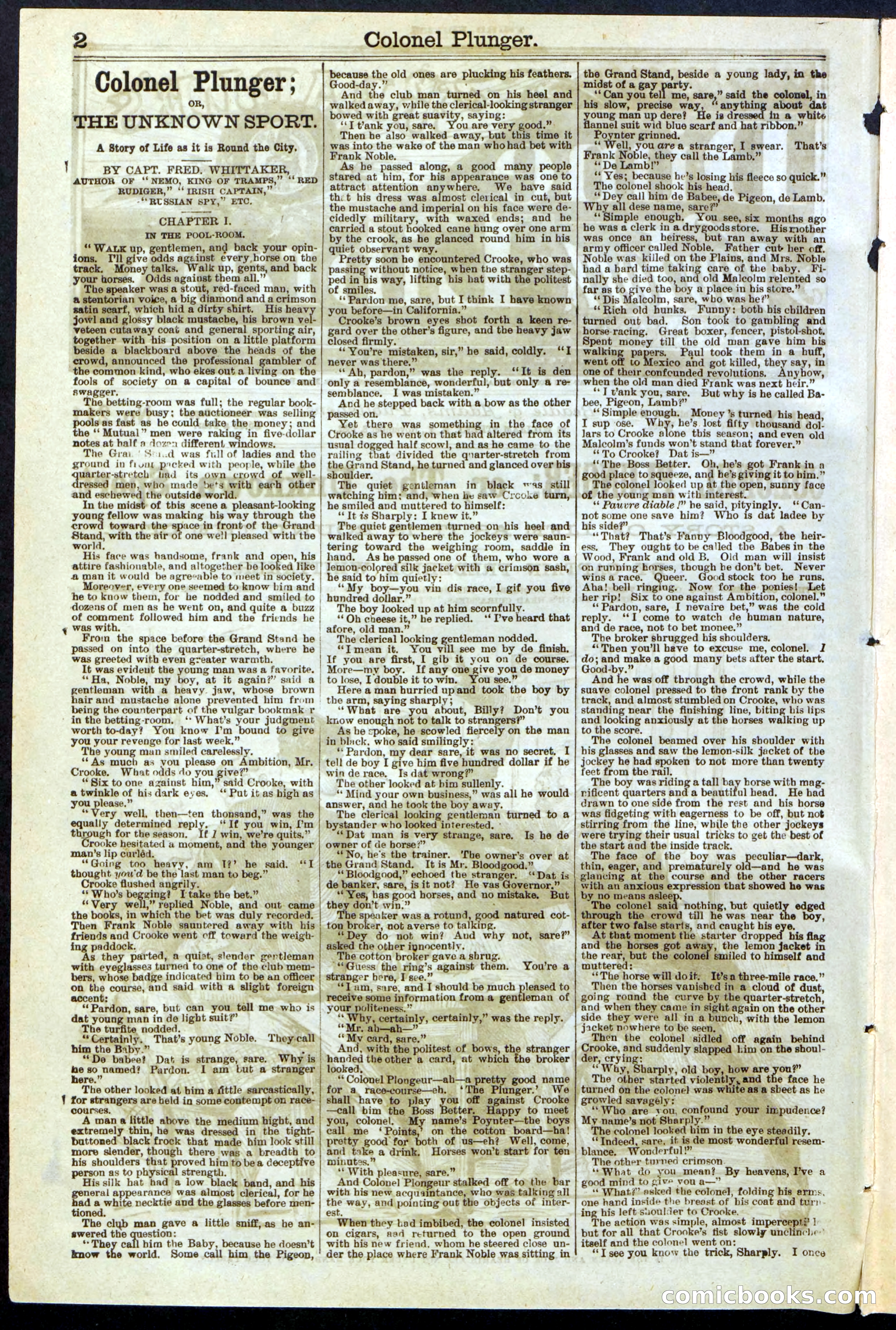
A restored page from Pulp Fiction, 1882. Page through the whole issue in the reader above.
📄 Transcribed text from this page (OCR, searchable)
Machine-transcribed from the original scan — historical spelling and the odd misread are preserved.
- Colonel Plunger; THE UNKNOWN SPORT. A Story of Life as it is Round the City, | BY CAPT. FRED. WHITTAKER, AUTHOR OF ‘‘ NEMO, KING OF TRAMPS,” ‘‘ RED RUDIGER,” ‘‘ IRISH CAPTAIN,” -*“RUSSIAN SPY,” ETC, _ CHAPTER I. IN THE POOL-ROOM. “WALK up, gentlemen, and back your opin- ions. I'll give odds ‘— every, horse on the aa: ‘Money talks. Walk up, gents, and back your horses. Odds agaiost them all.” ‘The speaker was a stout, red-faced man, with a stentorian voice, a big diamond and a crimson atin searf, which hid a dirty shirt. His hea jowl ai d glossy black mustache, his brown vel- ve cutaway coat and general sporting air, together with his position on a little platform beside a blackboard above the heads of the crowd, announced the professional gambler of the common kind, who ekes out a living on the fools of society on a capital of bounce and | swagger. The betting-room was full; the regular book- makers were busy; the auctioneer was selling pools as fast as he could take the money; and | the ‘‘ Mutual” men were raking in five-dollar notes at half a dozen different, windows. The Grai ground in ftunt pscked with people, while the uarter-stretch bad its own crowd of _well- men, who made bets with each other and eschewed the outside world. aoaie! In the midst of this scene a pleasant-looking young fellow was making his way through the crowd toward the space in front of the Grand Stand, with the air of one we!l pleased with the world, His face was handsome, frank and open, his attire fashionable, and altogether be looked like 4 man it would be agreeable to meet in society. Moreover, every one seemed to know bim and he to know them, for be nodded and smiled to dozens of men as he went on, and quite a buzz of comment followed him and the friends he was with. From the space before the Grand Stand he passed on into the quarter-stretch, where he was greeted with even greater warmth. It was evideut the young man was a favorite. **Ha, Noble, my gentleman with a heavy jaw, whose brown hair and mustache alone prevented him from being the counterpart of the vulgar bookmak r in the betting-room. ‘* What’s your judgment worth to-day? You know I’m bound to give you your revenge for last week.” The young man smiled carelessly. ‘* As much as vou please on Ambition, Mr, Crooke. What odds do you give!” “Six to one azainst him,” said Crooke, with a twinkle of his dark eves, ‘“‘ Put it as bigh as you please,” “Very well, then—ten thonsand,” was the equally determined reply. “Tf you win, ’m through for the season. If J win, we're quits.” rooke hesitated a moment, and the younger man’s lip curléd. al ““Going too heavy, am TIT?’ he said. “I thought you'd be the last man to beg.” Crooke flushed angrily. , : ‘* Who's pea ng? I take the bet.” “Very well,” replied Noble, and out came the books, in which the bet was duly recorded. Then Frank Noble sauntered away with his friends and Crooke went cff toward the weigh- ing paddock. 5 they parted, a quiat, slender gentleman with eyeglasses turned to one of the club mem- bers, whose badge indicated bim to be an officer on the course, and said with a slight foreign accent; — aoa “Pardon, sare, but can you tell me who is dat young man in de light suit?” 7 The turfite nodded. , ~ That’s young Noble. They-call Why is a him the Baby.” **De babee? Dat is strange, sare. | be so named? Pardon. I am but a here.” The other looked at him a fittle ! for strangers are held in some contempt on race- courses. ©. ’ A wan a little extremely thin, he was in the tight- buttoned black frock that made him look still more slender, though there was a breadth to his shoulders that proved him to bea deceptive person as to physical strength. His silk bat had a low black band, and his neral appearance was almost clerical, for he ad a white necktie and the glasses before men- tioned. — ian The clyb man gave a little sniff,as he an- awered the question: * They call him the Baby, because he doesn’t know the world. Some call him the Pigeon, he bo) Yr S40 » above the medium hight, and Sucd was full of ladies and the | _More—my boy. If any one give you de money y, at it again?’ said a) Colonel Plunger. because the old ones are plucking his feathers. P OnmaEY 7 ' And the club man turned on his heel and walked away, while the clerical-looking stranger bowed with great suavity, saying: ‘‘T tank you, sare. You are very good.” Then he also walked away, but this time it was into the wake of the man whohad bet with Frank Noble. As he passed along, a good many people stared at him, for his appearance was one to attract attention anywhere. We have said thit his dress was almost clerical in cut, but the mustache and imperial on his face were de- cidedly military, with waxed ends; and he carried a stout hooked cane hung over one arm by the crook, as he glanced round him in bis quiet observant way. Pretty soon he encountered Crooke, who was passing without notice, when the stranger step- ped in his way, lifting his hat with the politest of smiles. ‘* Pardon me, sare, but I think I you before—in California.” Ste. Crooke’s brown eyes shot forth a keen re- gard over the other’s figure, and the heavy jaw closed firmly. ‘‘You’re mistaken, sir,” he said, coldly. ‘‘I never was there.” ; ‘Ah, pardon,” was the reply. “It is den only a resemblance, wonderful, but only a re- semblance. I was mistaken.” And he stepped back with a bow as the other passed on. Yet there was something in the face of Crooke as he went on that had altered from its usual dogged half scowl, and as he came to the railing that divided the qnarter-stretch from the Grand Stand, he turned and glanced over bis shoulder. . The quiet gentleman in black was still watching him: and, when he saw Crooke turn, he smiled and muttered to himself: ‘It is Sharply: I knew it.” The quiet gentlemen turned on his heel and walked away to where the jockeys were saun- tering toward the weighing room, saddle in hand. As he passed one of them, who wore a lemon-colored silk jacket with a crimson sash, he said to him quietly: ‘My boy—you vin dis race, I gif you five hundred dollar.” The boy looked up at him scornfully. ‘‘ Oh cheese it,” he replied. ‘‘ ’ve heard that afore, old man.” The clerical looking gentleman nodded. “T mean it. You vill see me by de finish, If you are first, I gib it you on de course. have known to lose, I double it to win. You see.” Here a man hurried upand took the boy by the arm, saying sharply; | “What are you about, Billy? Don’t you know enough not to talk to strangers?” As he spoke, he scowled fiercely on the man in black. who said smilingly: ‘Pardon, my dear sare, it was no secret. I tell de boy I give him five hundred dollar if he win de race. Is dat wrong?” The other looked at bim sullenly. ‘“‘ Mind your own business,” was all he would answer, and he took the boy away. The clerical looking gentleman turned to a bystander who looked interested, ° “Dat man is very strange, sare. Is he de owner of de horse?’ 2. , “No, he’s the trainer. ‘The owner’s over at the Grand Stand. It is Mr. Bloodgood.” ** Bloodgood,” ry Hao agess r. “Dat is | ol er, sare, is if not @ Vas | rnor.” | w de has good horses, and Yes. the F dott win.” The s ton broker, not averse to ta 2 Dey do not win? Aud why not, sare?’ asked the other ignocently. _ The cotton broker gave a sbrug. ““Guess the ring’s against them. You're a stranger bere, I see.” “Tam, sare, and I should be much pleased to ne information icom.angentioman of cote ny, ¢ erta ly certainly,” was the reply. “My ce re =" re,” , " : And, with the politest of bows, stranger handed thé o By card) ‘at whieh the broker looked. = ea Se ry Colonel P ) —A ft good name , ; Horses won't start for ten ee minutes.” % ‘* With pleasure, sare.” _ . } And Colonel Plongeur stalked off to the bar with his new acquaintance, who was talking all the way, and pointing out the objects of inter- est. ea . When they had imbibed, the colonel insisted on cigars, aed returned to the open ground with his new friend, whom he steered close un- der the place where Frank Noble was sitting in =) b ond . speaker was a rotund good natured cot-) Iking and when t der, ory ing: | The other started ‘ ae savagély: | My name’s nots Sharply.” at 3 is elon footed bin in the eye steadi -———— ee the Grand Stand, beside a young lady, in the midst of a ga pesky: **Can you te me, sare,” said the colonel, in his slow, precise way, “anything about dat oung man up dere? He is anal in a white nel suit wid blue scarf and hat ribbon,” pg grinned. | “Well, you area stranger, I swear. That's Frank Noble, they call the Lamb.” ** De Lamb!” ** Yes; because he’s losing his fleece so quick.” re oe eee. ] ey call him de Ba de Pigeon, de Lamb. Why all dese name, sare?” ie “Simple enough, You see, six months ago he was a clerk in a drygoodsstore. Hismother was once an heiress, but ran away with an army officer called Noble. Father cut her off, Noble was killed on the Plains, and Mrs. Noble had a bard time taking care of the baby. Fi- nally she died too, and old Maleo!lm relented so far as to give the boy a place in bis store,” “* Dis Mateaim. sare, wbo was he?” ‘Rich old hunks, Funny: both bis children turned out bad. Son took to gambling and horse-racing. Great boxer, fencer, pistol-shot, Spent money till the old man gave him his walvieg. pepers. Paul took them in a huff, went off to Mexico and got killed, they say, in one of their confounded revolutions. Anyhow, when the old man died Frank was next heir.” ‘*] vank you, sare. But why is he called Ba- OS eee Lamb?’ a ‘* Simple enough. oney ’s turned his head I sup ose. Why, he’s lost fifty thousand dol- Jars to Crooke alone this season; and even old Malcolm’s funds won’t stand that forever.” “To Crooke? Dat is—” ‘* The. Boss Better. Oh, he’s got Frank in a good place to squeeze, and he’s giving it to him.” The colonel looked up at the open, sunny face of the young mean with interest. ** Pauvre diable |” he said, pityingly. ‘ Can- not some one save him? Who is dat ladee by his side?” “That? That’s Fanny Bloodgood, the heir- ess, They ought to be called the Babes in the Wood, Frank and old B. Old man will insist on running horses, though be don’t bet. Never wins a race. ueer, ood stock ton he runs. Aha! bell ringing. Now for the ponies! Let her rip! Six to one against Ambition, colonel,” ‘* Pardon, sare, I nevaire bet,” was the cold reply. ‘*I come to watch de human nature, and de race, not to bet monee.” The broker shrugged his shoulders. ““Then you'll have to excuse me, colonel. J do; and make a good many bets after the start. ms 7 And he was off through the crowd, while the suave colonel pressed to the front rank by the track, and almost stumbled on Crooke, who was standing near the mma line, biting bis lips and looking anxiously at the horses walking up to the score. The colonel beamed over his shoulder with his glasses and saw the lemon-silk jacket of the jockey he had spoken to not more than twenty feet from the rail. The boy was riding a tall bay borse with mag- rificent quarters and a beautiful head. He had drawn to one side from the rest and his horse was fidgeting with eagerness to be off, but not stirring from the line, while the other jockeys were trying their usual tricks to get the best of the start and the inside track. The face of the boy was _peculiar—dark, thin, eager, and proviaeeey old—and he was ; the other racers the course an anxious expression that showed he was PADS ASlee onel said nothing, but quietly ed the crowd till he was near 33 ’s a three-mile race.” d the corvé byte Rartksireect: going round the curve by the quarter-stretch, en they came in sight again on the other side they were all in a bunch, with the lemon jacket nowhere to be an Then the colonel sidled off a behind Crooke, and suddenly slapped kim on the shoul- “ Why, ‘Who are vou, confound your ; deed, sare, it is de most wond erful esem blance. Wonderful!” ae The other turned crimson. “3 ‘“What do you mean? By heavens, "tive a good mind to give vou a—” > ‘* What?” esked the colonel, folding his erms, one hand inside the breast of bis coat and turn - ing his left suoulder to Crooke. ey The action was simple, almost impe ] but for all that Crooke’s fist slowly unclinche:’ itself and the colonel went on: ‘‘T see you know the trick, Sharply. I once Eomicbooks.com Cc