
Pulp Fiction, 1882 · page 24 of 32
Beadle's Dime Library No. 211 — page 24: what you’re looking at
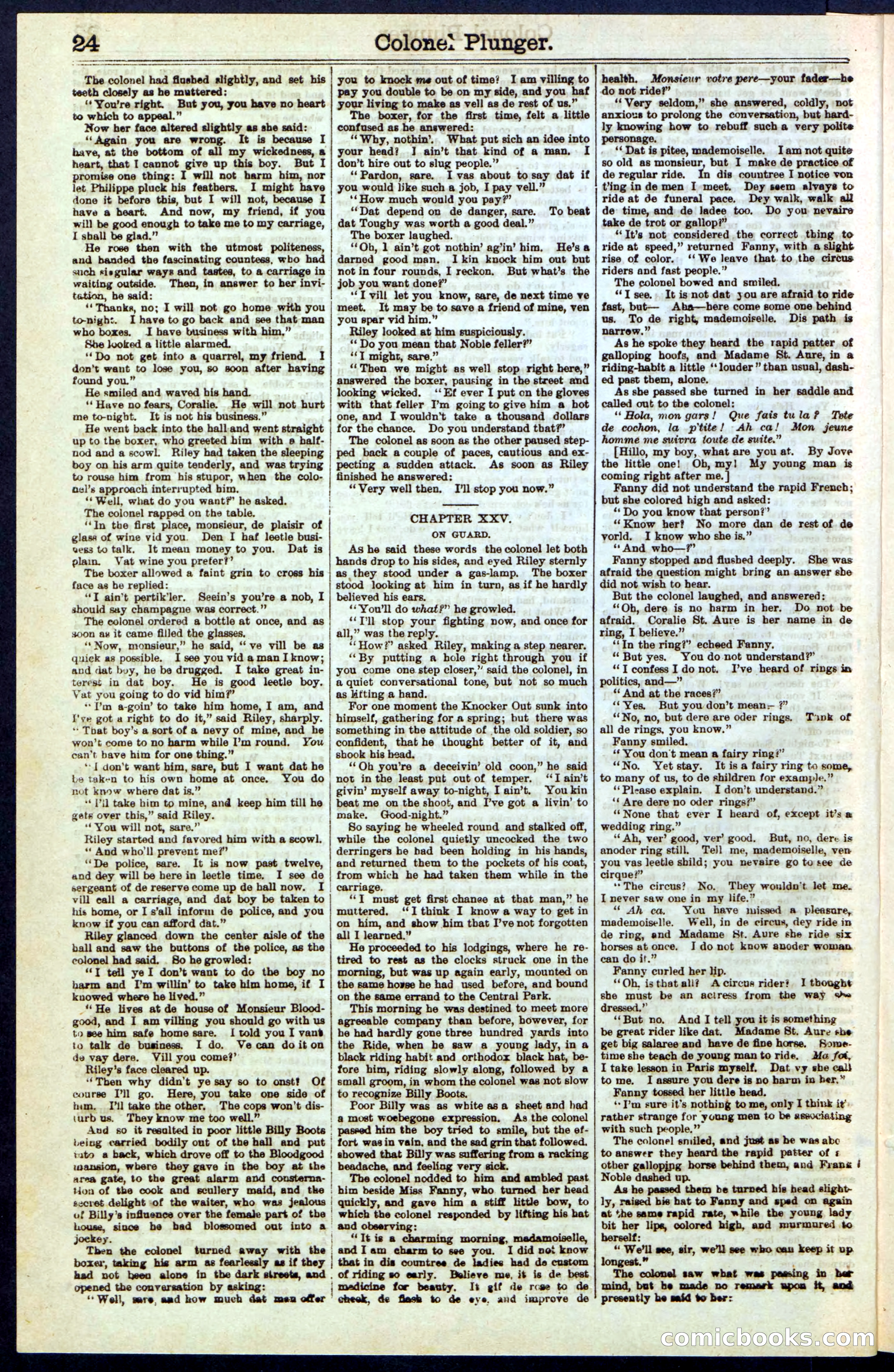
A restored page from Pulp Fiction, 1882. Page through the whole issue in the reader above.
📄 Transcribed text from this page (OCR, searchable)
Machine-transcribed from the original scan — historical spelling and the odd misread are preserved.
- d4 ee -_——- The colonel had flushed slightly, and set his teoth closely as he muttered: “You're right. But you, you have no heart to which to appeal.” Now her face altered slightly as she said: “Again y yeas 9 It is because I have, at the bottom of my wickedness, a heart, that I cannot give up this boy. But I promise one thing: I will not barm him, nor let Philippe pluck his feathers. I might have done it before this, but I will not, because I have a beart. And now, my friend, if you will be good enough to take me to my carriage, I sball be giad.” He rose then with the utmost politeness, and handed the fascinating countess, who had such sisgular ways and tastes, to a carriage in waiting outside. Then, in answer to ber invi- | job you want done?” tation, he said: |" “T vill let you know, sare, de next time ve ‘‘ Thanks, no; I will not go home with you | meet. It may be to save a friend of mine, ven to-night. Ihave to go back and see that man | you spar vid him.” who boxes, IJ have business with him,” Riley looked at him suspiciously. She looked a little alarmed. ** Do you mean that Noble feller?’ ‘‘Do not get into a quarrel, my friend. I ‘“‘T might, sare,” don't want to lose you, so soon after having “Then we might as well stop right here,” found you.” answered the boxer, pausing in the street and He smiled and waved his hand. looking wicked. ‘‘Ef ever I put on the gloves ‘‘ Have no fears, Coralie. He will not hurt | with that feller I’m going to give him a hot me to-night. It is not his business.” one, and I wouldn't take a thousand dollars He went back into the halland went straight | for the chance. Do you understand tbat?’ up to the boxer, who greeted him with a half- The colonel as soon as the other paused step- nod and a scowl. Riley bad taken the sleeping | ped back a couple of paces, cautious and ex- boy on his arm quite tenderly, and was trying | pecting a sudden attack. As soon as Riley to rouse him from his stupor, when the colo- | finished he answered: ocl’s approach interrupted bim. ; “Very wellthen. I'll stop you now.” ‘* Well, what do you want?’ he asked. Tee The colonel rapped on the table. ‘In the first place, monsieur, de plaisir of CHAPTER XXV. ON GUARD. glass of wine vid you. Den I haf leetle busi- vess to talk. It mean money to you. Dat is As he said these words the colonel let both plain. Vat wine you prefer?’ hands drop to his sides, and eyed Riley sternly The boxer allowed a faint grin to cross his | as they stood under a gas-lamp. The boxer face as be replied: stood looking at him in turn, as if he hardly “‘T ain't pertik’ler. Seein’s you’re a nob, I | believed his ears. ‘You'll do what?” he growled. should say champagne was correct.”’ The colonel ordered a bottle at once, and as; ‘‘I'll stop your fighting now, and once for goon ax it came filled the glasses. | all,” was the reply. ‘* Now, monsieur,” he ae “ve vill be as “How?” asked Riley, making a step nearer. quiek as possible. I see you vid a man I know; “By putting a hole right through you if and dat boy, he be drugged. I take great in- | you come one step closer,” said the colonel, in terest in dat boy. He is good leetle boy. | a quiet conversational tone, but not so much Vat you going to do vid him?’ as ifting a hand. *['m a-goin’ to take him home, I am, and For one moment the Knocker Out sunk into I've got a right to do it,” said Riley, sharply. | himself, gathering for a spring; but there was * Tbat boy’s a sort of a nevy of mine, and he | something in the attitude of the old soldier, so won’t come to no barm while Im round, You | confident, that he thought better of it, and can’t bave him for one thing.” shook his head, ‘*{ don’t want bim, sare, but I want dat he ‘(Ob you’re a deceivin’ old coon,” he said be taken to his own home at once. You do not in the least put outof temper. “I ain’t not know where dat is.” givin’ myself away to-night, Iain’t. You kin ‘il take him to mine, and keep him till he | beat me on the shoot, and I’ve got a livin’ to gets over this,” said Riley. make. Good-night.” ‘You will not, sare.” So saying he wield round and stalked off, Riley started and favored him with a scowl. | while the colonel quietly uncocked the two ** And who'll prevent me?” derringers he had been holding in his hands, “De police, sare. It is now past twelve, | and returned them to the pockets of his coat, and dey will be bere in leetle time. I see de | from which he had taken them while in the sergeant of de reserve come up de hall now. I | carriage. vill call a carriage, and dat boy be taken to “IT must get first chanee at that man,” he his bome, or I s’all inform de police, and you | muttered. ‘I think I know a way to get in know if you can afford dat.” on him, and show him tbat I’ve not forgotten Riley glanced down the center aisle of the | all I learned.” ball and saw the buttons of the police, as the He proceeded to his lodgings, where he re- colonel had said. . 80 he growled: tired to rest as the clocks struck one in the ““T teil ye I don’t want to do the boy no/ morning, but was up again early, mounted on barm and I’m willin’ to take him home, if I | the same hose he had used before, and bound knowed where he lived.” on the same errand to the Central Park. “ He lives at de house of Monsieur Blood- This morning he was destined to meet more good, and I am villing you should go with us | agreeable company than before, however, for to see him safe home sare. I told you I vant | he had hardly gone three hundred yards into to talk de business. I do. Vecan doiton | the Ride, when be saw a young lady, in a de vay dere. Vill you come?’ black riding habit and orthodox black hat, be- Riley’s face cleared up. fore him, riding slowly along, followed by a ‘Then why didn’t ye say so to onst? Of | small groom, in whom the colonel was not slow course I'll go. Here, you take one side of | to recognize Billy Boots. baie I'll take the other, The cops won't dis- | Poor Billy was as white asa sheet and had iurb us. They know me too well.” ‘ @ most woebegone expression. As the colonel And so it resalted in poor little Billy Boots | passed him the boy tried to smile, but the ef- veing carried bodily ont of the hall and put | fort was in vain, and the sad grin that followed. tato a back, which drove off to the Bloodgood | showed that Billy was suffering from a racking wansion, where they gave in the boy at the | beadache, and feeling very sick. area gate, to the great alarm and consterna-| The colonel nodded to him and ambled past tion of the cook and scullery maid, and tke | him beside Miss Fanny, who turned her head secret delight of the waiter, who was Jealous | | quickly, and gave him a stiff little bow, to of Billy’s influence over the female part of the | which the colonel responded by lifting his hat house, since be bad blossomed out into a and observing: jockey. “It is a charming morning, madamoiselle, Then the colonel turned away with the andIam charm to see you. I did noi know boxer, taking his arm as fearlessly az if they | that in dis countree de ladies had de custom had not been alone in the dark streets, and . of riding so early. Believe me, it is de best opened the conversation by asking: , madicine — Is gif de rose to de ‘Well, sare, and how much dat man offer | cheek, de to de eye. and improve de Colone: Plunger. you to peer ant out of time? I am villing to pay you double to be on my side, and you haf your living to make as vell as de rest of us,” The boxer, for the first time, felt a little confused as he answered: ‘““Why, nothin’. What put sich an idee into your head? J] ain’t that kind of a man, I don’t hire out to slug people.” ‘Pardon, sare. I vas about tosay dat if you would like such a job, I pay vell.” ‘*‘How much would you pay?’ ‘Dat depend on de danger, sare. To beat dat Toughy was worth a good deal.” The boxer laughed. ‘Ob, 1 ain’t got nothin’ ag’in’ him, He’sa darned good man, Ikin knock him out but not in four rounds, I reckon. But what’s the —_——-—- mm ie es health. Monsieur votre pere—your fader—he do not ride?’ ‘Very seldom,” she answered, coldly, not anxious to prolong the conversation, but hard- ly knowing how to rebuff sucha very polite personage. ‘* Dat is pitee, mademoiselle. Iam not quite so old as monsieur, but I make de practice of de regular ride. In dis countree I notice von ting in de men I meet. Dey seem alvays to ride at de funeral pace. Dey walk, walk all de time, and de ladee too. Do you nevaire take de trot or gallop?” ‘It’s not considered the correct thing to ride at speed,” returned Fanny, with a slight rise of color. ‘‘ We leave that. to the circus riders and fast people.” The colonel bowed and smiled. “‘T see. It is not dat you are afraid to ride fast, but— Aba—here come some one behind us. To de right, mademoiselle. Dis path is narrew.” As he spoke they heard the rapid patter of galloping hoofs, and Madame St. Aure, in a riding-habit a little ‘‘ louder” than usual, dash- ed past them, alone. As she passed she turned in her saddle and called out to the colonel: ‘* Hola, mon gars! Que fais tula? Tote de cochon, la p'tite! Ah ca! Mon jeune homme me suivra toute de suite.” [Hillo, my boy, what are youat. By Jove the little one! Ob, my! My young man is coming right after me. | Fanny did not understand the rapid French; but she colored high and asked: ‘*Do you know that person?” ‘“‘Know herf No more dan de rest of de vorld. I know who she is.” ** And who—?” Fanny stopped and flushed deeply. She was afraid the question might bring an answer she did not wish to hear. But the colonel laughed, and answered: ‘‘Ob, dere is no harm in her. Do not be afraid. Coralie St. Aure is her name in de ring, I believe.” ‘‘Tn the ring?” echeed Fanny. “ But yes. You do not understand?” ‘*T confess I do not. politics, and—” ** And at the races?” ‘‘Yes, But you don’t mean- ?” ‘No, no, but dere are oder rings. all de rings, you know.” Fanny smiled. ‘* You don't mean a fairy ring?’ “No. Yetstay. It isa fairy ring to some, to many of us, to de shildren for exampJe.” ‘*Please explain. I don’t understand.” ‘¢ Are dere no oder rings?” ‘‘None that ever I heard of, except it’s e wedding ring.” ‘Ah, ver’ good, ver’ good, But, no, dere is anoder ring still. Tell me, mademoiselle, ven you vas leetle shild; you nevaire go tosee de cirque?’ ‘The circus? No. They wouldn't let me. I never saw one in my life.” ‘“ Ah ca. You have missed a pleasare, mademoiselle. Well, in de circus, dey ride in de ring, and Madame St. Aure she ride six horses at once. I do not know anoder woman can do it.” Fanny curled her lip. “Oh, isthatalli? Accircus rider? I thought she must be an aciress from the way vw» I’ve heard of rings in Tink of dressed,”’ ‘‘But no. And I tell you it is something be great rider like dat. ame St. Aure she get big salaree and heve de fine horse. fSome- time she teach de young mantoride. Ma fot, I take lesson in Paris myself. Dat vy she cal} to me. I assure you dere is no harm in ber,” Fanny tossed her little head. ‘Tm sure it’s nothing to me, only I think it’. rather strange for young men to be associating with such people.” The colone!] smiled, and just as he was abo to answer they heard the rapid patter of s other gallopjng horse behind them, and Fran« ij Noble dashed up. As he passed them be turned hie head slight- ly, raised bis hat to Fanny and sped on again at the same rapid rate, while the young lady ref her lips, colored high, and murmured to herself: “ Welll see, sir, we'll see who cau keep it up Tho sclemet. sory thes ene peming $9: dee mind, but be made no remark upon it, and JOO <s) GoOm