
Pulp Fiction, 1882 · page 23 of 32
Beadle's Dime Library No. 211 — page 23: what you’re looking at
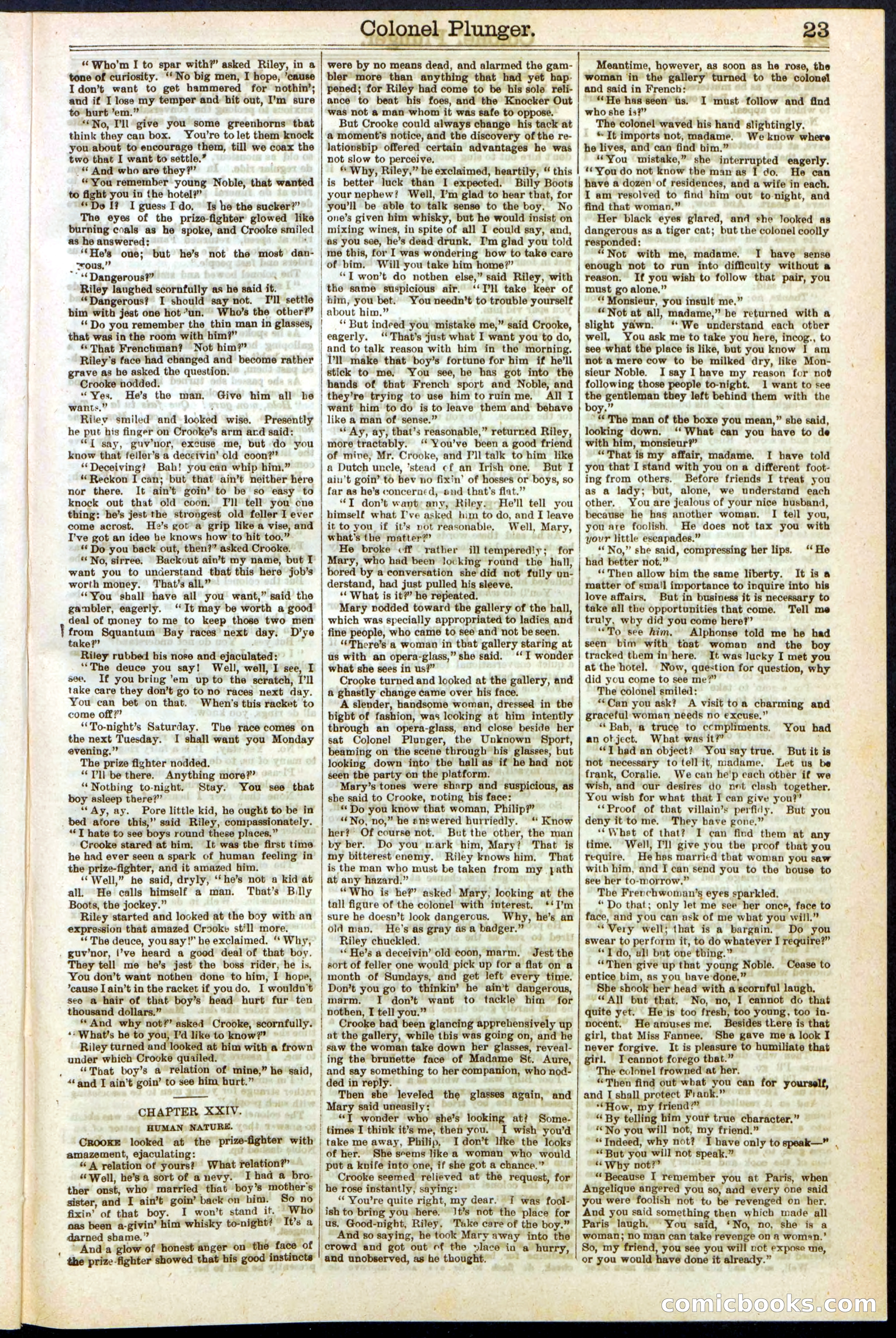
A restored page from Pulp Fiction, 1882. Page through the whole issue in the reader above.
📄 Transcribed text from this page (OCR, searchable)
Machine-transcribed from the original scan — historical spelling and the odd misread are preserved.
a ee me ‘“ Who'm I to spar with?” asked Riley, in a tone of curiosity. ‘*No big men, I hope, ’cause I don’t want to get hammered for nothin’; and if I lose my temper and bit out, I’m sure to hurt ’em.” ‘No, Pll give you some greenhorns that think they can box. You're tolet them knock you about to encourage them, till we coax the two that I want to settle.” | -* And who are they?’ “You remember young Noble, that wanted to fight you in the hotel?” “Doe I? I guess Ido, Is he the sucker?” The eyes of the prize-fighter glowed like burning coals as he spoke, and Crooke smiled as he answered: . ‘*He’s one; but he’s not the most dan- _ ous,” | ' “* Dangerous?” ; Riley laughed scornfully as he said it. “Dangerous? I should say not. I'll settle bim with jest one hot ’un. Who's the other?’ ‘Do you remember the thin man in glasses, that was in the room with him?” ‘That Frenchman? Not him?” Riley's face had changed and become rather grave as he asked the question. Crooke nodded. “Yes. He’s the man. Give him all he wants.” : Rilev smiled and looked wise. Presently he put his finger on Crooke’s arm ard said: — “[ say, guv’nor, excuse me, but do you know that feiler’s a deceivin’ old coon?” “Deceiving? Bah! you can whip him.” *Reckon I can; but that ain’t neither here nor there. It ain’t goin’ to be so easy to knock out that old coon. Tl tell you one thing: he’s jest the strongest old feller I ever come acrost. He’s got a grip like a vise, and I’ve got an idee be knows how to hit too.” “Do you back out, then?” asked Crooke. “No, sirree. Backout ain’t my name, but I want you to understand tbat this here job’s worth money. That's all.” ‘‘You shall have all you want,” said the gambler, eagerly. “It may be worth a good deal of money to me to keep those two men from Squantum Bay races next day. D’ye take?” Riley rubbed bis nose and ejaculated: “The deuce you say! Well, well, I see, I see. If you bring ’em up to the scratch, I'll take care they don’t go to no races next day. You can bet on that. When's this racket to come off?” ‘*To-night’s Saturday. The race comes on the next Tuesday. I shall want you Monday evening.” The prize fighter nodded. “‘T’ll be there. Anything more?” “Nothing to-night. Stay. You see that boy asleep there?” ‘““Ay, ay. Pore little kid, he ought to be in bed afore this,” said Riley, compassionately. “‘T hate to see boys round these places.” Crooke stared at bim, It was the first time he had ever seen a spark of human feeling in the prize-fighter, and it amazed him. ‘“ Well,” he said, dryly, “‘he’s not a kid at all. He calls himself a man. That’s Billy Boots, the jockey.” Riley started and looked at the boy with an expression that amazed Crook still more. ‘The deuce, yousay!” be exclaimed. ‘ Why, _ guv’nor, |’ve heard a good deal of that boy. They tell me he’s jest the boss rider, he is. You don’t want nothen done to him, I hope, ’cause I ain’t in the racket if youdo. I wouldn't seo a hair of that boy’s head hurt fur ten thousand dollars.” **And why not?’ asked Crooke, scornfully. ** What's he to you, I’d like to know?” Riley turned and looked at him with a frown under which Crooke quailed. : “That boy’s a relation of mine,” he said, “(and I ain't goin’ to see him hurt.” CHAPTER XXIV. HUMAN NATURE. ea CROOKE looked at the prize-fighter with amazement, ejaculating: ' “A relation of ‘yours? What relation?” “Well, he’s sort of a nevy. I had a bro- | me this, for I was wondering how to take care | eagerly. | and to talk reason with him in the morning. were by no means dead, and alarmed the gam- bler more than anything that had yet hap- pened; for Riley had come to be his sole reli- ance to beat his foes, and the Knocker Out was not a man whom it was safe to oppose. But Crooke could always change his tack at a moment's notice, and the discovery of the re- lationsbip offered certain advantages he was not slow to perceive, * Why, Riley,” he exclaimed, heartily, “ this is better luck than I expected. Billy Boots your nephew? Well, I’m glad to hear that, for you'll be able to talk sense to the boy. No one’s given him whisky, but he would insist on mixing wines, in spite of all I could say, and, as you see, he’s dead drunk. I’m glad you told of bim. Will you take him home?’ ' “JT won’t do nothen else,” said Riley, with | the same suspicious air. ‘‘TH take keer of him, you bet. ‘You needn’t to trouble yourself about him.” | But indeed you mistake me,” said Crooke, “That's ‘just what I want you to do, I'l! make that boy’s fortune for him if he’ll stick to me, ‘You see, he has got into the hands of that French sport and Noble, and | they’re trying to use himtoruinme, All I | want him ‘to do is to leave them and behave like a man of sense.” . ‘“Ay, ay, that’s reasonable,” returned Riley, more tractably. ‘ You’ve been a good friend of mive, Mr. Crooke, and Pll talk to him like a Dutch uncle, ’stead cf an Irish one, But I aiu't goin’ to bev no fixin’ of hosses or boys, so far as he’s concerned, end that’s flat.” *T don’t want: any, Riley. -He’ll tell you himself what I've asked him to do, and I leave it to you if it’s not reasonable. Well, Mary, what's the matter?” He broke «ff rather ill temperediy; for Mary, who had been locking round the hall, bored by a conversation she did not fully un- derstand, had just pulled his sleeve. ‘* What is it?’ he repeated. Mary nodded toward the gallery of the hall, which was specially appropriated to ladies and fine people, who came to see and not be seen. ‘““There’s a woman in that gallery staring at us with an opera-glass,” she said. ‘I wonder what she sees in us?” Crooke turned and looked at the gallery, and a ghastly change came over his face. A slender, handsome woman, dressed in the bigbt of fashion, was looking at him intently through an opera-glass, and close beside her sat Colonel Plunger, the Unknown Sport, beaming on the scene through his glasses, but looking down into the hall as if he had not seen the party on the platform. Mary’s tones were sharp and suspicious, as she said to Crooke, noting bis face: “Do you know that woman, Philip?” ‘‘No, no,” he answered hurriedly. her?’ Of course not. But the other, the man by ber. Do you mark him, Mary? That is my bitterest enemy. Riley knows him. That f “ Know is the man who must be taken from my path at any hazard.” “Who is he?’ asked Mary, looking at the tall figure of the colonel with interest. ‘I’m sure he doesn’t look dangerous. Why, he’s an old man, He's as gray as a badger.” Riley chuckled. ‘* He’s a deceivin’ old coon, marm. Jest the sort of feller one would pick up for a flat on a month of Sundays, and get left every time. Don’t you go to thinkin’ he ain’t dangerous, _marm. I don’t want to tackle him for nothen, I tell you.” Crooke had been glancing apprehensively up at the gallery, while this was going on, and he saw the woman take down her glasses, reveal- ing the brunette face of Madame St. Aure, _and say something to her companion, who nod- _ ded in reply. | Then she leveled the glasses again, and Mary said uneasily: | wee. ' “T wonder who she’s looking at? Some- | times I think it’s me, the you. I wish you'd | take me away, Philip, I don’t like the looks of her. She seems like a woman who would | puta knife into one, if she got a chance.” Crooke seemed relieved at the request, for + ther onst, who married that boy’s mother’s | he rose instantly, saying: sister, and I ain’t goin’ back on him. So no fixin’ of that boy. I won’t stand it. Who oas been a-givin’ him whisky to-night? It’s a darned shame.” dies ~ And a glow of ‘honest atger on ‘the face of ' the prize fighter showed that his good instincts “ You’re quite right, my dear. T was fool’ ish to bring you here. It’s not the place for us. Good-night, Riley. Take care of the boy.” And so saying, he took Mary away into the crowd and got out of the »lace ina hurry, and unobserved, as he thought. ™ 7 23 Meantime, however, as soon as he rose, the woman in the gallery turned to the colonel and said in French: ‘He has seen ts. who she is?” The colonel waved his hand slightingly. “Tt imports not, madame. We know where he lives, and can find bim.” “You wistake,” she interrupted eagerly. ‘©You do not know the man as I do. He can have a dozen of residences, and a wife in each. I am resolved to find him out to-night, and find that woman.” Her black eyes glared, and she looked as dangerous as a tiger cat; but the colonel coolly responded: “Not with me, madame. TI have sense enough not to run into difficulty without a reason. If you wish to follow that pair, you must go alone.” “Monsieur, you insult me.” “Not at all, madame,” be returned with a slight yawn. ‘We understand each otber well, You ask me to take you here, incog., to see what the place is like, but you know I am not a mere cow to be milked dry, like Mon- sieur Noble. I say I have my reason for not following those people to-night. 1 want to see the gentleman they left behind them with the boy.” ‘The man of the boxe you mean,” she said, looking down. ‘‘What can you have to de with him, monsieur?” “That is my affair, madame. I have told you that I stand with you on a different foot- ing from others. Before friends I treat you as a lady; but, alone, we understand each other. You are jealous of your nice husband, because he has another woman. I tell you, you are foolish, He does not tax you with your little eseapades.” I must follow and find “No,” she said, compressing her lips. “He had better not.” ‘Then allow bim the same liberty. It is a matter of small importance to inquire into his love affairs, But in business it is necessary to take all the opportunities that come. Tell me truly, why did you come here?” ‘To see him. Alphonse told me he had seen bim with toat woman and the boy tracked them in here. It was lucky I met you at the hotel. Now, question for question, why did you come to see me?” The colonel smiled: “Can you ask? A visit toa charming and graceful woman needs no excuse.” “Bab, a truce to ccmpliments. You had an ot ject. What was it?” | “‘T had an object? You say true. not necessary to tell it, madame. Let us be frank, Coralie. We can he'p each otber if we wish, and our desires do net clash together. You wish for what that I can give you?” “Proof of that villain’s perfidy. But you deny it to me. They have gone,” ‘“Whst of that? I can find them at any time. Well, I'll give you the proof that you require. He hes married that woman you saw with him, and [I can send you to the house to sew her to-morrow.” | The Frenchwoman’s eyes sparkled. “ Do that; only let me see her once, face to face, and you can ask of me what you will.” “Very well; that is a bargain. Do you swear to perform it, to do whatever I require?” “I do, ul! but one thing.” wer “Then give up that young Noble. Cease to entice bim, as you bave-done,” She shook her head with a scornful laugh. “AN but that. No, no, I cannot do that quite yet. He is too fresh, too young, too in- nocent. He arouses me. Besides there is that girl, that Miss Fannee. She gave mea look I never forgive. It is pleasure to humiliate that girl. YTcannot forego that.” The colonel frowned at her. “Then find out what you can for yourself, and [ shall protect Fi ank.” ‘How, my friend?” “ By telling him youf true character.” ‘“No you will not, my friend.” “Indeed, why not? TI have only to speak—” ~“ But you will not speak.” “a “Why not?” | “Because I remember you at Paris, when Angelique angered you so, and every One said you were foolish not to be revenged on her. And you said something then which made all Paris laugh. “You said, ‘No, no, she is a woman; no man can take revenge on a woman.’ So, my friend, you see you will not expose me, or you would have done it already.” But it is cS Eomichboo (€(0)