
Pulp Fiction, 1882 · page 25 of 32
Beadle's Dime Library No. 211 — page 25: what you’re looking at
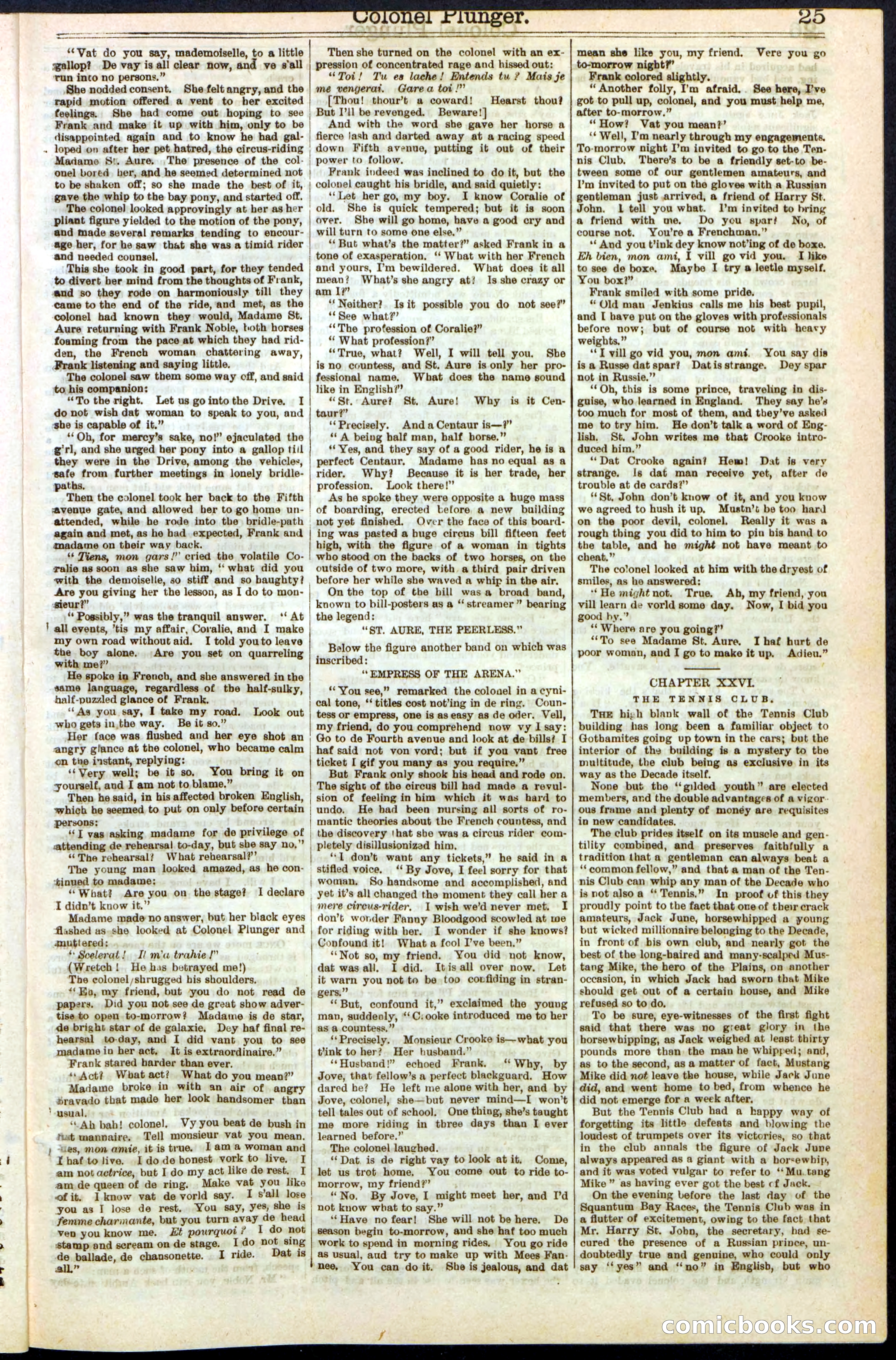
A restored page from Pulp Fiction, 1882. Page through the whole issue in the reader above.
📄 Transcribed text from this page (OCR, searchable)
Machine-transcribed from the original scan — historical spelling and the odd misread are preserved.
oo _—_—_— eee Oe ee ee “Vat do you say, mademoiselle, to a little gallop? De vay is all clear now, and vo s'all ‘run into no persons.” ; She nodded consent. She feltangry, and the rapid motion offered a vent to her excited feelings. Sbe bad come out hoping to see Frank and make it up with him, only to be disappointed again and to know he had gal- . loped on after her pet hatred, the circus-riding Madame Sr. Aure. The presence of the col- onel bored ber, and he seemed determined not to be shaken off; so she made the best of it, gave the whip to the bay pony, and started off. The colonel looked approvingly at ber as her pliant figure yielded to the motion of the pony, and made several remarks tending to encour- age her, for he saw that she was a timid rider and needed counsel, This she took in good part, for they tended to divert ber mind from the thoughts of Frank, and so they rode on harmoniously till they came to the end of the ride, and met, as the colonel had known they would, Madame St. Aure returning with Frank Noble, both horses foaming from the pace at which they had rid- den, the French woman chattering away, Frank listening and saying little. The colonel saw them some way off, and said to his companion: “To the right. Let us gointothe Drive. I do not wish dat woman to speak to you, and she is capable of it.” ‘*Oh, for mercy’s sake, no!” ejaculated the g'rl, and she urged her pony into a gallop tiil they were in the Drive, among the vehicles, safe from further meetings in lonely bridle- paths. Then the colonel took her back to the Fifth venue gate, and allowed ber to go home un- attended, while he rode into tbe bridle-path again and met, as he had expected, Frank and amadame on their way back. “* Tiens, mon gars!’ cried the volatile Co- ralie as soon as she saw him, ‘‘ what did you with the demoiselle, so stiff and so baughty? Are you giving her the lesson, as I do to mon- sieur?” “* Possibly,” was the tranquil answer. ‘‘ At all events, ’tis my affair, Coralie, and I make my own road withoutaid. I told youto leave the boy alone. Are you set on quarreling with me?” He spoke in French, and she answered in the same language, regardless of the half-sulky, half-puzzled glance of Frank. ‘‘As you say, I take my road. Look out who gets in,the way. Be it so.” Her face was flushed and her eye shot an angry glance at the colonel, who became calm on the instant, replying: ‘¢Very well; be it so, You bring it on yourself, and I am not to blame.” Then he said, in his affected broken English, which he seemed to put on only before certain persons; ‘‘T vas asking madame for de privilege of attending de rehearsal to-day, but sbe say no,” “The rehearsal? What rehearsal?’ The young man looked amazed, as he con- ‘tinued to madame; ‘What? Are you on the stage? 1 declare I didn’t know it.” Madame made no answer, but her black eyes flashed asshe looked at Colonel Plunger and | auuftiered: * Scelerat! Il m’u trahie!” (Wretch | He bas betrayed me!) The colonelsshrugged his shoulders, ** Ho, my friend, but you do not read de papers. Did you not see de great show adver- tise. to open to-morrow? Madame is de star, de bright star of de galaxie. Dey haf final re- hearsal to-day, and I did vant you to see madame io her act, It is extraordinaire.” Frank stared barder than ever. ‘\ Act? What act? What do you mean?” Madame broke in with an air of angry *ravado that made her look handsomer than usual. ‘Ab bah! colonel. Vy you beat de bush in fiat mannaire, Tell monsieur vat you mean. les, mon amie, it is true. [ama woman and IL haf to live. I dode honest vork to live, [I am not actrice, but I do my act like de rest. [ am de queen of de ring. Make vat you like of it. Iknow vat de vorld say. I s’all lose you as I lose de rest. You say, yes, she is femme charmante, but you turn avay de head ven you know me. Ht pourquoi? I do not stamp and seream on de stage. Ido not sing de ballade, de chansonette. I ride. Dat is all” : ote 16e. d@uatete -Tunger, ALI; Then she turned on the colonel with an ex- pression of concentrated rage and hissed out: “Toi! Tu es lache! Entends tu ? Mais je me vengerat. Garea toi!” [Thou! thour’t a coward! But I'll be revenged. Beware!] And with the word she gave her horse a fierce Jash and darted away at a racing speed down Fifth avenue, putting it out of their power to follow. Frank indeed was inclined to doit, but the | colonel caught his bridle, and said quietly: ‘‘Let her go, my boy. I know Coralie of old. She is quick tempered; but it is soon over. She will go home, bave a good ery and will turn to some one else,” ‘But what’s the matter?’ asked Frank in a tone of exasperation, ‘‘ What with her French and yours, I’m bewildered. What does it all mean? What’s she angry at? Is she crazy or am 1?” ‘Neither? Is it possible you do not see?” **See what?’ ‘‘The profession of Coralie?” * What profession?” “True, what? Well, I will tell you. She is no countess, and St. Aure is only her pro- fessional name. What does the name sound like in English?’ “St. Aure? St. Aure! taur?”’ ‘*Precizely. Anda Centaur is—?” ‘* A being balf man, balf borse.” ‘‘ Yes, and they say of a good rider, he is a perfect Centaur. Madame has no equal as a rider. Why? Because it is her trade, her profession. Look there!” As he spoke they were opposite a huge mass of boarding, erected before a new building | not yet finished. Over the face of this board- | ing was pasted a buge cireus bill fifteen feet Hearst thou? Why is it Cen- a high, with the figure of a woman in tights who stood on the backs of two horses, on the outside of two more, with a third pair driven before her while she waved a whif in the air. On the top of the bill was a broad band, known to bill-posters as a ‘‘ streamer” bearing the legend: “ST. AURE, THE PEERLESS.” Below the figure another band on which was inscribed: “EMPRESS OF THE ARENA.” **‘You see,” remarked the coloael in a cyni- | cal tone, * titles cost not’ing in de ring. Coun- tess or empress, one is as easy as de oder. Vell, my friend, do you comprehend now vy I say: Go to de Fourth avenue and look at de bills? I haf said not von vord; but if you vant free ticket I gif you many as you require,” But Frank only shook his head and rode on. The sight of the circus bill had made a revul- sion of feeling in him which it was hard to undo. He bad been nursing all sorts of ro- mantic theories about the French countess, and the discovery ‘hat sbe was a circus rider com- _ pletely disillusionized him, “1 don’t want any tickets,” he said in a | stifled voice. ‘ By Jove, I feel sorry for that | woman, So handsome and accomplished, and _ yet it’s all changed the moment they call her a | mere cireus-rider, I wish we’d never met. | don’t wonder Fanny Bloodgood scowled at we for riding with ber. I wonder if she knows? Confound it! What a fool I’ve been,” ‘‘Not so, my friend. You did not know, dat was all. I did. Itisall over now. Let it warn you not to be too confiding in stran- gers,” ‘‘ But, confound it,” exclaimed the young man, suddenly, *‘C:ooke introduced me to her as a countess,” ‘*Precisely. Monsieur Crooke is—what you tink to her? Her husband.” ‘‘Husband!” echoed Frank. ‘ Why, by Jove, that fellow’s a perfect blackguard. How dared be? He left me alone with her, and by Jove, colonel, she—but never mind—I won't tell tales out of school, One thing, she’s taught me more riding in three days than I ever learned before.” The colonel laughed. ‘Dat. is de right vay to look at it. Come, let us trot home, You come out to ride to- morrow, my friend?’ ; “No. By Jove, I might meet her, and I’d not know what to say.” ‘‘ Have no fear! She will not be here. De season begin to-morrow, and she haf too much work to spend in morning rides. You go ride as usual, aud try to make up with Mees Fan- nee, You can doit. She is jealous, and dat a —_— on mean she like you, my friend. Vere you go to-morrow nigbt?”’ , Frank colored tly. sligh “Another folly, I'm afraid, . See here, I’ve got to pull up, colonel, and you must help me, after to-morrow.” “How? Vat you mean?’ ‘* Well, I’m nearly through my engagements. To-morrow night I’m invited to go to the Ten- nis Club, There’s to be a friendly set-to be- tween some of our gentlemen amateurs, and I’m invited to put on the gloves with a Russian gentleman just arrived, a friend of Harry St. John. lL tell you what. I’m invited to bring a friend with me. Do you spar! No, of course not, You’re a Frenchman.” ‘‘ And you t’ink dey know not’ing of de boxe. Eh bien, mon ami, I vill go vid you. I ike to see de boxe. Maybe I try a leetle myself. You box?” Frank smiled with some pride. “Old man Jenkins calls me bis best pupil, and [ have put on the gloves with professionals before now; but of course not with heavy weights,” ‘*T vill go vid you, mon ami. You say dis is a Russe datspar? Datisstrange. Dey spar not in Russie.” “*Oh, this is some prince, traveling in dis- guise, who learned in England. They say he’s too much for most of them, and they’ve asked me totry him. He don’t talk a word of Eng- lish, St, John writes me that Crooke intro- duced him.” “Dat Crooke again? Hem! Dat is very strange. Is dat man receive yet, after de trouble at de cards?” “St. John don’t know of it, and you know we agreed to hush it up, Mustn’t be too hard on the poor devil, colonel. Really it was a rough thing you did to him to piu bis hand to the table, and he might not have meant to cheat,” The colonel looked at him with the dryest of smiles, as he answered; ‘He might not. True. Ab, my friend, you vill learn de vorld some day. Now, I bid you good hy.” *‘ Where are you going?” “‘To see Madame St. Aure. I haf hurt de poor woman, and I go to make it up. Adieu.” CHAPTER XXVIL THE TENNIS CLUB, THE high blank wall of the Tennis Club building has long been a familiar object to Gotbamites goipg up town in the cars; but the interior of the building is a mystery to the multitude, the club being as exclusive in its way as the Decade itself. None but the ‘gilded youth” are elected members, and the double advantages of a vigor. ous frame and plenty of monéy are requisites in new candidates. The club prides itself on its muscle and gen- tility combined, and preserves faithfully a tradition that a gentleman can always beat a ‘*common fellow,” and that a man of the Ten- nis Club can whip any man of the Decade who is not alsoa “Tennis.” In proof of this they proudly point to the fact that oneof their crack amateurs, Jack June, horsewhipped a young but wicked millionaire belonging to the Decade, in front of bis own club, and nearly got the best of the long-baired and many-scalped Mus- tang Mike, the hero of the Plains, on another occasion, in which Jack bad sworn that Mike should get out of a certain house, and Mike refused so to do, To be sure, eye-witnesses of the first fight said that there was no great glory in the horsewhipping, as Jack weighed at least thirty pounds more than, the man he whipped; and, as to the second, as a matter of fact, Mustang Mike did not leave the house, while Jack June did, and went home to bed, from whence he did not: emerge for a week after, But the Tennis Club had a happy way of forgetting its little defeats and blowing the loudest of trumpets over its victories, so that in the club annals the figure of Jack June always appeared as a giant with a horsewhip, and it was voted vulgar to refer to ‘‘Mu. tang Mike ” as having ever got the best cf Jack. On the evening before the last day of the Squantum Bay Races, the Tennis Club was in a flutter of excitement, owing to the fact that Mr. Harry St. Jobn, the secretary, had se- cured the presence of a Russian prince, un- doubtedly true and genuine, who could only say ‘‘yes” and ‘‘no” in Englisb, but who cS (E(0) Eomicboo