
Pulp Fiction, 1882 · page 16 of 32
Beadle's Dime Library No. 211 — page 16: what you’re looking at
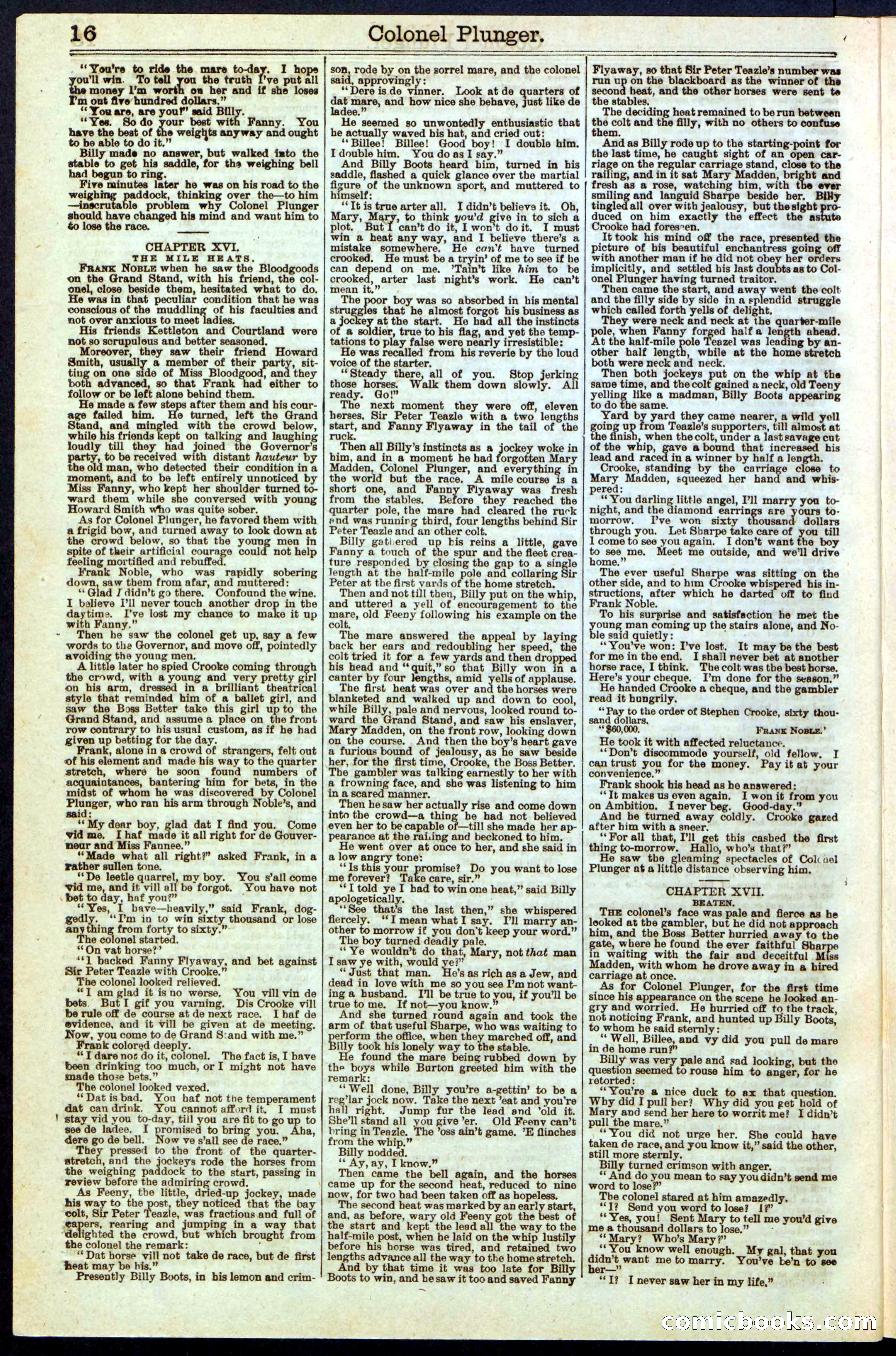
A restored page from Pulp Fiction, 1882. Page through the whole issue in the reader above.
📄 Transcribed text from this page (OCR, searchable)
Machine-transcribed from the original scan — historical spelling and the odd misread are preserved.
} 16 . “You're to ride the mare to-day. I ho ou'll win. To tell you the truth ve put all tne money l’m worth on her and if she loses I'm ont five hundred dollars.” ** You are, are you!” said av: “Yes. Sodo your best with Fanny. You have the best of the weights anyway and ought to be able to do it.” Billy no answer, but walked imto the stable to get his saddle, for tha weighing bell had begun to ring. Five minutes later he was on his road to the wages dock, t over the—to him —inscrutable prublem why Colonel Plunger should have changed his mind and want him to éo lose the race. CHAPTER XVI. THE MILE HEATS, Frank Nose when he saw the Bloodgoods on the Grand Stand, with his friend, the col- onel, close beside them, hesitated what to do. He was in that peculiar condition that he was conscious of the muddling of his faculties and not over anxious to meet ladies. His friends Kettleton and Courtland were not so scrupulous and better seasoned. Moreover, they saw their friend Howard Smith, usually a member of their ty, sit- ting on one side of Miss Blood , and they both advanced, so that Frank had either to follow or be left alone behind them. He made a few steps after them and his cour- age failed him. e turned, left the Grand Stand, and mingled with the crowd below, while his friends ept on talking and laughing loudly till they had joined the Governor’s , to be received with distant hauteur by the old man, who detected their condition in a moment, and to be left entirely unnoticed by Miss Fanny, who kept her shoulder turned to- ward them while she conversed with young Howard Smith who was quite sober, As for Colonel Plunger, he favored them with a frigid bow, and turned away to look down at the crowd below, so that the young men in spite of their artificial courage could not help feeling mortified and rebuffed. Frank Noble, who was rapidly sobering down, saw them from afar, and muttered: “‘@lad J didn’t go there.’ Confound the wine. I believe I’ll never touch another drop in the daytime. I've lost my chance to make it up with Fanny.” Then he saw the colonel get up, say a few words to the Governor, and move off, pointedly avoiding the young men. A little later he spied Crooke coming through the crowd, with a young and very pretty girl on his arm, dressed in a brilliant theatrical style that reminded him of a ballet girl, and saw Boss Better take this girl upto the Grand Stand, and assume a place on the front row contrary to his usual custom, as if he had given up betting for the day. Frank, alone in a crowd of strangers, felt out of his element and made his way to the quarter stretch, where he soon found numbers of uaintances, bantering him for bets, in the midst of whom he was discovered by Colonel Plunger, who ran his arm through Noble’s, and id: sald: ** My dear boy, glad dat I find you. Come vid me. [haf made it all right for de Gouver- mour and Miss Fannee.” ‘Made what all right?” asked Frank, in a rather sullen tone. **De leetle quarrel, my boy. You s’all come ‘vid me, and if vill all be forgot. You have not bet to day, haf you?” “Yes, I bave—heavily,” said Frank, dog- godly. ‘‘’m in to win sixty thousand or lose an ng from forty to sixty.” 6 colonel started. ‘On vat horse?’ “*] backed Fanny Flyaway, and bet against Sir Peter Teazle with Crooke.” The colonel looked relieved. “T am glad it isno werse. You vill vin de bets. But I gif you varning. Dis Crooke vill be rule off de course at de next race. I haf de evidence, and it vill be given at de meeting. Now, you come to de Grand S:and with me.” Frank colored deeply. “T dare nos do it, colonel. The fact is, I have been drinking too much, orI mizht not have made those bets.” The colonel looked vexed. *Datisbad. You haf not the temperament dat candrink. You cannot afford it, I must stay vid you to-day, tiil bir are fit to go y to ha, see de ladee. I promised to bring you. dere go de bell. Now ve s’all see de race,” They pressed to the front of the quarter- stretch, and the Jokers rode the horses from the weighing paddock to the sturt, passing in review before the sauiriog crowd. As Feeny, the little, dried-up jockey, made his way to the post, they noticed that the bay colt, Sir Peter Teazle, was fractious and full of aa rearing and jumping in a oar that ‘delighted the crowd, but which brought from the colonel the remark: : “Dat borse vill not take de race, but de first theat may be his.” Presently Billy Buots, in bis lemon and crim- Colonel Plunger, son, rode by on the sorrel mare, and the colonel said, yh py ““Dere is de vinner. Look at de quarters of a mare, and how nice she Hshave; Fuse like de ee. He seemed so unwontedly enthusiastic that he actually waved his hat, and cried out: ‘* Billee! Billee! Good boy! I double him. I double him. You do asI say.” And Billy Boots heard him, turned in bis saddle, flashed a quick glance over the martial figure of the unknown sport, and muttered to himself: ‘It is true arter all. I didn’t believa it. Oh, Mary, Mary, to think you'd give in to sich a plot. ButI can’t do it, I won’t doit. I must win a heat any way, and I believe there’s a mistake somewhere. He can't have turned crooked. He must bea tryin’ of me to see if he can depend on me. ’Tain’t like him to be crooked, arter last night’s work. He can’t mean it.” . The poor boy was so absorbed in his mental struggles that he almost forgot his business as a jockey at the start. He had all the instincts of a soldier, true to his flag, and yet the temp- tations to play false were nearly irresistible: He was recalled from his reverie by the loud "Steady there, all _of Stop jerki y there, all of you. p jerkin those horses. Walk them’ down slowly. All ready. Go!” The next moment they were off, eleven herses, Sir Peter Teazle with a two lengths net and Fanny Flyaway in the tail of the ruc Then all Billy’s instincts as a jockey woke in bim, and in a moment he had forgotten Mary Madden, Colonel Plunger, and everything in the world but the race. A mile course is a short one, and mney Fiyaway was fresh from the stables. Before they reached the quarter pole, the mare had cleared the ruck end was running third, four lengths behind Sir Peter Teazle and an other colt. Billy gatiered up his reins a little, gave Fanny a touch of the spur and the fleet crea- ture responded by closing the gap to a single length at the half-mile pole and collaring Sir Peter at the first vards of the home stretch, Then and not till then, Billy put on the whip, and uttered a yell of encouragement to the a old Feeny following his example on the colt. The mare answered the appeal by laying back her ears and redoubling her speed, the colt tried it for a few yards and then roped his head and “quit,” so that Billy won in a canter by four lengths, amid ve of applause. The first heat was over and the horses were blanketed and walked up and down to cool, while Billy, pale and nervous, looked round to- ward the Grand Stand, and saw his enslaver, Mary Madden, on the front row, looking down on the course. And then the boy’s heart gave a furious bound of jealousy, as he saw beside her, for the first time, Crooke, the Boss Better. The gambler was talking earnestly to her with a frowning face, and she was listening to him in a scared manner. Then he saw her actually rise and come down into the crowd—a thing he had not believed even her to be capable of—till she made her ap- pearance at the railing and beckoned to him. He went over at once to her, and she said in a low angry tone: “Is this your prcmzieet Do you want to lose me forever? Take care, sir.” ‘“*I told ye I had to win one heat,” said Billy apologetically, ‘See that’s the last then,” she whispered fiercely. “I mean what I say. I'll marry an- other to morrow if you don't keep your word,” The boy turned deadly pale. “Ye wouldn’t do that, Mary, not that man I saw ye with, would ye?” “Just that man. He's as rich as a Jew, and dead in love with me so you see I’m not want- ing a husband. I'll be true to you, if you'll be true tome. If not—you know.” And she turned round again and took the arm of that useful Sharpe, who was waiting to at ago the office, when they marched off, and illy took his lonely way to the stable. He found the mare being rubbed down by the boys while Burton greeted him with the remark: ‘‘ Well done, Billy you’re a-gettin’ to be a 5, Hoa jock now. Take the next ’eat and you're hall right. Jump fur the lead and ‘old it. She'll stand all you give’er. Old Feeny can’t bring in Teazle. The ’oss ain’t game. ’E flinches from the whip.” Billy nodded. ‘** Ay, ay, I know.” Then came the bell again, and the horses | came up for the second heat, reduced to nine now, for two had been taken off as hopeless. The second heat was marked by an cone start, and, as before, wary old Feeny got the best of the start and kept the lead all the way to the half-mile post, when be laid on the whip lustily before his horse was tired, and retained two lengths advance all the way to the home stretch. And by that time it was too late for Billy Boots to win, and he saw it too and saved Fanny RACH oO URR i eae. a a AT RR a mm — mer Te A a en en ht SC ct <qnsunsnsaennasnatssaauassasa=o=nangapeaenuepsqnapeeecpasseenespepemeenaeeee eee Flyaway, so that Sir Peter Teazle’s number was run up on the blackboard as the winner of the second heat, and the other horses were sent te the stables, The deciding heat remained to be run between the colt and the filly, with no others to confuse em. And as Billy rode up to the starting-point for the last time, he caught sight of an open car- riage on the regular carriage stand, close to the railing, and in it sat Mary Madden, bright and fresh as a rose, watching him, with the ever smiling and languid Sharpe beside ber. tingled all over with jealousy, but thesight duced on him exactly the effect the astute Crooke had fores°en. It took his mind off the race, presented the picture of bis beautiful enchantress going off with another man if he did not obey her orders implicitly, and settled his last doubts as to Col- onel Plunger having turned traitor. Then came the start, and away went the colt and the filly side by side in a splendid struggle which called forth yells of delight. They were neck and neck at the quarter-mile pole, when Fanny forged halfa length ahead. At the half-mile pole Teazel was leading by an- other half length, while at the home stretch both were neck and neck. Then both jockeys put on the whip at the same time, and the colt gained a neck, old Teeny yong like a madman, Billy Boots appearing to do the same. Yard by yard they came nearer, a wild yoll going up rom Teazle’s supporters, till almost at the finish, when the colt, under a last savage cut of the whip, ve a bound that increased his lead and raced in a winner by half a length. Crooke, standing by the carriage close to meet | Madden, squeezed her hand and whis- pered: “You darling little angel, I’ll marry you to- night, and the diamond earrings are yours to- morrow. I’ve won sixty thousand dollars through you. Let Sharpe take care of you till 1 come to see you again. I don’t want the boy to see me, Meet me outside, and we'll drive home.” The ever useful Sharpe was sitting on the other side, and to him Crooke whispered his in- structions, after which he darted off to find Frank Noble. To his surprise and satisfaction he met the young man coming up the stairs alone, and No- le said quietly: ' ‘You've won: I’ve lost. It may be the best for mein the end, I shall never bet at another horse race, I think. The colt was the best horse. Here’s your cheque. I’m done for the season.” He handed Crooke a cheque, and the gambler read it bungrily. “re bag order of Stephen Crooke, sixty thou- sand do ** $60,000. Frank Noste.’ He took it with affected reluctance. ‘**Don’t discommode yourself, old fellow. I can trust you for the money. Pay it at your convenience.” Frank shook bis head as he answered: ‘It makes us even again, I won it from you on Ambition, Inever beg. Good-day.” And he turned away coldly. Crooke gazed after him with a sneer. **For all that, I'll get this cashed the first lo, who’s that?” thing to-morrow, He saw the gleaming spectacles of Col< uel Plunger at a little distance observing him, CHAPTER XVII. BEATEN, THE colonel’s face was pale and fierce as he looked at tbe Seg od but he did not approach him, and the Better hurried away to the gate, where he found the ever faithful Sharpe in waiting with the fair and deceitful Miss Madden, with whom he drove away in a bired carriage at once. _As for Colonel Plunger, for the first time since his appearance on the scene he Jooked an- gry and worried. He hurried off to the track, not noticing Frank, and hunted up Billy Boots, to whom he said sternly: ** Well, Billee, and vy did you pull de mare in de home run?” Billy was very pale and sad looking, but the Tossa seemed to rouse him to anger, for he re : “You're a nice duck to ax that question. Why did I pull her?) Why did you get hold of Mary and send her here to worrit me? I didn’t pull the mare.” “You did not urge her. She could have taken de race, and you know it,” said the other, still more sternly. Billy turned crimson with anger. ** And do you mean to say youdidn’t send me word to lose?” The colonel stared at him amazedly, “I? Send you word to lose? 1?” **'Yes, you! Sent M to tell me you'd give mea thousand dollars to Jose.” Mary? Who's Mary?’ “You know well enough. My gal, that you sian, want metomarry. You've be’n to see er— “I? I never saw her in my life,” MMICELNCKOLKS (<0) (E(0)